Impressionism
The Beach at Étretat
Claude Monet, 1883
The Beach at Étretat (Étretat, la plage et la porte d'Amont) is an 1883 painting by Claude Monet of fishing boats drawn up on the shingle below the Amont cliff at Étretat, Normandy. It is in the Musée d'Orsay, Paris.
- Artist
- Claude Monet
- Date
- 1883
- Medium
- Oil on canvas
- Dimensions
- 66 × 81 cm
- Collection
- Musée d'Orsay, Paris, France
- Movement
- Impressionism
- Catalogue
- Wildenstein 828
Painted at Étretat and the Normandy CoastMore at Monet at the Musée d'Orsay
What you are looking at
A long beach of grey-brown shingle curves away from us toward a towering cliff. Along it, in tight rows, lie the fishing boats of Étretat, hauled up out of reach of the tide: dark hulls with bands of red, white and green, some tipped on their sides, their bows pointing at the water. On the left the sea is a cold grey-green, and a single line of surf rolls in on a long diagonal, a bright white seam that leads the eye to the foot of the cliff. Two small boats with rust-red sails are working offshore. Tiny figures, fishermen and their families, stand among the hulls near the bottom edge.
The cliff is the Falaise d'Amont, the eastern headland of the bay. Its face catches a low sun along the top in ochre and olive, and at its far end, where it runs out into the sea at left, you can make out the small arch of the Porte d'Amont. The Musée d'Orsay's title, Étretat, la plage et la porte d'Amont, names it.
Claude Monet painted the canvas in 1883. It measures 66 by 81 centimeters, is number 828 in Wildenstein's catalogue, and is signed at lower right.
Where and when
Étretat is a fishing village on the Normandy coast north of Le Havre, closed between two chalk headlands: the Amont cliff to the east, the Aval cliff with its arch and needle to the west. Monet knew it from his youth and had wintered there in 1868–69, but he came to paint it seriously at the end of January 1883, staying about three weeks at the Hôtel Blanquet. He worked from the beach and the cliff paths in raw winter weather, often on several canvases at once, and wrote to Alice Hoschedé about gales that kept him indoors and seas that changed faster than he could paint.
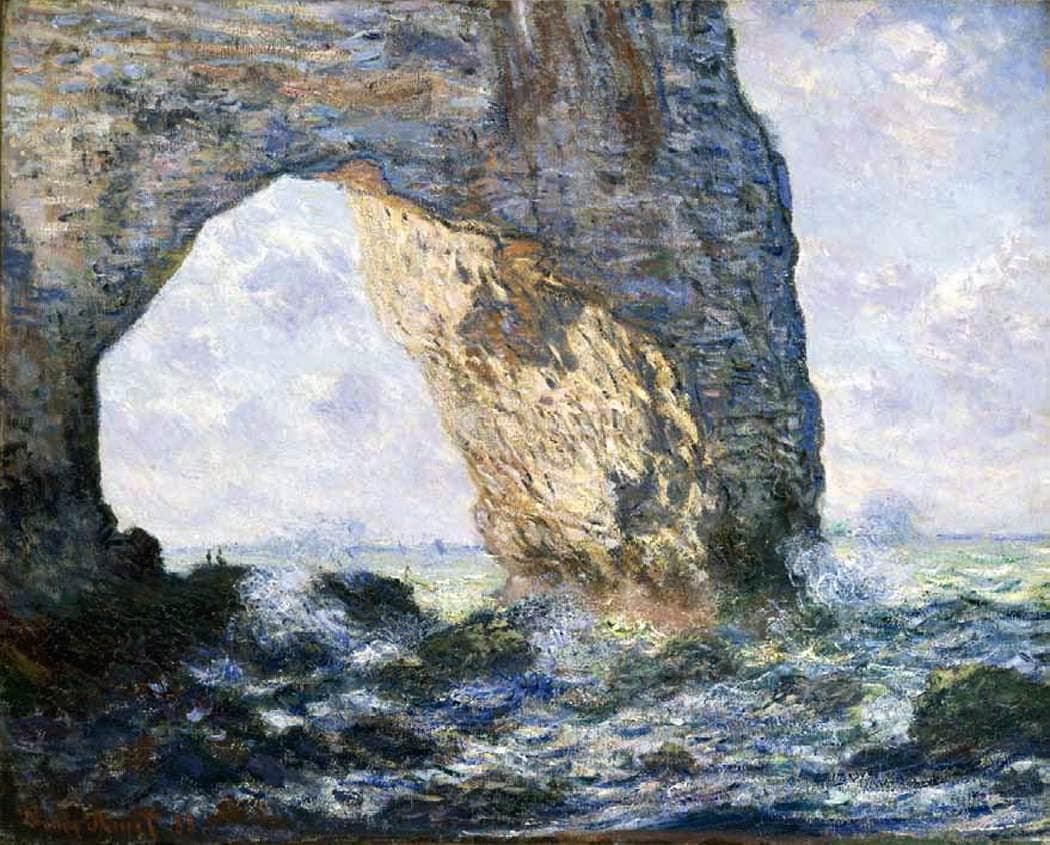
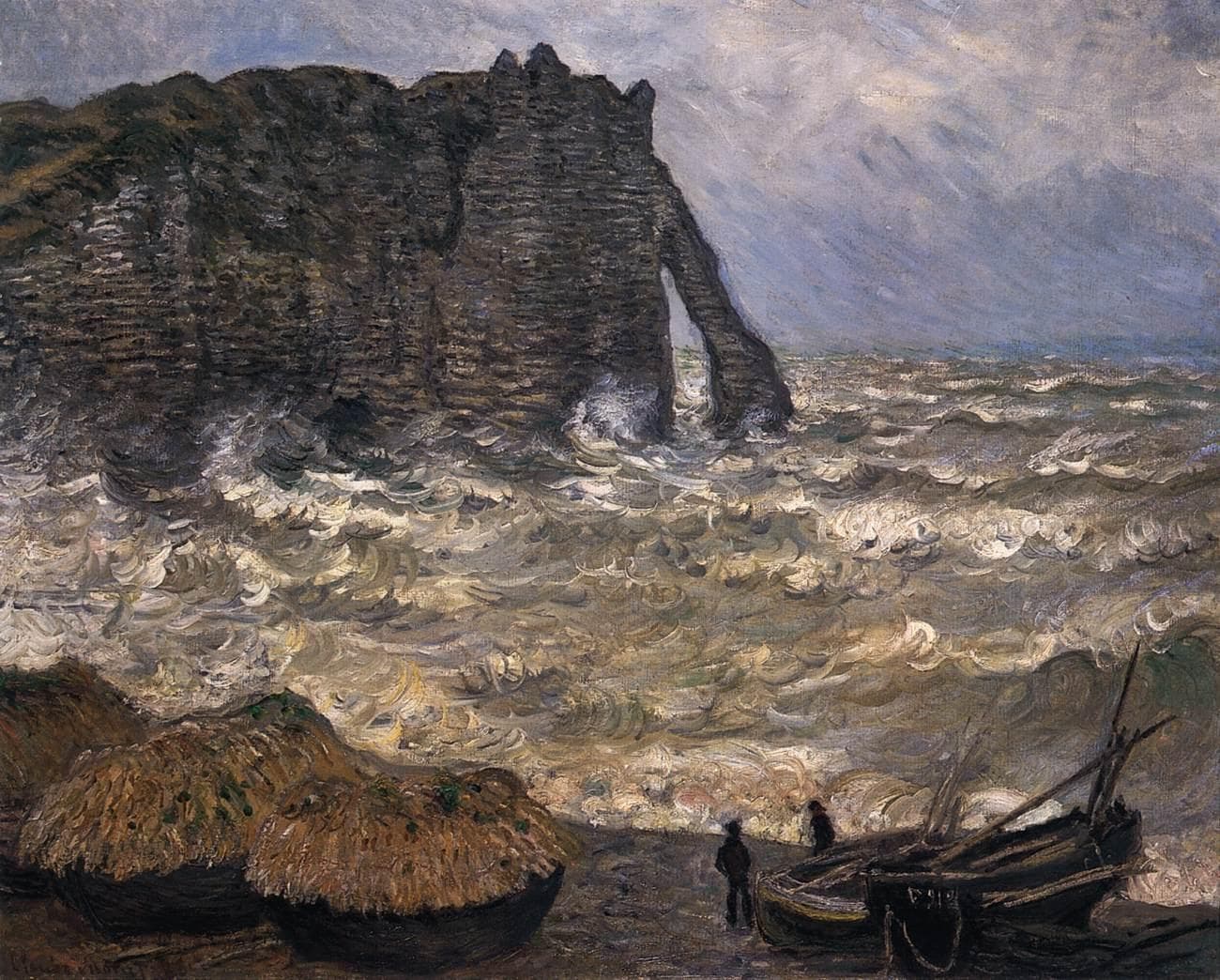
That winter he was 42, newly settled at Poissy and about to move to Giverny in April. He needed pictures for a one-man show Durand-Ruel was staging in Paris in March 1883, and he came back with some of the most famous images of the coast, including The Manneporte and Rough Sea at Étretat. For the whole coastal campaign, see Étretat and the Normandy Coast.
How it was painted
This picture is quieter than the storm and arch pictures. Its subject is the working beach, where the fishermen kept their boats, and the cliff is a backdrop rather than the star.
The boats are the key to the composition. Monet lines them up in a fan that follows the curve of the shore, getting smaller and closer together as they recede, so they measure out the depth of the bay. Each hull is a few strokes: a dark line for the gunwale, a band of red or white, a curved touch of shadow underneath. The same three or four colors repeat from boat to boat, which turns the beach into a pattern.
Then look at the cliff. Its face is made of short vertical and diagonal strokes of ochre, olive and grey that follow the chalk strata, with warmer color along the lit top and a cool, shadowed base. The surf line is the boldest stroke in the picture: thick white paint dragged in one long diagonal and broken at its edge into flecks of foam. Against it, the green sea is laid in flatter, horizontal touches.
The motif and its siblings
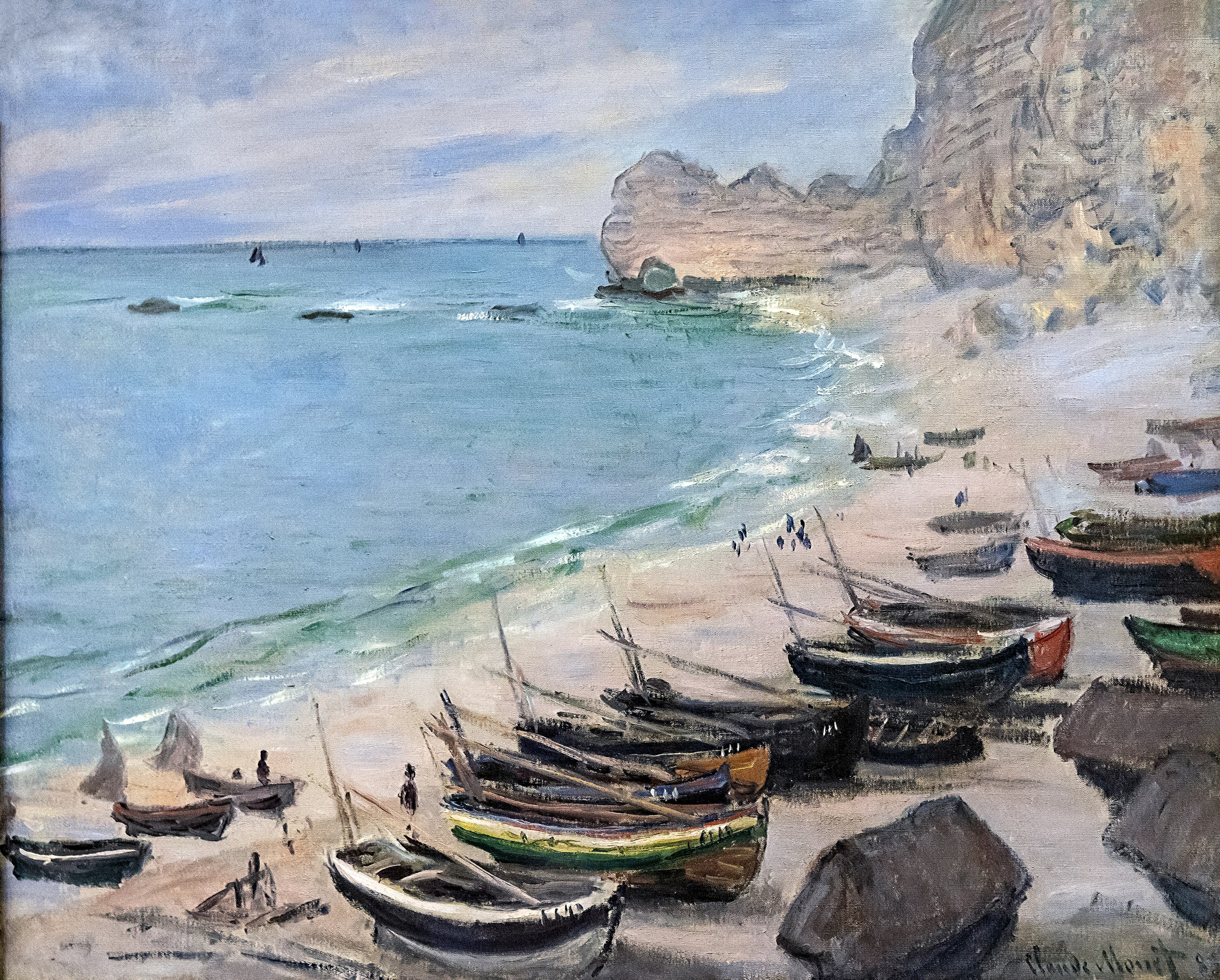
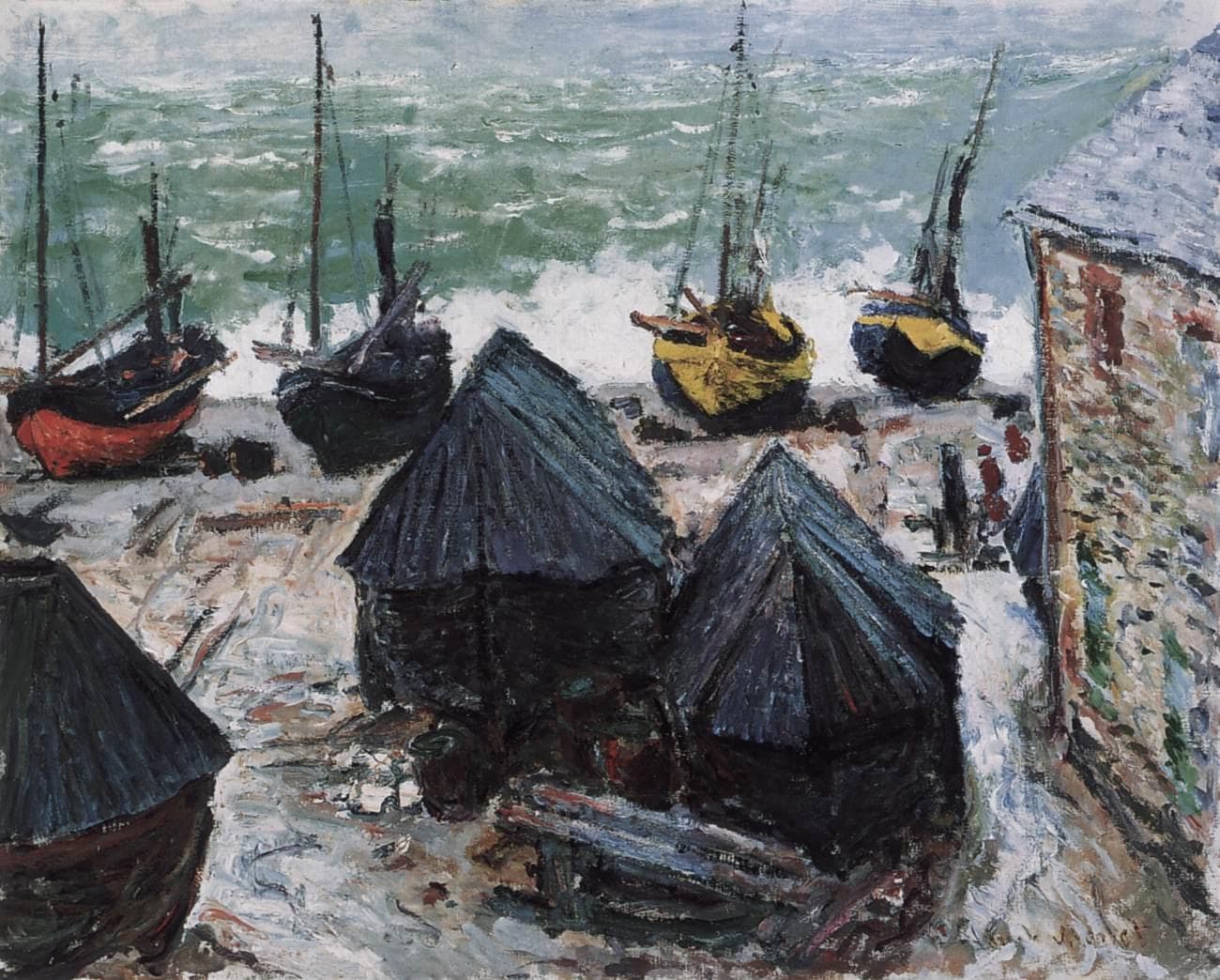
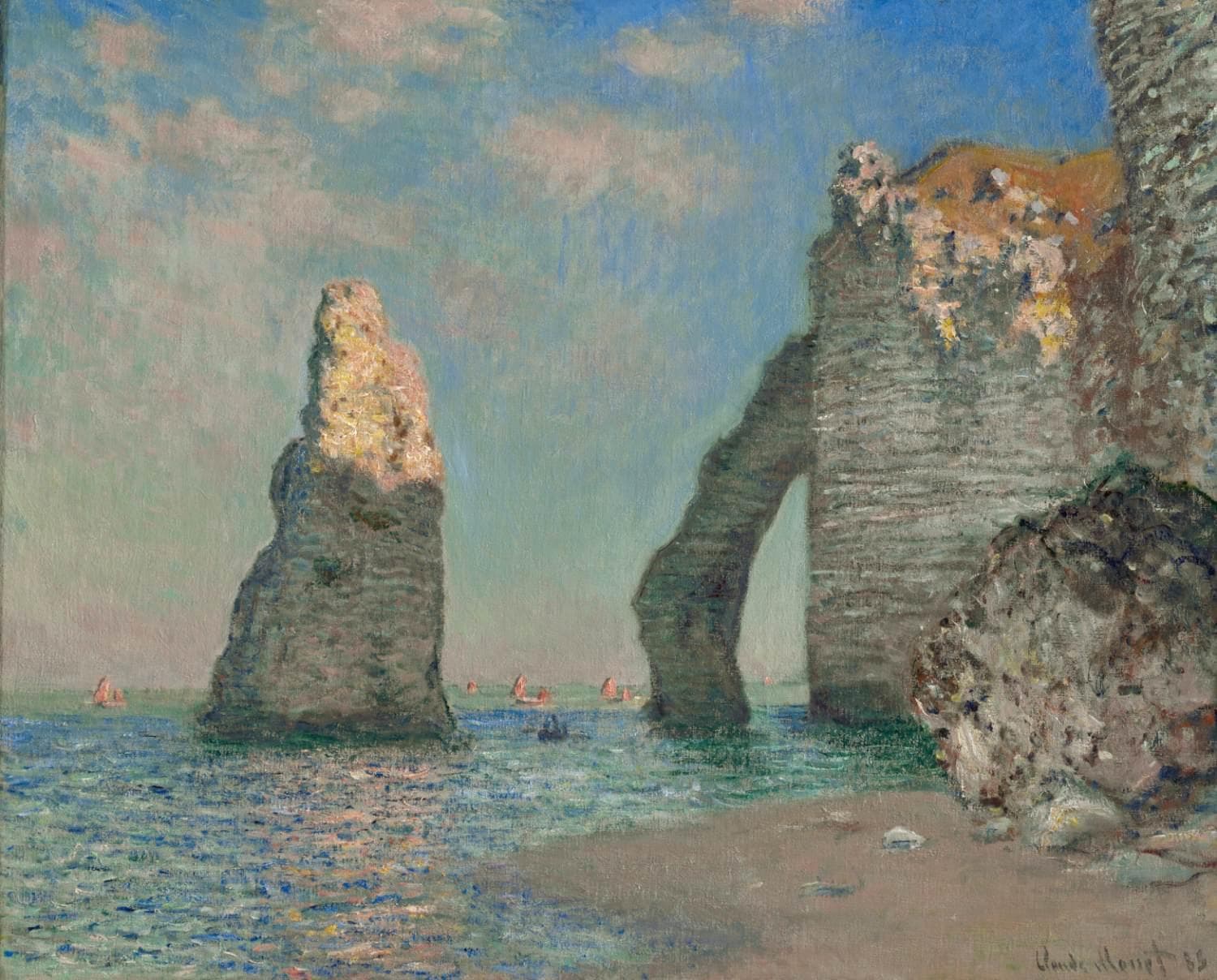
Monet painted the boats on the beach several times in 1883 and again in 1885, when he returned for a longer autumn stay. Compare Boats on the Beach at Étretat from the same visit, and the later Boats on the Beach at Étretat in Chicago, where the hulls fill the foreground. On the other side of the bay the Aval cliff is the subject of The Cliffs at Étretat.
Painters had come to Étretat since the 1830s; Courbet painted its cliffs and its boats on the shingle in 1869–70. Monet's version keeps the working life of the beach while making the weather and the light the real subject.
Where to see it
The painting is in the Musée d'Orsay: see Monet at the Musée d'Orsay. For more on the painter, see Claude Monet.
Questions & answers
Where is Monet's The Beach at Étretat?
The painting, titled by the museum Étretat, la plage et la porte d'Amont, is in the Musée d'Orsay in Paris. It is oil on canvas, 66 by 81 centimeters, painted in 1883 and catalogued by Wildenstein as number 828.
When did Monet paint at Étretat?
Monet painted at Étretat in the winter of 1868–69, for about three weeks in late January and February 1883, when this picture was made, and again from October to December 1885, with a shorter return in 1886.
What does The Beach at Étretat show?
Fishing boats hauled up in rows on the curving shingle beach, a line of surf on the left, two red-sailed boats offshore, and the Falaise d'Amont, the eastern cliff of the bay, ending in the small arch of the Porte d'Amont.
Is this the same cliff as in Monet's famous Étretat arches?
No. The best-known arches, the Porte d'Aval and the Manneporte, and the needle-shaped Aiguille are on the western side of the bay. This picture looks east to the Amont cliff and its smaller arch.
More by the artist
Claude Monet

Bridge over a Pond of Water Lilies
Claude Monet · 1899

Woman with a Parasol – Madame Monet and Her Son
Claude Monet · 1875

Sunset in Venice
Claude Monet · 1908–12

La Grenouillère
Claude Monet · 1869

Beach in Pourville
Claude Monet · 1882

Springtime
Claude Monet · 1872

Boating on the River Epte
Claude Monet · 1890

The Seine at Asnières (Hermitage)
Claude Monet · 1873
Also painted in 1883
The same year
Kindred works
You may also study
The Manneporte (Étretat)
Claude Monet · 1883
Rough Sea at Étretat
Claude Monet · 1883
Boats on the Beach at Étretat (1883)
Claude Monet · 1883
Boats on the Beach at Étretat
Claude Monet · 1885
The Cliffs at Étretat
Claude Monet · 1885

The Scream
Edvard Munch · 1893

Ophelia
John Everett Millais · 1851–52

The Great Wave off Kanagawa
Katsushika Hokusai · c. 1830–32