Image: Fondation Bemberg, Toulouse; photograph by Didier Descouens (Wikimedia Commons) · Public domain · via Wikimedia Commons
Impressionism
Boats on the Beach at Étretat (1883)
Claude Monet, 1883
Boats on the Beach at Étretat is an 1883 painting by Claude Monet of fishing boats drawn up on the shingle at Étretat, with the sea and white chalk cliffs behind. It is in the Fondation Bemberg, Hôtel d'Assézat, Toulouse.
- Artist
- Claude Monet
- Date
- 1883
- Medium
- Oil on canvas
- Dimensions
- 65 × 81 cm
- Collection
- Fondation Bemberg, Toulouse, France
- Movement
- Impressionism
- Catalogue
- Wildenstein 829
Painted at Étretat and the Normandy Coast
What you are looking at
A long curve of pale shingle runs from the bottom of the picture up toward a wall of white chalk cliffs on the right. Drawn up on the beach, in rows that follow its curve, are some twenty small fishing boats, their hulls painted black, green, red and white, their thin masts and oars leaning at every angle. At lower right, a pair of big dark rocks or boat sheds anchor the corner. On the left the sea is a clear turquoise that deepens to blue toward the horizon, with a fringe of white surf along the beach and a few tiny sails far out. At the top right the cliff opens in a natural arch. A scatter of small figures stands among the boats.
The light is bright and even, the sky a mottled blue and white. It is a working beach, not a resort: the boats are the town's fishing fleet, hauled out above the tide line.
The detail most people miss is how the boats are drawn. Each hull is a single curved stroke of dark paint with a line of color along its gunwale, and the masts are flicked in with a fine brush. From a few feet away they read as a fleet; up close they are hardly more than handwriting.
Where and when it was painted
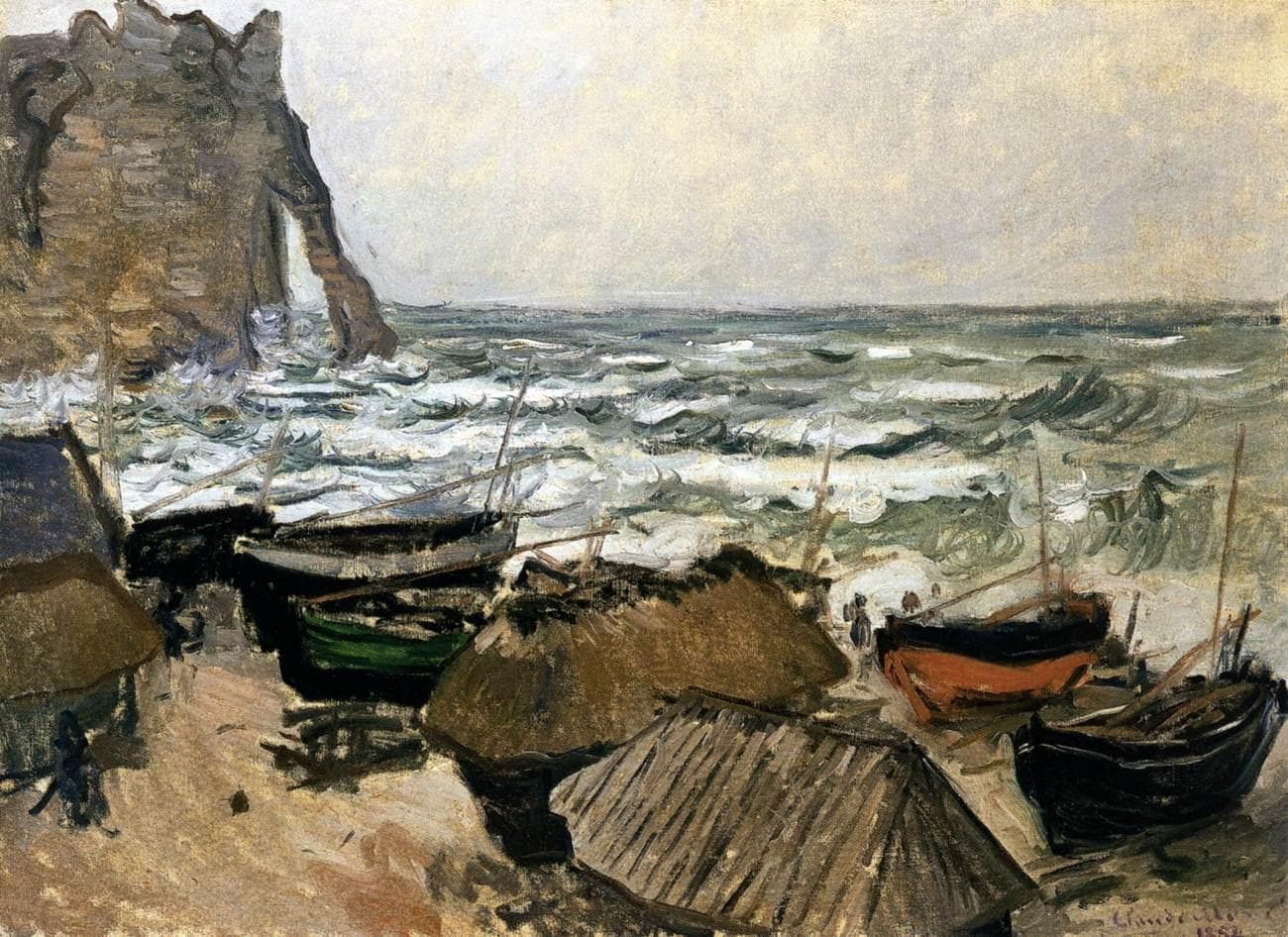
Étretat is a fishing village on the Normandy coast north of Le Havre, set in a bay between two great chalk cliffs, the Falaise d'Aval with its arch, the Porte d'Aval, to the west and the Falaise d'Amont to the east. By the 1880s it was also a fashionable resort, and painters from Courbet onward had made its cliffs famous.
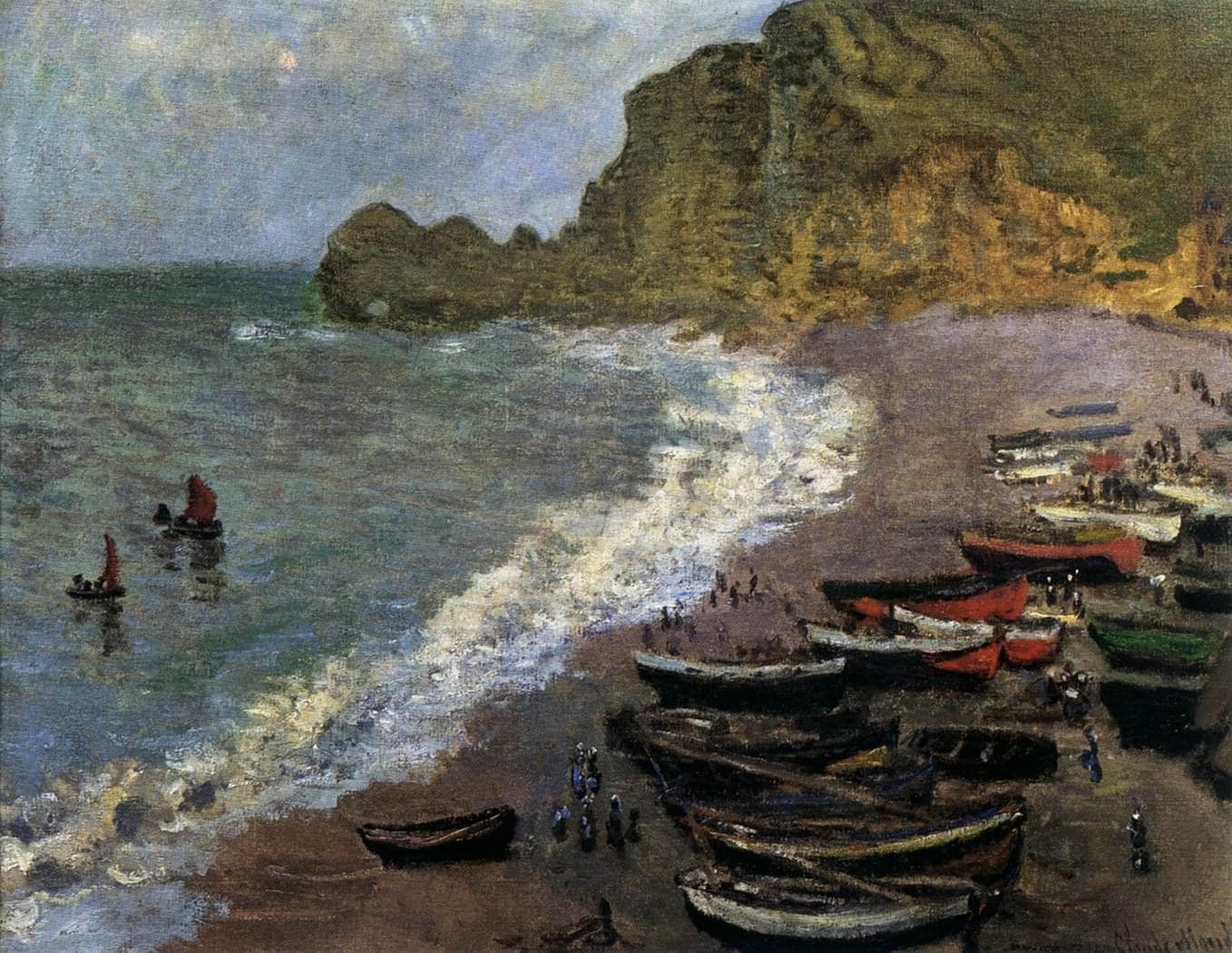
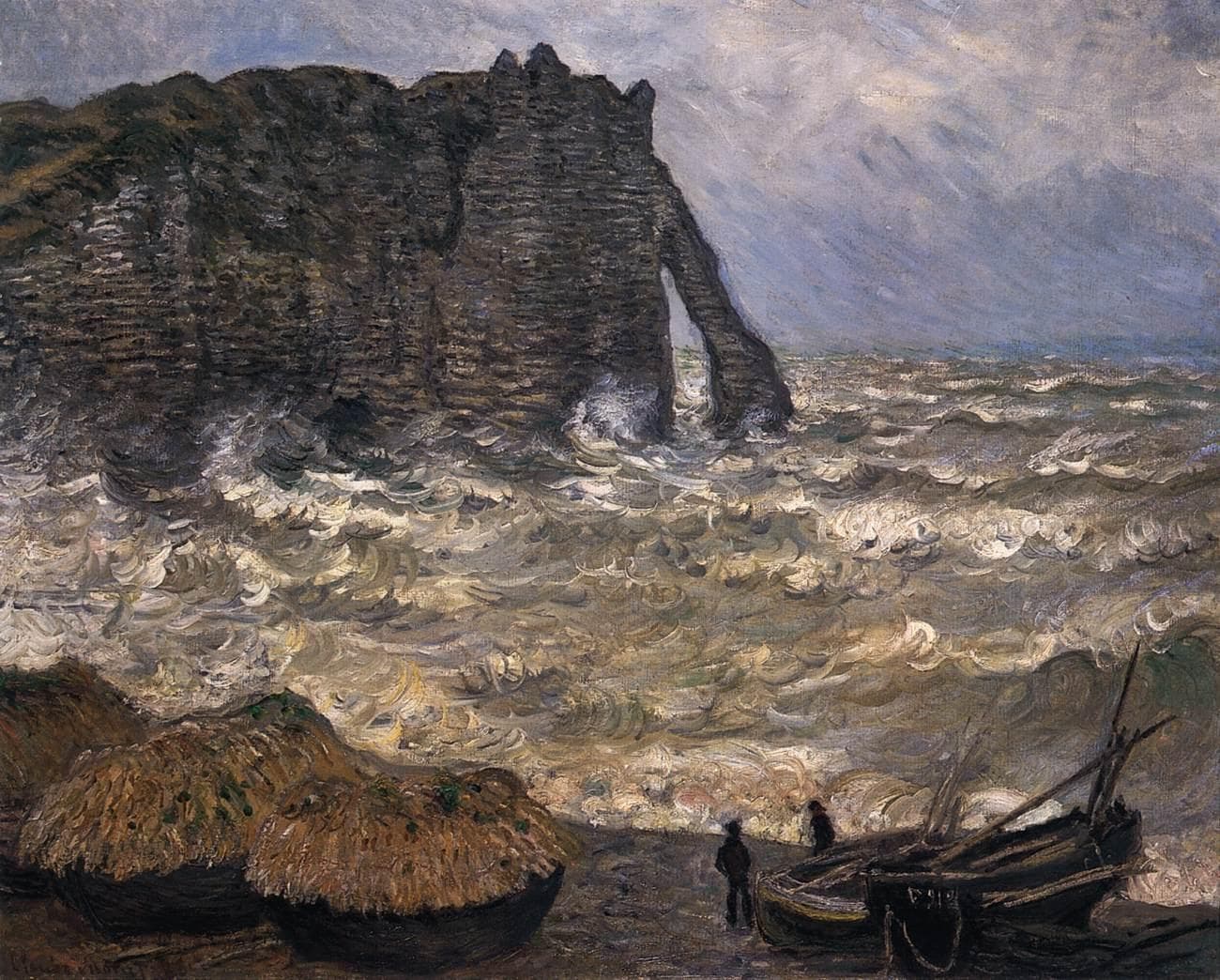
Monet first went there to work at the end of January 1883 and stayed into February, painting the beach, the boats and the cliffs in winter light. This canvas belongs to that first campaign, alongside The Beach at Étretat in the Musée d'Orsay and the storm of Rough Sea at Étretat in Lyon. He came back in 1884, 1885 and 1886 and painted the village more than fifty times. For the whole coast, see Étretat and the Normandy coast.
How it was painted
The canvas is a standard 65 by 81 centimeters. The composition is built on the curve of the beach, which carries the eye from the boats in the foreground up to the cliffs, and on a clear division of color: warm sand and dark hulls on the right, cool sea on the left. The surf is a row of short white strokes along the water's edge. The cliffs are painted in creamy whites and ochres with violet shadows, more solidly than the sea.
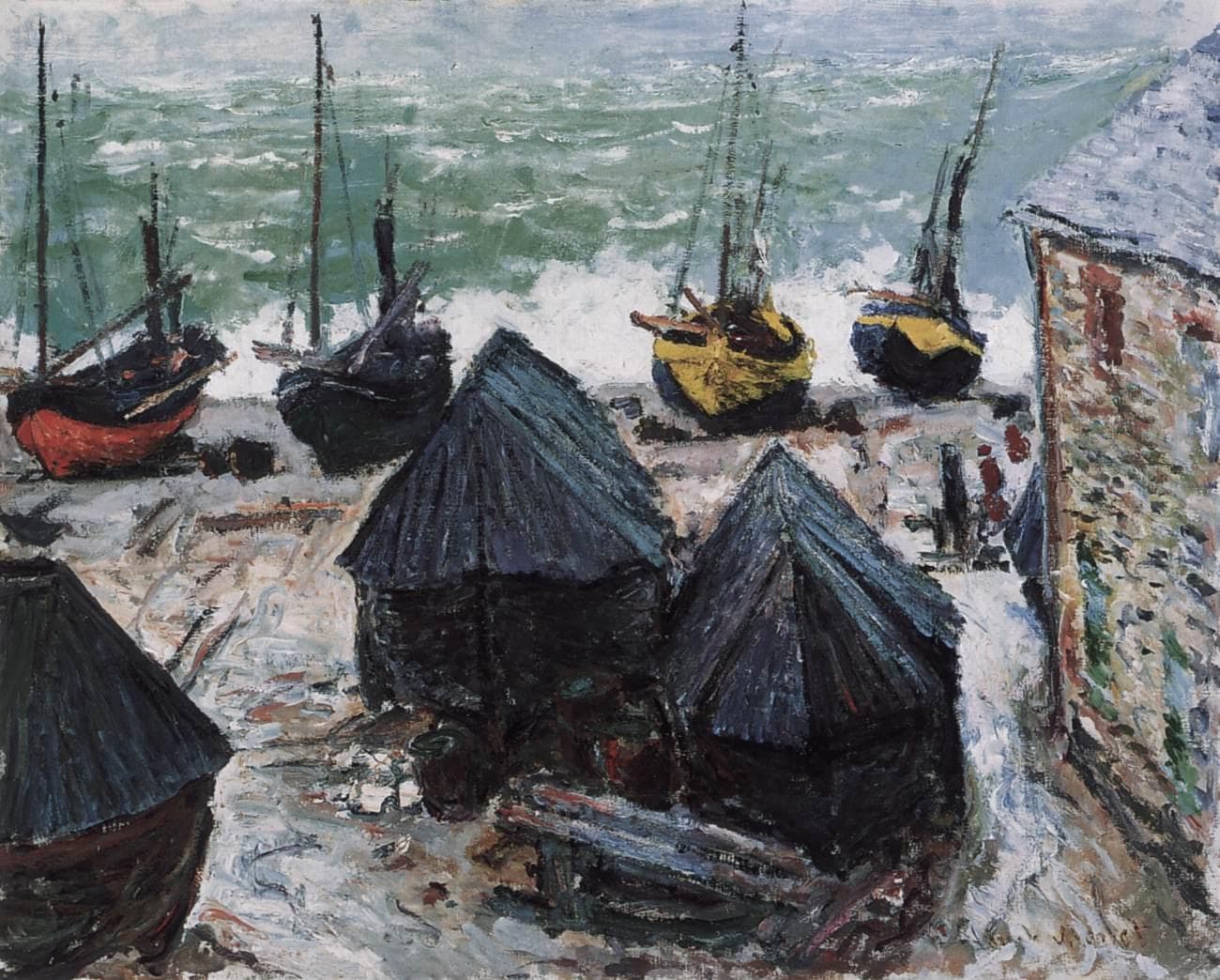
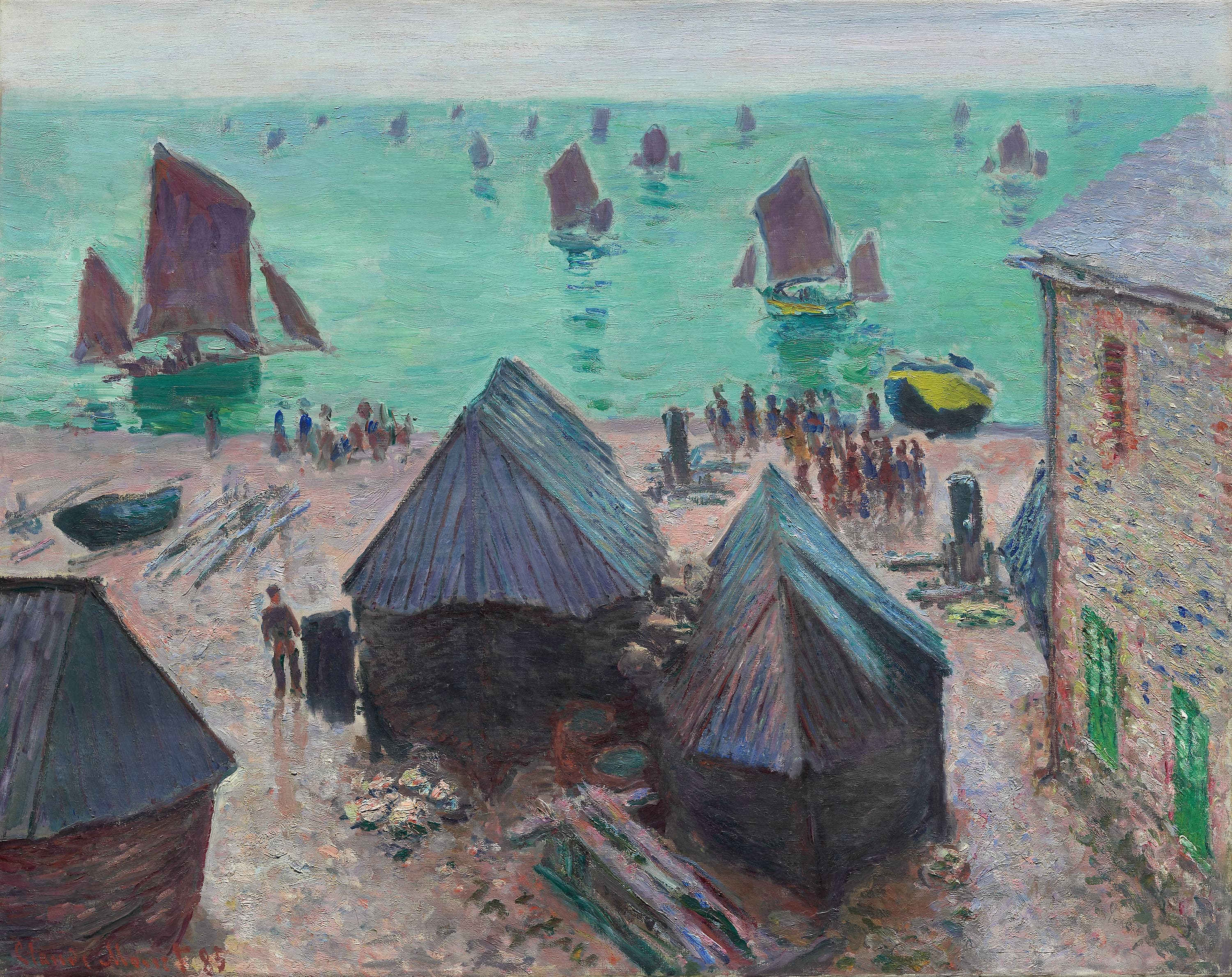
Monet came back to the boats of Étretat in the autumn of 1885, when bad weather kept him in his room at the Hôtel Blanquet and he painted the beach from the window in Boats on the Beach at Étretat and The Departure of the Boats, Étretat, both now in Chicago. Those later pictures look down on the beach from above, in softer, wetter color; this 1883 canvas stands on the shingle among the boats in sharp winter light.
The boats themselves were a dying type. Étretat's fishermen worked from the open beach, hauling their boats up the shingle with capstans, and the oldest hulls ended their lives turned upside down and thatched as storage sheds, the caloges that Monet painted in 1885. In 1883 he shows the fleet still in use, a working community at the foot of the cliffs that tourists came to admire.
Ownership and where to see it
The painting belonged to the writer Abel Hermant and passed through the dealers Georges Petit and Durand-Ruel before the Argentine-born collector Georges Bemberg acquired it. It is now inventory 2077 of the Fondation Bemberg, which displays his collection in the Renaissance Hôtel d'Assézat in Toulouse and counts this among its masterpieces. In 2025–26 it was lent to the exhibition Étretat par-delà les falaises in Lyon and Frankfurt. See where to see Monet's paintings and the Claude Monet page.
Questions & answers
Where is Monet's Boats on the Beach at Étretat (1883)?
It is in the Fondation Bemberg in Toulouse (inventory 2077), which shows the collection of Georges Bemberg in the Hôtel d'Assézat. The canvas measures 65 by 81 centimeters. A different 1885 painting with a similar title is in the Art Institute of Chicago.
When did Monet paint Boats on the Beach at Étretat?
He painted it in 1883, during his first working stay at Étretat from late January into February that year. He returned to the village in 1884, 1885 and 1886.
What does the painting show?
About twenty small fishing boats drawn up on the curving shingle beach at Étretat, with a turquoise sea on the left and white chalk cliffs, including a natural arch, on the right. Small figures stand among the boats.
How many paintings of Étretat did Monet make?
More than fifty, made during stays in 1883, 1884, 1885 and 1886. They include views of the cliffs and arches, storms, and the boats on the beach, such as the two 1885 canvases in Chicago painted from his hotel window.
More by the artist
Claude Monet

Bridge over a Pond of Water Lilies
Claude Monet · 1899

Woman with a Parasol – Madame Monet and Her Son
Claude Monet · 1875

Sunset in Venice
Claude Monet · 1908–12

La Grenouillère
Claude Monet · 1869

Beach in Pourville
Claude Monet · 1882

Springtime
Claude Monet · 1872

Boating on the River Epte
Claude Monet · 1890

The Seine at Asnières (Hermitage)
Claude Monet · 1873
Also painted in 1883
The same year
Kindred works
You may also study
The Beach at Étretat
Claude Monet · 1883
Rough Sea at Étretat
Claude Monet · 1883
Boats on the Beach at Étretat
Claude Monet · 1885
The Departure of the Boats, Étretat
Claude Monet · 1885
Fishing Boats and the Porte d'Aval
Claude Monet · 1884

The Scream
Edvard Munch · 1893

Ophelia
John Everett Millais · 1851–52

The Great Wave off Kanagawa
Katsushika Hokusai · c. 1830–32