Impressionism
Road at Louveciennes, Snow Effect
Claude Monet, 1869–70
Road at Louveciennes, Snow Effect is a winter landscape Claude Monet painted in 1869–70: a snowy village road runs between houses and bare trees toward a gray horizon, with a lone walker in the middle. It is in a private collection.
- Artist
- Claude Monet
- Date
- 1869–70
- Medium
- Oil on canvas
- Dimensions
- 56 × 65 cm
- Collection
- Private collection
- Movement
- Impressionism
Road at Louveciennes, Snow Effect is one of the snow pictures Claude Monet painted in the winter of 1869–70 in Louveciennes, a hill village west of Paris above the Seine. It is in a private collection and rarely seen in public, so it is known today mostly through reproductions. Its title, date and size (recorded as about 56 × 65 cm) come from older catalogue listings and have not been checked against the Wildenstein catalogue raisonné.
What you are looking at
A broad country road, packed with snow and cut by cart ruts, runs straight away from us toward a pale vanishing point. On the left, behind a low wall and a strip of snowy verge, stand ocher-yellow houses with tall chimneys and shuttered windows, half screened by a row of thin, bare trees. Their branches are laid in with a few long dark strokes and end in feathery crowns that dissolve into the sky. On the right, two cottages with white roofs sit back from the road behind a ditch, and a tree with fine, frosted twigs leans over them.
A single man in dark clothes walks down the middle of the road toward us. He is the only vertical accent in the lower half of the picture, and he gives the road its scale. Further back, two smaller figures stand together at the foot of the trees on the left, and a few more specks of people can be picked out where the road narrows. Overhead, a heavy sky of gray and lilac takes up almost half the canvas. Monet signed the picture at lower left.
How the snow is painted
The snow on the road is not white. Monet builds it from cream, pale blue, gray and lilac, and drags warmer browns through it for the ruts and footprints, so the surface reads as trampled and slightly wet. The verges are handled differently again: on the right, green grass and brown earth show through a thin crust, set down in short horizontal dabs. The shadows under the trees on the left are blue rather than gray, the observation that snow scenes forced on every painter who looked hard enough.
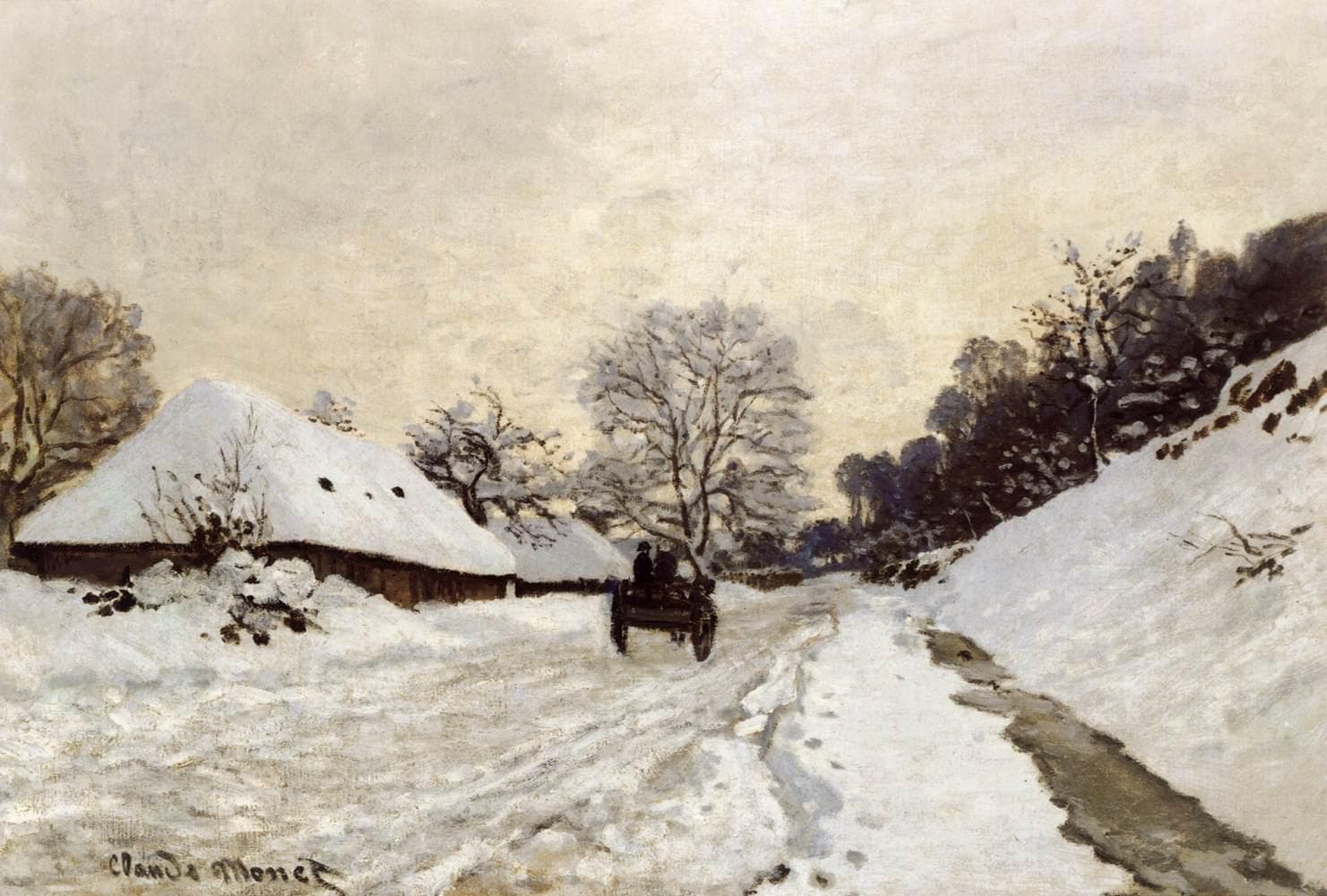
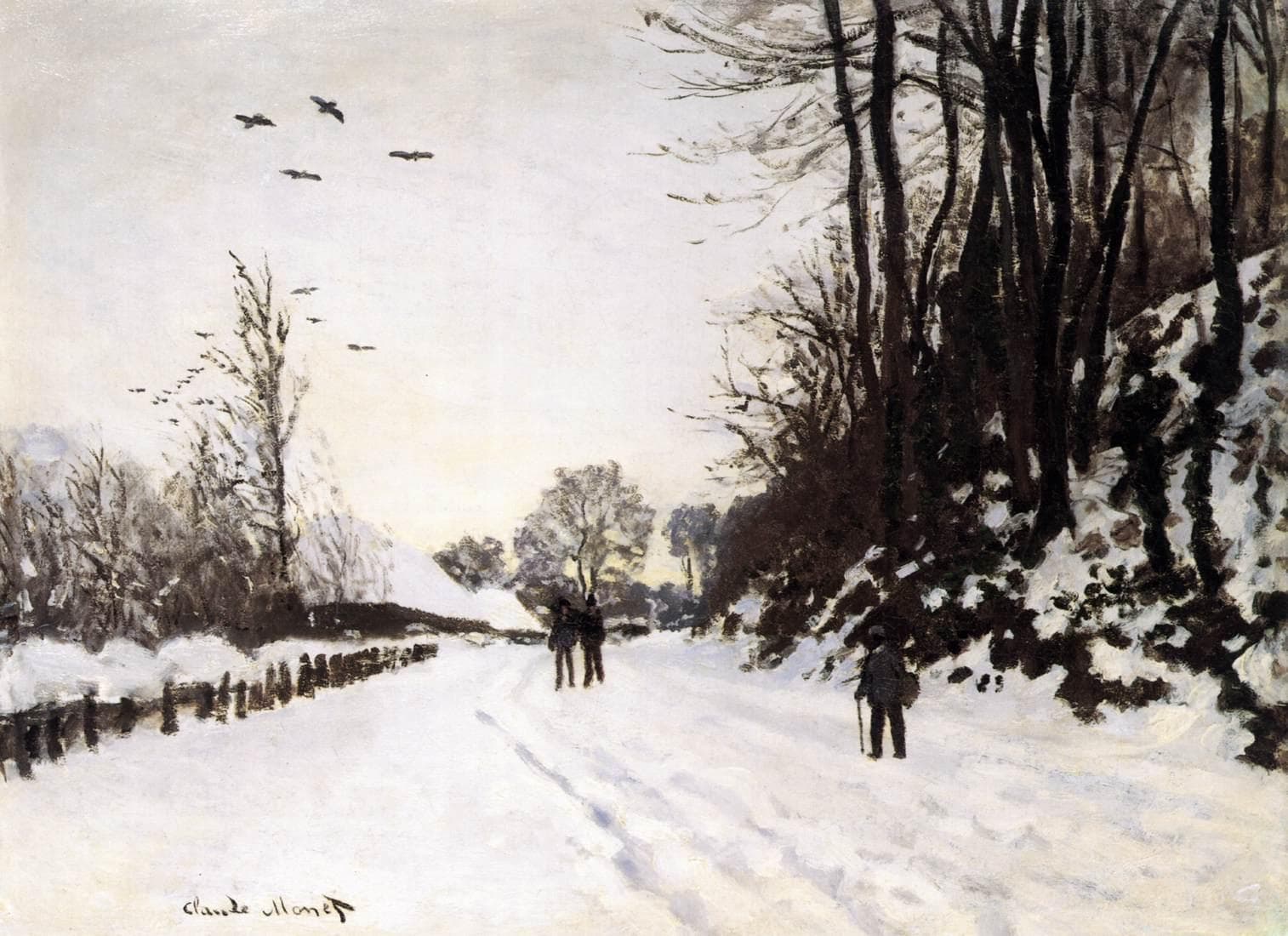
The composition is the most traditional device there is, a straight road receding to a central point, but Monet leaves the center almost empty. The real subject is the cold, even light of an overcast winter day and the space it fills. Compare his earlier snow picture, A Cart on the Snowy Road at Honfleur, where the road is equally plain and the weather does the work.
Louveciennes, winter 1869–70
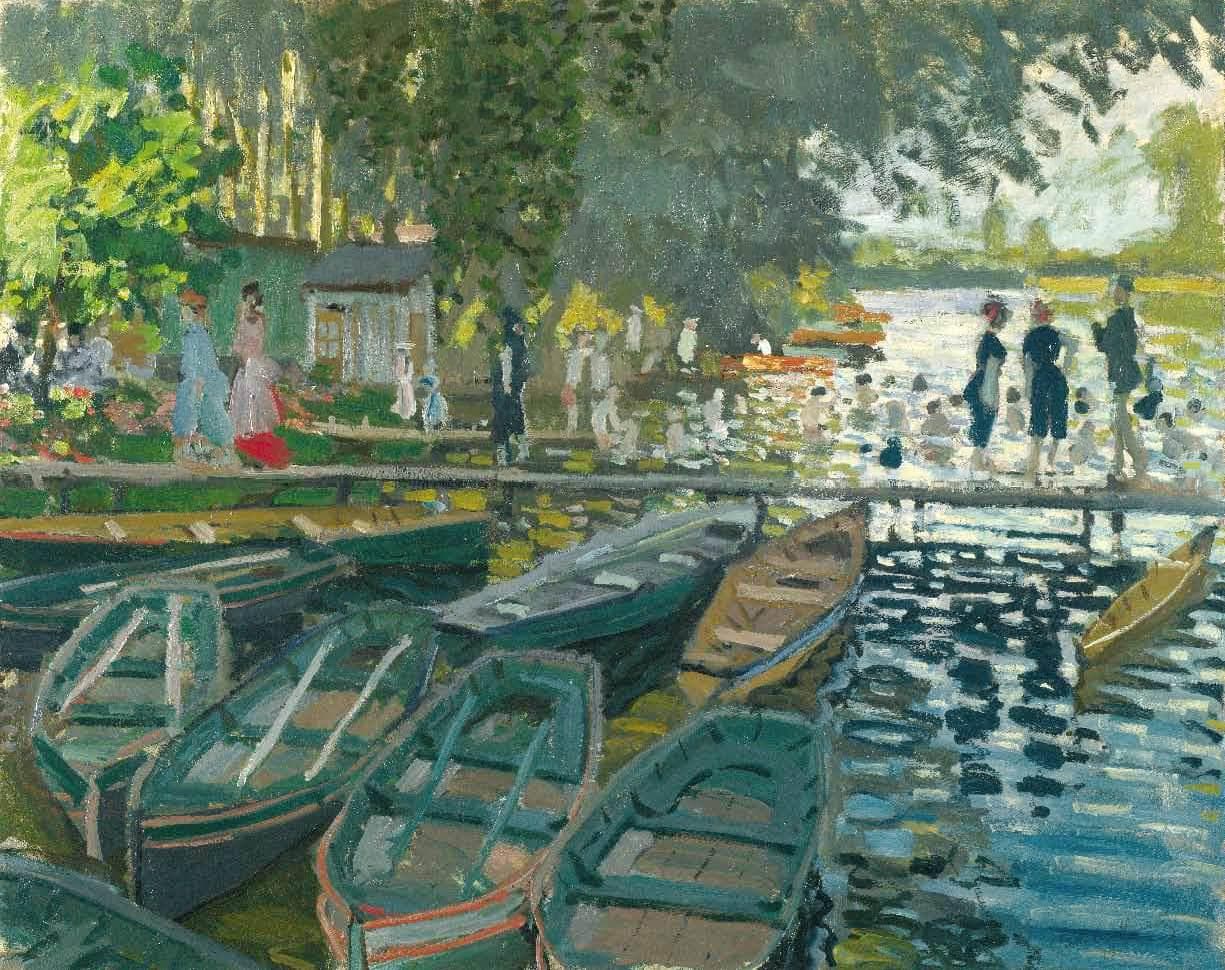
In 1869 Monet, his partner Camille and their infant son Jean were living at Saint-Michel, near Bougival on the Seine, desperately short of money. That summer he and Pierre-Auguste Renoir had painted the bathing place at La Grenouillère. Camille Pissarro had settled close by in Louveciennes, on the Route de Versailles, and in the winter the two painters worked side by side in the snow. Pissarro painted the same roads, sometimes from nearly the same spot; his Route de Versailles, Louveciennes, Rain Effect of 1870 at the Clark Art Institute shows how close their concerns had become.
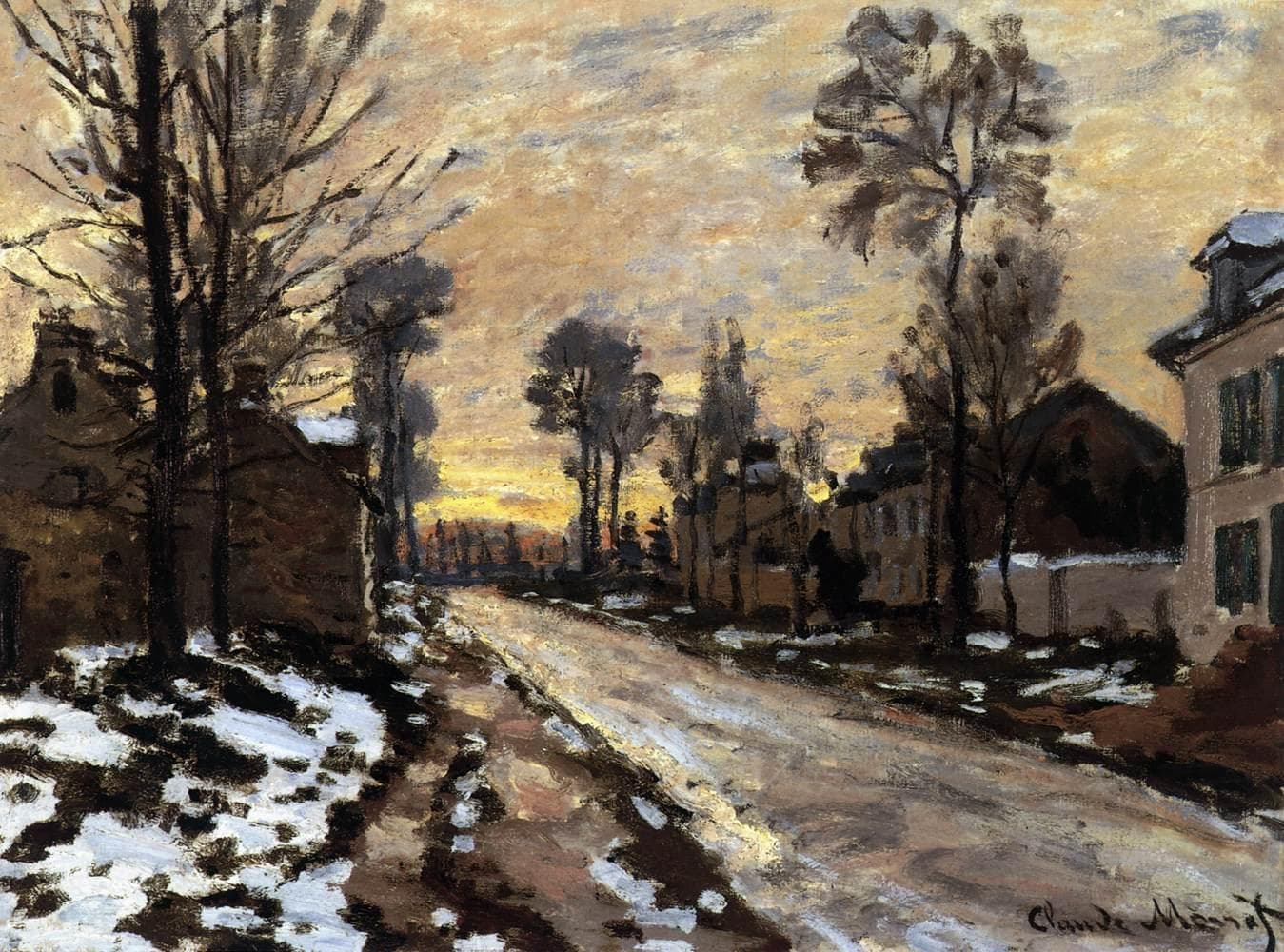
Monet made several views of the roads around the village that winter. The best-known companion is Road to Louveciennes, Melting Snow, Sunset, where the same kind of street is seen in a thaw under a burning evening sky. Setting the two side by side shows Monet, twenty years before his series, already testing one motif under different conditions.
Why these snow scenes matter
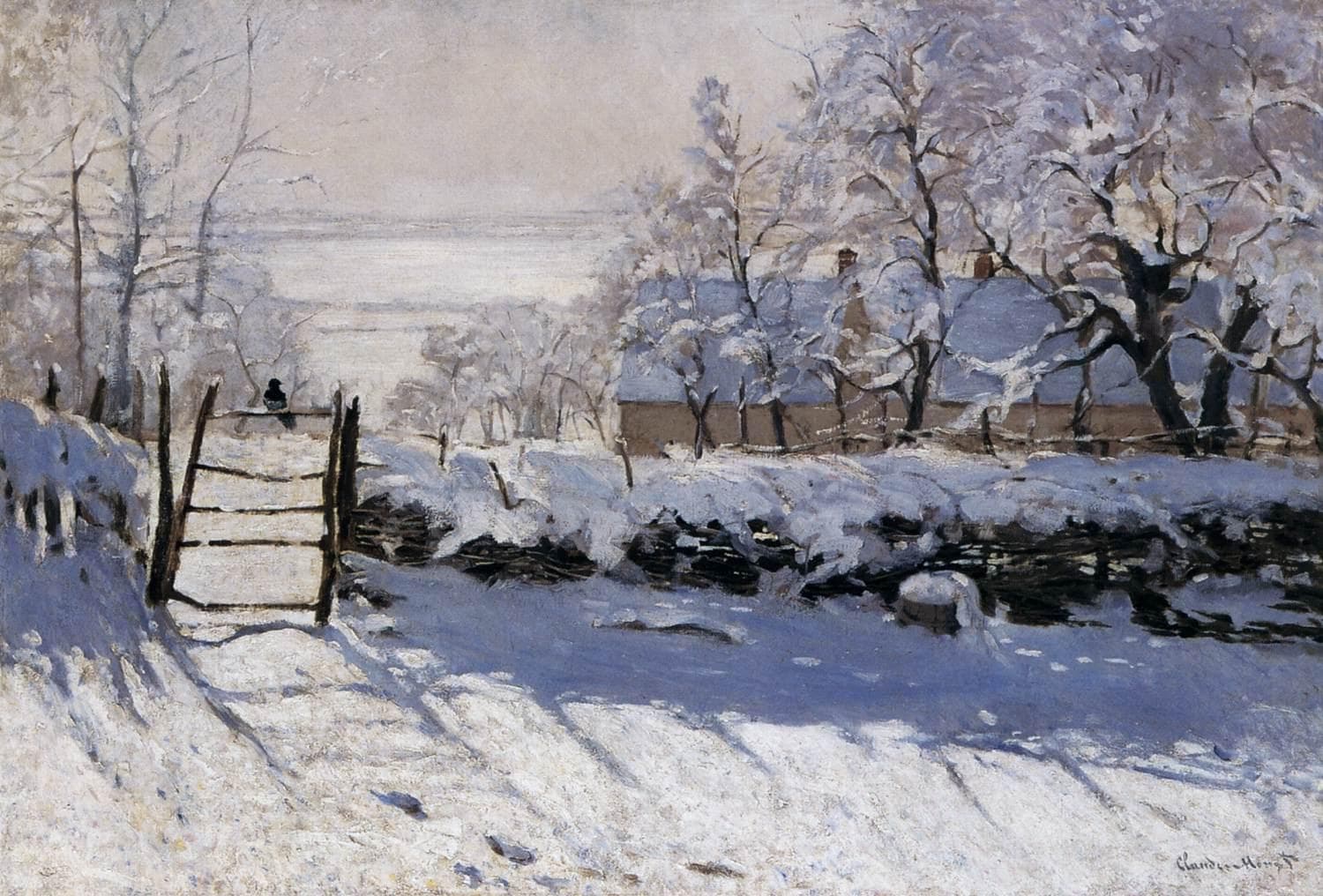
Snow had a special role in the making of Impressionism. The Magpie, Monet's great snow picture of 1868–69, had been rejected by the Salon of 1869. In works like this one he kept pushing the same question: how to paint the colored shadows and reflected light of a white world. Sisley, Pissarro and Monet all came back to it, and Monet would still be painting snow at Argenteuil in 1875 and at Vétheuil in 1879–80.
The winter of 1869–70 was also the last quiet season before a break. In July 1870 France went to war with Prussia. Monet left for London, and Pissarro's house at Louveciennes was occupied by Prussian troops, who destroyed or damaged many of the canvases he had left there. These snowy roads are a record of the months just before that rupture. For the wider story of these years, see Monet's life in paintings.
Where to see it
The painting is in a private collection and is not on public view; it surfaces occasionally in exhibitions and sale catalogues. Monet's early winter pictures that can be seen in museums include The Magpie at the Musée d'Orsay; our guide to where to see Monet's paintings lists the collections worldwide. More on Claude Monet.
Questions & answers
Where is Monet's Road at Louveciennes, Snow Effect?
The painting is in a private collection and is not on permanent public display. It appears occasionally in exhibitions. Monet's best-known early snow picture, The Magpie of 1868–69, can be seen at the Musée d'Orsay in Paris.
When and where did Monet paint the road at Louveciennes in snow?
He painted it in the winter of 1869–70 at Louveciennes, a village on the hills west of Paris, while living nearby at Saint-Michel near Bougival. Camille Pissarro lived in Louveciennes on the Route de Versailles, and the two painted the snowy roads side by side.
What does Road at Louveciennes, Snow Effect show?
A wide snowy road with cart ruts runs straight away between ocher houses and bare trees on the left and snow-roofed cottages on the right. A man walks toward us down the middle. The real subject is the gray winter light and the colored shadows in the snow.
Did Monet paint other views of Louveciennes?
Yes. The same winter he painted Road to Louveciennes, Melting Snow, Sunset, a thaw seen under a golden evening sky, and other views of the village roads. Pissarro and Sisley painted the same streets repeatedly around 1870–72.
More by the artist
Claude Monet

Bridge over a Pond of Water Lilies
Claude Monet · 1899

Woman with a Parasol – Madame Monet and Her Son
Claude Monet · 1875

Sunset in Venice
Claude Monet · 1908–12

La Grenouillère
Claude Monet · 1869

Beach in Pourville
Claude Monet · 1882

Springtime
Claude Monet · 1872

Boating on the River Epte
Claude Monet · 1890

The Seine at Asnières (Hermitage)
Claude Monet · 1873
Also painted in 1869
The same year
Kindred works
You may also study
Road to Louveciennes, Melting Snow, Sunset
Claude Monet · 1869–70
The Magpie
Claude Monet · 1868–69
A Cart on the Snowy Road at Honfleur
Claude Monet · c. 1867
Bathers at La Grenouillère
Claude Monet · 1869
The Bridge at Bougival
Claude Monet · 1869
Road by Saint-Siméon Farm in Winter
Claude Monet · 1867

The Scream
Edvard Munch · 1893

Ophelia
John Everett Millais · 1851–52