Impressionism
Road to Louveciennes, Melting Snow, Sunset
Claude Monet, 1869–70
Road to Louveciennes, Melting Snow, Sunset is a small winter landscape by Claude Monet, painted in 1869–70 (Wildenstein 148): a village road in thaw shines under a golden evening sky. It is in a private collection.
- Artist
- Claude Monet
- Date
- 1869–70
- Medium
- Oil on canvas
- Dimensions
- 41 × 54.2 cm
- Collection
- Private collection
- Movement
- Impressionism
- Catalogue
- Wildenstein 148
Road to Louveciennes, Melting Snow, Sunset is a small oil on canvas, 41 by 54.2 centimeters, that Claude Monet painted in the winter of 1869–70 at Louveciennes, the village west of Paris where his friend Camille Pissarro then lived. It is catalogued by Daniel Wildenstein as number 148 and dated by him to 1869. The picture is in a private collection.
What you are looking at
A village road runs away from us into the evening. The snow is going: it survives in gray-white patches on the bank at lower left and in streaks along the ruts, while the road itself has turned to wet mud that catches the last light and shines like a strip of pale metal. Stone houses line both sides, their roofs still edged with white. At the right a pale house with green shutters steps into the picture, cut off by the frame; at the left a low brown cottage sits in shadow behind a tangle of bare trunks.
Tall trees stand along the road, their thin crowns drawn as dark, feathery blots against a sky of gold, orange and smoky gray. The sun has dropped to the end of the street, and its glow sits just above the roofs at the vanishing point. Monet signed the canvas in dark paint at lower right.
Looking closely
The light is the subject. The low sun turns the whole upper half warm and burnished, and Monet carries that warmth down onto the road, painting the wet surface with long strokes of cream, yellow and pale violet that follow its perspective. The remaining snow is cooler, bluish where it lies in shadow, so the picture is built on a contrast of temperatures: warm reflection against cold residue. That is the whole story of a thaw at dusk, told in color rather than detail.
The trees are laid in quickly with a loaded brush, their trunks slightly blurred, as if the air were heavy with damp. The houses are blocks of brown and ocher with almost no windows described. Everything is subordinated to one passing moment of light, the kind of transient condition Monet would chase for the rest of his career.
The format helps. At roughly 41 by 54 centimeters the canvas is small enough to carry to a roadside and finish in a session or two, and the speed shows in the dragged, unblended strokes of the sky. Monet would hardly have had more than half an hour of this light on a winter evening.
Monet and Louveciennes
In 1869 Monet was living at Saint-Michel, near Bougival on the Seine, short of money and working closely with Pierre-Auguste Renoir at the bathing place of La Grenouillère. He also painted the river at The Bridge at Bougival. Pissarro had settled at Louveciennes, on the road to Versailles, and Monet walked up to paint its streets when winter came.
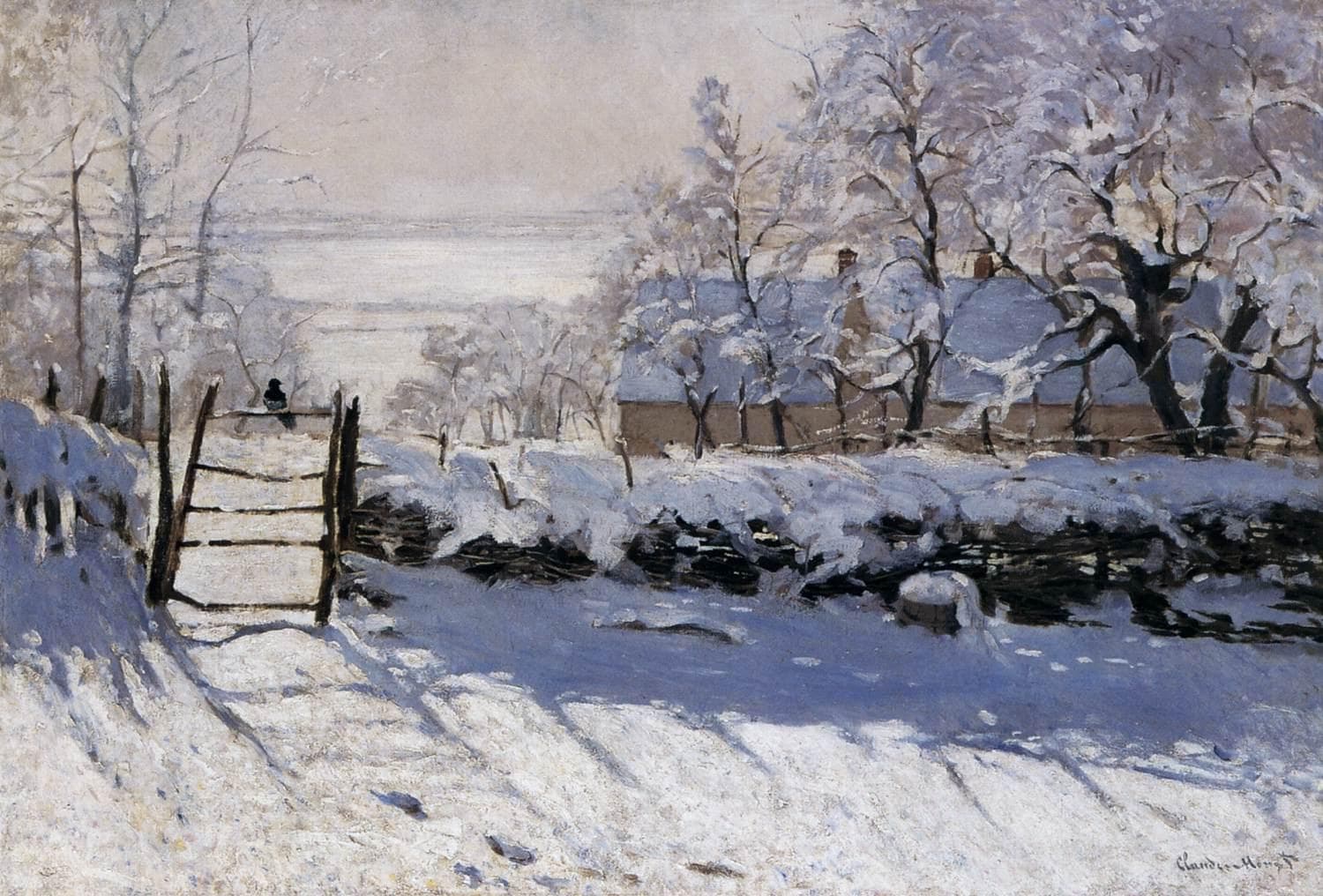
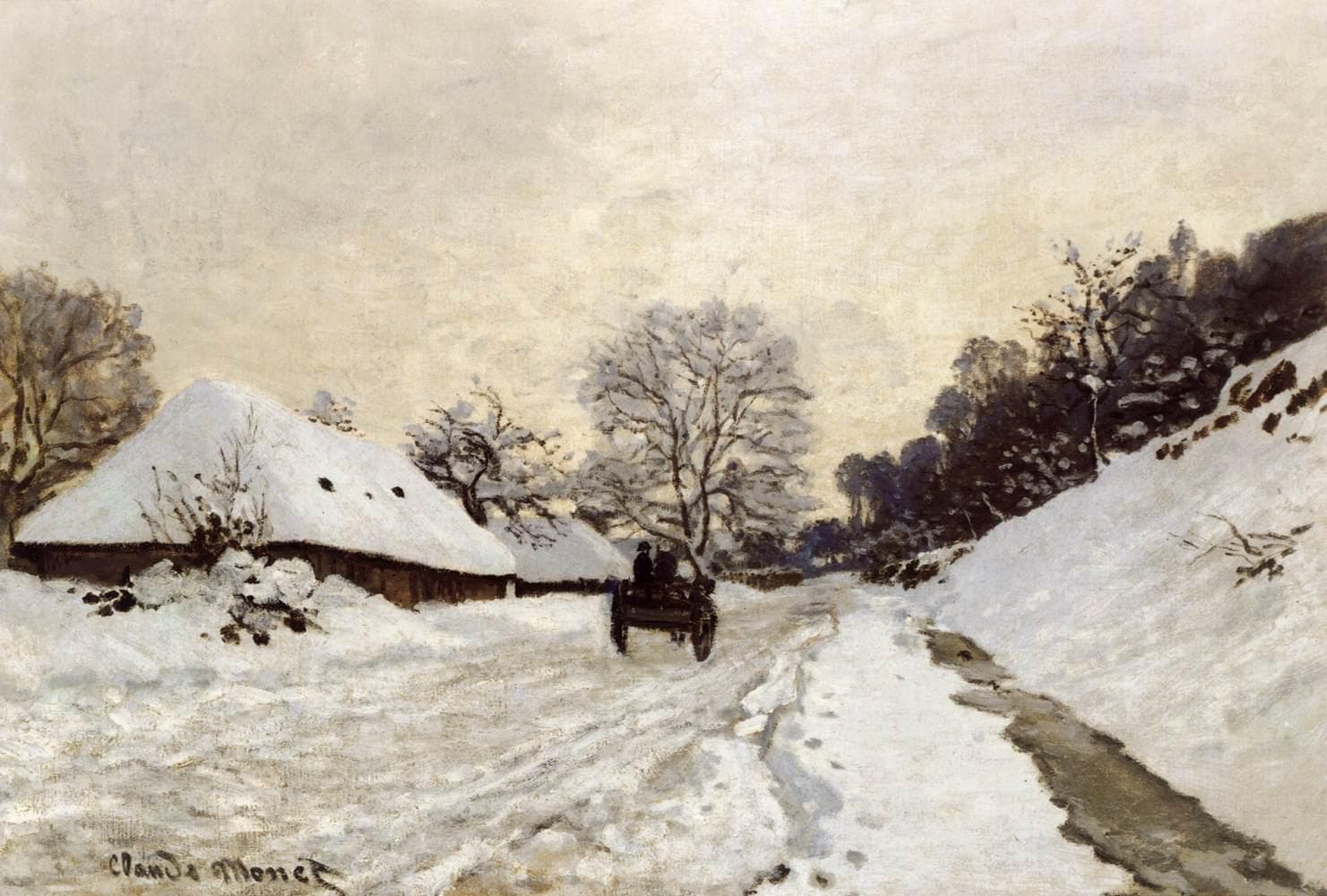
This canvas is the twilight partner of Road at Louveciennes, Snow Effect, which shows a similar road under fresh snow in flat gray daylight. Seen together, they show Monet beginning to treat one kind of motif under different conditions, the idea that would drive his series two decades later. The earlier A Cart on the Snowy Road at Honfleur and the great The Magpie belong to the same line of winter experiments.
Context: the last winter before the war
Within months the world of these quiet village pictures was broken. The Franco-Prussian War began in July 1870, and Louveciennes lay in the path of the Prussian advance on Paris. Pissarro's house was occupied and many of the paintings stored there were lost or damaged. Monet, newly married to Camille, left for London. Pictures from the winter of 1869–70 are therefore a fragile record of the moment just before Impressionism took shape. For the broader timeline, see Monet's life in paintings.
Where to see it
The painting is in a private collection and is not on public display. Monet's other works of the Bougival years can be seen in museums including the National Gallery in London and the Metropolitan Museum in New York; see where to see Monet's paintings and the main Claude Monet page.
Questions & answers
Where is Monet's Road to Louveciennes, Melting Snow, Sunset?
The painting is in a private collection and is not on public view. It is a small canvas, 41 by 54.2 centimeters, catalogued by Wildenstein as number 148. It dates from the winter of 1869–70, when Monet was living near Bougival and painting the roads of nearby Louveciennes.
When was Road to Louveciennes, Melting Snow, Sunset painted?
Wildenstein dates it to 1869, and it is usually placed in the winter of 1869–70. Monet was then living at Saint-Michel near Bougival, west of Paris, and walking up to Louveciennes, where Camille Pissarro had settled on the road to Versailles.
What does the painting show?
A village road at sunset, with snow melting into patches on the bank and the wet road reflecting a golden sky. Bare trees and stone houses line both sides, and a pale house with green shutters stands at the right edge. The subject is the warm evening light on a cold, thawing street.
Did Monet paint other views of Louveciennes?
Yes. The same winter he painted Road at Louveciennes, Snow Effect, showing a similar road under fresh snow in gray daylight. Pissarro and Sisley also painted the village roads repeatedly around 1870. Together they show Monet testing one motif under different light.
More by the artist
Claude Monet

Bridge over a Pond of Water Lilies
Claude Monet · 1899

Woman with a Parasol – Madame Monet and Her Son
Claude Monet · 1875

Sunset in Venice
Claude Monet · 1908–12

La Grenouillère
Claude Monet · 1869

Beach in Pourville
Claude Monet · 1882

Springtime
Claude Monet · 1872

Boating on the River Epte
Claude Monet · 1890

The Seine at Asnières (Hermitage)
Claude Monet · 1873
Also painted in 1869
The same year
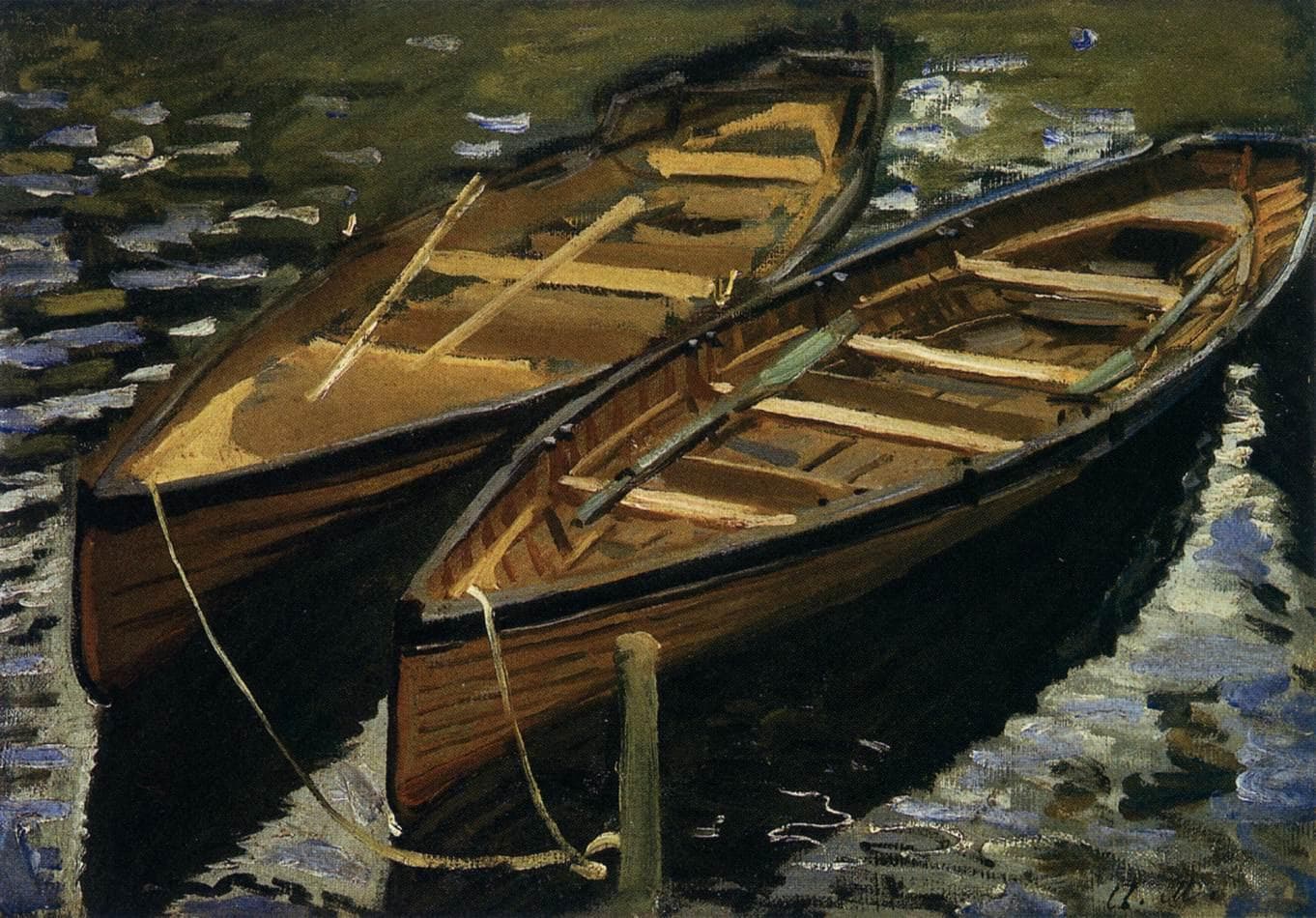
Kindred works
You may also study
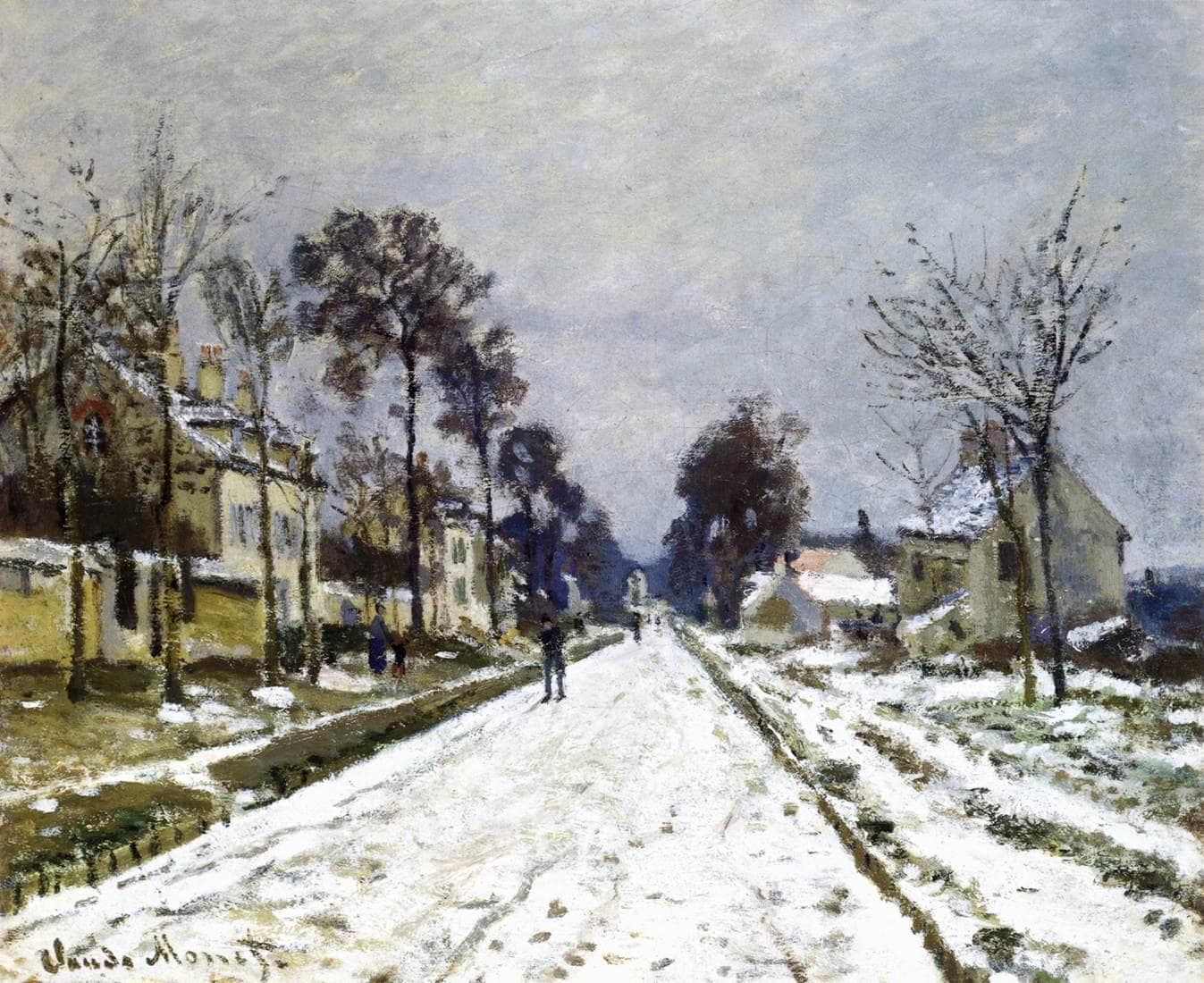
Road at Louveciennes, Snow Effect
Claude Monet · 1869–70
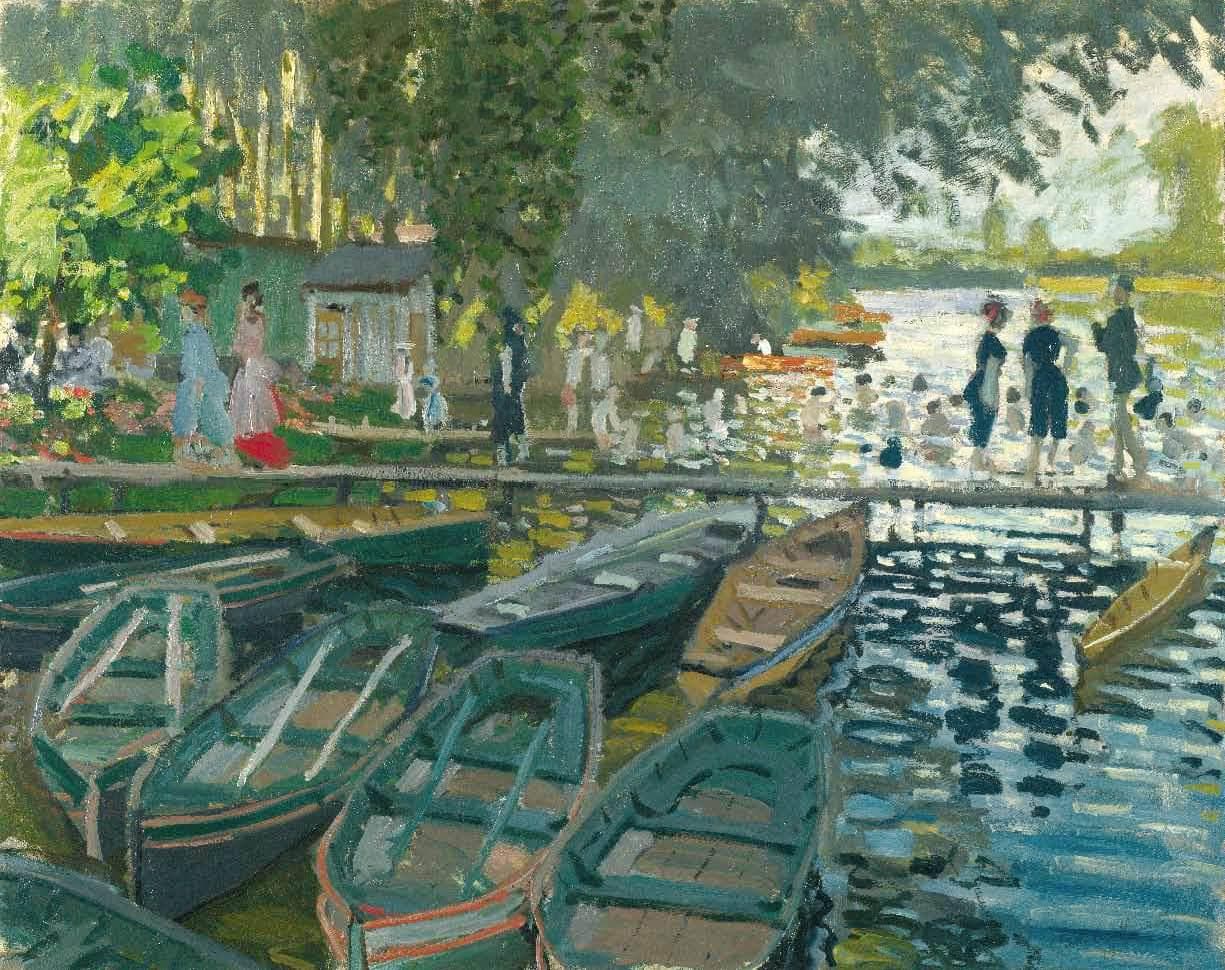
Bathers at La Grenouillère
Claude Monet · 1869
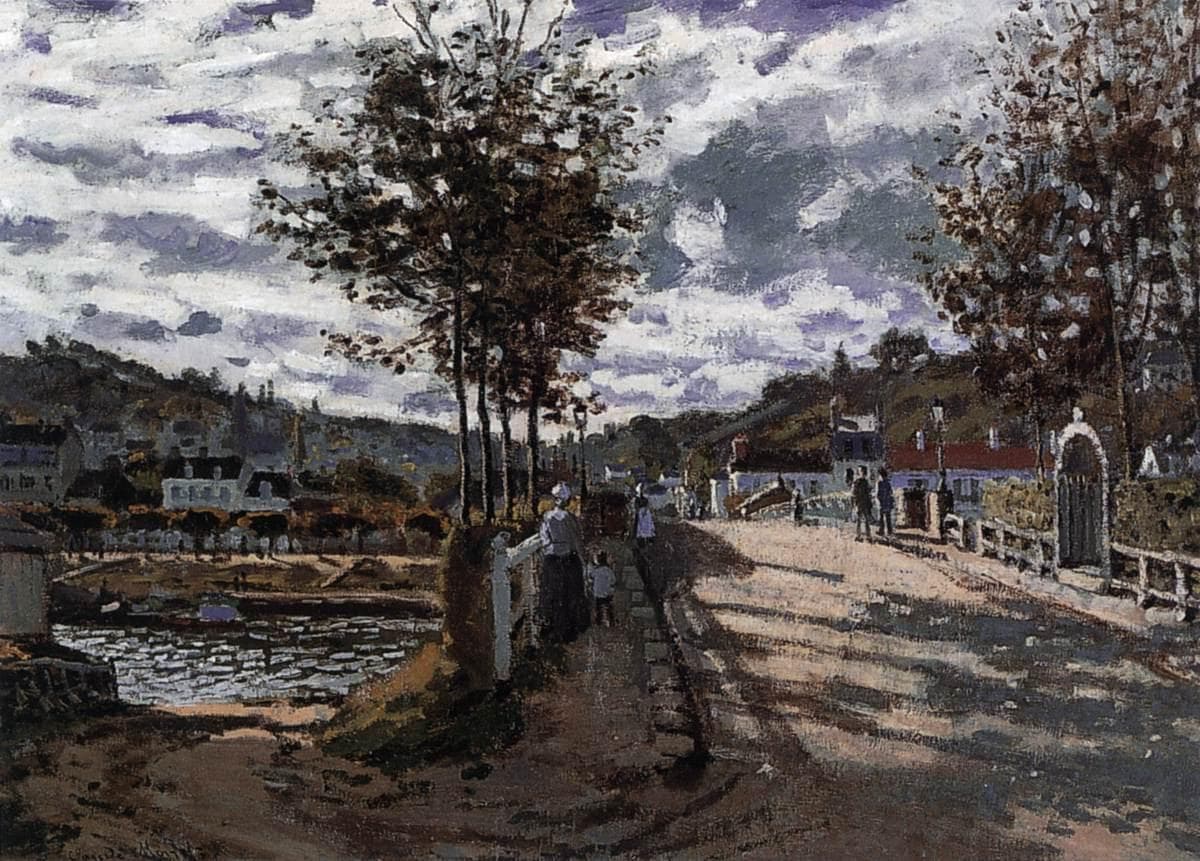
The Bridge at Bougival
Claude Monet · 1869
The Magpie
Claude Monet · 1868–69
A Cart on the Snowy Road at Honfleur
Claude Monet · c. 1867

The Scream
Edvard Munch · 1893

Ophelia
John Everett Millais · 1851–52

The Great Wave off Kanagawa
Katsushika Hokusai · c. 1830–32