Impressionism
The Boats
Claude Monet, 1869
The Boats (Barques) is a small 1869 painting by Claude Monet of two wooden rowing boats moored on rippling water, a close-up of the motif he explored on the Seine that summer. It belongs to the Kunsthalle Bremen, Germany.
- Artist
- Claude Monet
- Date
- 1869
- Medium
- Oil on canvas
- Dimensions
- 33 × 46.5 cm
- Collection
- Kunsthalle Bremen, Bremen, Germany
- Movement
- Impressionism
- Catalogue
- Wildenstein 137
What you are looking at
Two wooden rowing boats lie side by side, seen from above and close up, their bows pointing toward the top left. Their hulls are a warm honey brown, the planks, ribs and thwarts picked out in darker lines, and each has a pair of oars lying along the seats, the nearer pair tinted a faded green. A pale rope loops down from each boat to a weathered wooden post at the bottom of the canvas. Around them the water is almost black-green in the shadow of the hulls, broken into short horizontal flicks of blue, lilac and white where light catches the ripples.
The picture is tightly cropped. The far boat runs off the top edge and the near one almost touches the right edge, so there is no bank, no horizon and no sky. Everything we know about the setting comes from the water and the light on it.
This small canvas, called Barques in French, was painted by Claude Monet in 1869. It measures 33 by 46.5 centimeters, is number 137 in Wildenstein's catalogue, and belongs to the Kunsthalle Bremen, which also owns Monet's full-length portrait Camille (Woman in Green Dress).
Where and when
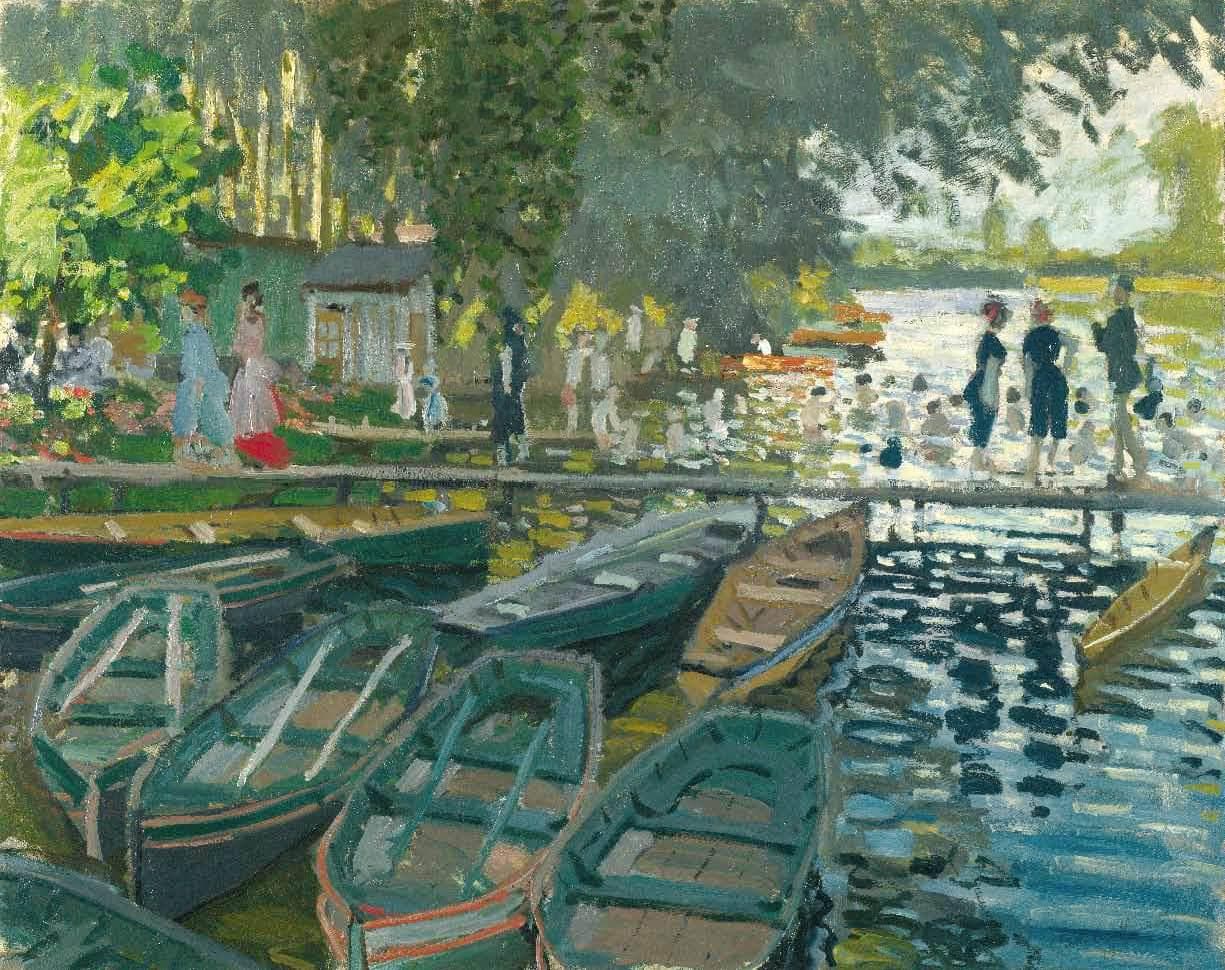
In 1869 Monet was living at Saint-Michel near Bougival, on the Seine west of Paris, with Camille Doncieux and their two-year-old son Jean, so short of money that at times he could not buy paint. That summer he and Pierre-Auguste Renoir worked side by side at La Grenouillère, a floating café and bathing place on the river at Croissy, where rowing boats for hire lay moored in rows at the water's edge.
In Monet's views of La Grenouillère, the moored boats in the foreground are painted exactly like these, in quick, loaded strokes, while the water around them is broken into separate flecks of color. Barques reads like a close-up study of that motif, though there is no evidence it was painted at La Grenouillère itself rather than elsewhere on that stretch of river.
How it was painted
What makes the picture modern is the water. Monet does not blend it into a smooth surface; he lays down separate dashes of dark green, blue and white side by side, each stroke roughly the shape of a ripple, and lets the eye mix them into the shimmer of moving water. Look at the right-hand side, where the light is strongest: the white and blue strokes are thick and slightly raised, catching real light on the canvas.
The boats are handled differently, with longer strokes that follow the planking and a warm, almost uniform ochre that makes the wood glow against the cold water. The ropes are single curving lines of pale paint dragged across the darker surface.
Notice the viewpoint, too. We look down on the boats from the bank, so they fill the frame at an angle and are cut off at the edges, a cropping that feels closer to photography or Japanese prints than to traditional marine painting. The reflections are just a few darker strokes beneath the hulls. The small size and direct handling suggest a single session outdoors.
The motif and its siblings
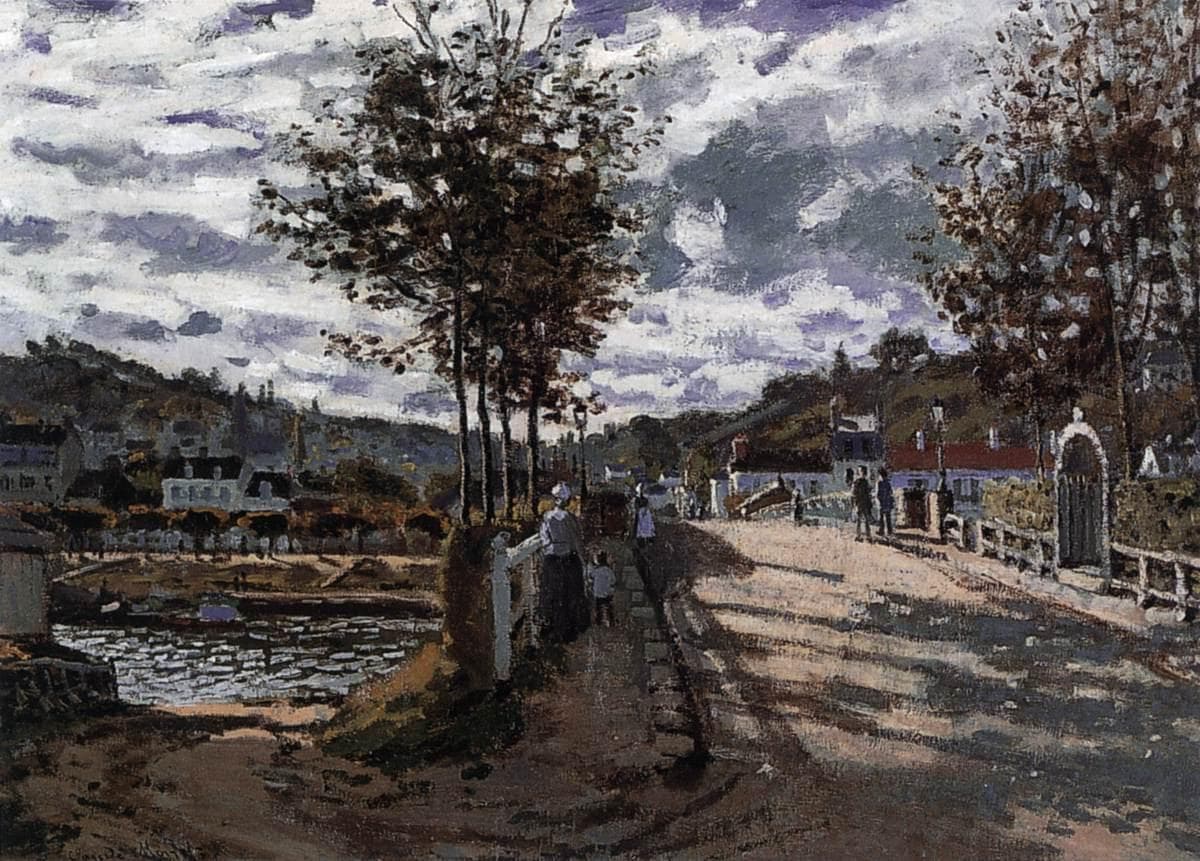
The moored boat stayed with Monet for the rest of his career. Compare the crowded boats in La Grenouillère in London and La Grenouillère in New York, both painted that summer, and the nearby river road of The Bridge at Bougival. At Argenteuil in the 1870s the boats became sailboats and his own floating studio boat; at Giverny in the 1880s, the empty rowing boat of The Barque returns to this same close, downward look.
Where to see it
The painting belongs to the Kunsthalle Bremen, a museum founded by a citizens' art association in 1823, whose Monet holdings are anchored by the 1866 portrait of Camille. As a small work it is not always on display, so check before visiting. For other museums with Monet's work, see where to see Monet's paintings, and for his life, Claude Monet. For the technique he was developing here, see How Monet Painted.
Questions & answers
Where is Monet's The Boats (Barques)?
The painting belongs to the Kunsthalle Bremen in Germany, which also owns Monet's 1866 portrait Camille (Woman in Green Dress). Barques is a small canvas, 33 by 46.5 centimeters, catalogued by Wildenstein as number 137.
When and where was The Boats painted?
It is dated 1869, the summer Monet spent near Bougival on the Seine west of Paris, painting the river and the bathing place of La Grenouillère with Renoir. The exact spot is not recorded.
What does The Boats show?
Two wooden rowing boats with oars, moored side by side to a post and seen from above, on dark water broken by blue and white ripples. There is no sky or bank; the subject is the boats and the light on the water.
Is The Boats related to La Grenouillère?
It shares the motif and the technique of Monet's 1869 La Grenouillère paintings in London and New York, where moored rowing boats fill the foreground. It is best seen as a close-up study of that subject, though it is not documented as painted at La Grenouillère itself.
More by the artist
Claude Monet

Bridge over a Pond of Water Lilies
Claude Monet · 1899

Woman with a Parasol – Madame Monet and Her Son
Claude Monet · 1875

Sunset in Venice
Claude Monet · 1908–12

La Grenouillère
Claude Monet · 1869

Beach in Pourville
Claude Monet · 1882

Springtime
Claude Monet · 1872

Boating on the River Epte
Claude Monet · 1890

The Seine at Asnières (Hermitage)
Claude Monet · 1873
Also painted in 1869
The same year
Kindred works
You may also study
Bathers at La Grenouillère
Claude Monet · 1869
The Bridge at Bougival
Claude Monet · 1869
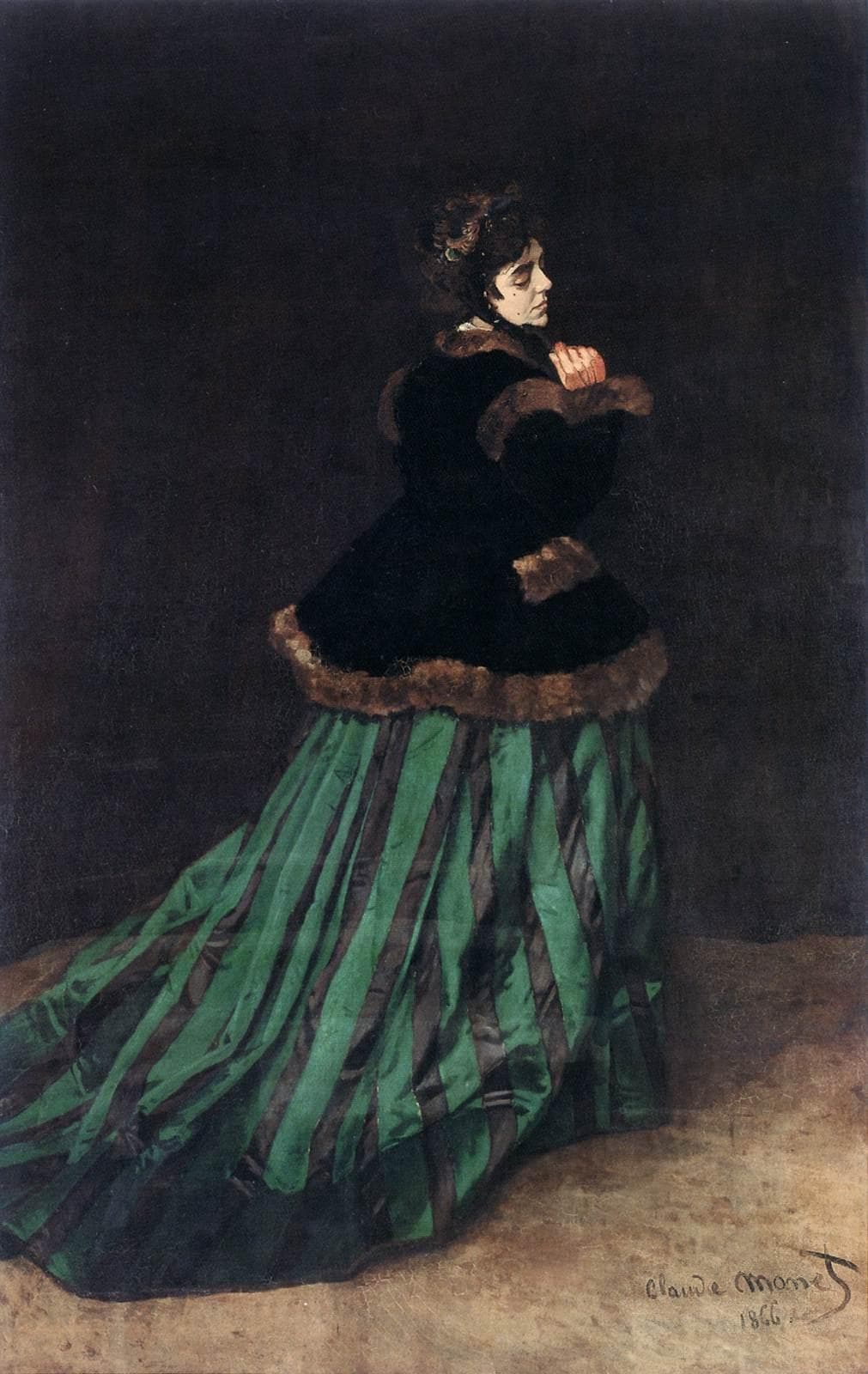
Camille (The Woman in the Green Dress)
Claude Monet · 1866
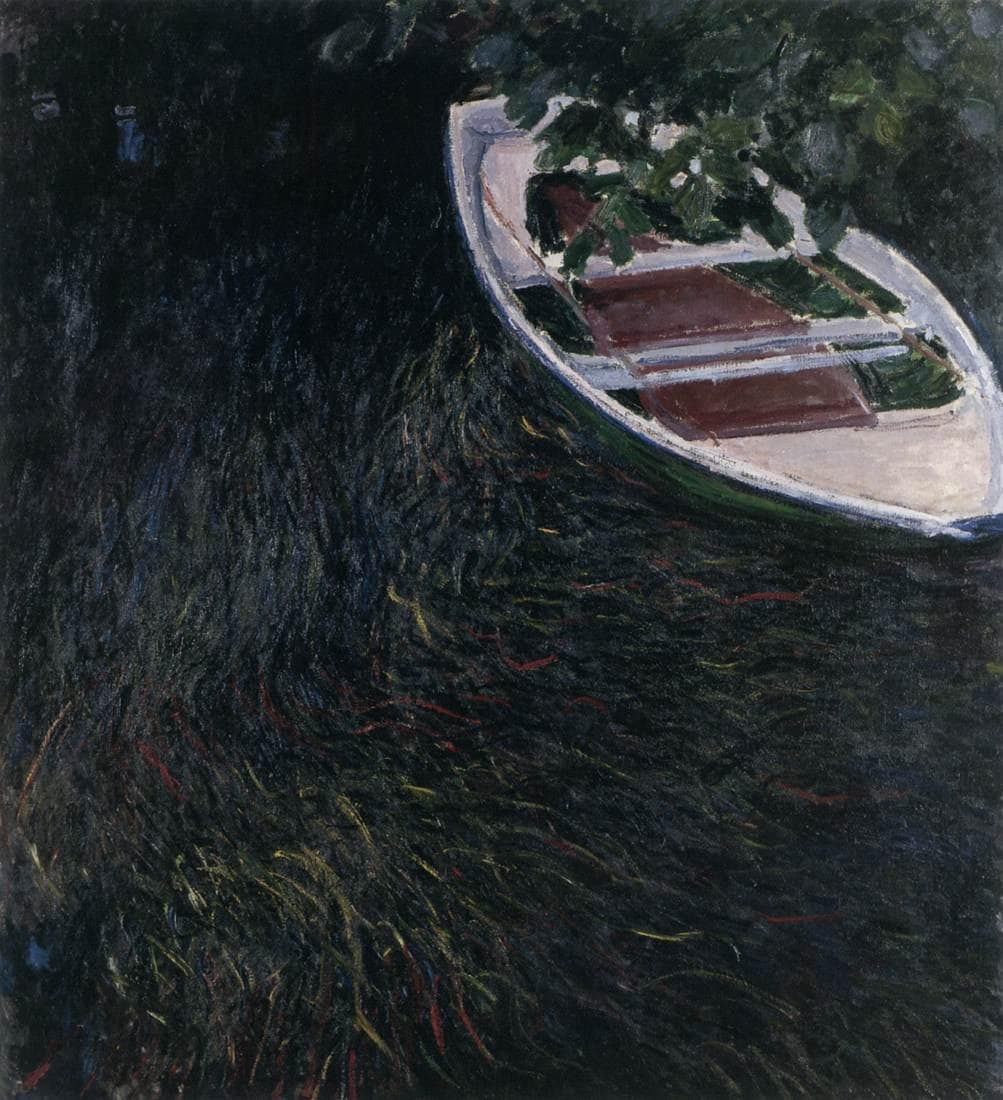
The Barque
Claude Monet · 1887

Ophelia
John Everett Millais · 1851–52

The Great Wave off Kanagawa
Katsushika Hokusai · c. 1830–32
The Birth of Venus
Sandro Botticelli · c. 1484–1486
Spleen et Idéal
Carlos Schwabe · 1907