Impressionism
Fishing Boats and the Porte d'Aval
Claude Monet, 1884
Fishing Boats, also called Fishing Boats and the Porte d'Aval, is an 1884 painting by Claude Monet of boats and thatched sheds on the beach at Étretat under a rough sea and the great rock arch. It is in the Wallraf-Richartz-Museum, Cologne.
- Artist
- Claude Monet
- Date
- 1884
- Medium
- Oil on canvas
- Dimensions
- 73 × 100 cm
- Collection
- Wallraf-Richartz-Museum & Fondation Corboud, Cologne, Germany
- Movement
- Impressionism
- Catalogue
- Wildenstein 822
Painted at Étretat and the Normandy Coast
Claude Monet's Fishing Boats, catalogued as Fishing Boats and the Porte d'Aval and in French as Falaises et barques à Étretat (Wildenstein 822), is a large view of the beach at Étretat on the Normandy coast, signed and dated 1884 at lower right. The canvas, about 73 by 100 centimeters, is in the Wallraf-Richartz-Museum & Fondation Corboud in Cologne, Germany (inventory WRM 3120), which acquired it in 1961.
What you are looking at
The foreground is a crowded strip of shingle. Fishing boats are drawn up above the waterline: dark hulls in black and brown, one with a green stripe at the left, and at the right a boat with a bright rust-red hull, their masts leaning at different angles. Among them squat caloges, old boats turned upside down and roofed with thatch or planks to serve as fishermen's sheds; two in the center, one with a ridged plank roof, form the heaviest shapes in the picture. A few tiny figures stand by the boats at the right, and a dark figure leans in a doorway at the far left.
Behind the beach the Channel is in turmoil. Long rollers of gray-green water, flecked with white foam, break across the middle of the canvas, and their curling crests are drawn with quick, hooked strokes. At the upper left, rising out of the spray, stands the Porte d'Aval, the famous chalk arch at the western end of the bay, its rock brown and gray in the dull light. The sky is low and pale, a cream-gray almost the same tone as the cliff.
How it was painted
The canvas is large and the handling vigorous. Monet builds the waves from short, curving strokes of white over darker green, so they seem to curl and break, and treats the boats and sheds as bold, simple shapes in dark paint. The thatched roofs are dragged in with long, dry, ochre strokes that look like straw; the plank roof is drawn with a series of parallel lines. The solid base of hulls and sheds lets the restless sea read more strongly above it.
The color is restrained: browns, blacks, gray-greens and cream, with a single strong accent in the red hull. That one warm note, set at the right, balances the mass of the cliff at the upper left, and the composition swings between them along the diagonal of the beach.
Étretat, a working beach
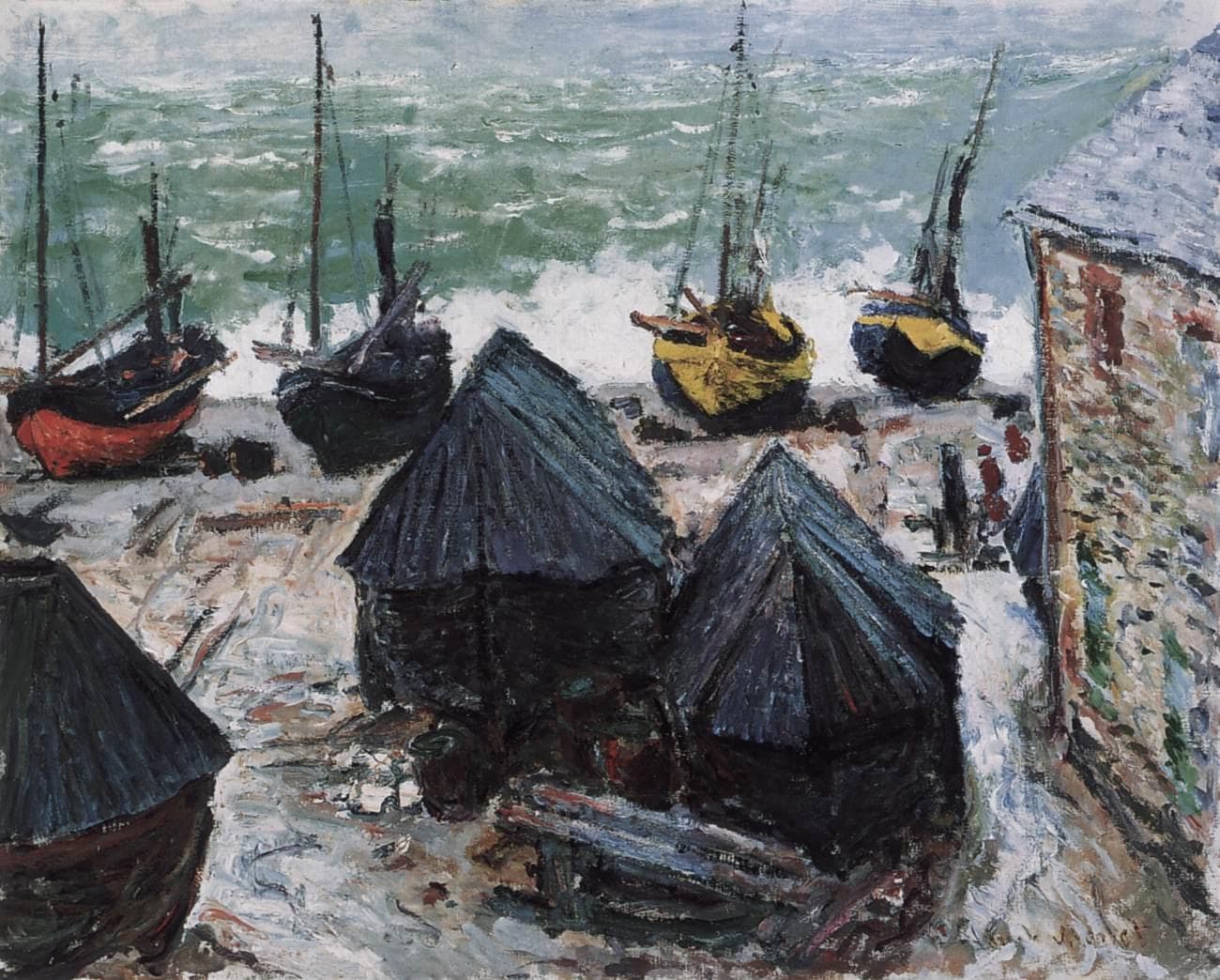
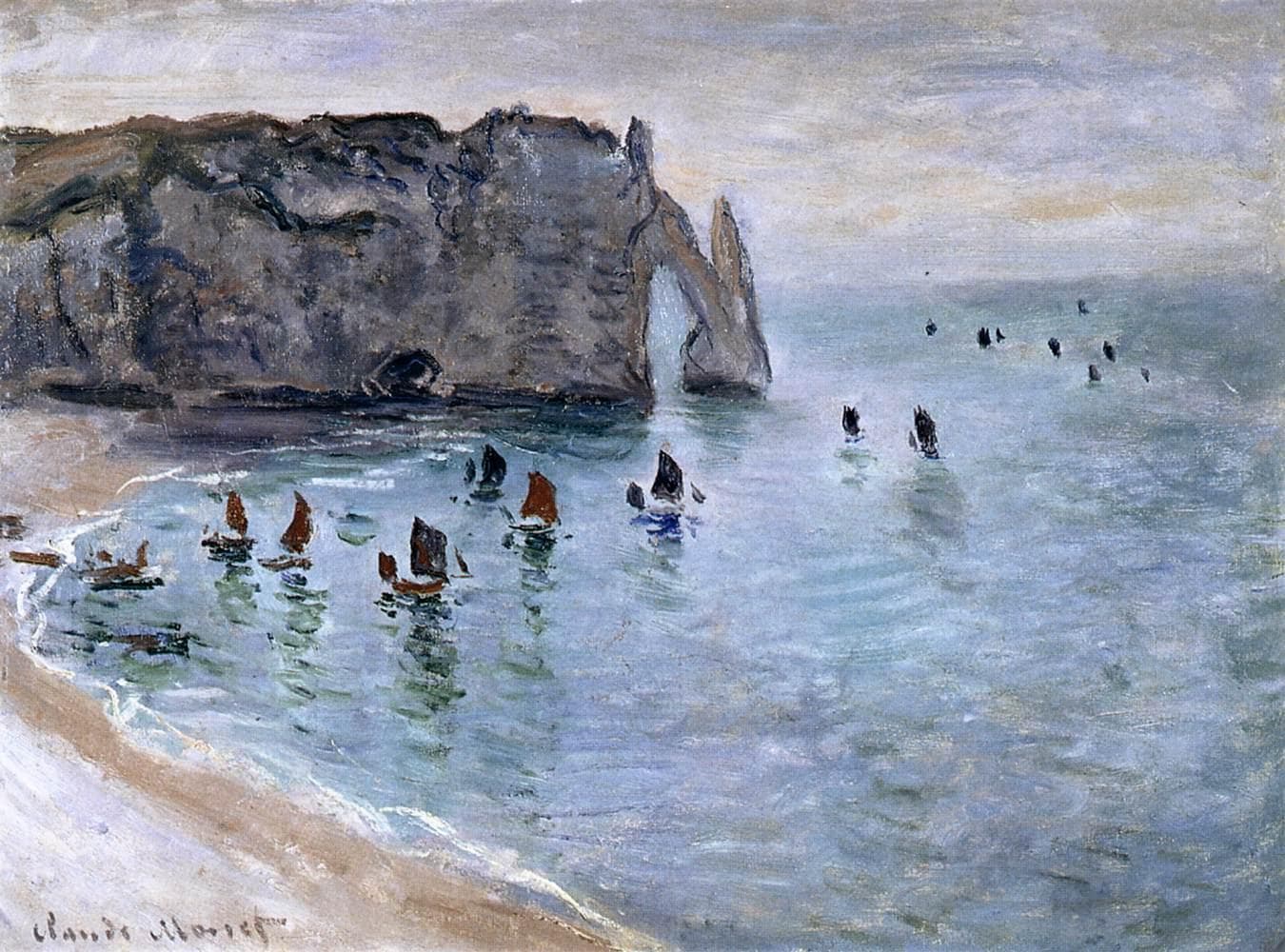
Monet first painted Étretat in 1868–69 and returned repeatedly between 1883 and 1886. The village was a fashionable resort, but Monet was drawn as much to its fishing community as to its cliffs. The same mix of caloges and boats appears in Boats on the Beach at Étretat, painted from a hotel window in November 1885 and now in Chicago, and the fleet at sea is the subject of Étretat, the Porte d'Aval: Fishing Boats Leaving the Harbor in Dijon and The Departure of the Boats, Étretat. The sea here is close to his storm pictures, such as Rough Sea at Étretat in Lyon. Our hub on Étretat and the Normandy coast follows all of these campaigns.
Compared with those later canvases, this one keeps more of the documentary feel of a harbor picture: the boats, sheds and fishermen are all described, and the cliff serves as a landmark rather than as the subject. Within two years Monet would be painting the cliffs alone, without people, as pure masses of light and color. The canvas also records the everyday equipment of a fishing beach, the sheds, hulls, masts and tackle, with the care of someone who had grown up among boats on this coast at Le Havre.
Where to see it
The painting hangs in the Wallraf-Richartz-Museum & Fondation Corboud in Cologne, which has a strong collection of French Impressionism. For other collections, see where to see Monet's paintings. Other boat pictures include Three Fishing Boats in Budapest. More on Claude Monet.
Questions & answers
Where is Monet's Fishing Boats with the Porte d'Aval?
This painting, signed and dated 1884, is in the Wallraf-Richartz-Museum & Fondation Corboud in Cologne, Germany, which acquired it in 1961. It is catalogued by Wildenstein as number 822 and measures about 73 by 100 centimeters, one of the larger canvases from Monet's Étretat campaigns.
When and where was it painted?
Monet signed and dated it 1884. It shows the beach at Étretat on the Normandy coast, which he painted in several campaigns between 1883 and 1886, looking west toward the Porte d'Aval arch at the end of the bay.
What are the thatched structures on the beach?
They are caloges: retired fishing boats turned upside down and roofed with thatch or planks, used by Étretat's fishermen as storage sheds for nets, sails and gear. They were a distinctive sight on the beach in the 1880s and appear in several of Monet's paintings of the village.
What is the arch in the painting?
The arch at upper left is the Porte d'Aval, a natural opening in the chalk cliffs at the western end of Étretat's beach, with the pointed rock stack called the Aiguille beside it. It is the most famous landmark on this part of the Normandy coast and a favorite subject of Monet's.
More by the artist
Claude Monet

Bridge over a Pond of Water Lilies
Claude Monet · 1899

Woman with a Parasol – Madame Monet and Her Son
Claude Monet · 1875

Sunset in Venice
Claude Monet · 1908–12

La Grenouillère
Claude Monet · 1869

Beach in Pourville
Claude Monet · 1882

Springtime
Claude Monet · 1872

Boating on the River Epte
Claude Monet · 1890

The Seine at Asnières (Hermitage)
Claude Monet · 1873
Also painted in 1884
The same year
Kindred works
You may also study
Boats on the Beach at Étretat
Claude Monet · 1885
Étretat, the Porte d'Aval: Fishing Boats Leaving the Harbor
Claude Monet · 1885
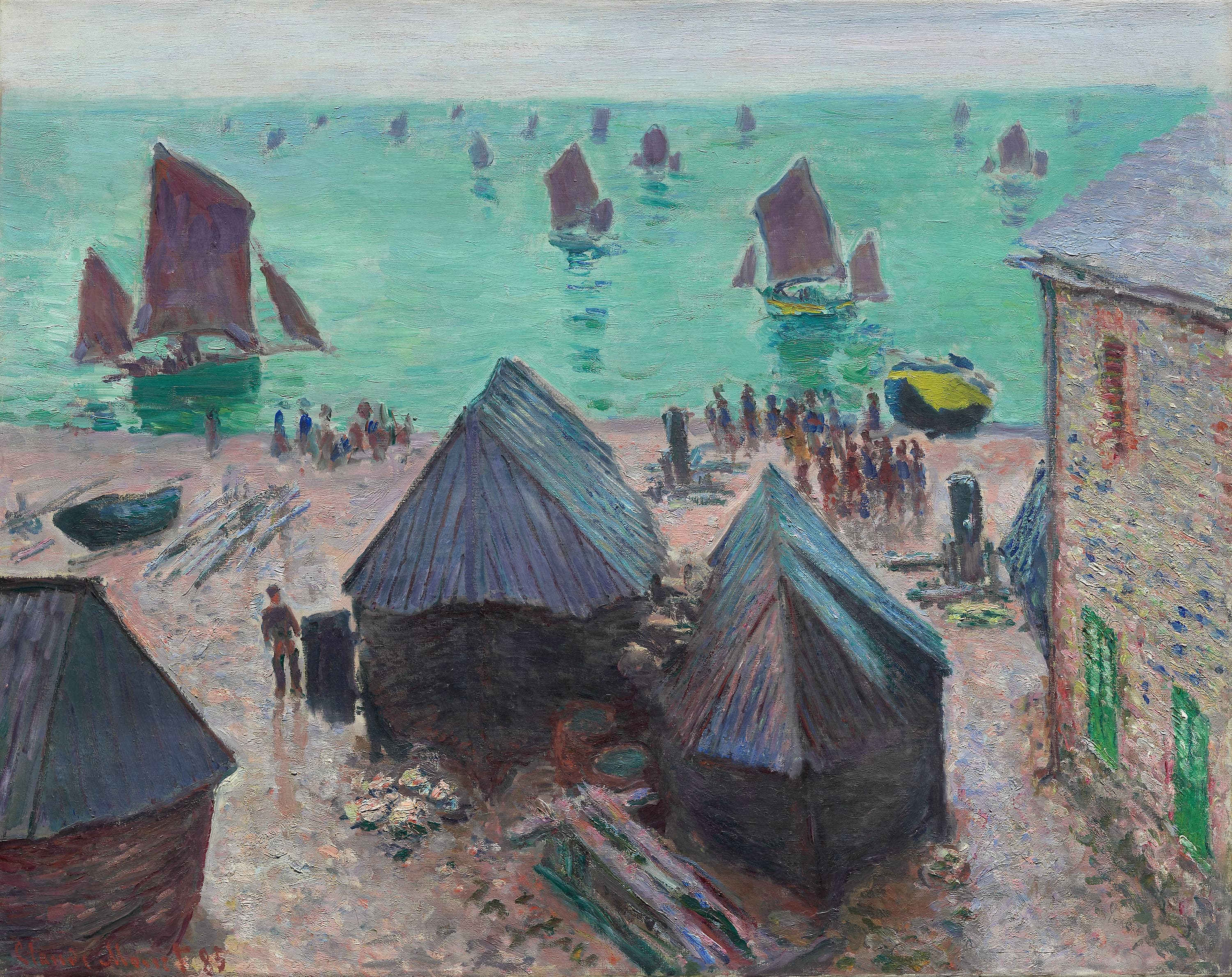
The Departure of the Boats, Étretat
Claude Monet · 1885
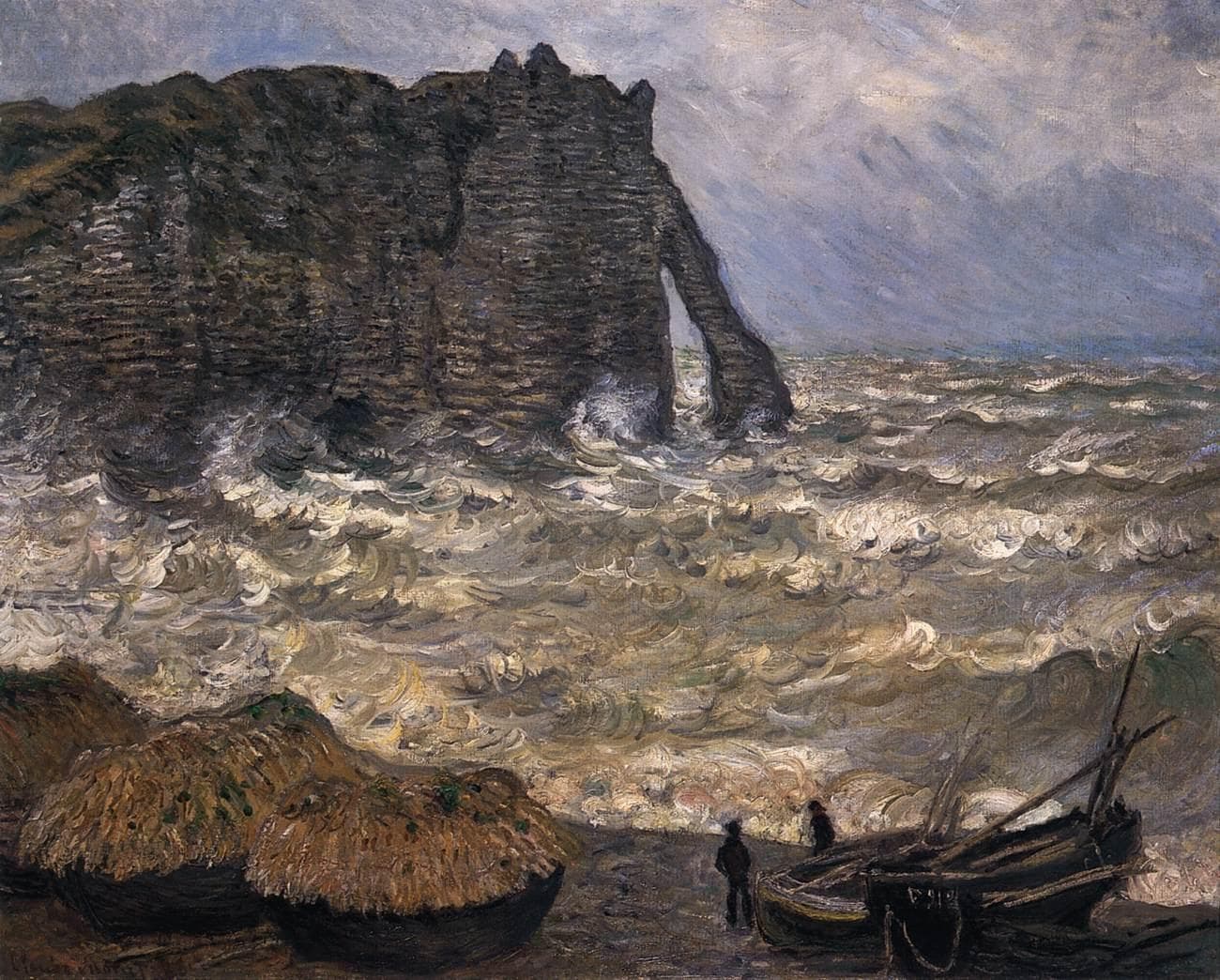
Rough Sea at Étretat
Claude Monet · 1883
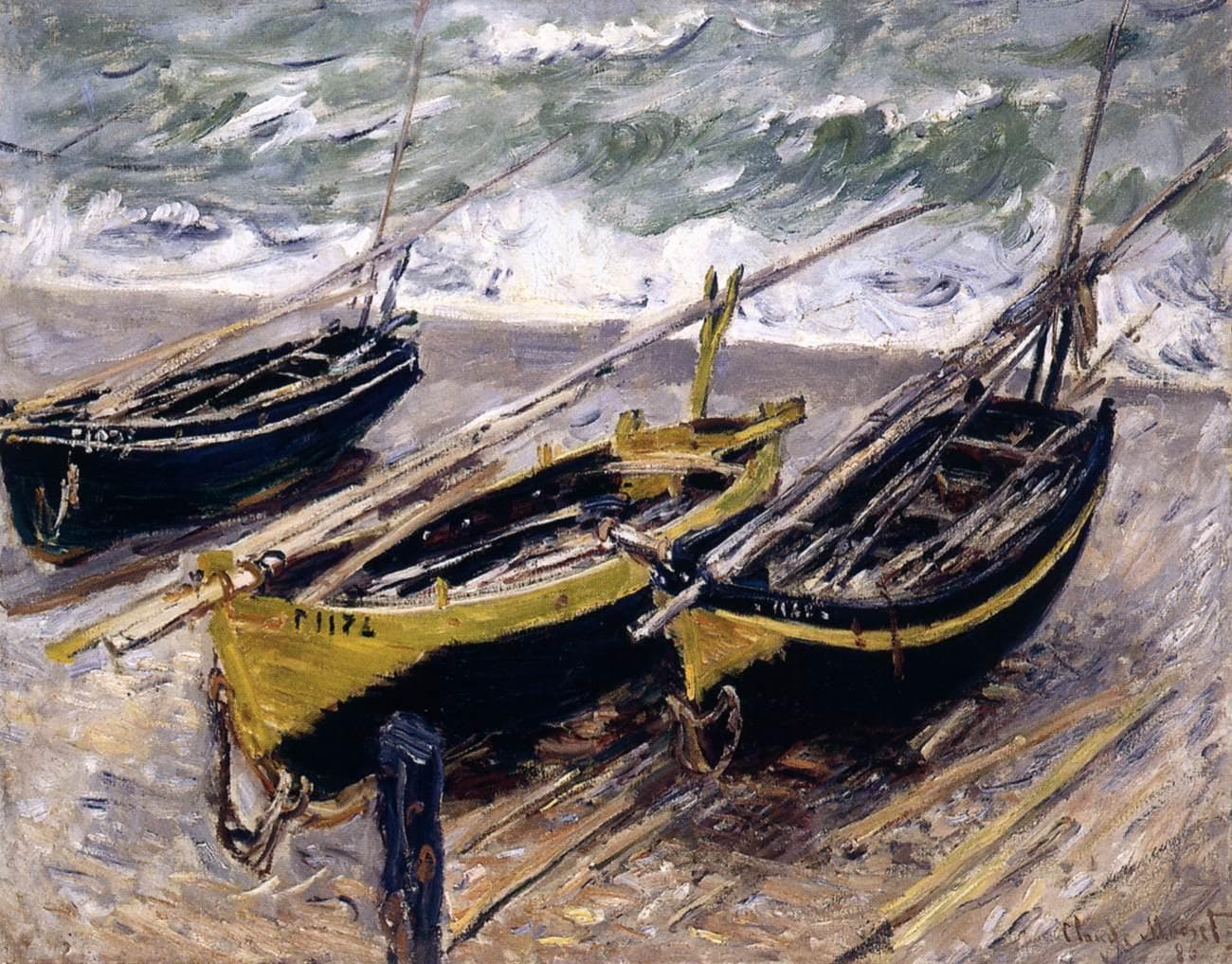
Three Fishing Boats
Claude Monet · 1885

Ophelia
John Everett Millais · 1851–52

The Great Wave off Kanagawa
Katsushika Hokusai · c. 1830–32
The Birth of Venus
Sandro Botticelli · c. 1484–1486