Impressionism
Villas in Bordighera
Claude Monet, 1884
Villas in Bordighera is an 1884 painting by Claude Monet of white villas, palms and a flowering agave on the Italian Riviera, with blue mountains behind. This version is in the Santa Barbara Museum of Art; a larger one is in the Musée d'Orsay.
- Artist
- Claude Monet
- Date
- 1884
- Medium
- Oil on canvas
- Dimensions
- 74 × 92.5 cm
- Collection
- Santa Barbara Museum of Art, Santa Barbara, United States
- Movement
- Impressionism
- Catalogue
- Wildenstein 856
Painted at Monet on the Mediterranean
What you are looking at
A tall, bare stalk shoots up through the center of the picture: the flowering spike of an agave, topped with clusters of buds and branching flower heads. At its foot, the agave's own spiky blue-gray leaves fan out across the bottom of the canvas. To the right, the corner of a tall pale villa with an arched window and a balcony is cut by the frame, its walls tinted lilac and gold.
Palm trees spread their fronds on either side. On the left, more villas, cream and pink, glimpse through a riot of orange, ocher and green vegetation along a sunny path, where two tiny figures walk. Behind everything rise blue-violet mountains under a hazy sky.
The colors are hot: orange, yellow, rust and pink set against cool blue. It is midday, or close to it, in a Mediterranean winter that feels like summer.
Bordighera, 1884
Claude Monet went to Bordighera, on the Italian Riviera just across the border from France, in January 1884, intending a short trip. He stayed until April and painted around forty canvases. The light and the exotic vegetation, palms, olives, lemon trees and agaves in the gardens of wealthy foreign residents, both excited and frustrated him. In letters to Alice Hoschedé he complained that rendering such colors would need a palette of diamonds and jewels. That journey, and his later stay at Antibes, are surveyed on Monet on the Mediterranean.
Bordighera was then a winter colony for the British, with villas, hotels and lavish gardens laid out along the slopes. Monet worked in some of them, including the garden of the Moreno family, and walked the paths between the villas looking for motifs.
How it was painted
The agave stalk is the boldest thing Monet painted at Bordighera. It is drawn with a long, slightly wavering line of rust and green, from the bottom of the picture almost to the top, and it splits the composition in two. On either side he packs the space with short, curving strokes, so the stalk stands alone, like a flagpole in a crowd.
Look at the villa on the right. It is barely white at all: its wall is painted in strokes of lilac, pale blue and yellow, which is how strong sunlight looks on a pale surface. The palm fronds are quick, fanning strokes of green and orange. The mountains are laid in with broken blues and purples, and the pink of the villas on the left repeats in the haze above them.
The agave leaves at the bottom are a separate study in themselves: long, pointed strokes of slate blue, green and violet, each tapering to a tip, crossing one another like blades. Against the warm ground they are the coolest notes in the picture, and they pin the composition to the bottom edge.
The Villas pictures and how this one differs
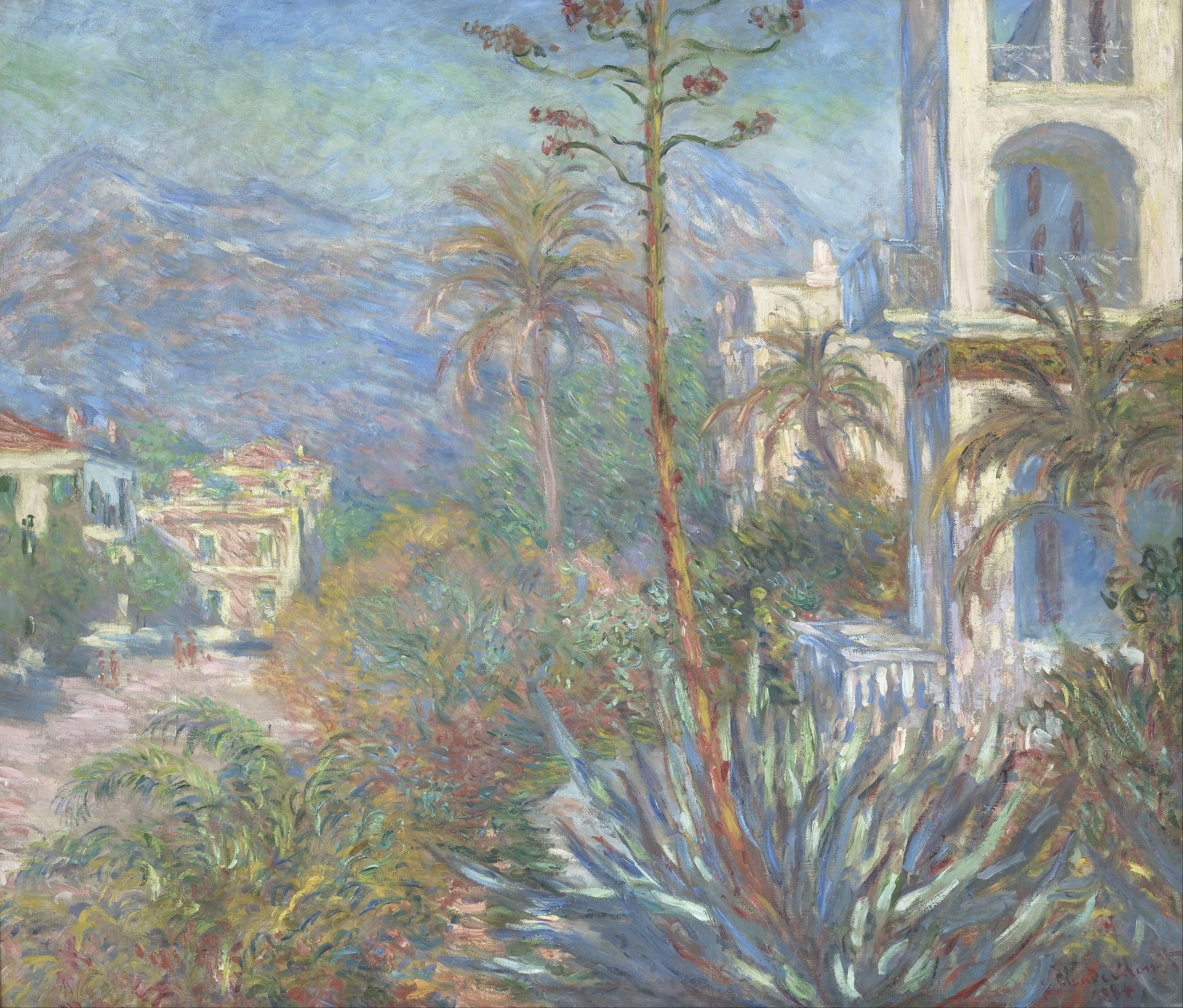
Monet painted this view of villas among palms in at least three versions. This one, catalogued by Wildenstein as W.856, is in the Santa Barbara Museum of Art. A larger canvas of nearly the same view, Villas at Bordighera (W.857, 115 × 130 cm), is in the Musée d'Orsay, and a smaller one (60 × 73 cm) belongs to the Hasso Plattner Collection at the Museum Barberini in Potsdam. The versions differ in how much sky they allow and how far the villas recede; Santa Barbara's is the most crowded with vegetation, the agave pushed to the center like a signature.
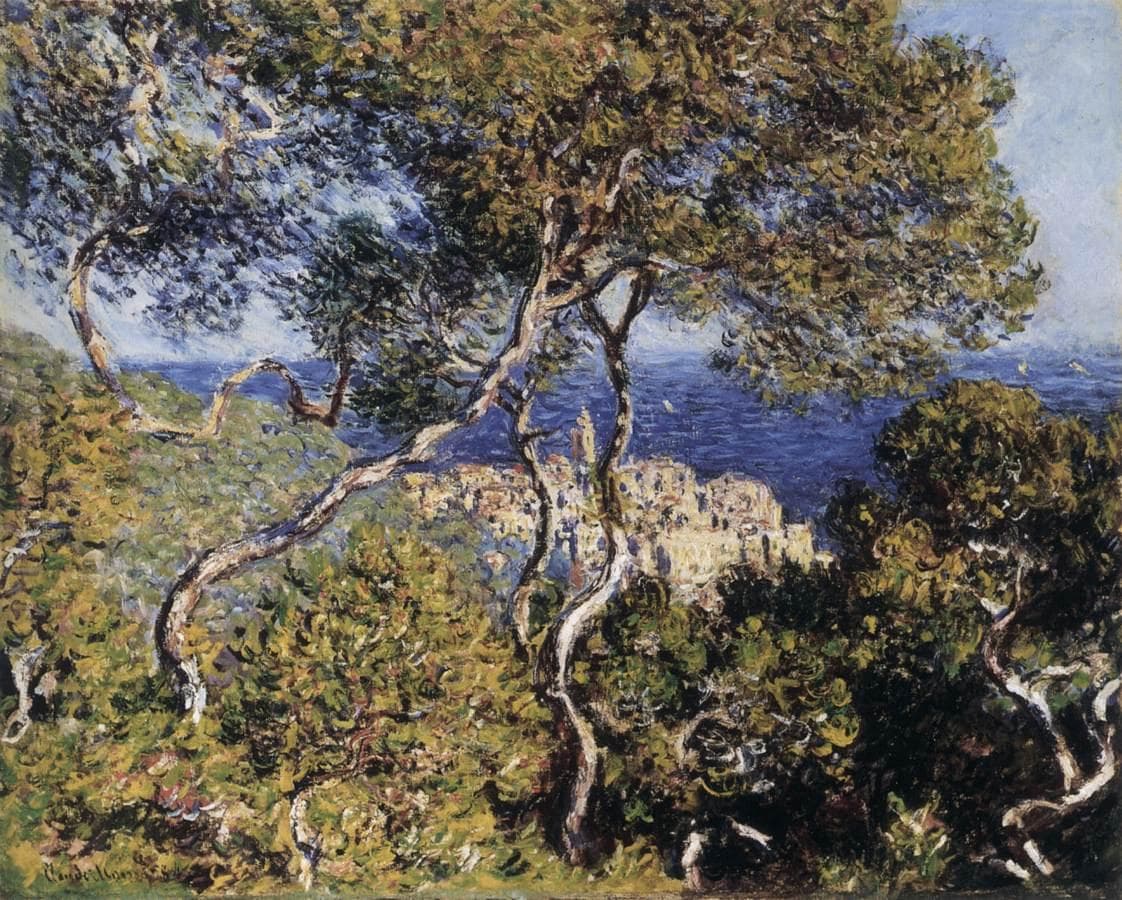
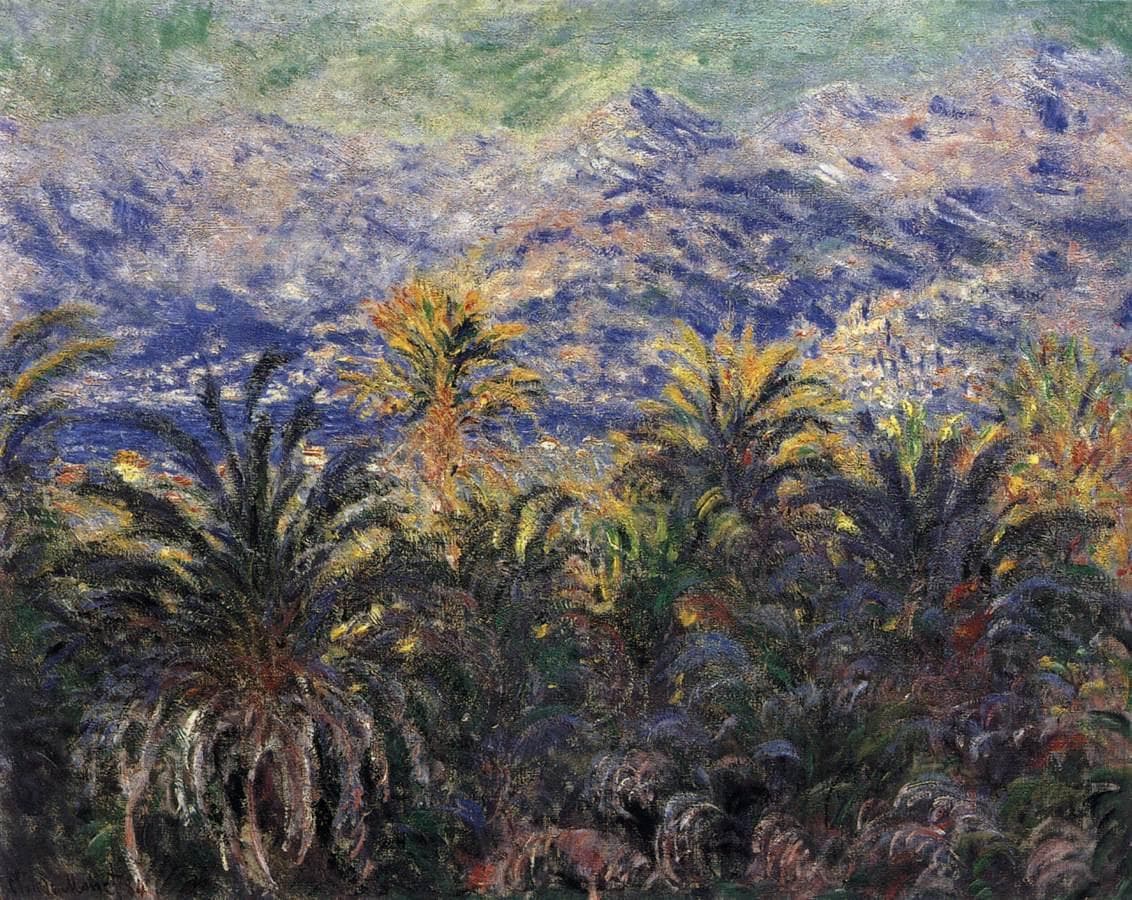
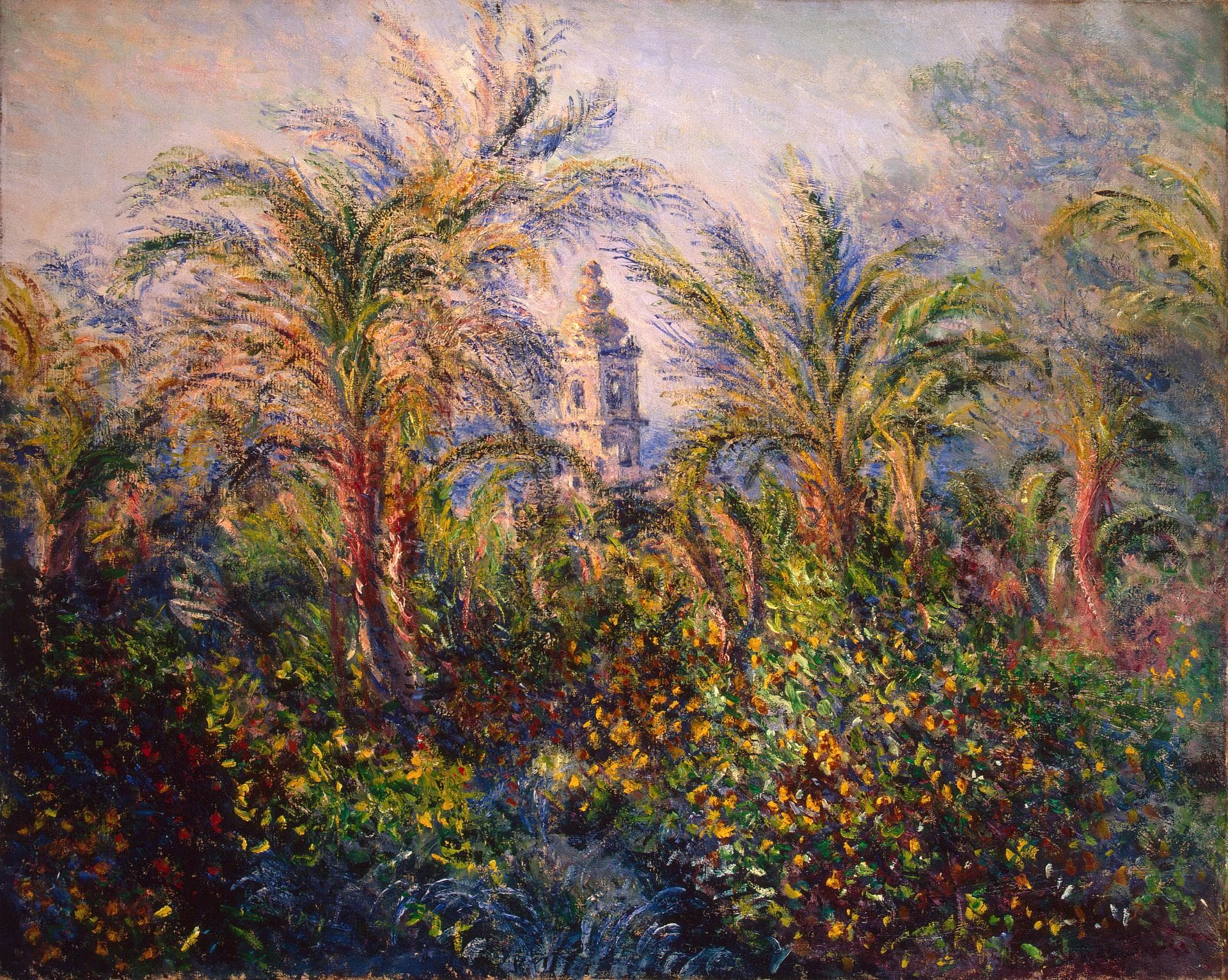
Other canvases from the trip take wider views: the town on its hill in Bordighera in Chicago, the trunks of Palm Trees at Bordighera at the Met, and the hazy Garden at Bordighera, Impression of Morning in the Hermitage.
Where to see it
The painting is in the Santa Barbara Museum of Art in California (1968.20.5). For the other museums that hold Monet's Riviera pictures, see Where to See Monet's Paintings.
Questions & answers
Where is Monet's Villas in Bordighera?
Monet painted the view several times. This version, about 74 by 92.5 centimeters, is in the Santa Barbara Museum of Art in California (1968.20.5). A larger version of nearly the same scene, 115 by 130 centimeters, is in the Musée d'Orsay in Paris, and a smaller one is in the Museum Barberini in Potsdam.
When and where was it painted?
In early 1884 at Bordighera on the Italian Riviera, just east of the French border near Menton. Monet stayed from January to April, painting around forty canvases of the town's gardens, villas, palms and mountains. Wildenstein catalogues this version as W.856.
What is the tall stalk in the middle of the painting?
It is the flower spike of an agave, the large succulent whose spiky blue-gray leaves fill the bottom of the canvas. Agaves send up a single tall stalk once in their lives. Monet uses it as a bold vertical that divides the composition.
How do the versions of Villas in Bordighera differ?
All three show villas among palms with mountains behind. The Orsay canvas is the largest and most open, the Barberini version the smallest. This Santa Barbara picture is the most crowded with vegetation, with the agave stalk set squarely in the center and a villa cut by the right edge.
More by the artist
Claude Monet

Bridge over a Pond of Water Lilies
Claude Monet · 1899

Woman with a Parasol – Madame Monet and Her Son
Claude Monet · 1875

Sunset in Venice
Claude Monet · 1908–12

La Grenouillère
Claude Monet · 1869

Beach in Pourville
Claude Monet · 1882

Springtime
Claude Monet · 1872

Boating on the River Epte
Claude Monet · 1890

The Seine at Asnières (Hermitage)
Claude Monet · 1873
Also painted in 1884
The same year
Kindred works
You may also study
Villas at Bordighera
Claude Monet · 1884
Bordighera
Claude Monet · 1884
Palm Trees at Bordighera
Claude Monet · 1884
Garden at Bordighera, Impression of Morning
Claude Monet · 1884
The Valley of the Nervia
Claude Monet · 1884
Antibes
Claude Monet · 1888

The Scream
Edvard Munch · 1893

Ophelia
John Everett Millais · 1851–52