Image: Musée d'Orsay, Paris (Google Art Project); via Wikimedia Commons · Public domain · via Wikimedia Commons
Impressionism
Villas at Bordighera
Claude Monet, 1884
Villas at Bordighera is an 1884 painting by Claude Monet of white Riviera villas, palms and a flowering agave below blue mountains on the Italian coast. This large, nearly square version is in the Musée d'Orsay.
- Artist
- Claude Monet
- Date
- 1884
- Medium
- Oil on canvas
- Dimensions
- 115 × 130 cm
- Collection
- Musée d'Orsay, Paris, France
- Movement
- Impressionism
- Catalogue
- Wildenstein 857
Painted at Monet on the MediterraneanMore at Monet at the Musée d'Orsay
What you are looking at
A tall agave stalk, thin and crooked, shoots up the center of the canvas almost to the top edge, its flower clusters painted as small red-brown tufts. At its base a great spiky agave plant spreads its blue-green blades across the lower right. Around it, a garden of palms and shrubs fills the foreground in a tangle of greens, ochres and rusts. To the right rises the pale, sunlit tower of a villa with arched windows and balconies, cut off by the edge of the picture.
On the left, a path runs downhill past more villas, their walls cream and pink, their shutters green. Behind everything, the mountains of the Ligurian Alps rise in hazy blue and violet, and the sky is a pale, luminous blue-green. The light is the strong, white light of the Mediterranean, and the shadows are blue.
Where and when it was painted
In January 1884 Monet traveled to Bordighera on the Italian Riviera, near the French border, and stayed until April. He had visited briefly with Renoir in December 1883 and returned alone, determined to capture the southern light. He found it difficult: in his letters he complained that the colors were too bright and the light impossible to paint, that he needed "diamonds and precious stones" on his palette.
Bordighera was then a fashionable winter resort for the British and other wealthy foreigners, and its gardens were full of exotic plants. The tower on the right belongs to the Villa Etelinda, built for the banker Raphaël Bischoffsheim by Charles Garnier, the architect of the Paris Opéra, who had a house in the town. Monet painted the villas from the hillside above.
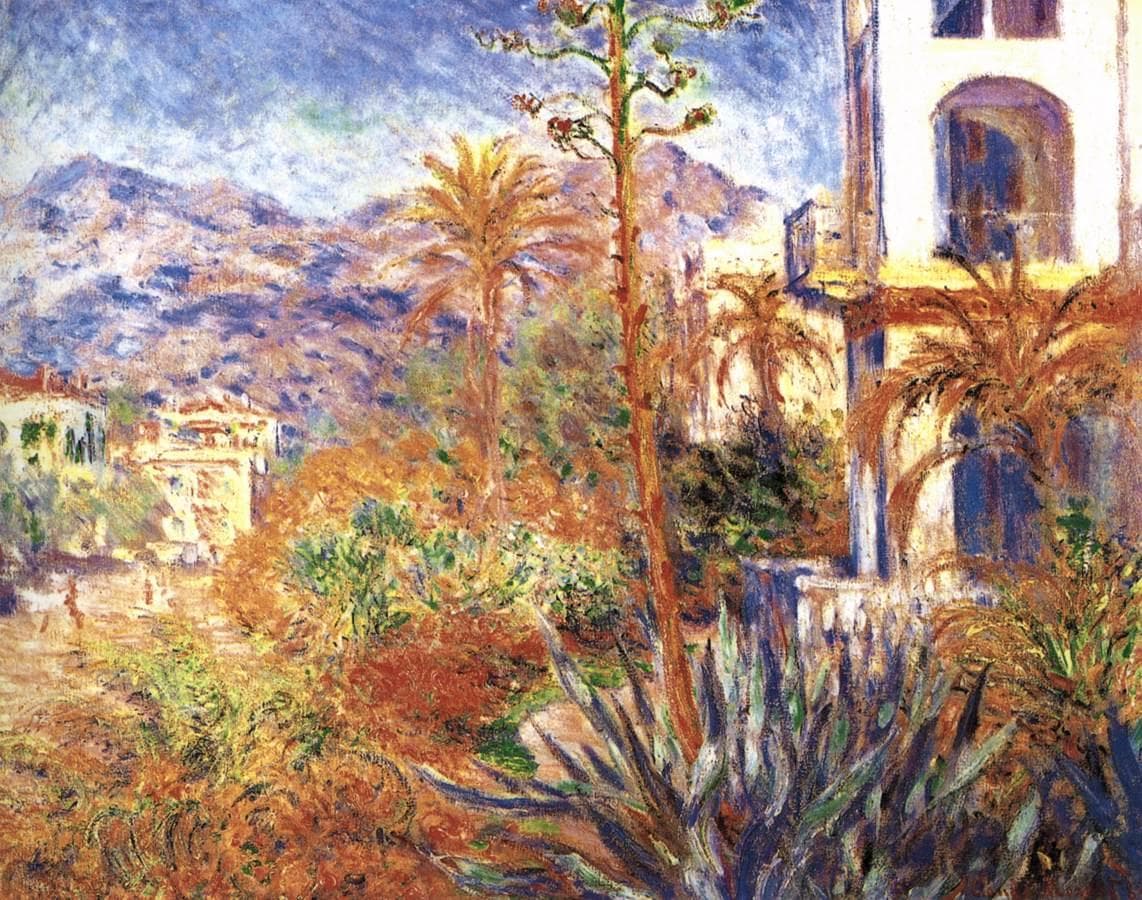
He painted two versions of this view. The Orsay's is the larger and nearly square, with the character of a decorative panel. It was worked up after his return, at Giverny, from the studies made on the spot. The other version, smaller and more horizontal, is in the Santa Barbara Museum of Art, published here as Villas in Bordighera.
How it was painted
The agave stalk is the key to the composition: a single wavering vertical that divides the canvas and leads the eye up from the dense garden to the open sky. Around it Monet weaves the plants and buildings into an allover pattern of strokes, short, curving and crossing, that fills almost every part of the surface.
The palette is warmer and brighter than in his northern pictures. Monet sets the cool blues and violets of the mountains against the warm creams and pinks of the villas and the rusts and ochres of the garden. The shadows are painted in blue and turquoise, never in brown or black. The tower is laid in with thick, chalky white, the brightest note on the canvas.
The agave is a deliberate exotic touch. These plants flower only once, after many years, sending up a single tall stalk and then dying, and a flowering agave was a sight northern visitors to the Riviera went out of their way to see. Monet uses its strange, angular silhouette almost like a Japanese motif, an asymmetrical line that breaks the expected order of a landscape.
Bordighera and the Mediterranean
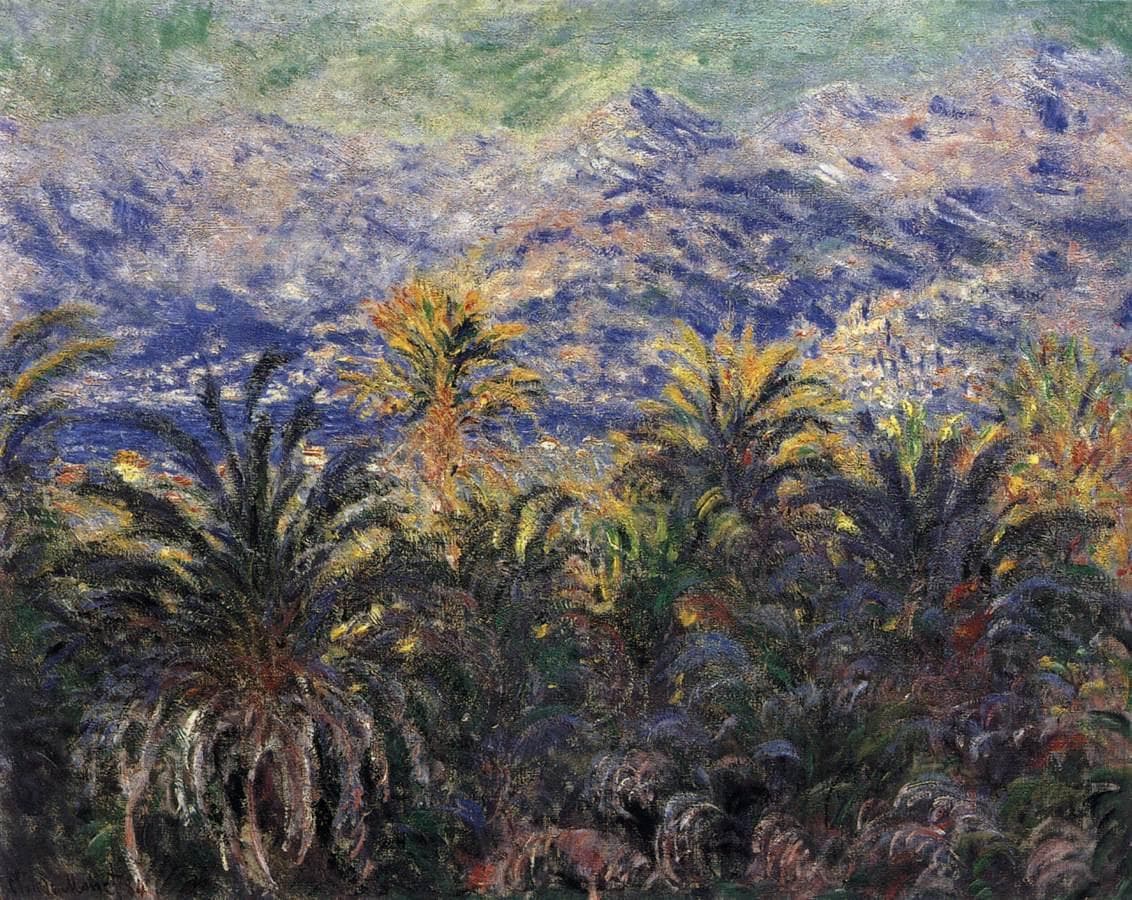
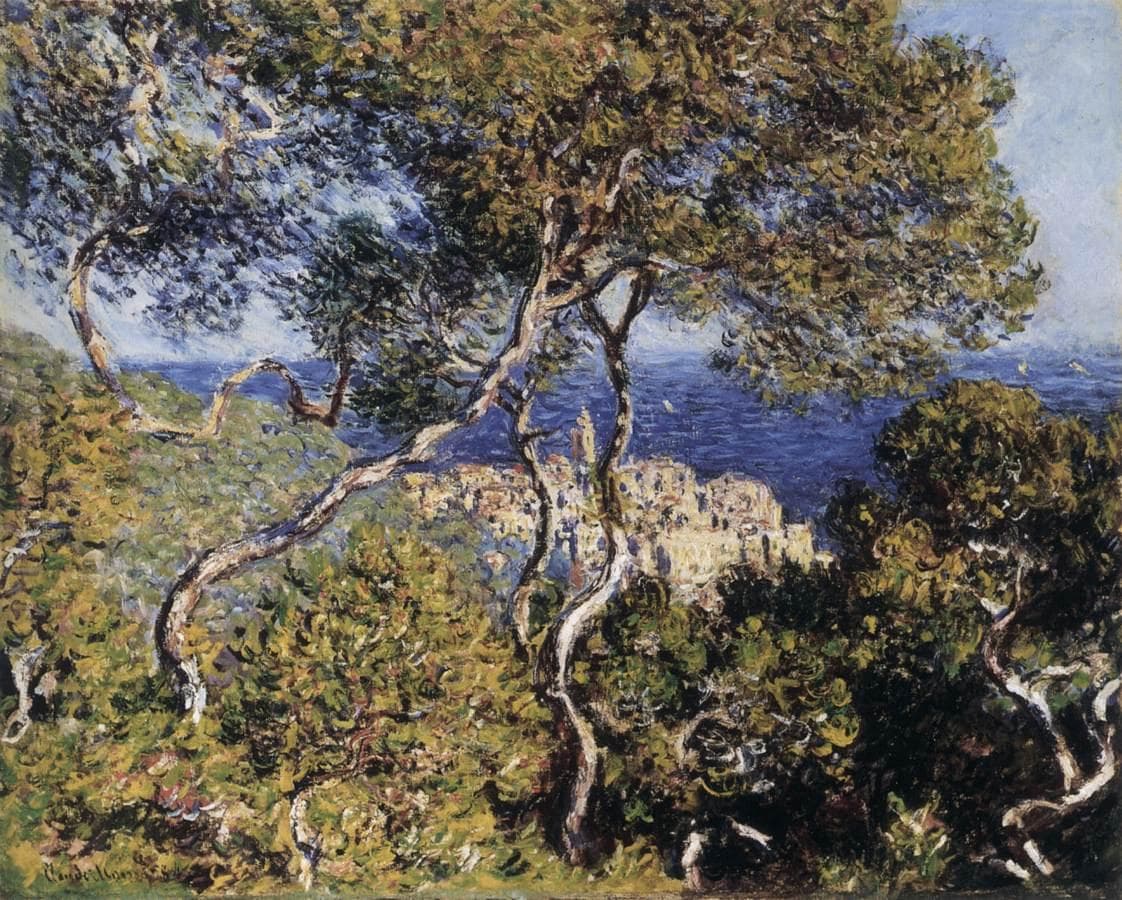
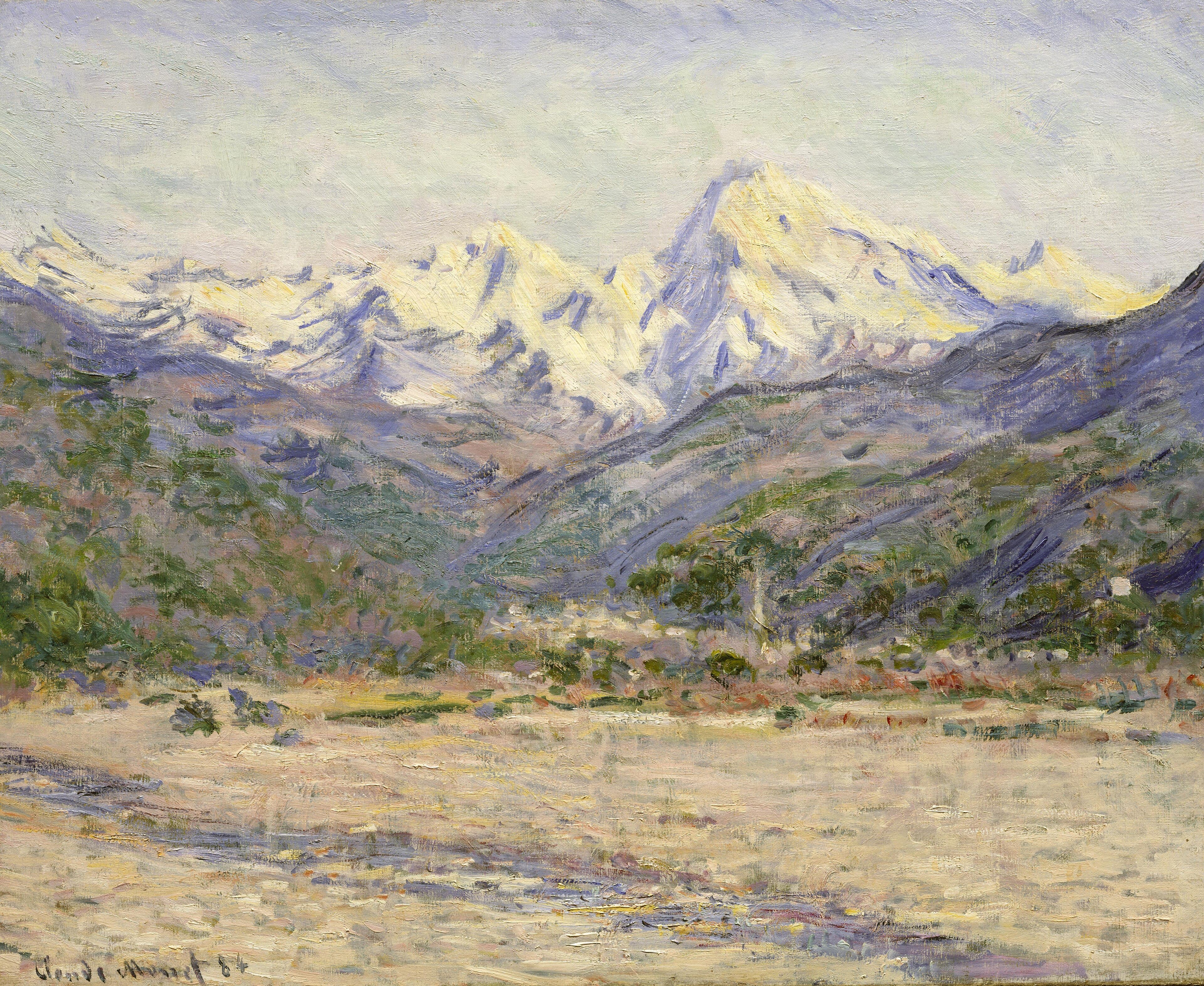
The Bordighera campaign produced about fifty canvases, including Palm Trees at Bordighera at the Met, Bordighera at the Art Institute of Chicago and The Valley of the Nervia. It was the first of Monet's journeys to the south, followed by Antibes in 1888. See Monet on the Mediterranean.
Ownership
The painting was acquired by the Musée d'Orsay in 2000 (RF 2000-94) with support from the Fonds du Patrimoine, the Meyer Foundation and an anonymous Canadian donor.
Where to see it
Villas at Bordighera is in the Musée d'Orsay in Paris. See Monet at the Musée d'Orsay for the museum's other Monets.
Questions & answers
Where is Monet's Villas at Bordighera?
This large, nearly square version is in the Musée d'Orsay in Paris, which acquired it in 2000 (RF 2000-94). A smaller version of the same view is in the Santa Barbara Museum of Art in California.
When and where was Villas at Bordighera painted?
Monet painted the view in 1884 during his stay at Bordighera on the Italian Riviera from January to April. The Orsay version was completed at Giverny after his return, working from his studies made on the spot.
What does Villas at Bordighera show?
White and pink Riviera villas among palms and a garden, with a tall flowering agave in the center and the blue mountains of Liguria behind. The tower at right belongs to the Villa Etelinda, built by Charles Garnier.
How many paintings did Monet make at Bordighera?
About fifty canvases during his three months there in 1884, including palm gardens, views of the town and sea, and the Nervia valley. He painted the villas twice.
More by the artist
Claude Monet

Bridge over a Pond of Water Lilies
Claude Monet · 1899

Woman with a Parasol – Madame Monet and Her Son
Claude Monet · 1875

Sunset in Venice
Claude Monet · 1908–12

La Grenouillère
Claude Monet · 1869

Beach in Pourville
Claude Monet · 1882

Springtime
Claude Monet · 1872

Boating on the River Epte
Claude Monet · 1890

The Seine at Asnières (Hermitage)
Claude Monet · 1873
Also painted in 1884
The same year
Kindred works
You may also study
Villas in Bordighera
Claude Monet · 1884
Palm Trees at Bordighera
Claude Monet · 1884
Bordighera
Claude Monet · 1884
The Valley of the Nervia
Claude Monet · 1884
Garden at Bordighera, Impression of Morning
Claude Monet · 1884

The Scream
Edvard Munch · 1893

Ophelia
John Everett Millais · 1851–52

The Great Wave off Kanagawa
Katsushika Hokusai · c. 1830–32