Image: Barnes Foundation, Philadelphia; via Wikimedia Commons · Public domain · via Wikimedia Commons
Impressionism
The Studio Boat (Le Bateau-atelier)
Claude Monet, 1876
The Studio Boat is an 1876 painting by Claude Monet of himself at work in his floating studio on a quiet backwater of the Seine near Argenteuil. It is in the Barnes Foundation, Philadelphia.
- Artist
- Claude Monet
- Date
- 1876
- Medium
- Oil on canvas
- Dimensions
- 72.7 × 60 cm
- Collection
- Barnes Foundation, Philadelphia, United States
- Movement
- Impressionism
- Catalogue
- Wildenstein 390
Painted at Monet at Argenteuil
What you are looking at
A small boat with a white-painted wooden cabin floats head-on toward us down a narrow, still channel. Through the open rear of the cabin we see a man in a black hat and dark jacket, bent forward over something in his lap: a painter at work. A green-blue curtain is half drawn across the cabin's opening, and a little square window is cut into each side wall. A boat hook or mooring pole sticks out from the stern.
On both sides, dense trees and bushes crowd the banks, painted in tangled, curling strokes of green, gray and ochre. The water fills the lower half of the canvas, and in it the boat appears again upside down, its white cabin breaking into wavering vertical bars of white and blue. A pale violet sky opens at the top between the trees. The signature is at lower right.
Where and when it was painted
In 1873, soon after moving to Argenteuil, Monet bought a boat and had a plank cabin built on it, "just enough room to set up my easel," as he later described it. The idea came from Charles-François Daubigny, the Barbizon landscapist, who had worked for years from his own studio boat, the Botin. From the water Monet could paint the river at its own level, follow the light up and down the Seine, and reach views no one on the bank could see. Édouard Manet painted him at work on board with Camille in the summer of 1874.
This canvas dates from 1876, near the end of the Argenteuil years. Unlike the busy regattas and bridges of 1872–74, it shows a quiet, enclosed channel with no sign of the town's factories or railway. Art historians have read it as part of Monet's turn, in the later 1870s, away from the modern suburb toward a more private, contemplative nature.
How it was painted
The composition is unusual for Monet: tall, nearly square, with the boat placed dead center and the channel running straight back into the picture like a corridor. The banks press in from both sides. The brushwork on the trees is loose and swirling, closer to drawing than to description, while the reflections below are laid in with long vertical strokes that echo the cabin's walls.
The painter in the cabin is a detail many viewers miss. Monet did not, of course, paint this picture while sitting in the boat he is painting, so the figure is an invention or a reconstruction: a picture of the artist at work, placed inside the tool that made his river paintings possible. Some scholars see the canvas as a statement about the creative role of the painter, and a forerunner of the quiet, enclosed river views of the Mornings on the Seine series twenty years later.
The color is restrained for a summer picture. The greens are grayed and mixed with ochre and violet, and the sky is a pale mauve rather than blue, which suggests late afternoon or a hazy day. The cabin is the brightest thing on the canvas, and Monet uses its white to pull the eye to the center, then lets the reflection carry it down to the bottom edge. The picture is about stillness: no wind ripples the water, and the only movement is the slow drift of the boat toward us.
Other studio-boat pictures
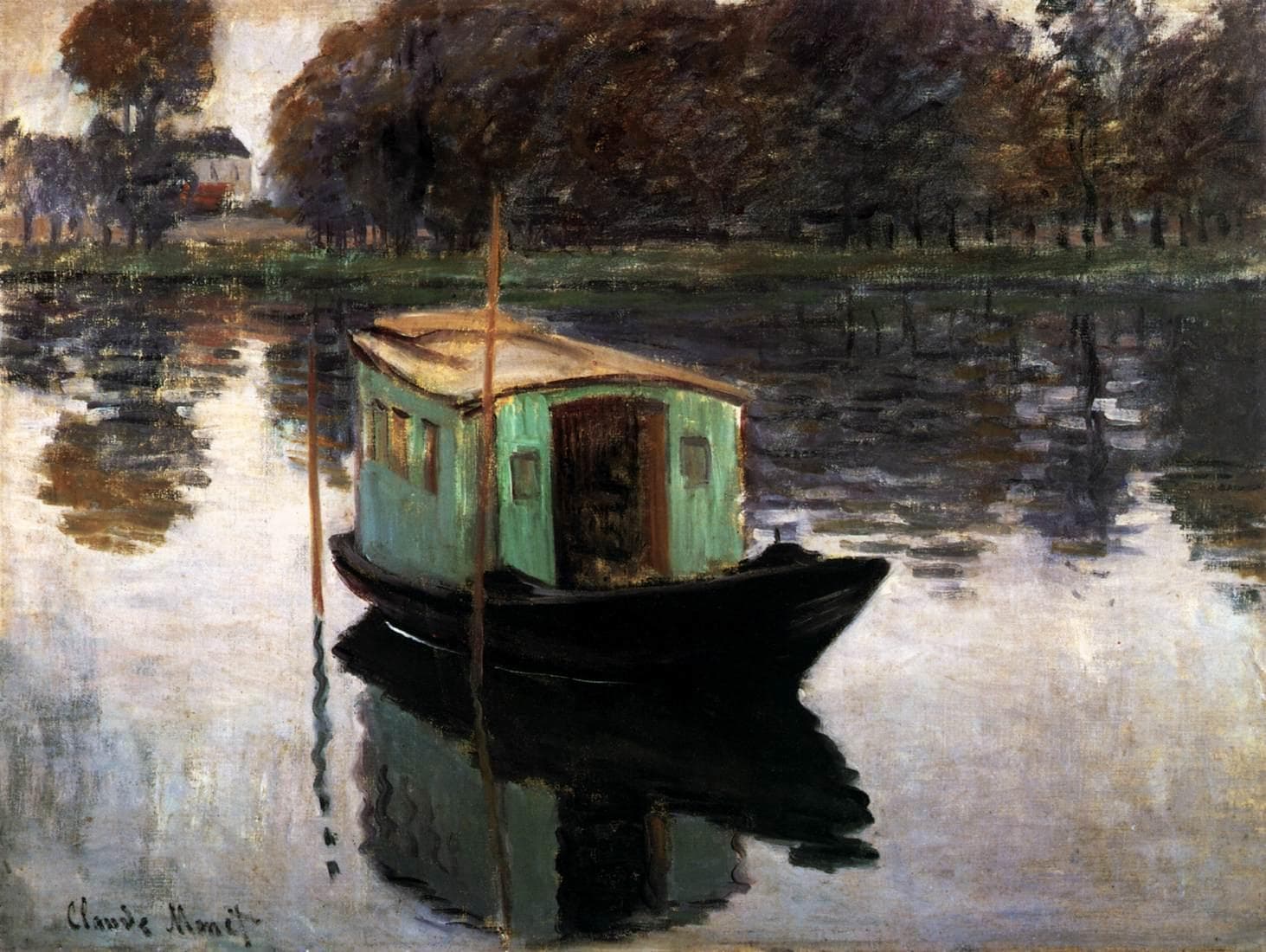
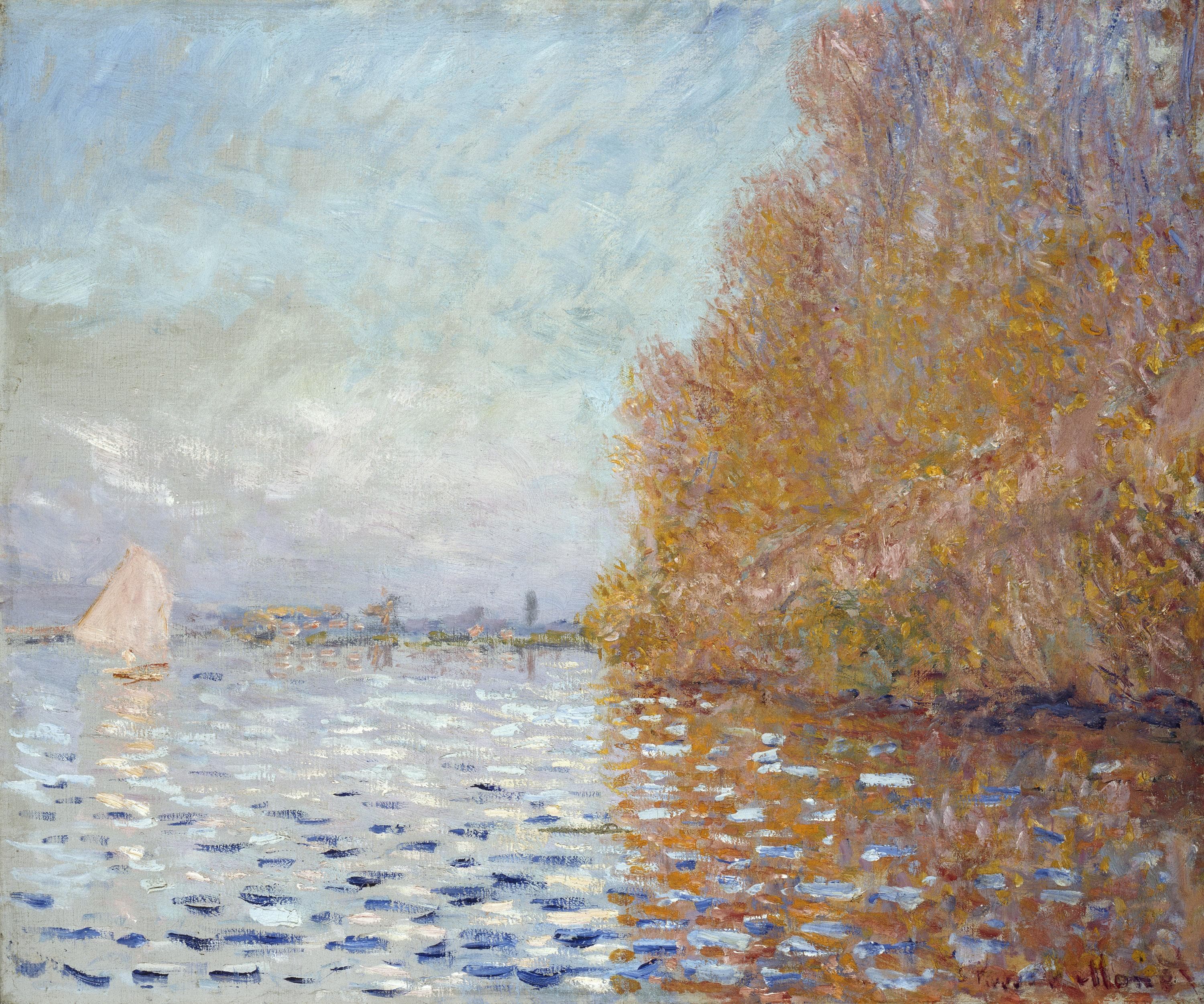
Monet painted the boat several times. The 1874 The Studio Boat in the Kröller-Müller Museum shows it moored alone on open water at dusk; another version is in Neuchâtel. Boats moored along the Argenteuil banks appear throughout this period, as in Argenteuil Basin with a Single Sailboat. He kept a boat at Giverny too, which reappears in The Boat at Giverny.
Where to see it
The Studio Boat is in the Barnes Foundation in Philadelphia (BF730), hung according to Albert C. Barnes's own arrangement. Because of the terms of Barnes's bequest it does not travel. For other collections, see where to see Monet's paintings.
Questions & answers
Where is Monet's The Studio Boat (Le Bateau-atelier)?
This 1876 version is in the Barnes Foundation in Philadelphia, inventory BF730. An earlier studio-boat picture of 1874 is in the Kröller-Müller Museum in Otterlo, and another version is in Neuchâtel, Switzerland.
When and where was The Studio Boat painted?
Monet painted it in 1876 on the Seine near Argenteuil, the town west of Paris where he lived from 1871 to 1878. He had bought the boat around 1873 and fitted it with a wooden cabin.
Who is the man in the studio boat?
It is Monet himself, shown bent over his work in the cabin. Since he could not paint the boat while sitting in it, the figure is a deliberate image of the artist at work rather than something observed.
Why did Monet have a studio boat?
Following Charles-François Daubigny's example, he wanted to paint the river from the water. The floating studio let him moor midstream, follow changing light and paint views and reflections from a low viewpoint close to the surface.
More by the artist
Claude Monet

Bridge over a Pond of Water Lilies
Claude Monet · 1899

Woman with a Parasol – Madame Monet and Her Son
Claude Monet · 1875

Sunset in Venice
Claude Monet · 1908–12

La Grenouillère
Claude Monet · 1869

Beach in Pourville
Claude Monet · 1882

Springtime
Claude Monet · 1872

Boating on the River Epte
Claude Monet · 1890

The Seine at Asnières (Hermitage)
Claude Monet · 1873
Also painted in 1876
The same year
Kindred works
You may also study
The Studio Boat
Claude Monet · 1874
Argenteuil Basin with a Single Sailboat
Claude Monet · 1874
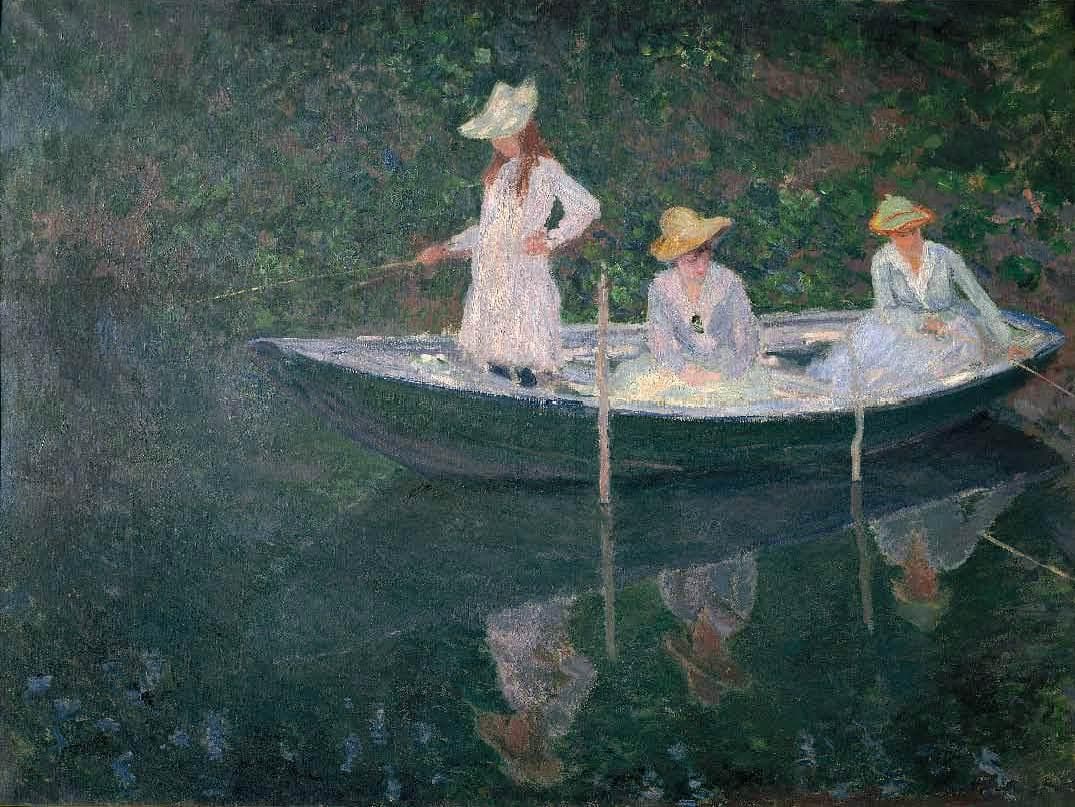
The Boat at Giverny
Claude Monet · c. 1887
The Basin at Argenteuil
Claude Monet · 1872
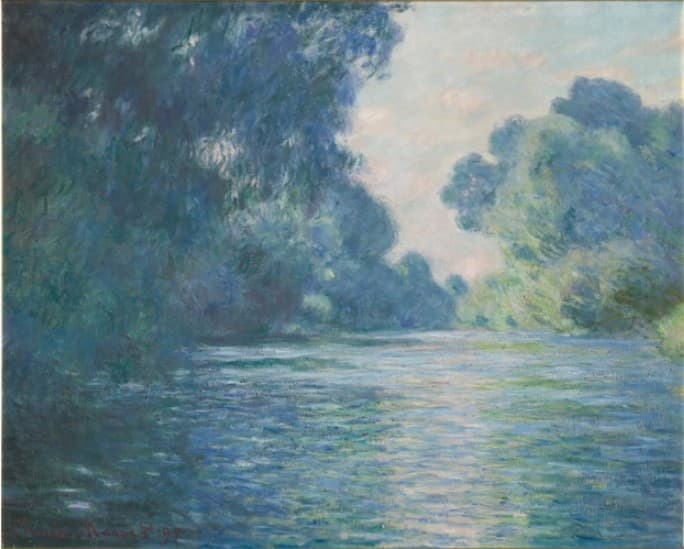
Arm of the Seine near Giverny
Claude Monet · 1897

The Scream
Edvard Munch · 1893

Ophelia
John Everett Millais · 1851–52

The Great Wave off Kanagawa
Katsushika Hokusai · c. 1830–32