Image: The Metropolitan Museum of Art, New York (Open Access) · Public domain · via Wikimedia Commons
Early Impressionism
The Green Wave
Claude Monet, c. 1866–67
The Green Wave (La Vague verte) is a small seascape by Claude Monet, painted about 1866–67, of a fishing boat heeling over in a dark green swell. It is in the Metropolitan Museum of Art, New York.
- Artist
- Claude Monet
- Date
- c. 1866–67
- Medium
- Oil on canvas
- Dimensions
- 48.6 × 64.8 cm
- Collection
- Metropolitan Museum of Art, New York, United States
- Movement
- Early Impressionism
- Catalogue
- Wildenstein 73
Painted at Étretat and the Normandy CoastMore at Monet at the Met
What you are looking at
A fishing boat with a grey-brown sail heels hard to the left as it climbs a wave. Its dark hull cuts a curl of white spray, a figure crouches near the bow, and a sheet of rope runs taut from the masthead. Behind it a second boat leans the other way, and on the horizon at the upper left a tall-masted ship is a pale silhouette against a heavy, low sky. Everything else is water: a deep bottle-green sea, streaked with black and flecked with white, that takes up about four-fifths of the canvas.
The horizon is not straight. It rises and dips with the swell, so we feel we are in a small boat ourselves, looking across moving water. The near boat is cut by the top of the sail and pushed off-center to the left, as though Monet had caught it in passing.
Look closely at the foam. The white is pure, thick and laid on with a palette knife in a few quick passes, and the darker troughs of the waves are made by dragging black into the green while it was still wet. The sail carries a registration letter, an H, painted in two strokes.
Where and when it was painted
The canvas is signed and dated 1865 at lower right, but the date is not reliable. Monet often signed and dated pictures years later, and the style and a contemporary account place it in 1866 or 1867. The critic Zacharie Astruc remembered seeing Monet paint seascapes with a palette knife in 1866, and this is one of only a few pictures Monet made that way.
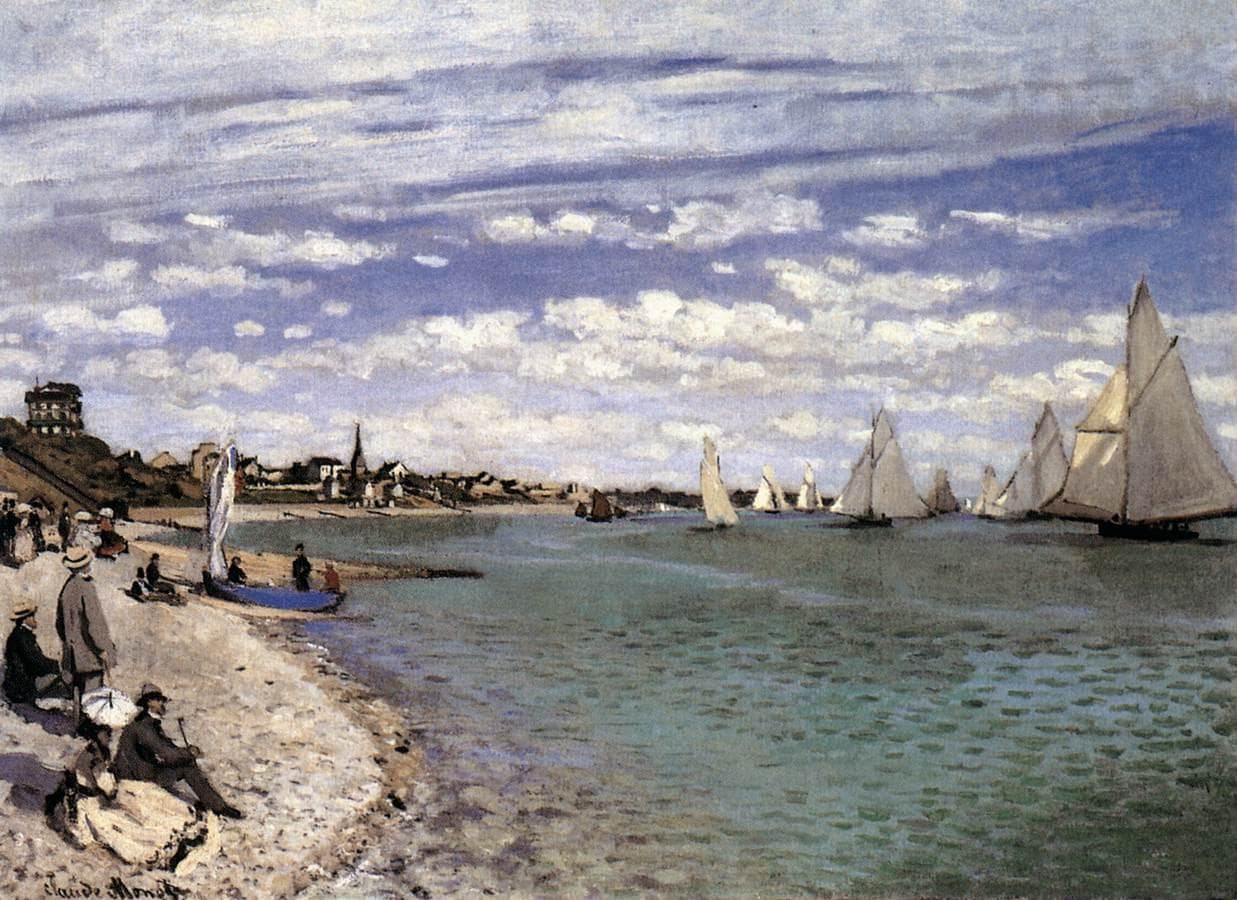
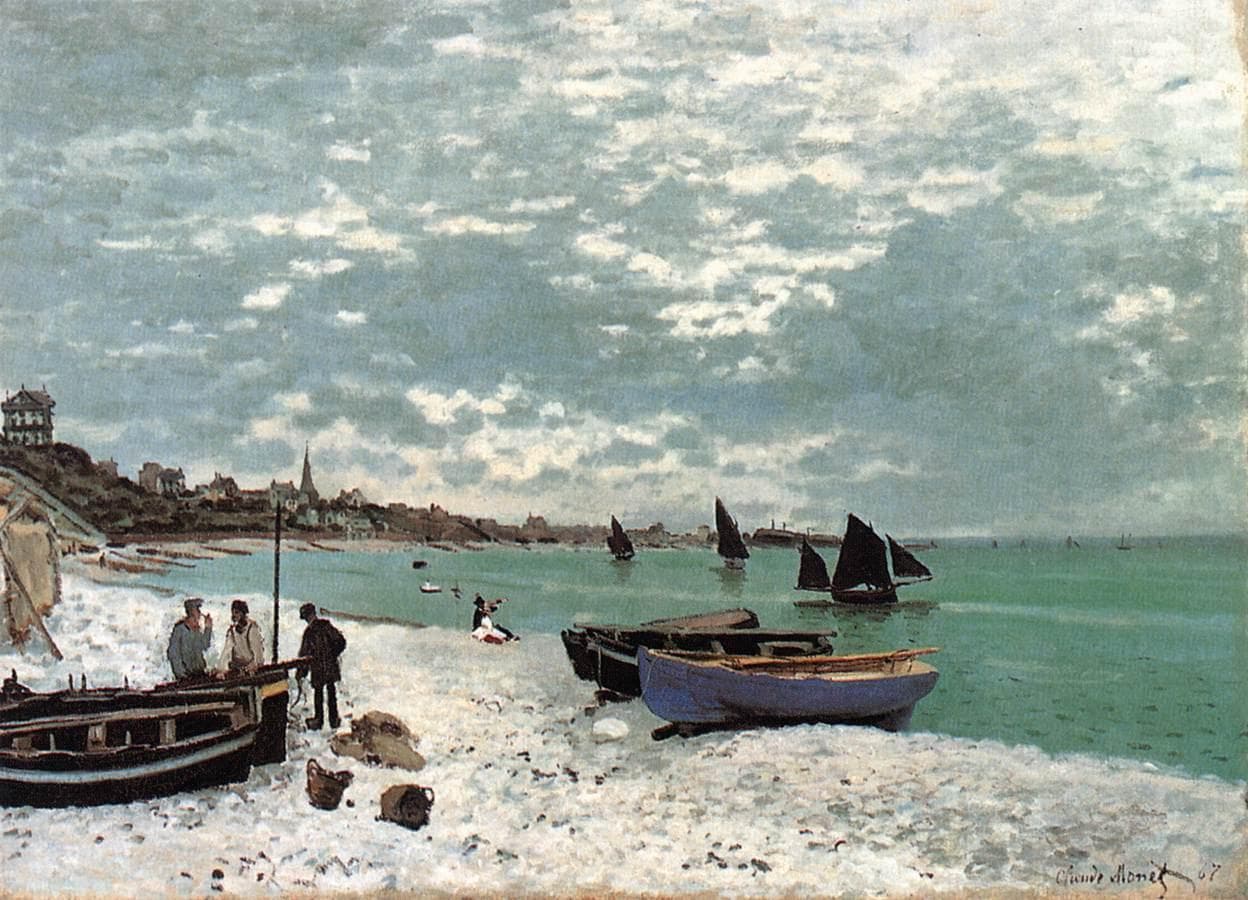
He had grown up in Le Havre and spent the summers of the mid-1860s on the Normandy coast at Sainte-Adresse and Honfleur. In 1867, while staying with his family at Sainte-Adresse, he painted the bright, crowded Regatta at Sainte-Adresse and The Beach at Sainte-Adresse. The Green Wave belongs to the same coast but is their opposite: no holiday crowd, only weather and work. For the coast he painted all his life, see Étretat and the Normandy coast.
How it was painted
The picture owes a clear debt to Édouard Manet, whose sea paintings of 1864, with their dark water, high horizons and sharply cut boats, Monet knew well. Manet in turn had looked at Japanese prints, and the sweeping curve of the wave and the abrupt cropping have reminded many viewers of Hokusai and Hiroshige.
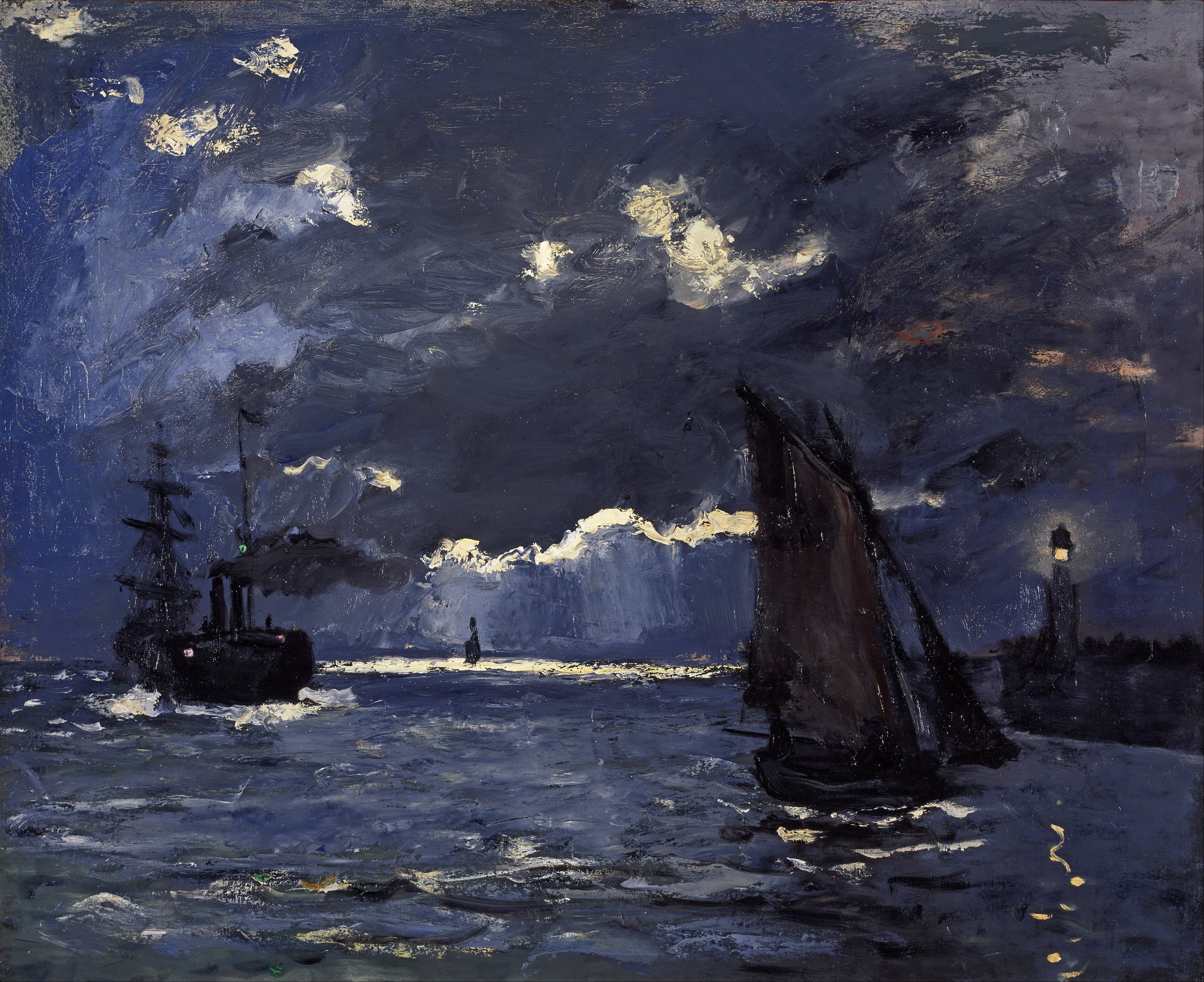
What is Monet's own is the material energy. Instead of building up the sea in glazes, he worked wet into wet with knife and brush, letting the white sit raw on top. The sky is just as summary: a band of grey cloud scraped over a lighter ground. At 48.6 by 64.8 centimeters the canvas is small, and it reads less as a finished marine than as a record of a few minutes of rough water. Compare the calm night of A Seascape, Shipping by Moonlight from a year or two earlier.
What it meant for Monet
In the mid-1860s Monet was trying to make his name at the Salon with large, carefully finished canvases, and seascapes were a safe genre with a long Dutch and French tradition behind them. The Green Wave shows him pushing that genre somewhere less comfortable. There is no anecdote and no picturesque harbor, and the finish is rough by Salon standards. Its subject is the sea as a physical force, and the knife work makes the paint itself behave like water. The same interest in surface and motion runs through his later storms at Étretat and Belle-Île, such as Storm off Belle-Île.
Ownership and where to see it
The painting was lent to the fourth Impressionist exhibition in Paris in 1879, listed simply as a marine. It later entered the collection of Louisine and Henry O. Havemeyer in New York and came to the Metropolitan Museum with Louisine Havemeyer's bequest in 1929 (accession 29.100.111), part of the H. O. Havemeyer Collection that gives the Met one of its strongest groups of French nineteenth-century painting. See Monet at the Met and the Claude Monet page.
Questions & answers
Where is Monet's The Green Wave?
The Green Wave is in the Metropolitan Museum of Art in New York (accession 29.100.111). It came to the museum in 1929 with the bequest of Louisine Havemeyer, as part of the H. O. Havemeyer Collection. The canvas measures 48.6 by 64.8 centimeters.
When was The Green Wave painted?
It is signed and dated 1865, but the date is thought to have been added later. The style and a contemporary account by Zacharie Astruc of Monet painting seascapes with a palette knife suggest 1866–67, when he was working on the Normandy coast.
What does The Green Wave show?
A small fishing boat heels over as it climbs a dark green wave, throwing up white spray, with a second boat and a distant tall ship behind. The sea fills most of the canvas and the horizon rises and falls with the swell.
Who influenced Monet's The Green Wave?
The dark sea, high horizon and sharply cropped boat show the influence of Édouard Manet's seascapes of 1864. The curling wave and abrupt framing have also been compared with Japanese woodblock prints by Hokusai and Hiroshige.
More by the artist
Claude Monet

Bridge over a Pond of Water Lilies
Claude Monet · 1899

Woman with a Parasol – Madame Monet and Her Son
Claude Monet · 1875

Sunset in Venice
Claude Monet · 1908–12

La Grenouillère
Claude Monet · 1869

Beach in Pourville
Claude Monet · 1882

Springtime
Claude Monet · 1872

Boating on the River Epte
Claude Monet · 1890

The Seine at Asnières (Hermitage)
Claude Monet · 1873
Also painted in 1866
The same year
Kindred works
You may also study
Regatta at Sainte-Adresse
Claude Monet · 1867
The Beach at Sainte-Adresse
Claude Monet · 1867
A Seascape, Shipping by Moonlight
Claude Monet · c. 1864
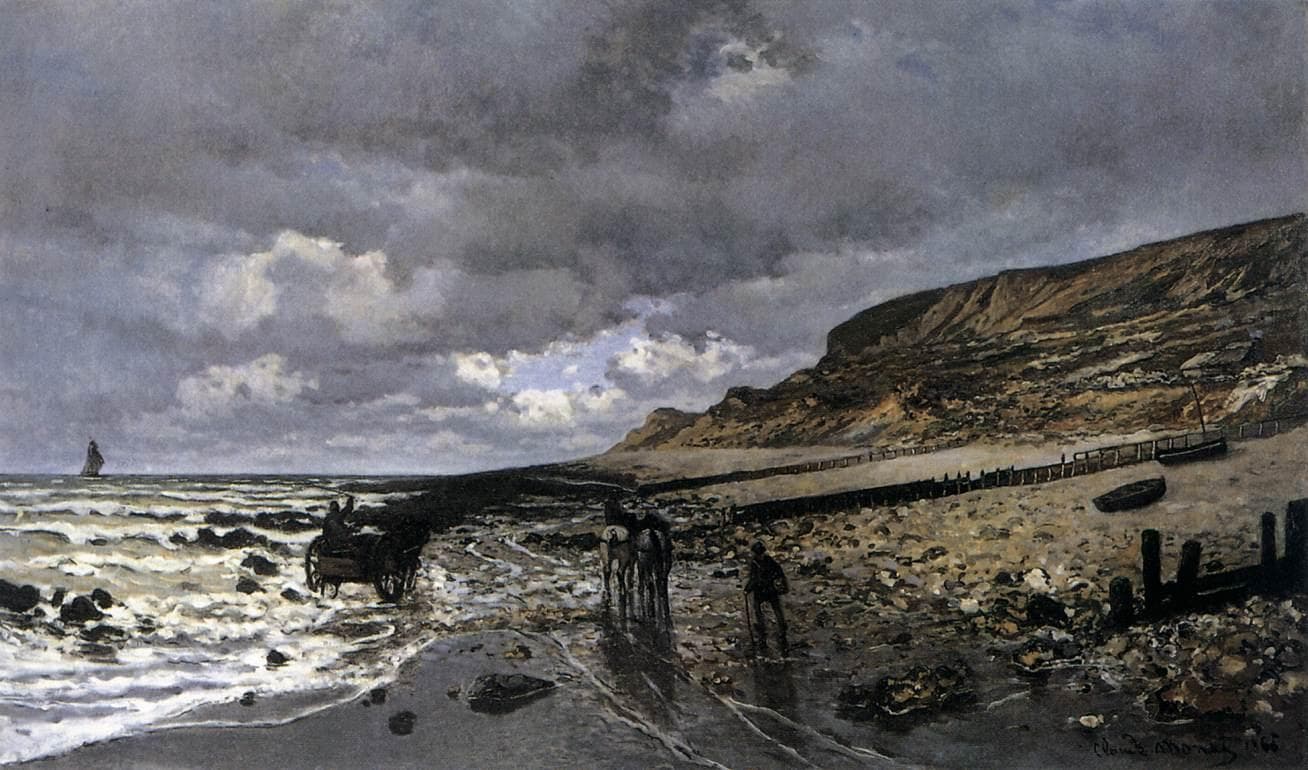
La Pointe de la Hève at Low Tide
Claude Monet · 1865
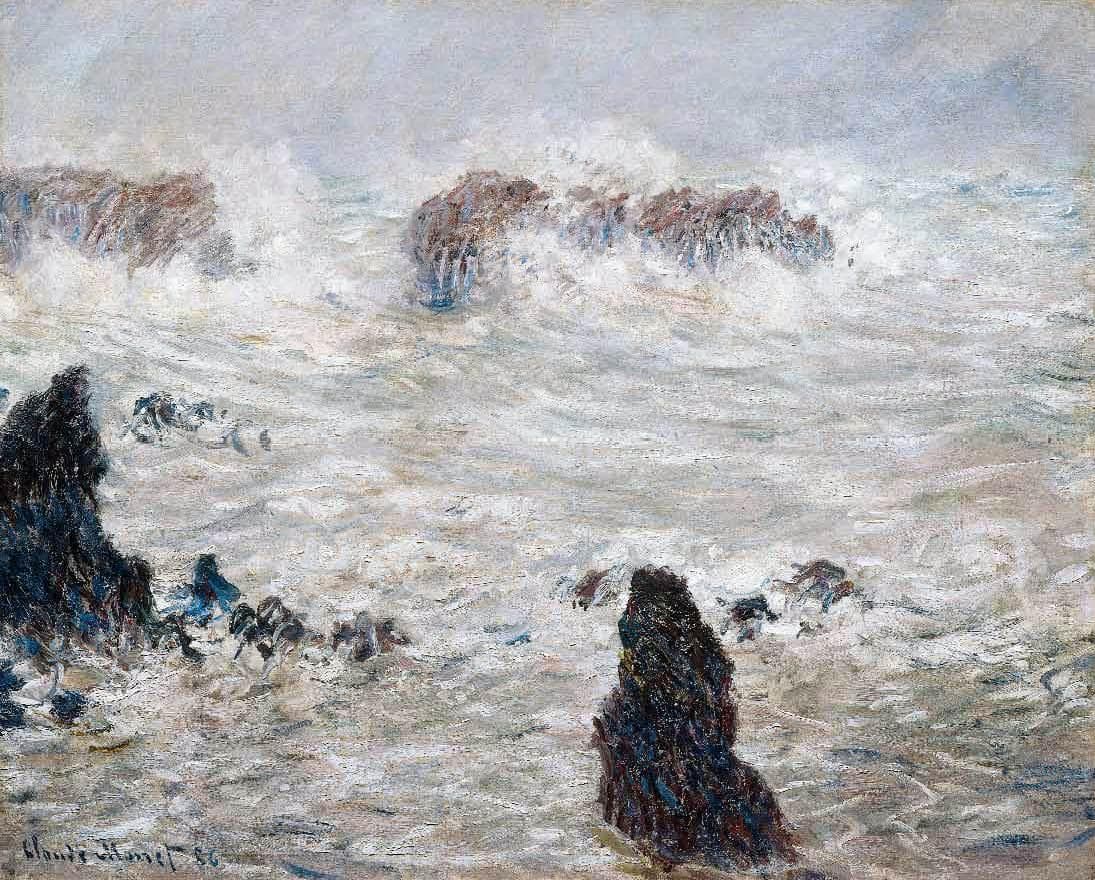
Storm off Belle-Île
Claude Monet · 1886

Ophelia
John Everett Millais · 1851–52

The Great Wave off Kanagawa
Katsushika Hokusai · c. 1830–32
The Birth of Venus
Sandro Botticelli · c. 1484–1486