Impressionism
Stack of Wheat, Snow Effect, Overcast Day
Claude Monet, 1890–91
Stack of Wheat (Snow Effect, Overcast Day) is a winter canvas from Claude Monet's 1890–91 wheat stacks series, painted at Giverny: a rust-red stack in snow under a grey sky. The 66 × 93 cm canvas (Wildenstein 1281) is in the Art Institute of Chicago.
- Artist
- Claude Monet
- Date
- 1890–91
- Medium
- Oil on canvas
- Dimensions
- 66 × 93 cm
- Collection
- Art Institute of Chicago, Chicago, United States
- Movement
- Impressionism
- Catalogue
- Wildenstein 1281
What you are looking at
A single wheat stack, pushed to the left of center, rises from a snowy field. Unlike most of Monet's winter stacks, this one carries almost no snow on its cap: it reads as one solid mass of rust, orange and brown, the warmest color in a cold picture. Behind it the hillside above Giverny is a band of deep blue and white, the snow on its slopes broken by dark trees, with the snow-covered roofs of a few farmhouses at the right. The sky is overcast, but look near the top just left of center and you will find a pale disc, the sun showing faintly through the cloud.
Monet paints the shadow side of the stack in deep red-brown and lets it fall onto the snow as a strip of olive and ocher at the base, where the ground has thawed or the stubble shows through. At far left a few more patches of brown stubble break the snow. The snow in the foreground is made of horizontal, dragged strokes of white over lilac and blue, rougher and thicker than the smooth paint of the sky. The trees on the far slope are only vertical touches of blue, but they give the hill its scale. The signature and the date, "Claude Monet 91," are written in red at the lower right.
The stack's top is slightly lopsided, a small knob at the peak where the thatch was tied off. Monet records it faithfully; these were real farm structures, not idealized cones.
Giverny, winter 1890–91
The stacks stood in the field beside Monet's house at Giverny. He began painting them in late summer 1890 and continued into the winter, working on several canvases at once and moving between them as the weather turned. The title of this work names a precise condition, snow on the ground and a covered sky, and that precision is the point of the whole series: the motif stays the same while light and atmosphere change.
How it was painted
The canvas measures 66 by 93 centimeters. The colors are organized as two opposing blocks: the warm stack against the cool blue band of the hill. Everything else is a mediator between them. The sky is brushed thinly and smoothly, the snow thickly and roughly, so that texture as well as color separates near from far. The sun disc is the subtlest touch in the picture: a slightly paler, warmer smudge in the grey, with no outline at all. Many visitors walk past without seeing it, yet it explains the whole effect, the faint warmth in a cold, flat light.
The series
The series is gathered in our Haystacks hub. Fifteen of the stacks were exhibited at the Galerie Durand-Ruel in Paris in May 1891 to great acclaim. This canvas was sold to Durand-Ruel on 9 May 1891 under the title Les Meules, effet de neige, temps couvert, and the Chicago collector Martin A. Ryerson bought it from the dealer's New York branch in 1893.
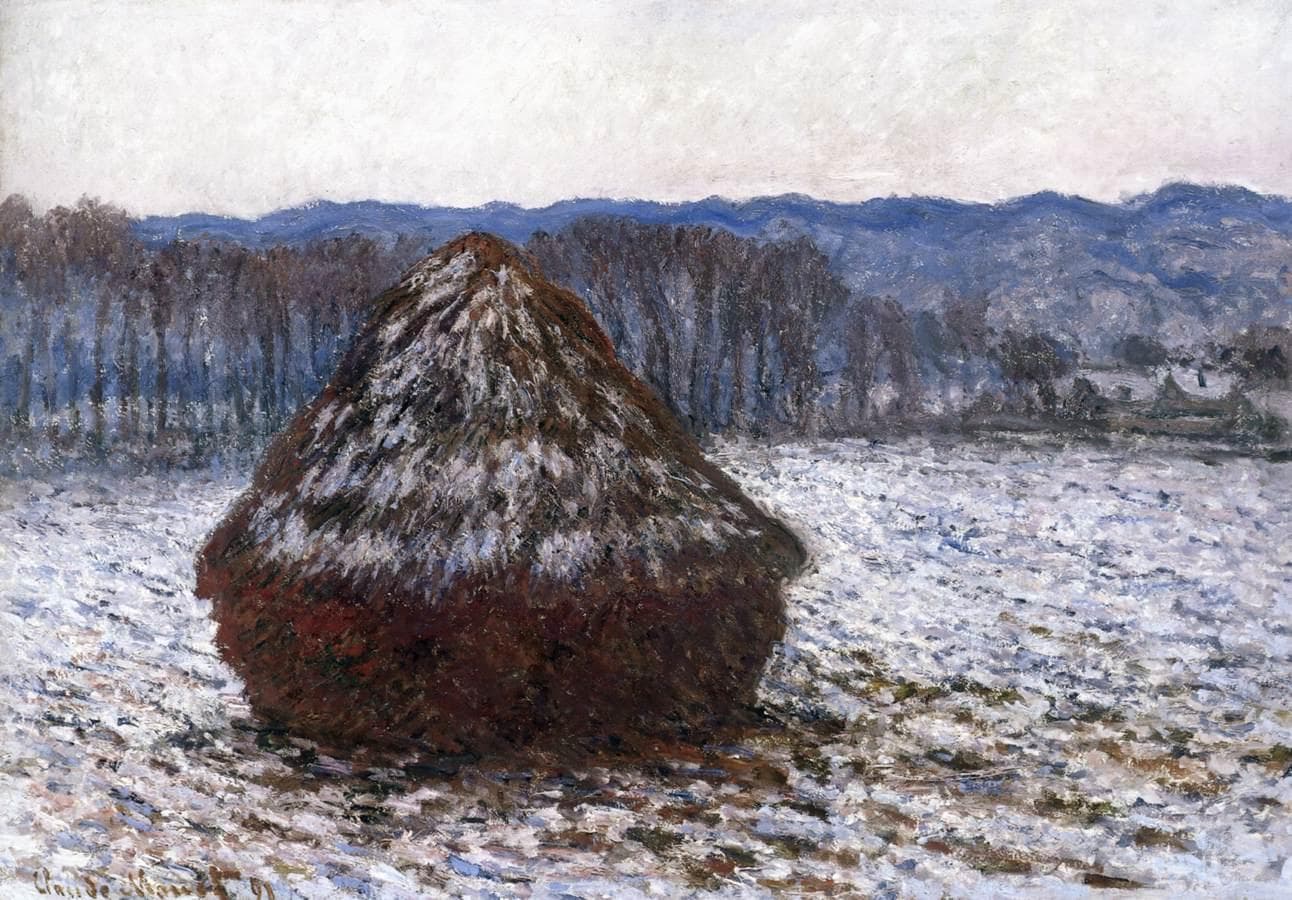
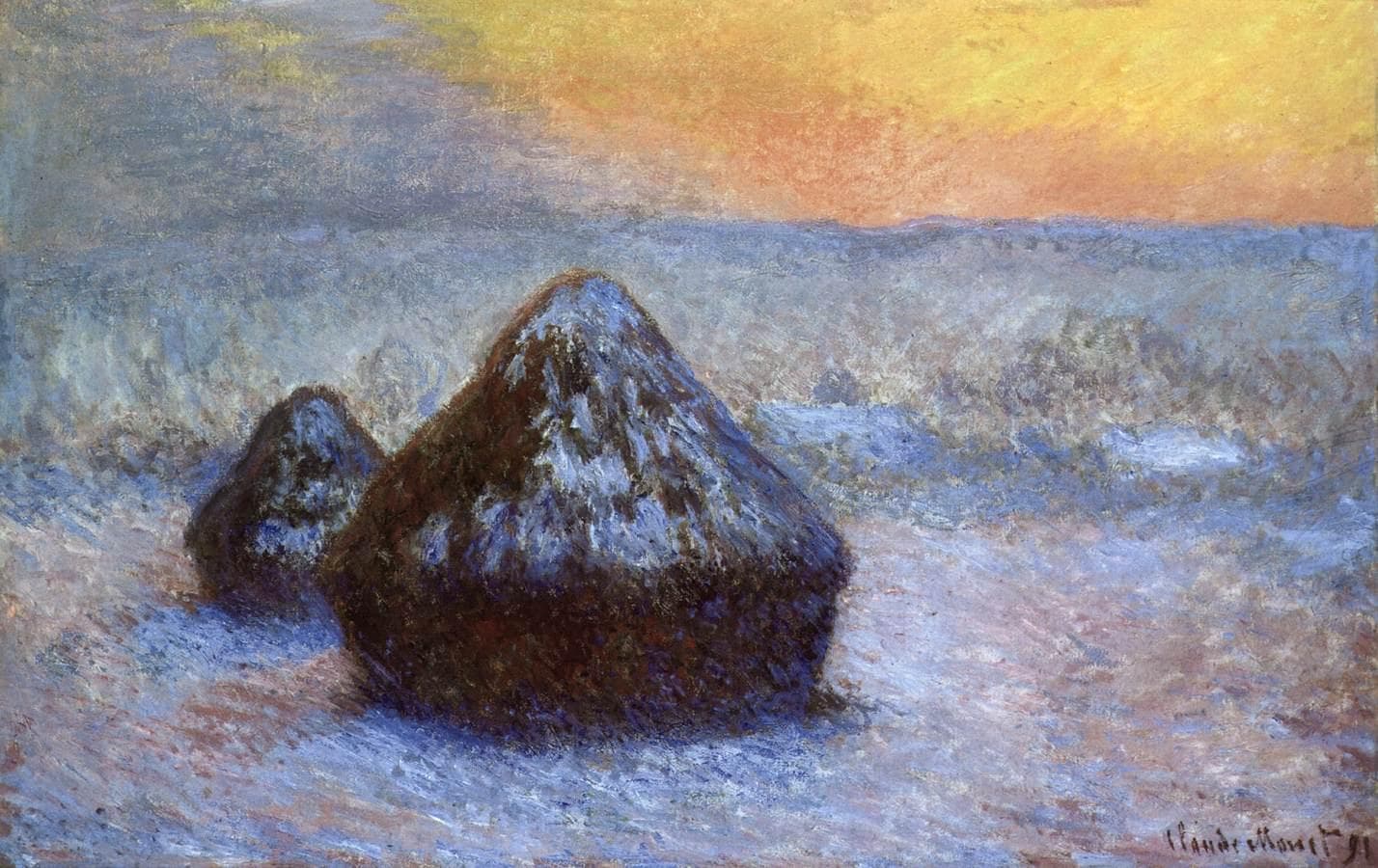
The Art Institute holds several canvases from the series, so this grey-day view can be compared with the frosty light of Stack of Wheat and the burning sky of Stacks of Wheat, Sunset, Snow Effect. Other winter stacks are in Boston, Haystack in the Snow, Morning, and Edinburgh, Haystack, Effect of White Frost.
Meaning
Claude Monet wanted to show that even a dull winter day has its own color. Under cloud, the snow turns blue, the hill deepens to indigo, and the stack glows as if it held its own heat. It is a study of soft, diffused light rather than bright frost or sunset.
Where to see it
The painting has belonged to the Art Institute of Chicago since 1933, when it arrived with the bequest of Martin A. Ryerson, and it usually hangs with the other stacks; see our guide to Monet at the Art Institute of Chicago.
Questions & answers
Where is Stack of Wheat, Snow Effect, Overcast Day?
It is in the Art Institute of Chicago, part of the Mr. and Mrs. Martin A. Ryerson Collection that entered the museum in 1933. The canvas (Wildenstein 1281) measures 66 by 93 centimeters and usually hangs with other Monet wheat stacks in the museum's Impressionist galleries.
When did Monet paint Stack of Wheat, Snow Effect, Overcast Day?
Monet painted it in the winter of 1890–91 in the field beside his home at Giverny, Normandy. The canvas is signed and dated '91 at lower right, and Monet sold it to his dealer Durand-Ruel in May 1891, the month the series was exhibited in Paris.
What is special about this haystack painting?
Monet keeps the stack almost free of snow, so its solid rust-red mass contrasts sharply with the blue and white landscape. A faint sun disc shows through the overcast sky. It is a study of soft, cloudy winter light rather than bright frost or sunset.
How many wheat stack paintings are in Chicago?
The Art Institute of Chicago holds one of the largest groups of Monet's wheat stacks anywhere, including this overcast winter view, Stack of Wheat and Stacks of Wheat, Sunset, Snow Effect, along with autumn and summer canvases. Many came from Chicago collectors such as the Palmers and the Ryersons.
More by the artist
Claude Monet

Bridge over a Pond of Water Lilies
Claude Monet · 1899

Woman with a Parasol – Madame Monet and Her Son
Claude Monet · 1875

Sunset in Venice
Claude Monet · 1908–12

La Grenouillère
Claude Monet · 1869

Beach in Pourville
Claude Monet · 1882

Springtime
Claude Monet · 1872

Boating on the River Epte
Claude Monet · 1890

The Seine at Asnières (Hermitage)
Claude Monet · 1873
Also painted in 1890
The same year
Kindred works
You may also study
Stack of Wheat
Claude Monet · 1890–91
Stacks of Wheat, Sunset, Snow Effect
Claude Monet · 1890–91
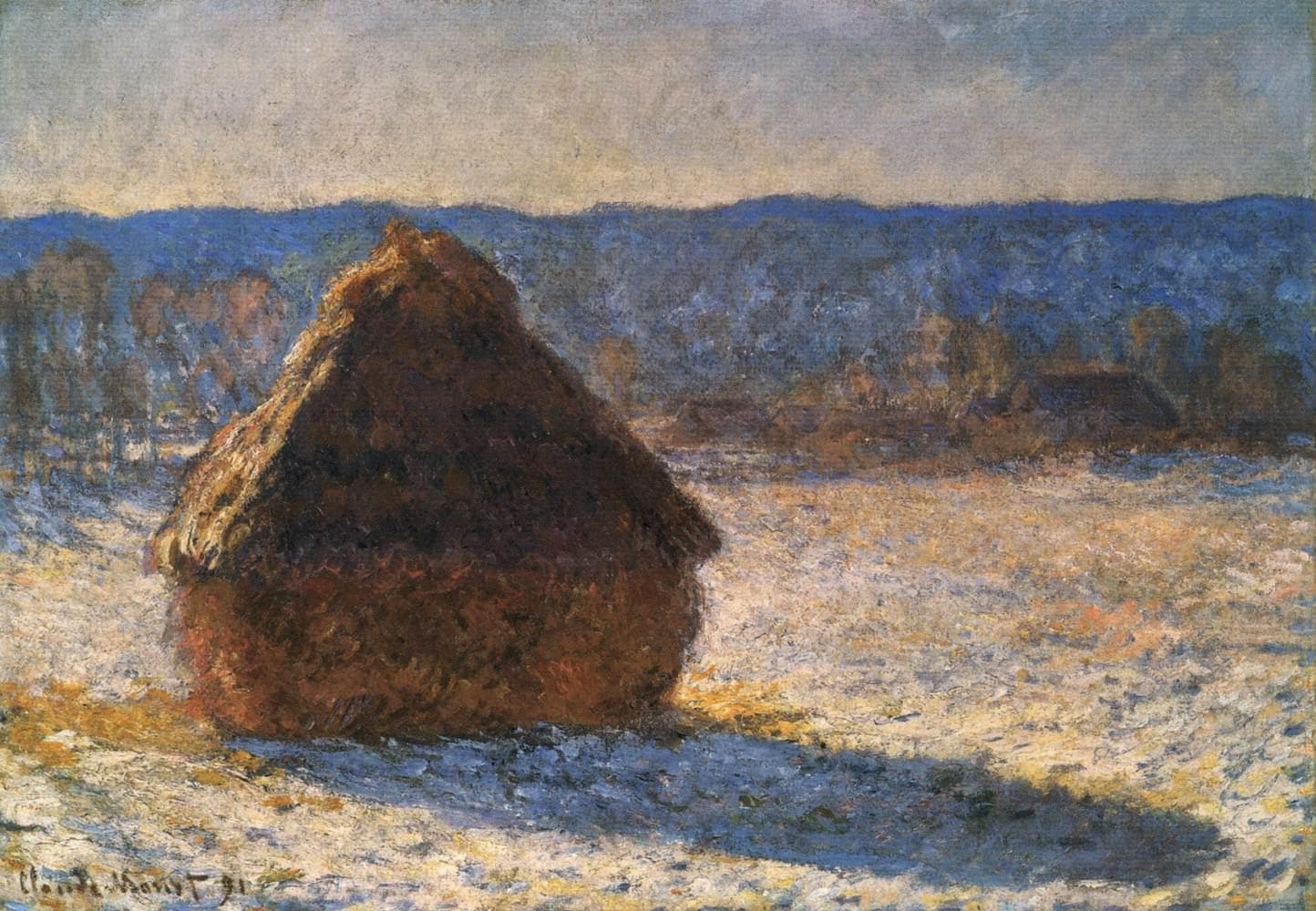
Grainstack (Snow Effect)
Claude Monet · 1891
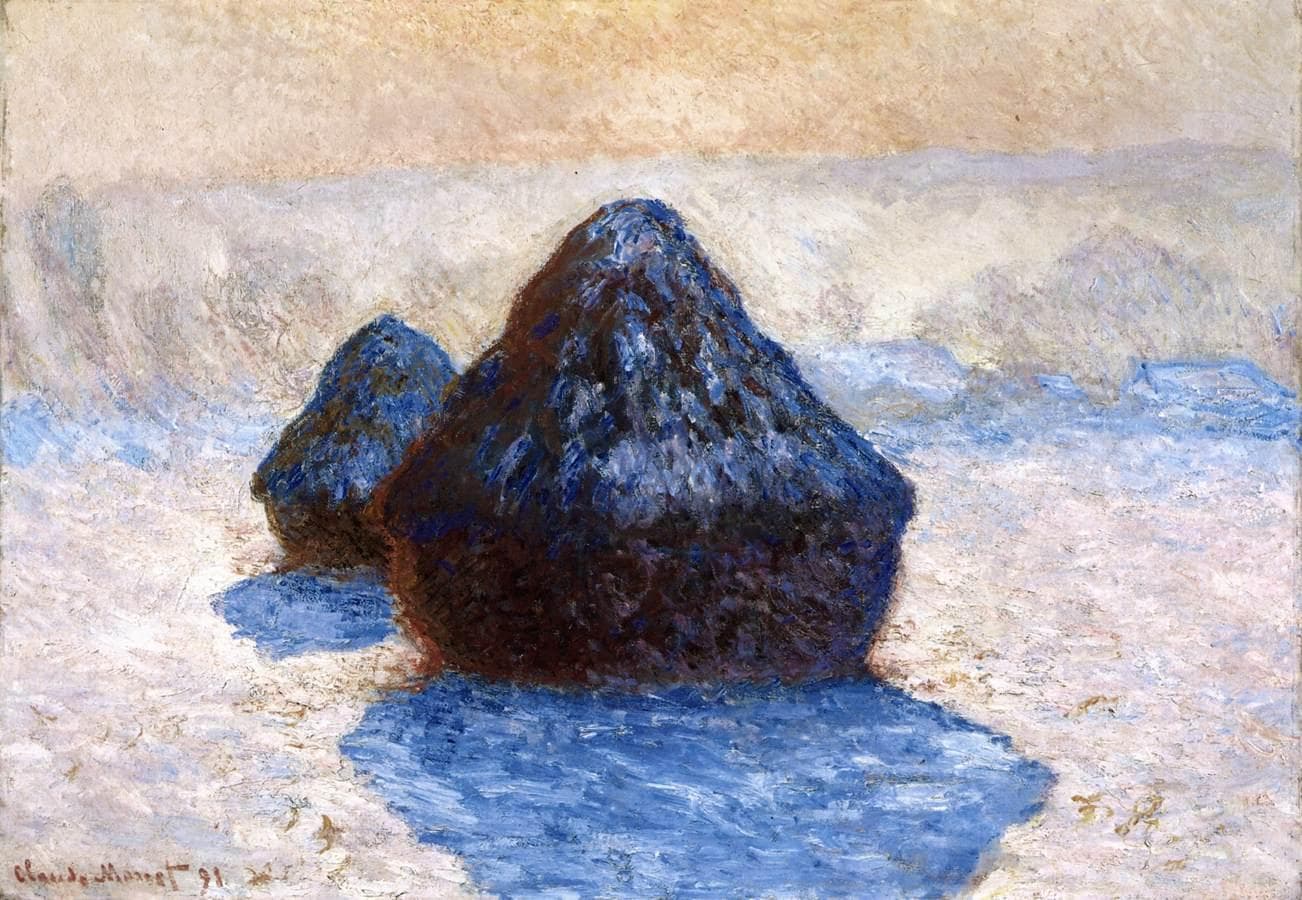
Haystacks, Snow Effect
Claude Monet · 1891
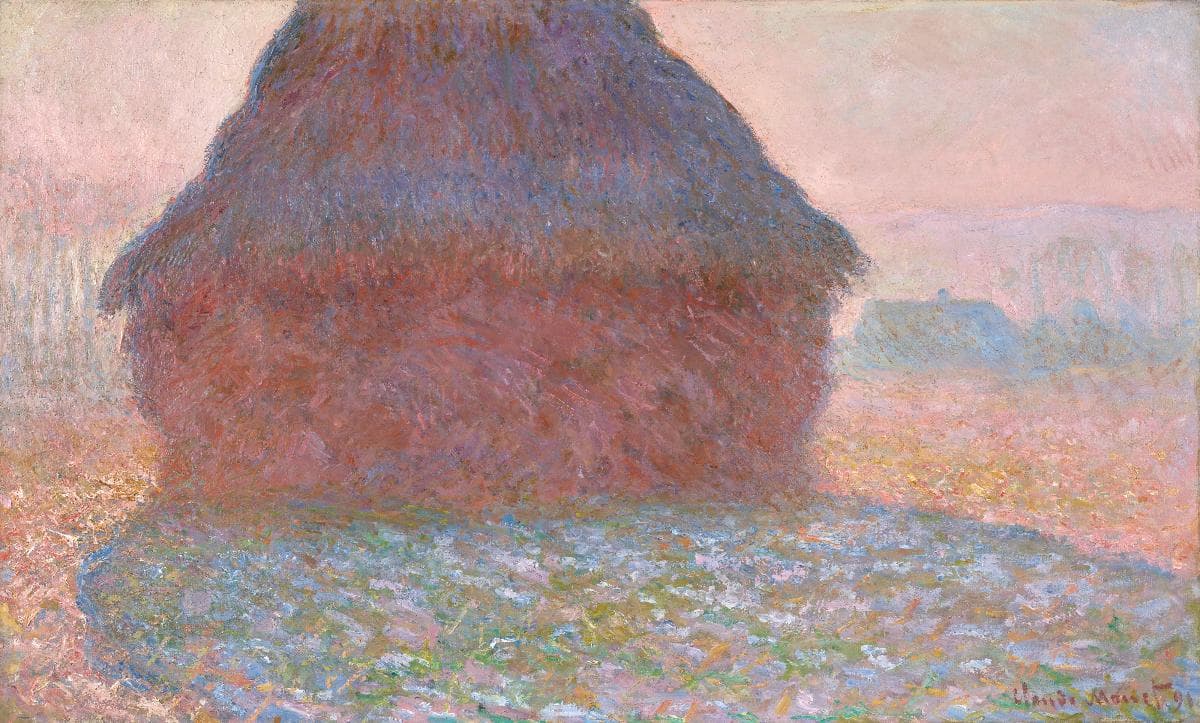
Grainstack in Sunlight
Claude Monet · 1891

The Scream
Edvard Munch · 1893

Ophelia
John Everett Millais · 1851–52

The Great Wave off Kanagawa
Katsushika Hokusai · c. 1830–32