Image: Auckland Art Gallery Toi o Tāmaki, on loan from the collection of Hideaki Fukutake · Public domain · via Wikimedia Commons
Le pont japonais (Japanese Bridge)
Claude Monet, 1918–24
Le pont japonais is a late Claude Monet view of his Giverny footbridge, dated 1918–24, in pale mint, jade and lilac. Since 2016 it has been on long-term loan to Auckland Art Gallery Toi o Tāmaki from a Japanese private collection.
- Artist
- Claude Monet
- Date
- 1918–24
- Medium
- Oil on canvas
- Dimensions
- 100.5 × 111.5 cm
- Collection
- Auckland Art Gallery Toi o Tāmaki (on loan from the collection of Hideaki Fukutake), Auckland, New Zealand
- Movement
- Impressionism
- Nature & Landscape
- Water & Sea
Le pont japonais (Japanese Bridge) is a painting by Claude Monet of the arched wooden footbridge over the water-lily pond in his garden at Giverny, dated 1918–24. It measures about 100.5 by 111.5 centimeters. The canvas belongs to the Fukutake collection in Japan and arrived at Auckland Art Gallery Toi o Tāmaki in November 2016 on a five-year loan, the first Monet the gallery had ever shown as part of its collection displays.
What you're looking at
Of all the late bridges, this is one of the lightest and freshest in color. The palette is pale mint, jade, sea green and turquoise, lifted with lilac, soft violet and a few strokes of pink and red. The bridge is a low, dark arch just below the middle of the canvas, drawn as a band of deeper blue-green with a line of violet along its rail and a couple of quick red touches near the center. Above it the wisteria and trees are painted in thin, swirling strokes of green over lighter, almost white ground, so that the foliage looks airy rather than dense. In the upper right, the greens give way to lilac and pale blue, perhaps the wisteria in flower or light filtering through the willow.
Below the bridge the pond opens out. Its center is a pale, milky green, the reflection of the bright sky and leaves, ringed by darker blue and green. Horizontal dashes of white, blue and violet near the bottom suggest lily pads and ripples, and two or three short strokes of red at the right may be flowers. At the lower right corner the signature, Claude Monet, is written in a fine dark line. Bare or thinly covered canvas shows at the corners.
The overall effect is spring-like and luminous, a long way from the heavy reds of some late bridges.
The late bridge paintings
Monet first painted his bridge in 1899, in a series of carefully balanced views such as Bridge over a Pond of Water Lilies at the Metropolitan Museum. After a gap of almost twenty years he returned to it around 1918, alongside his work on the Water Lilies decorations destined for the Orangerie. His eyesight was damaged by cataracts, and the canvases he made over the next six years vary enormously in color and finish. Most remained in his studio and passed to his son Michel, then to the Musée Marmottan Monet, but several, like this one, entered private collections.
How it was painted
The paint here is thinner and more fluid than in many late bridges. Monet lays a light underlayer, then draws over it with long, looping strokes of green and violet, leaving gaps that let the paler color breathe through. The arch is not outlined but emerges where the strokes thicken and darken. The near-square format, slightly wider than tall, holds the bridge in the center and leaves generous space for the water.
How this version differs
Set this canvas next to the São Paulo bridge, with its saturated emerald, or the dark brown-red Marmottan bridge, and its lightness stands out at once. It is closest in key to the turquoise bridge lent to the National Gallery, London, but its forms are looser and its color more pastel. The bridge pictures as a group are traced in the Japanese Footbridge series; the garden itself is in Monet's Giverny.
Where to see it
The gallery's record credits the work to the collection of Hideaki Fukutake, on loan to Auckland Art Gallery Toi o Tāmaki; 2016 press coverage named Soichiro Fukutake, the founder of the Benesse Art Site on Naoshima, as lender. The loan was announced for five years, and the gallery's online record has since listed the work as not on display, so check with the gallery before planning a visit. It is only the second Monet associated with a public collection in New Zealand. For public collections elsewhere, see where to see Monet's paintings.
Questions & answers
Is there a Monet at Auckland Art Gallery?
Yes. Le pont japonais (Japanese Bridge), 1918–24, came to Auckland Art Gallery Toi o Tāmaki in November 2016 on long-term loan from the Fukutake collection in Japan. Its online record has since shown it as not on display, so check before visiting.
When and where was it painted?
Monet painted it at Giverny between 1918 and 1924, in the water garden he had created in the 1890s, during the last years of his life.
What does the painting show?
It shows the arched footbridge over Monet's lily pond in pale greens and lilac, with airy wisteria and foliage above and a milky, light-filled pond below, signed at the lower right.
How is it different from other late Japanese bridges?
It is one of the lightest and most pastel of the group, painted thinly in mint, jade and lilac, while many late bridges are dark and saturated with reds, oranges or deep greens.
More by the artist
Claude Monet
The Japanese Bridge
Claude Monet · c. 1919–24
The Japanese Bridge
Claude Monet · 1918–24
The Japanese Bridge over the Water-Lily Pond in Giverny
Claude Monet · 1920–24
Le Pont japonais
Claude Monet · 1918–24
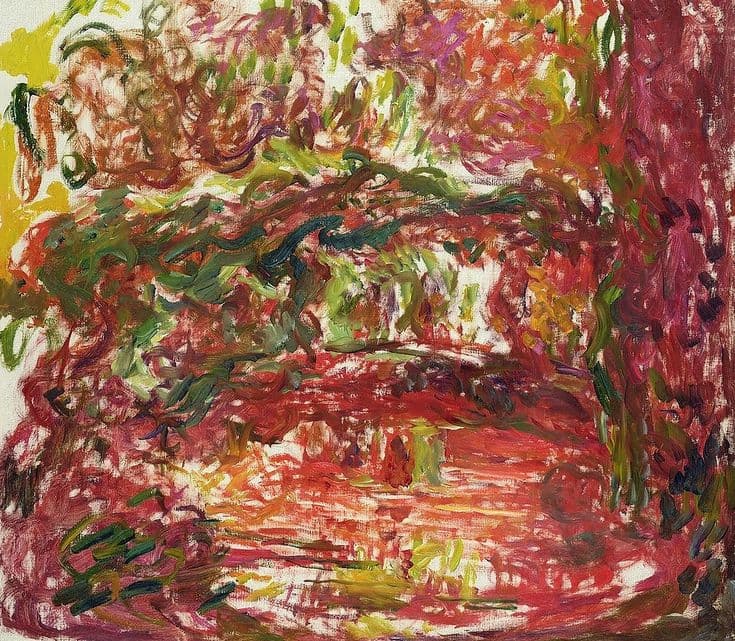
The Japanese Bridge
Claude Monet · 1918–24
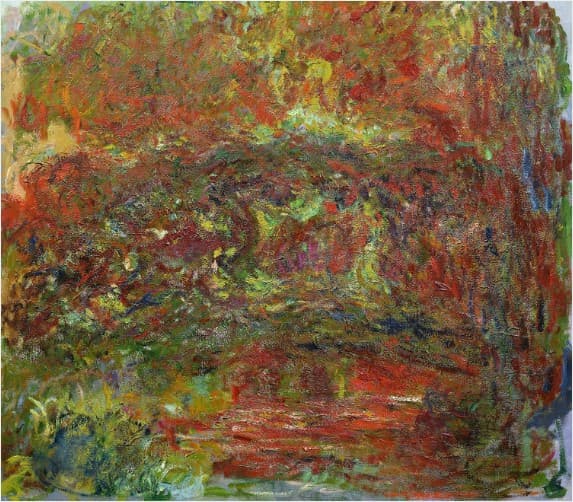
Le pont japonais
Claude Monet · 1918–24
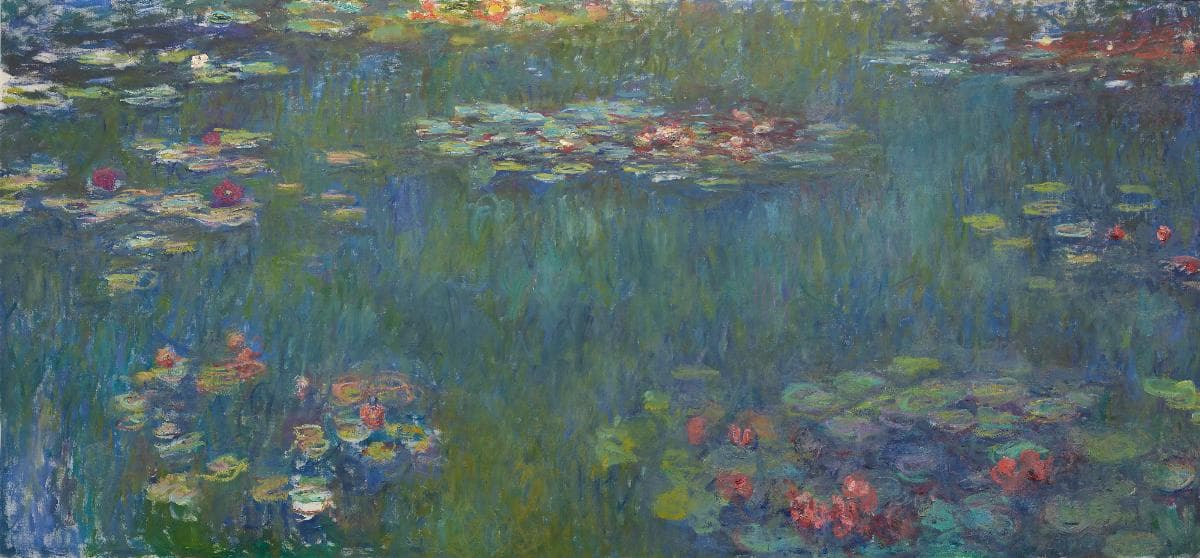
The Water-Lily Pond, Green Reflections
Claude Monet · 1920–26

The Water Lilies: The Clouds
Claude Monet · c. 1914–26
Also painted in 1921
The same year
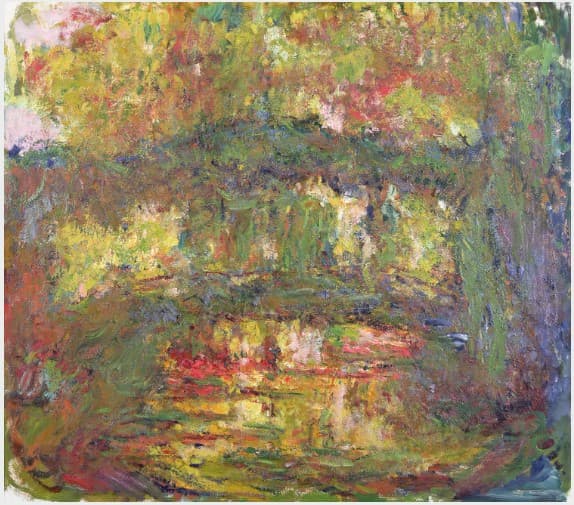
Kindred works
You may also study
The Japanese Bridge
Claude Monet · 1918–24
The Japanese Bridge
Claude Monet · 1919–24

Bridge over a Pond of Water Lilies
Claude Monet · 1899
Nymphéas (Water Lilies)
Claude Monet · c. 1914–1919
Water Lilies (1904, MuMa Le Havre)
Claude Monet · 1904
Waterlilies (1903, Dayton Art Institute)
Claude Monet · 1903
Nymphéas (Water Lilies), 1907 (Wadsworth Atheneum)
Claude Monet · 1907
The Japanese Bridge or The Lily Pond
Claude Monet · 1900