Impressionism
The Beach at Trouville
Claude Monet, 1870
The Beach at Trouville is a small 1870 oil by Claude Monet of two women seated on the sand under parasols, probably his wife Camille on the left. Painted partly on the spot, with grains of sand still in the paint, it is in the National Gallery, London.
- Artist
- Claude Monet
- Date
- 1870
- Medium
- Oil on canvas
- Dimensions
- 38 × 46.5 cm
- Collection
- The National Gallery, London, United Kingdom
- Movement
- Impressionism
- Catalogue
- Wildenstein 158
Painted at Étretat and the Normandy Coast
What you are looking at
Two women sit side by side on wooden chairs on a beach, so close to us that the frame crops them at the waist and the shoulder. On the left, a young woman in a white dress striped with gray-blue shades herself with a navy parasol. Her straw hat is trimmed with flowers in red, yellow and green, and her face is half lost in shadow, sketched in a few warm, flat strokes. On the right, a woman dressed entirely in black, with a black hat and a black parasol, bends over a book or newspaper. Between them stands an empty chair with a rust-red seat, its back half turned toward us.
Behind them the beach opens out: a stretch of pale sand, the striped awnings of bathing tents, a few distant figures, a flagpole with a red pennant, and the low line of the sea under a wide, gray-and-white summer sky. The empty chair is the hinge of the picture. It holds the space between the two women, and it suggests someone who has just left, perhaps the painter himself.
In the lower left corner Monet signed the picture with just his initials and the year, "Cl. M. 70," written in dark paint among the folds of the white skirt. The informality of the signature suits a picture that feels made for himself, a record of a summer rather than a showpiece for the Salon.
Sand in the paint
This is a small canvas, only 38 × 46.5 cm, and it was painted fast. The dress on the left is made of long, loaded strokes of white and gray laid side by side; the faces are blocked in without detail; the sky is a few broad sweeps of the brush. The National Gallery's conservators have found grains of sand caught in the paint, evidence that the picture was painted at least partly on the beach itself, with the wind blowing sand onto the wet surface. It is a rare physical trace of Impressionist outdoor painting, and one of the details that most visitors never notice.
The palette, analyzed by the gallery's scientists, is simple: artificial ultramarine and cobalt blue, viridian green, red and yellow ochres, vermilion and ivory black. Monet uses the black boldly for the second woman's dress, a reminder that the early Impressionists had not yet banished black from their palettes.
Who are the women?
The woman on the left is generally identified as Camille Doncieux, whom Monet married in Paris on 28 June 1870, just before this holiday. The woman in black is less certain. She has often been said to be the wife of the painter Eugène Boudin, Monet's early mentor, who was also at Trouville that summer and painted the beach himself; another suggestion is a relative of Camille's. The faces are too summary to settle the question.
Context: summer 1870
Monet, Camille and their three-year-old son Jean spent the summer of 1870 at Trouville, the fashionable resort on the Normandy coast, staying at the Hôtel Tivoli. Monet painted a group of pictures there, among them views of the beach and the grand Hôtel des Roches Noires. The National Gallery notes that this work and the others from that summer present Normandy as a holiday destination, a place of leisure for Parisians who arrived by train, rather than the working fishing coast of earlier painters.
The holiday ended abruptly. France declared war on Prussia in July 1870, and as the military situation collapsed, Monet left for London in the autumn to avoid conscription. There he met the dealer Paul Durand-Ruel, who would become the key supporter of the Impressionists. This little canvas is therefore one of the last pictures of Monet's first period, painted on the eve of war, exile and a new beginning.
Meaning
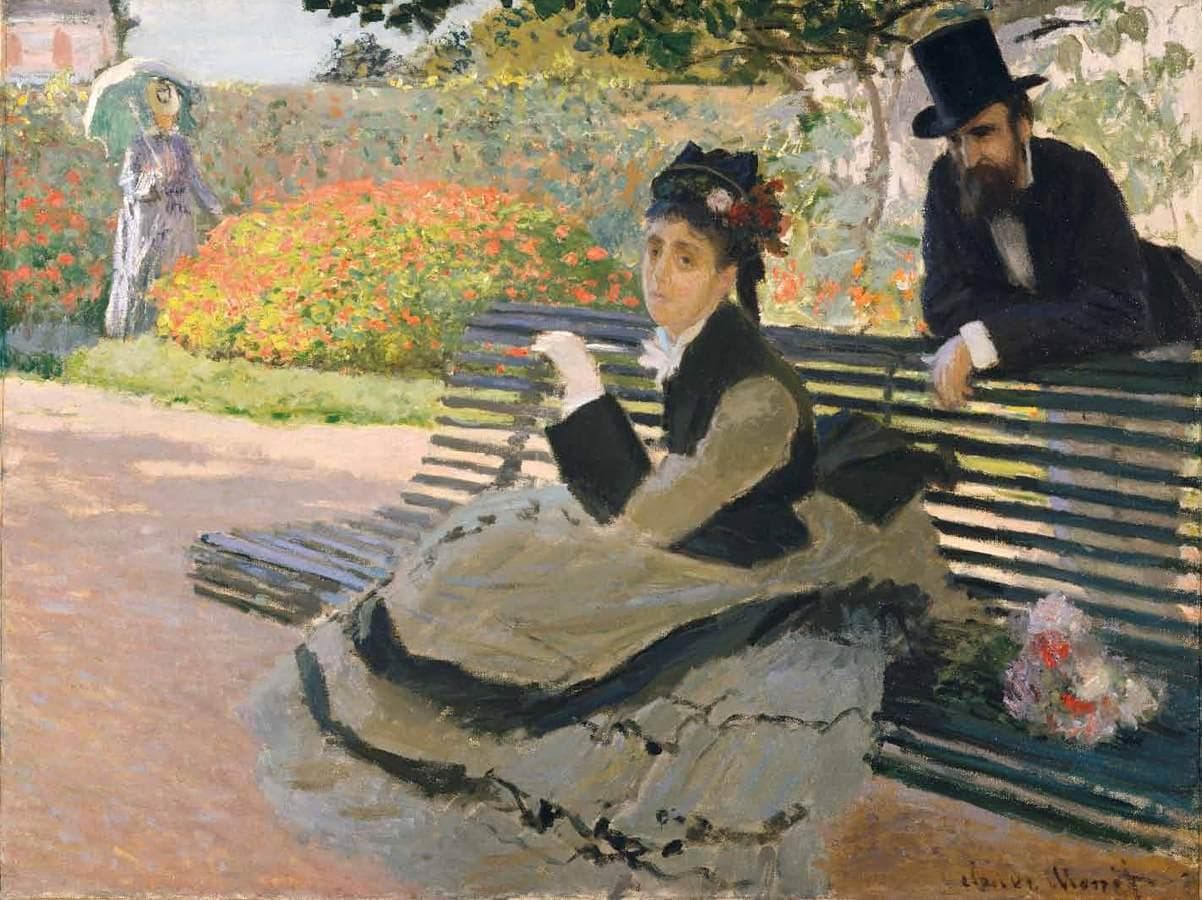
The painting is often read as one of the first true Impressionist beach scenes: modern people at leisure, painted as Monet saw them, in the open air and in a single session or very few. Its subject is not the sea but a moment of ordinary seaside life, the light on a white dress, the shade of a parasol. The empty chair and the averted faces give it a quiet, unposed intimacy, more like a snapshot of a honeymoon than a formal portrait. For comparisons, see Landing Stage at Trouville, Low Tide, the later Woman with a Parasol and Camille Monet on a Garden Bench.
Where to see it
The Beach at Trouville (NG3951) was bought by the National Gallery in 1924 through the Courtauld Fund, set up by the collector Samuel Courtauld to acquire modern French paintings for the nation. It hangs in the gallery's rooms of nineteenth-century French painting in Trafalgar Square, London; check the gallery's website for the current room.
Questions & answers
Where is Monet's The Beach at Trouville?
It is in the National Gallery in London (NG3951), bought in 1924 through the Courtauld Fund. It hangs with the gallery's nineteenth-century French paintings in Trafalgar Square.
Who is in Monet's The Beach at Trouville?
The woman on the left in white is generally identified as Camille Doncieux, whom Monet married in June 1870. The woman in black on the right has been suggested to be the wife of the painter Eugène Boudin, but this is not certain.
Is there really sand in The Beach at Trouville?
Yes. The National Gallery has found grains of sand embedded in the paint, showing that Monet painted the canvas at least partly on the beach itself, where wind blew sand onto the wet surface.
When did Monet paint The Beach at Trouville?
He painted it in summer 1870 at Trouville on the Normandy coast, on holiday with Camille and their son Jean, shortly before the Franco-Prussian War sent him to London.
More by the artist
Claude Monet

Bridge over a Pond of Water Lilies
Claude Monet · 1899

Woman with a Parasol – Madame Monet and Her Son
Claude Monet · 1875

Sunset in Venice
Claude Monet · 1908–12

La Grenouillère
Claude Monet · 1869

Beach in Pourville
Claude Monet · 1882

Springtime
Claude Monet · 1872

Boating on the River Epte
Claude Monet · 1890

The Seine at Asnières (Hermitage)
Claude Monet · 1873
Also painted in 1870
The same year
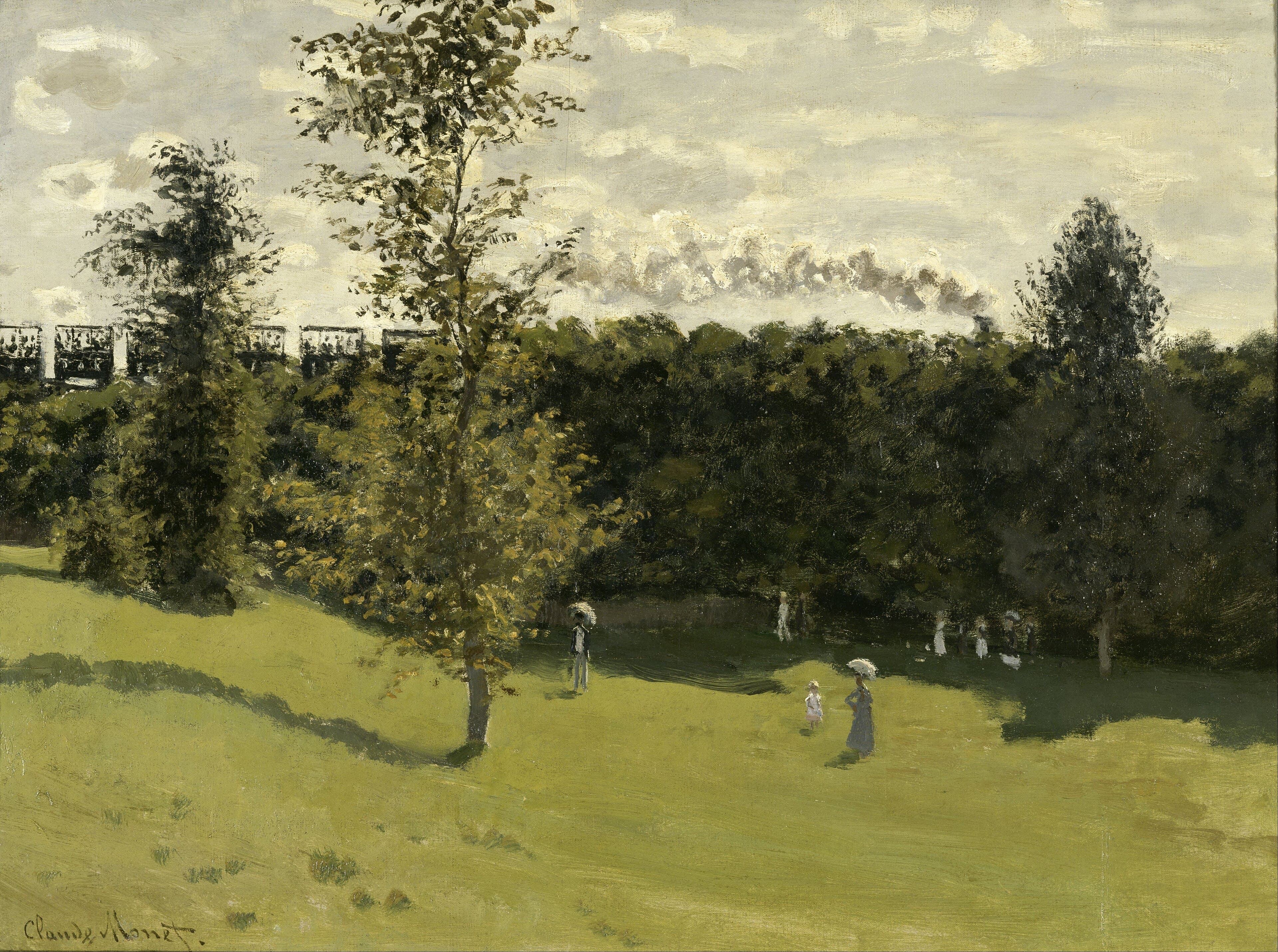
Train in the Countryside
Claude Monet · c. 1870
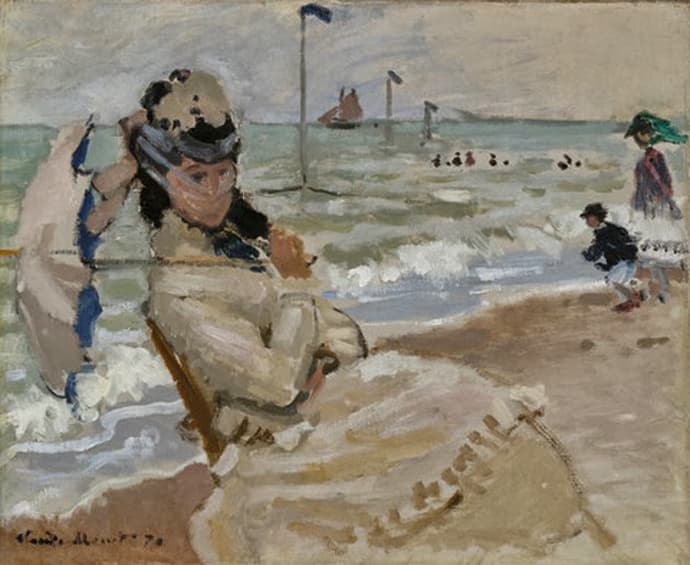
Camille on the Beach at Trouville
Claude Monet · 1870
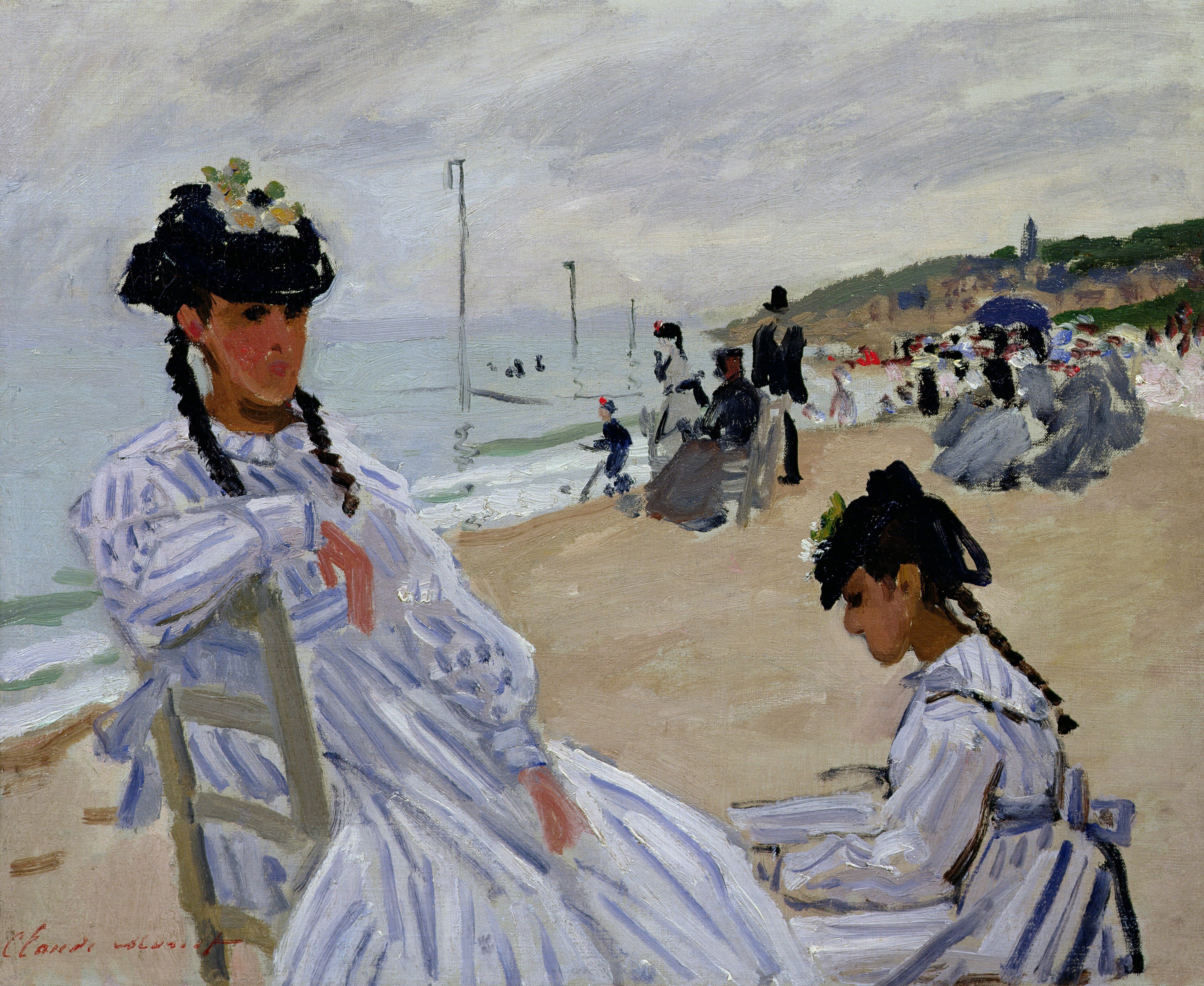
On the Beach at Trouville
Claude Monet · 1870
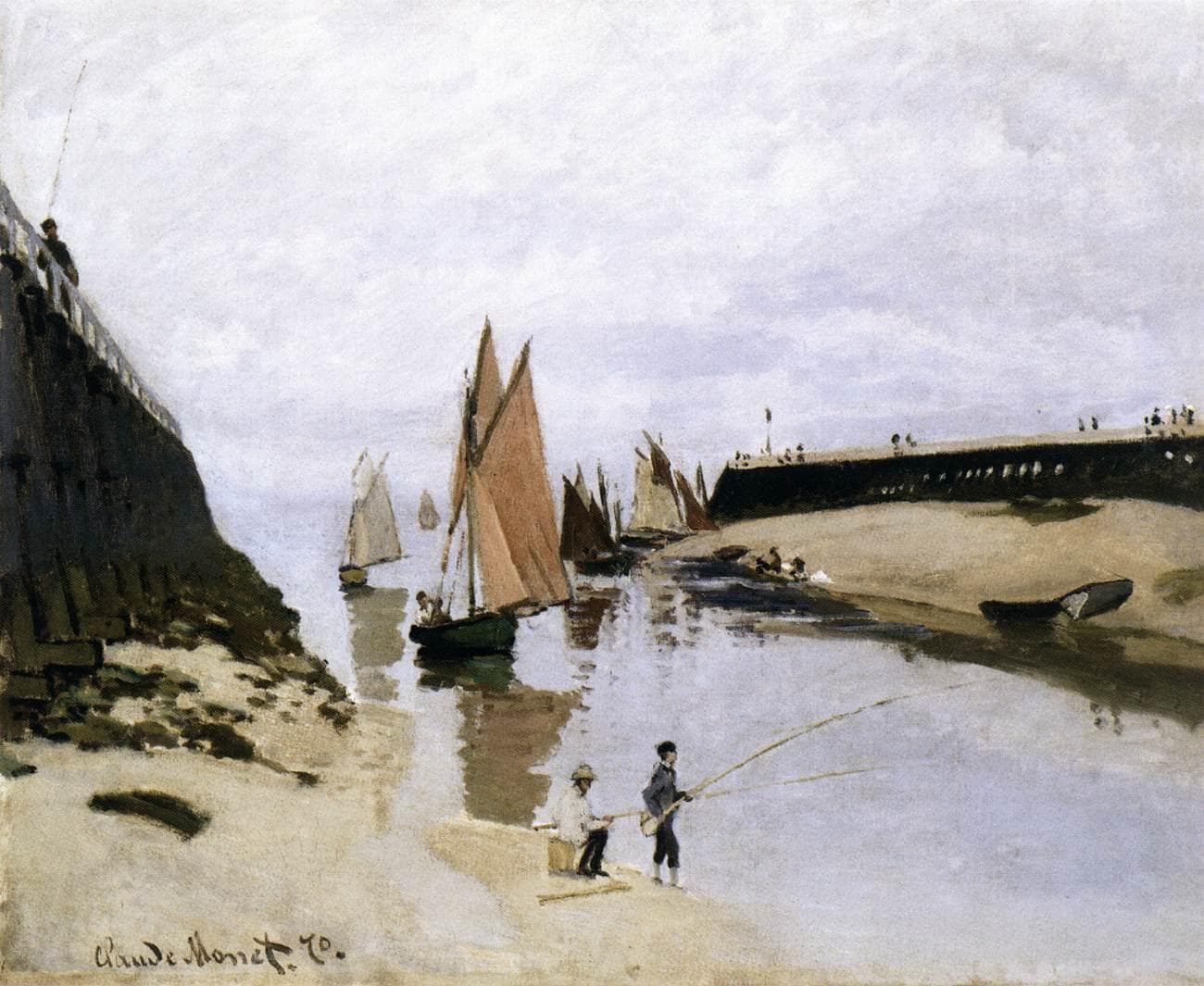
Landing Stage at Trouville, Low Tide
Claude Monet · 1870
The Red Kerchief (The Red Cape)
Claude Monet · c. 1868–73
The Hôtel des Roches Noires, Trouville
Claude Monet · 1870
Kindred works
You may also study
The Hôtel des Roches Noires, Trouville
Claude Monet · 1870
Landing Stage at Trouville, Low Tide
Claude Monet · 1870
Camille Monet on a Garden Bench
Claude Monet · 1873

Venus de Milo
Alexandros of Antioch · c. 150–125 BC

Ophelia
John Everett Millais · 1851–52

The Great Wave off Kanagawa
Katsushika Hokusai · c. 1830–32
Las Meninas
Diego Velázquez · 1656
The Birth of Venus
Sandro Botticelli · c. 1484–1486