Impressionism
The Hôtel des Roches Noires, Trouville
Claude Monet, 1870
The Hôtel des Roches Noires, Trouville is a painting by Claude Monet of flags snapping above a grand seaside hotel and its crowded promenade, made in summer 1870 on his honeymoon in Normandy. It hangs in the Musée d'Orsay, Paris.
- Artist
- Claude Monet
- Date
- 1870
- Medium
- Oil on canvas
- Dimensions
- 81 × 58.5 cm
- Collection
- Musée d'Orsay, Paris, France
- Movement
- Impressionism
- Catalogue
- Wildenstein W 155
Painted at Étretat and the Normandy CoastMore at Monet at the Musée d'Orsay
The Hôtel des Roches Noires, Trouville is a painting by Claude Monet of the promenade in front of a luxury seaside hotel on the Normandy coast, made in the summer of 1870 while he was on honeymoon with Camille Doncieux. The upright canvas, about 81 by 58.5 centimeters, is signed and dated at lower right and is number 155 in Wildenstein's catalogue. It belongs to the Musée d'Orsay in Paris (RF 1947 30).
What does the Hôtel des Roches Noires painting show?
The hotel fills the right side of the canvas, a cream and yellow facade blazing in full sun, with balconies, tall windows, a mansard roof and ornate finials against the sky. Guests lean over the upper balconies, and a broad flight of steps descends from the terrace to the boardwalk.
The left half is wind. A tall white pole runs up the left edge, and from it a huge flag of red and white stripes streams out across the upper corner, painted in a few long, broken strokes. It is generally read as the American Stars and Stripes, though Monet shows no blue field of stars, only rippling bands. Further off, smaller flags fly from two poles, the upper one the French tricolor, while white clouds race across a deep blue sky.
On the promenade below, the summer crowd is sketched in touches of white, black and gray. A white awning shades a group at center. At lower left, a woman in a deckchair is cut off by the frame, a parasol and a lamp post beside her. Near the steps, a man in a straw hat strides toward us with a cane, and a bed of red flowers lines the hotel's garden at right.
How Monet painted the wind
Look at the big flag up close and it barely exists as an object: a few dragged strokes of red over white and blue, the edges left ragged so the cloth seems to snap and twist. The clouds are painted the same way, wet into wet. The facade, by contrast, is built with firmer, heavier paint and crisp shadows, so the stone feels solid against the moving air.
The composition rests on a strong diagonal. The hotel front runs sharply back into depth from the right edge, while the flagpoles and lamp posts stand vertical, a device Monet had already tried at the seaside in Garden at Sainte-Adresse, with its own pair of flags. The light falls from the left, throwing the boardwalk into a long, cool shadow at lower right and leaving the facade almost white with sun.
The summer of 1870 at Trouville
Monet married Camille on 28 June 1870 in Paris, with Gustave Courbet as a witness, and the couple went to Trouville, the fashionable resort at the mouth of the Touques, with their young son Jean. The Hôtel des Roches Noires, opened in 1866, was the grandest address on the seafront. The Monets lodged at a more modest hotel, and he painted this one from the promenade, the public side of resort life.
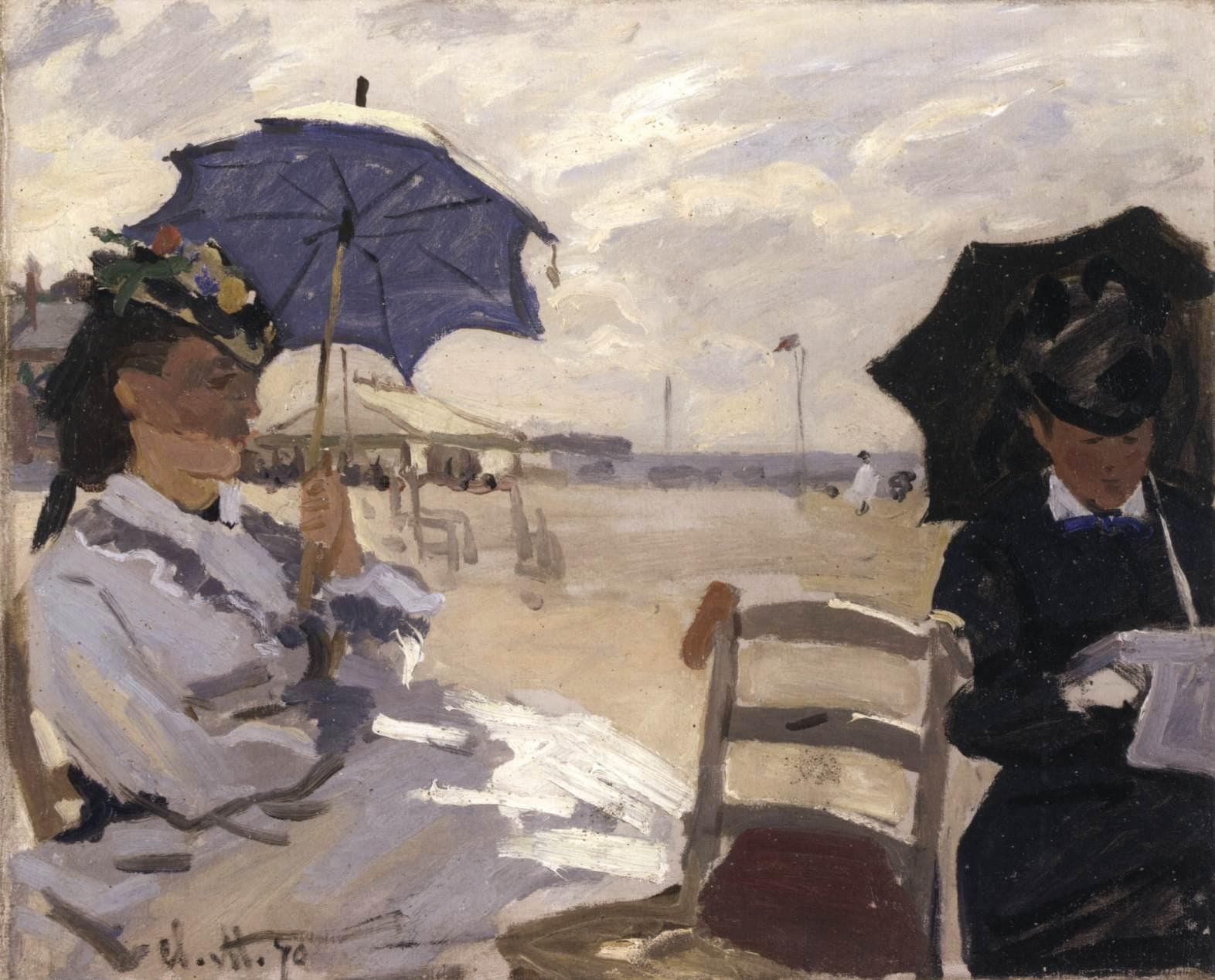
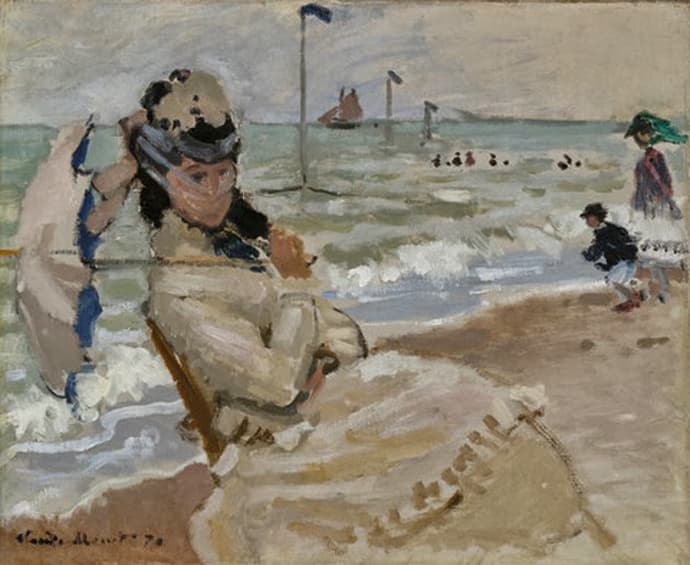
That summer he made a small group of beach and boardwalk pictures, including The Beach at Trouville and Camille on the Beach in Trouville, often with Eugène Boudin painting nearby. France declared war on Prussia on 19 July. By the autumn Monet had left for London to avoid the fighting, and the Second Empire whose holiday crowd this picture records had fallen.
How it fits Monet's Normandy pictures
The Normandy coast was Monet's home ground: he grew up in Le Havre and painted Sainte-Adresse, Honfleur and Trouville throughout the 1860s, and later Étretat and Pourville. Among the Trouville pictures, this is the most urban and the most vertical, closer to his Paris street views than to the beach scenes. Compare it with the low, gray harbor view of Landing Stage at Trouville, Low Tide, and see the whole coast in our Étretat and the Normandy Coast hub.
Where to see it
The painting is in the Musée d'Orsay in Paris. It was given to the French national museums in 1947 by Jacques Laroche, who kept a life interest, and it entered the collection physically in 1976. Our Monet at the Musée d'Orsay guide lists the museum's other Monets, and his life is told on our Claude Monet page.
Questions & answers
Where is The Hôtel des Roches Noires by Monet?
It is in the Musée d'Orsay in Paris, inventory RF 1947 30. Jacques Laroche gave it to the French national museums in 1947 while keeping a life interest, and it entered the collection in 1976. The upright canvas, about 81 by 58.5 centimeters, usually hangs with the museum's early Impressionist paintings.
When and where did Monet paint the Hôtel des Roches Noires?
He painted it at Trouville, on the Normandy coast, in the summer of 1870, during his honeymoon after marrying Camille Doncieux on 28 June. The Franco-Prussian War broke out that July, and by the autumn Monet had left France for London.
Why is there an American flag in Monet's painting of Trouville?
Grand resort hotels flew the flags of the nations of their guests, and Trouville drew wealthy foreign visitors, including Americans. The big red-and-white striped flag is usually read as the Stars and Stripes, though Monet paints no field of stars. It is mainly there as a burst of wind and color.
Did Monet paint other pictures at Trouville?
Yes. In the summer of 1870 he painted a small group of Trouville scenes, including The Beach at Trouville in London's National Gallery, several small beach pictures of Camille and the harbor view Landing Stage at Trouville, Low Tide. This is the only one centered on a hotel facade.
More by the artist
Claude Monet

Bridge over a Pond of Water Lilies
Claude Monet · 1899

Woman with a Parasol – Madame Monet and Her Son
Claude Monet · 1875

Sunset in Venice
Claude Monet · 1908–12

La Grenouillère
Claude Monet · 1869

Beach in Pourville
Claude Monet · 1882

Springtime
Claude Monet · 1872

Boating on the River Epte
Claude Monet · 1890

The Seine at Asnières (Hermitage)
Claude Monet · 1873
Also painted in 1870
The same year
Kindred works
You may also study
The Beach at Trouville
Claude Monet · 1870
Camille on the Beach at Trouville
Claude Monet · 1870
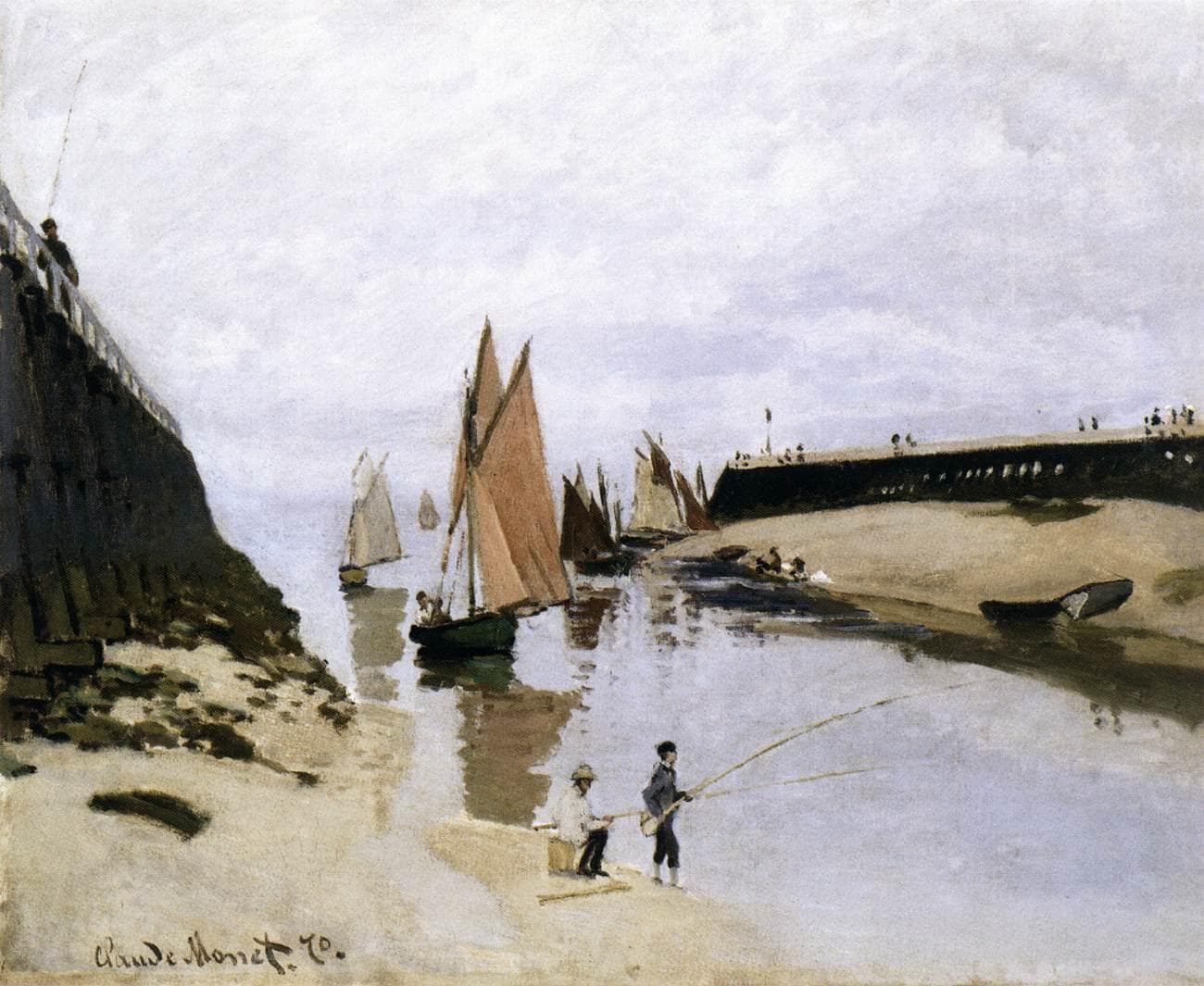
Landing Stage at Trouville, Low Tide
Claude Monet · 1870
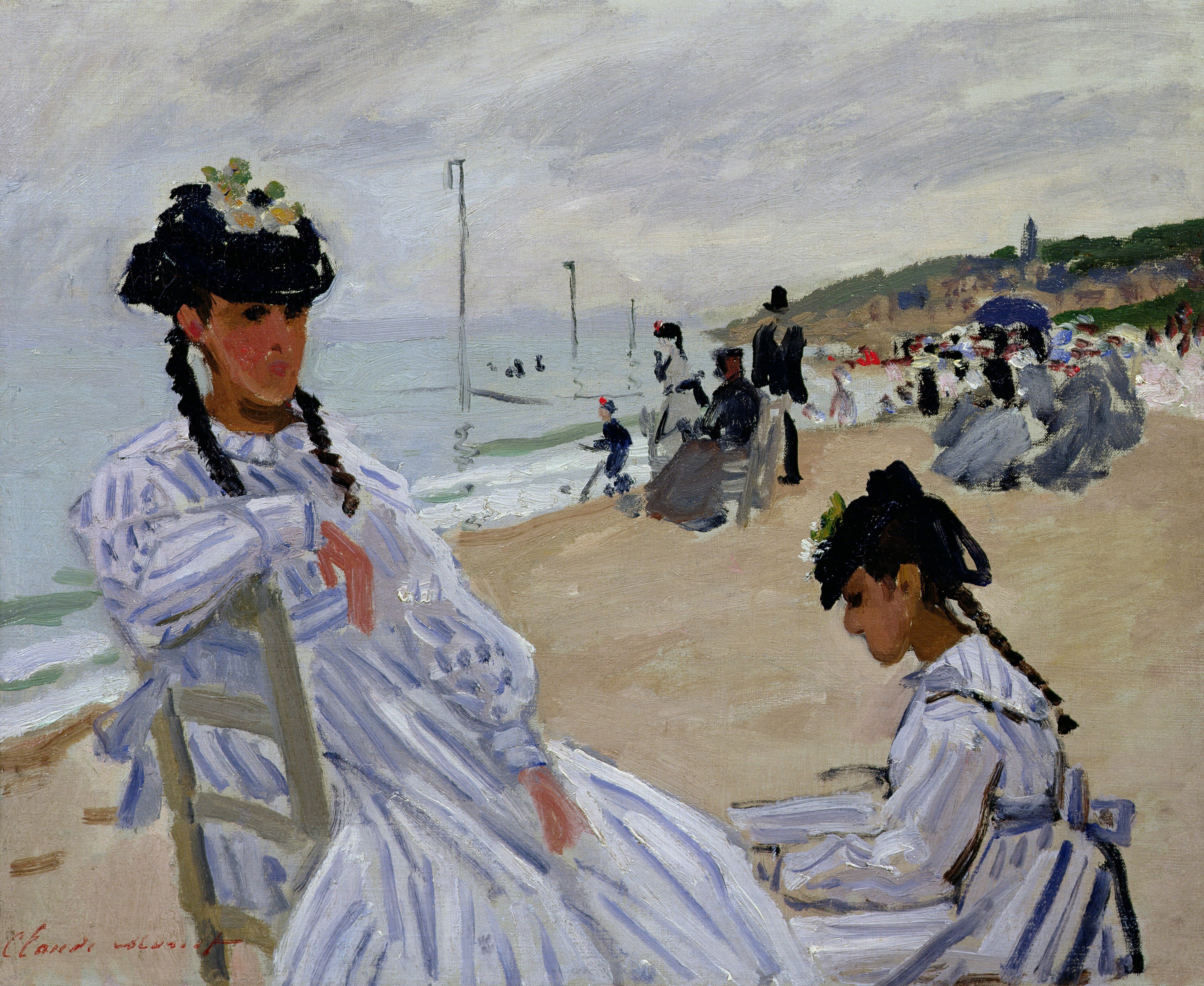
On the Beach at Trouville
Claude Monet · 1870
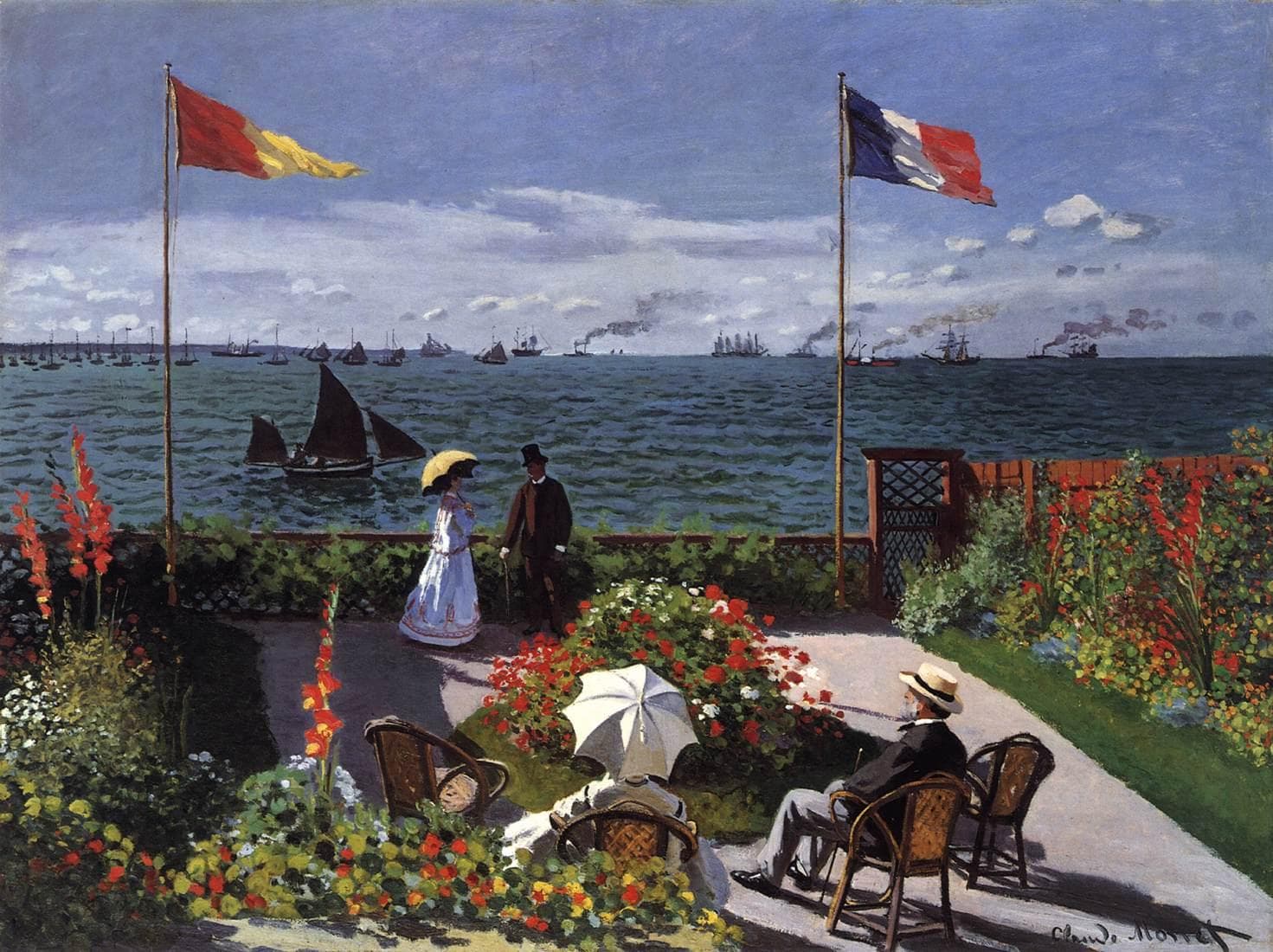
Garden at Sainte-Adresse
Claude Monet · 1867
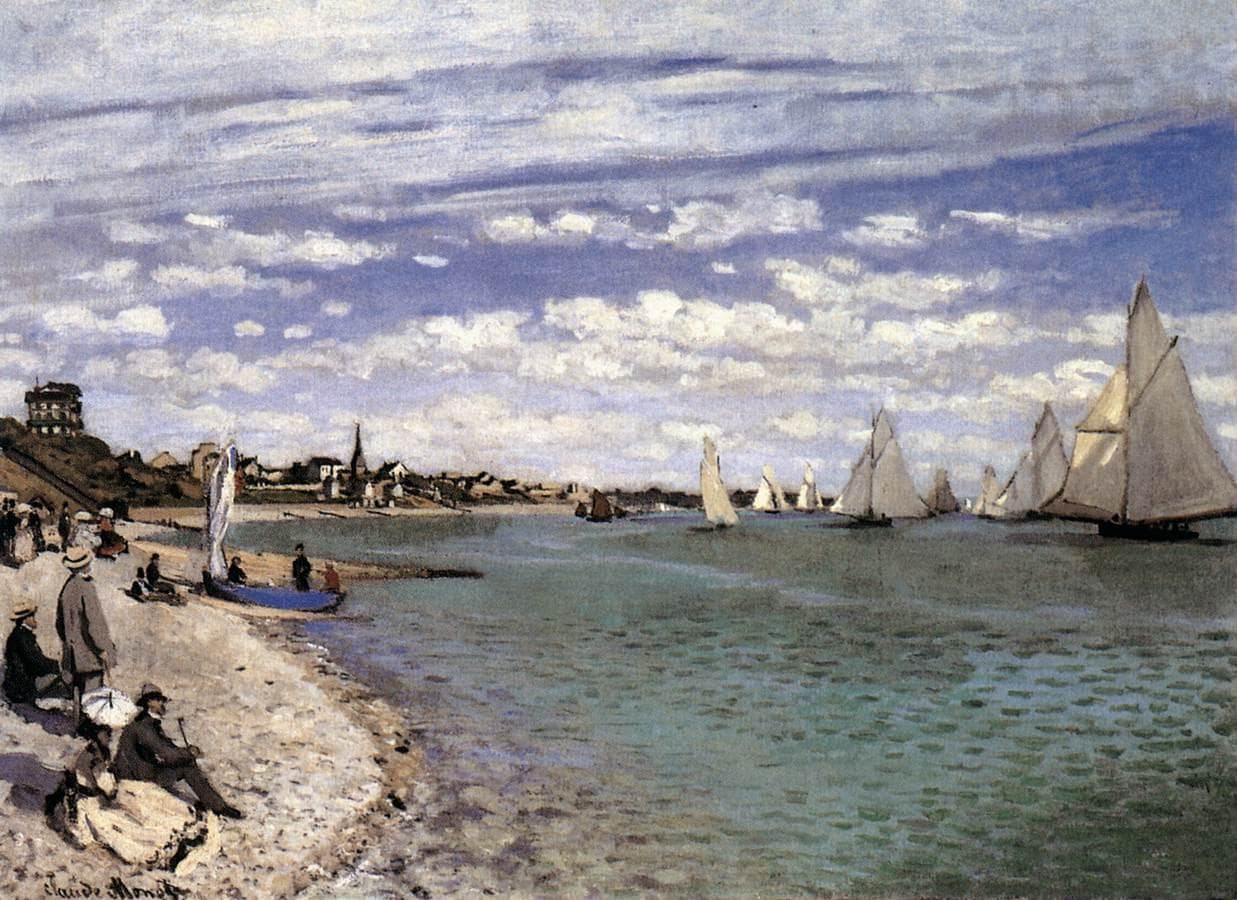
Regatta at Sainte-Adresse
Claude Monet · 1867

Ophelia
John Everett Millais · 1851–52

The Great Wave off Kanagawa
Katsushika Hokusai · c. 1830–32