Image: Yale University Art Gallery, New Haven · Public domain · via Wikimedia Commons
Impressionism
Camille on the Beach at Trouville
Claude Monet, 1870
Camille on the Beach at Trouville is a small oil sketch by Claude Monet, signed and dated 1870, of his new wife Camille seated on the windy beach at Trouville, holding her parasol and hat. It is in the Yale University Art Gallery.
- Artist
- Claude Monet
- Date
- 1870
- Medium
- Oil on canvas
- Dimensions
- 38.1 × 46.4 cm
- Collection
- Yale University Art Gallery, New Haven, United States
- Movement
- Impressionism
- Catalogue
- Wildenstein 160
Painted at Étretat and the Normandy Coast
Camille on the Beach at Trouville is a small, fast oil sketch Claude Monet painted in the summer of 1870, a few weeks after he married Camille Doncieux. It shows her sitting on the sand at Trouville on a blustery day, gripping her parasol, while the sea churns behind her. It is in the Yale University Art Gallery in New Haven, Connecticut.
What you are looking at
Camille sits close to us on the left, filling nearly half the canvas, turned toward the right with her head bowed against the wind. She wears a pale summer dress painted in creamy whites and grays, and a straw hat tied on with a dark veil or ribbon that blows across her face; one hand holds the hat to her head. A white parasol with a blue-striped edge is half-closed at her side, tilted by the wind. Her face is little more than a few strokes of pink and gray beneath the veil.
Behind her the beach slopes down to the sea, which is choppy and green-gray, breaking in lines of white. Two tall poles with flags stand in the water, one flying a blue pennant, marking the bathing area, and a red-sailed fishing boat rides on the horizon. At right a child in dark clothes runs or bends on the sand, and further back a woman in a pale dress with a green hat or parasol walks along the edge of the water. Small dark heads of bathers dot the waves. The signature and date, Claude Monet 70, are at lower left.
The composition is lopsided on purpose. Camille is pushed to the left edge and partly cut off, and the open space to the right is filled with movement: the wind in the flags, the waves, the running child. It feels less like a posed portrait than a glance at someone sitting next to you on the sand, which is exactly what it was.
Where and when it was painted
Monet married Camille in Paris on 28 June 1870, and they spent the summer at Trouville, the fashionable seaside resort on the Normandy coast, with their three-year-old son Jean. Monet's friend and mentor Eugène Boudin, who had made a career painting Trouville's elegant beach crowds, was there with his wife. Monet painted several small beach scenes that summer, often with Camille, before the Franco-Prussian War broke out in July and he left for London in the autumn. The resort and the rest of the coast are covered on our Normandy coast hub.
How it was painted
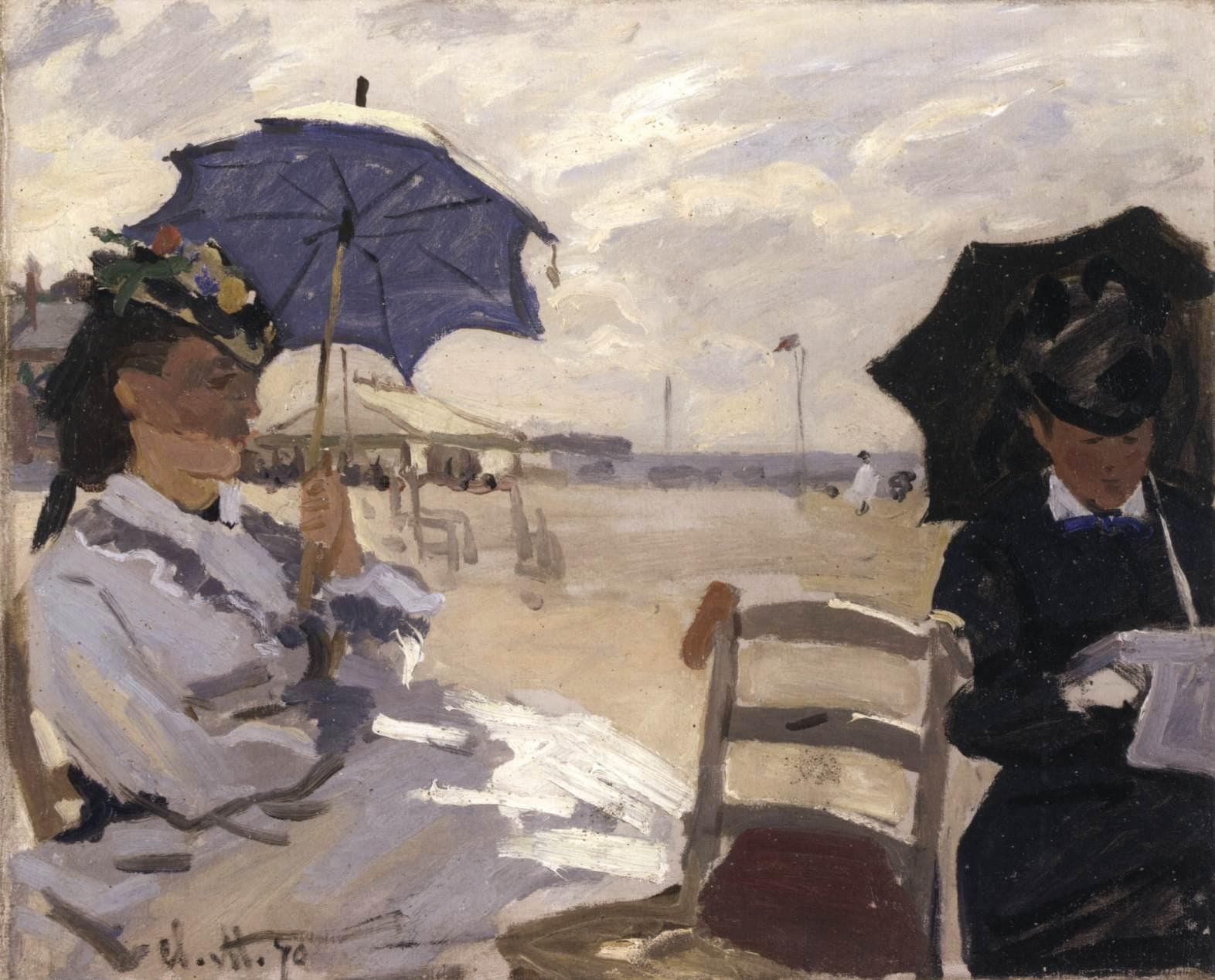
These Trouville canvases are some of the most spontaneous pictures of Monet's early career. The paint is thin in places and thick and dragged in others, laid on wet into wet with broad brushes. The figure is built from a few big strokes: the dress, the parasol, the dark band of the veil. Nothing is finished in the traditional sense, and yet the wind, the light and Camille's pose are caught exactly. The small size meant he could carry the canvas to the beach and work quickly between gusts. The companion picture in London, The Beach at Trouville, even has grains of sand embedded in its paint.
The Trouville pictures
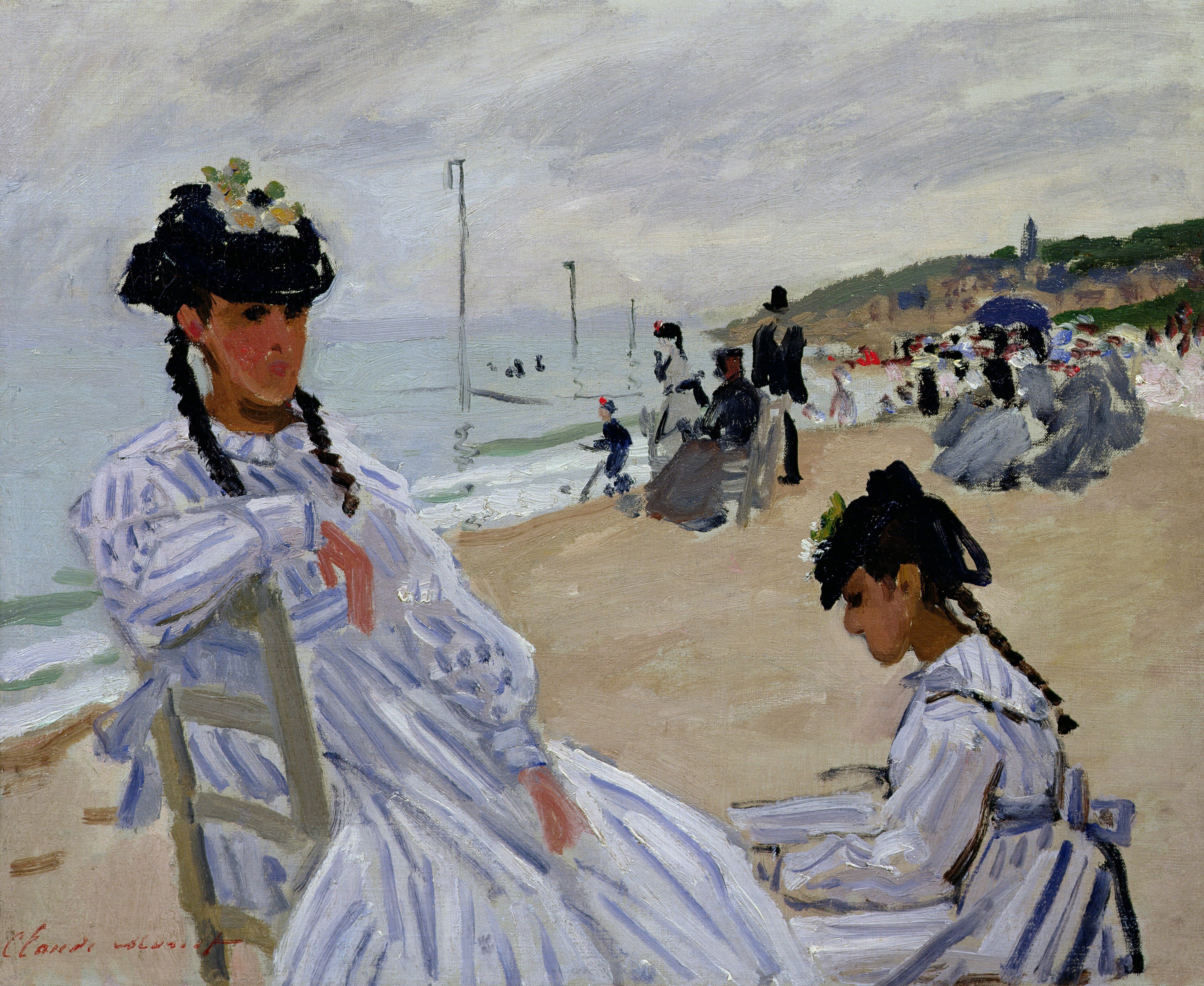
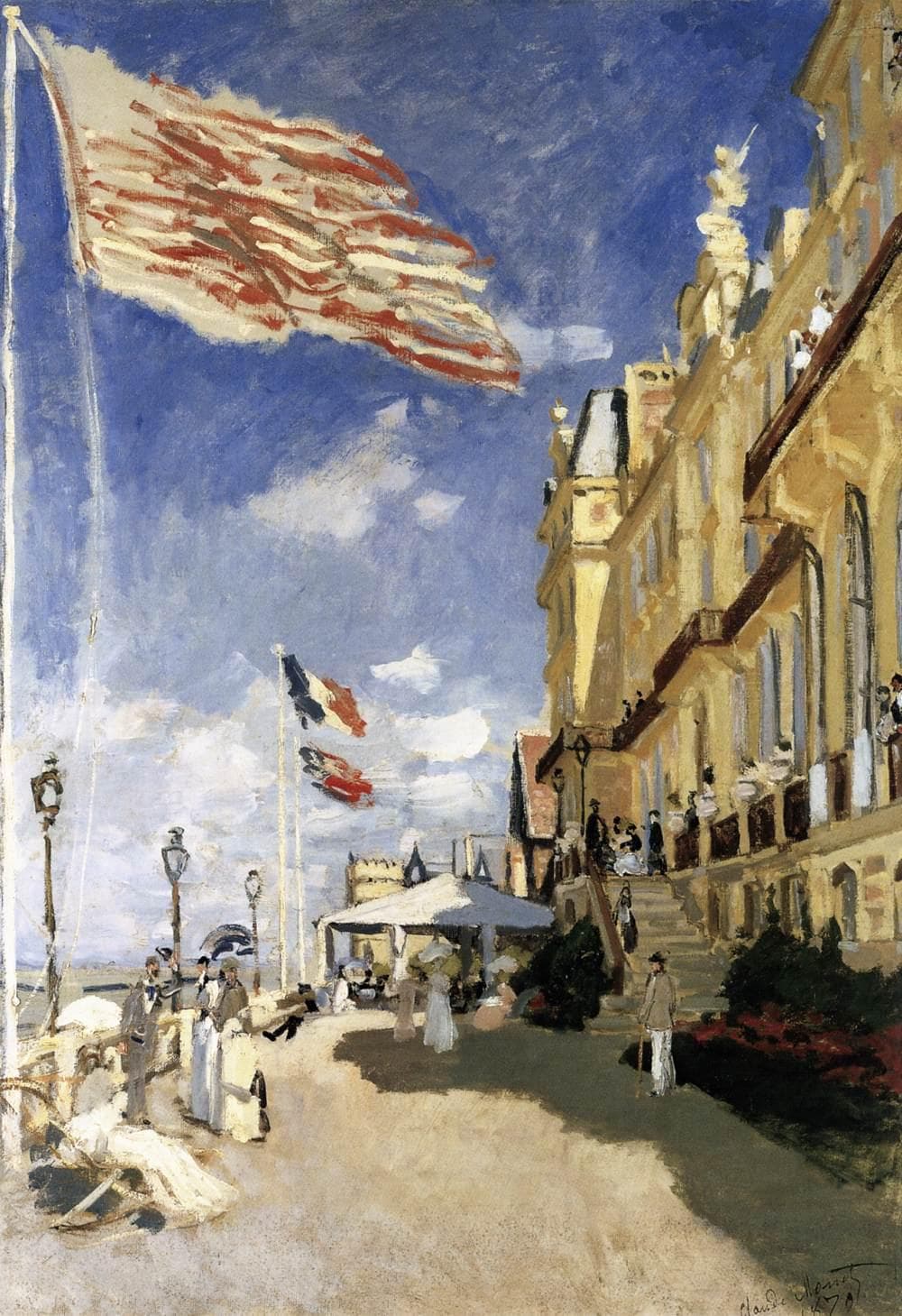
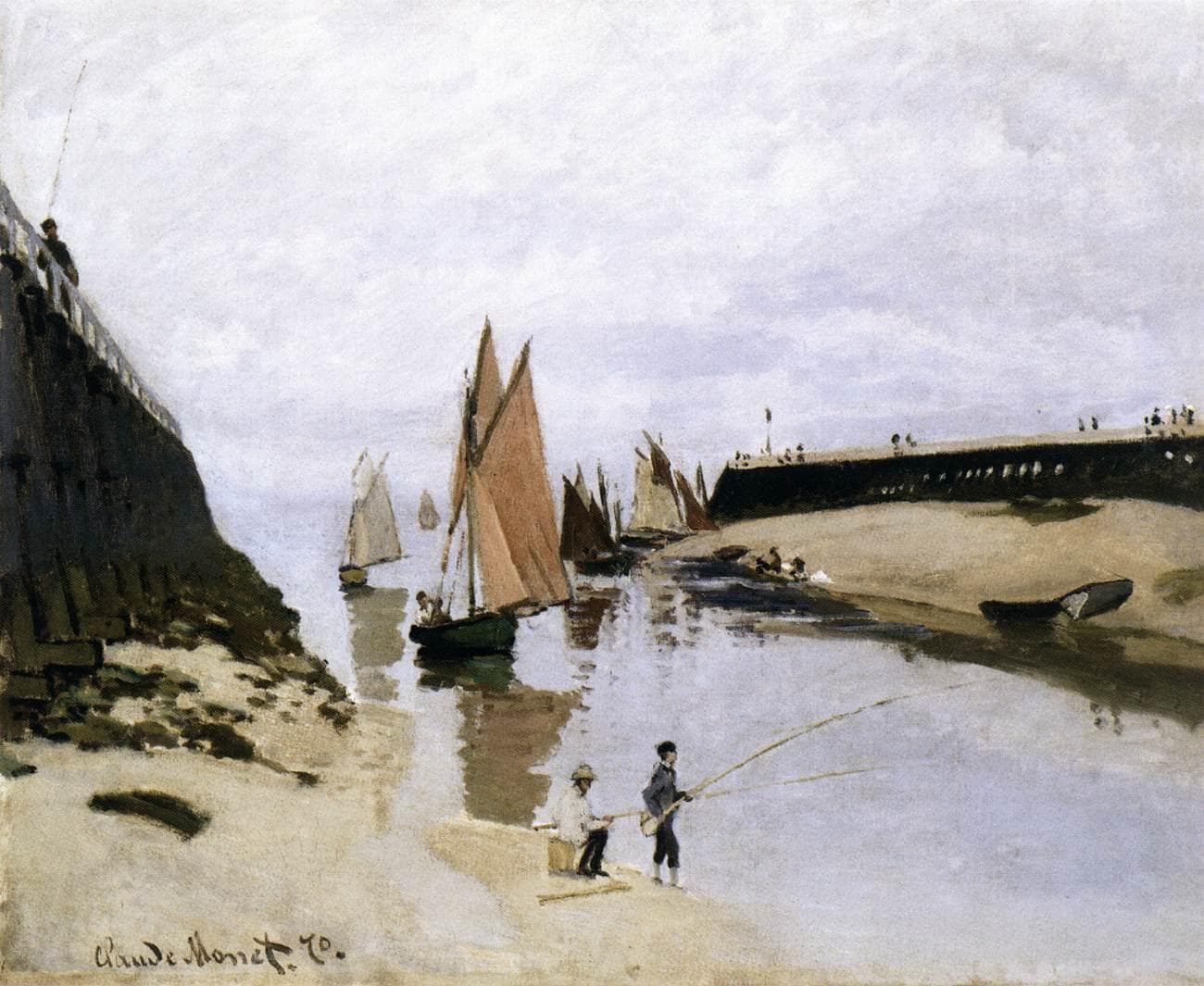
Monet painted about half a dozen beach scenes at Trouville in 1870. Two of them show Camille seated close to the viewer: this one, and On the Beach at Trouville in the Musée Marmottan, where she sits in a striped dress beside another woman. He also painted the grand hotel facade in The Hôtel des Roches Noires and the pier in Landing Stage at Trouville, Low Tide. Together they are the last record of Monet's life before the war scattered his circle.
Where to see it
The painting is in the Yale University Art Gallery (1998.46.1), which is free to visit. For other public collections, see where to see Monet's paintings.
Questions & answers
Where is Monet's Camille on the Beach at Trouville?
It is in the Yale University Art Gallery in New Haven, Connecticut (accession 1998.46.1). The gallery is free to visit, and the small canvas is shown with its collection of French 19th-century painting when on view.
When was it painted?
In the summer of 1870, when Monet and Camille spent their honeymoon at the seaside resort of Trouville in Normandy. Monet signed and dated it 1870 at lower left.
What does the painting show?
Camille Monet seated on the windy beach in a pale summer dress, holding her hat on with a veil blowing across her face and a striped parasol at her side. Behind her are flagpoles in the surf, a red-sailed boat, a running child and a woman walking by the water.
Did Monet paint other pictures at Trouville?
Yes, about half a dozen in 1870, including The Beach at Trouville (National Gallery, London), On the Beach at Trouville (Musée Marmottan), The Hôtel des Roches Noires (Musée d'Orsay) and Landing Stage at Trouville, Low Tide (Budapest).
More by the artist
Claude Monet

Bridge over a Pond of Water Lilies
Claude Monet · 1899

Woman with a Parasol – Madame Monet and Her Son
Claude Monet · 1875

Sunset in Venice
Claude Monet · 1908–12

La Grenouillère
Claude Monet · 1869

Beach in Pourville
Claude Monet · 1882

Springtime
Claude Monet · 1872

Boating on the River Epte
Claude Monet · 1890

The Seine at Asnières (Hermitage)
Claude Monet · 1873
Also painted in 1870
The same year
Kindred works
You may also study
On the Beach at Trouville
Claude Monet · 1870
The Beach at Trouville
Claude Monet · 1870
The Hôtel des Roches Noires, Trouville
Claude Monet · 1870
Landing Stage at Trouville, Low Tide
Claude Monet · 1870
Camille (The Woman in the Green Dress)
Claude Monet · 1866

Venus de Milo
Alexandros of Antioch · c. 150–125 BC

Ophelia
John Everett Millais · 1851–52

The Great Wave off Kanagawa
Katsushika Hokusai · c. 1830–32