Impressionism
Ice Floes on the Seine near Bennecourt
Claude Monet, 1893
Ice Floes on the Seine near Bennecourt is a Claude Monet painting of 1893 showing broken ice glittering on the river past a dark thicket, with hills lost in mauve haze. It is in a private collection.
- Artist
- Claude Monet
- Date
- 1893
- Medium
- Oil on canvas
- Dimensions
- 65 × 100 cm
- Collection
- Private collection
- Movement
- Impressionism
- Catalogue
- Wildenstein W 1339
Painted at Giverny: Monet's House and Garden
Ice Floes on the Seine near Bennecourt is one of about a dozen pictures Claude Monet painted in early 1893, when the Seine froze near his home at Giverny and then broke up into drifting ice. The canvas, 65 by 100 centimeters and signed "Claude Monet" at lower right, is in a private collection. It is listed as number 1339 in Wildenstein's catalogue, where it is known in English as Break-up, the Seine near Bennecourt.
What you are looking at
The view looks across a wide stretch of river toward a long line of hills. At the left, a dense thicket of bare trees and shrubs rises from the water's edge. It is painted in plum, rust, violet and brown, with dozens of thin vertical strokes standing for stems and branches, and at its foot a band of cold blue-green marks open water.
Everything else is light. The river fills the lower half of the canvas with a moving sheet of ice. Monet paints each floe as a short horizontal stroke of white, silver or pale gray, and lets darker strokes of blue-green and slate show between them where the current runs. Across the center a band of glare spreads over the ice, as if a low winter sun were burning just behind the haze. Here the strokes become paler and softer until they almost merge.
Beyond the river a low island or spit of land crosses the picture, and behind it rise the hills, dissolved into a wall of lilac and gray. Faint shapes stand at the water's edge: a tall, thin vertical near the center, probably a poplar, and a pale rounded clump at right that reads as a group of trees half swallowed by mist. The sky is a warm, dusty mauve shading to ochre near the top.
The detail worth looking for is the edge of the thicket. Where the bare branches meet the haze, Monet drags violet strokes into the mauve sky, so the trees seem to give off a colored vapor of their own.
Where and when was it painted?
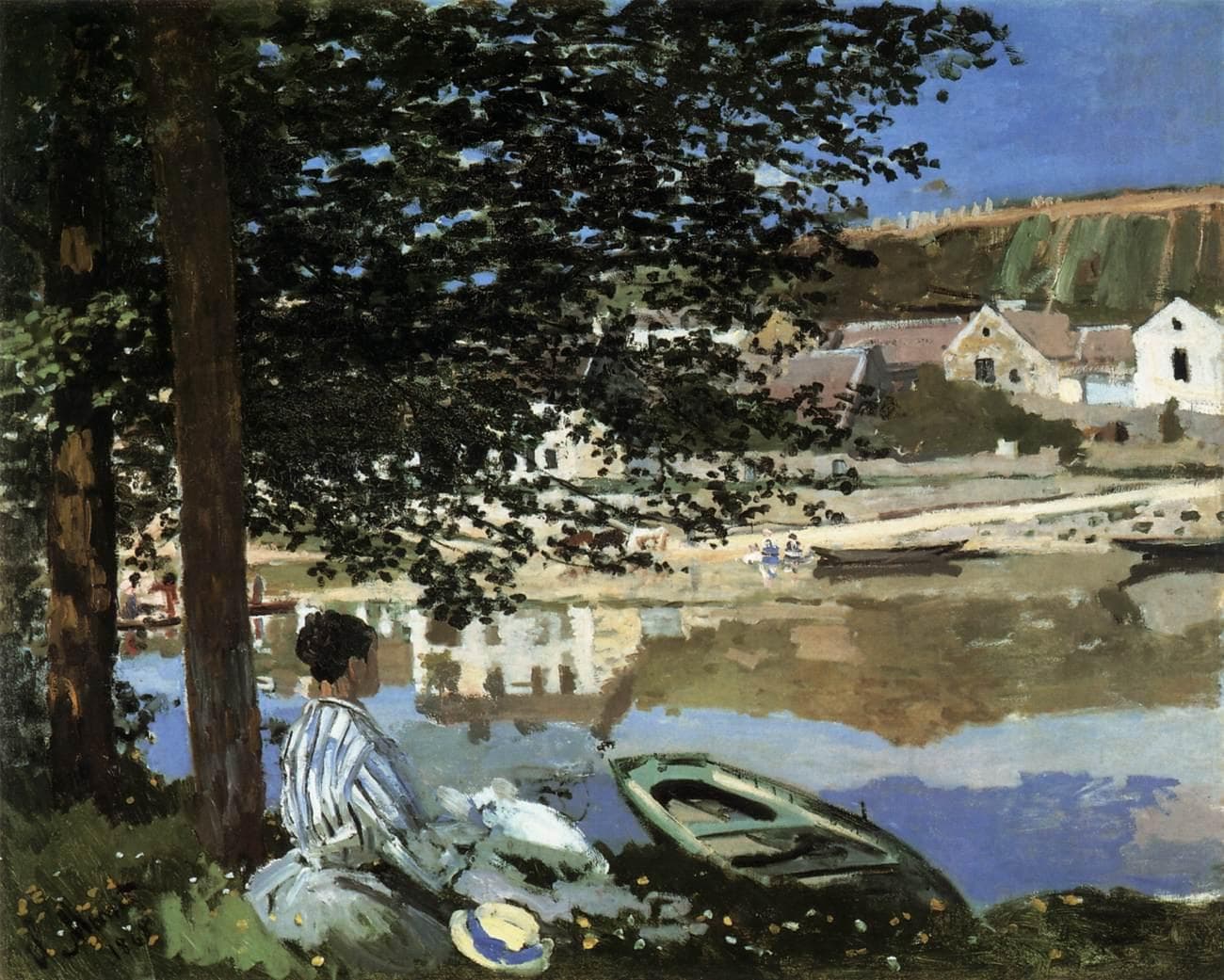
The winter of 1892–93 was severe, and the Seine froze. When the thaw began, Monet worked on the bank near Bennecourt, a village a few miles upstream from Giverny, just across the boundary between Normandy and the Île-de-France. He knew the place well. He had painted On the Bank of the Seine, Bennecourt there in 1868 and had lived close by since 1883, as told on our Giverny page.
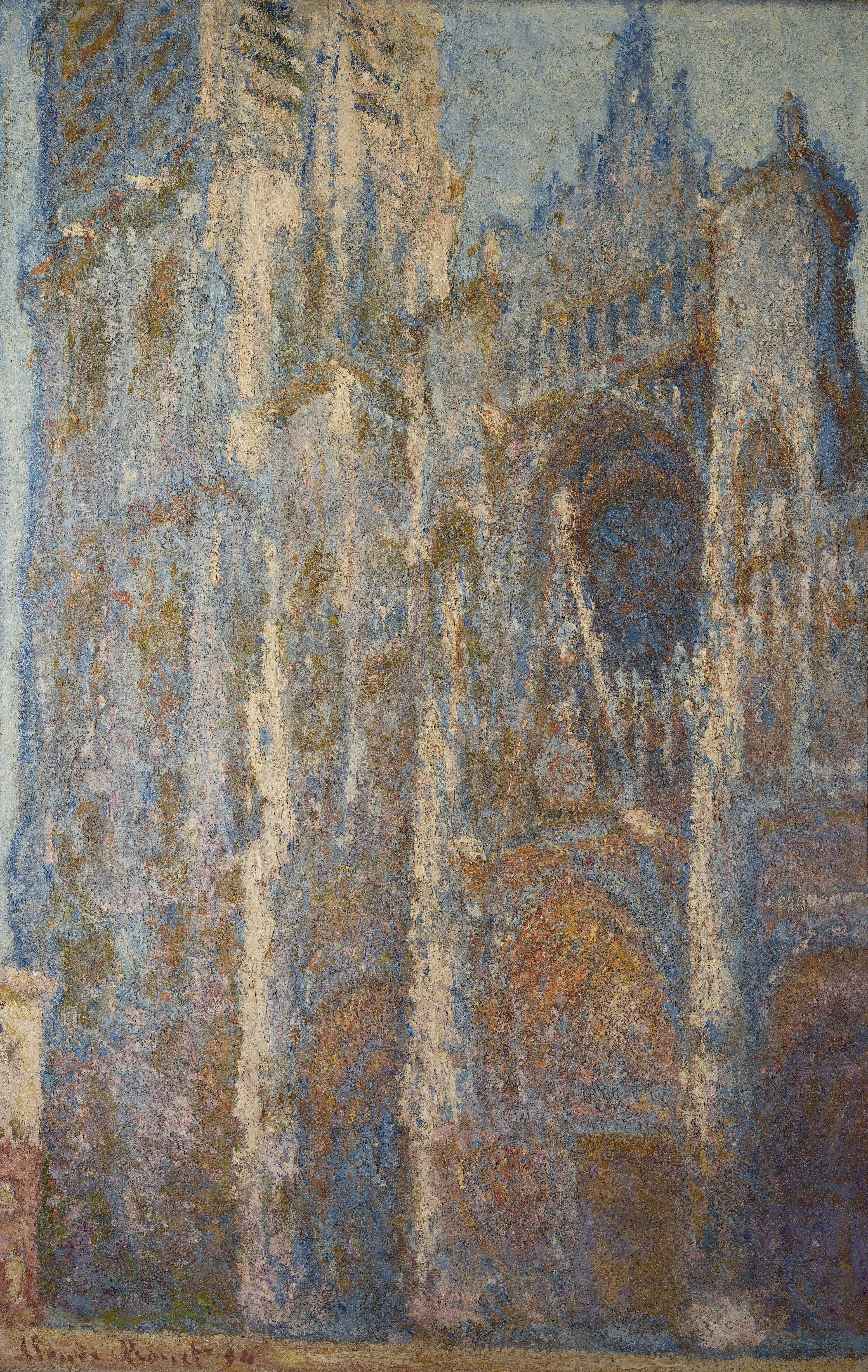
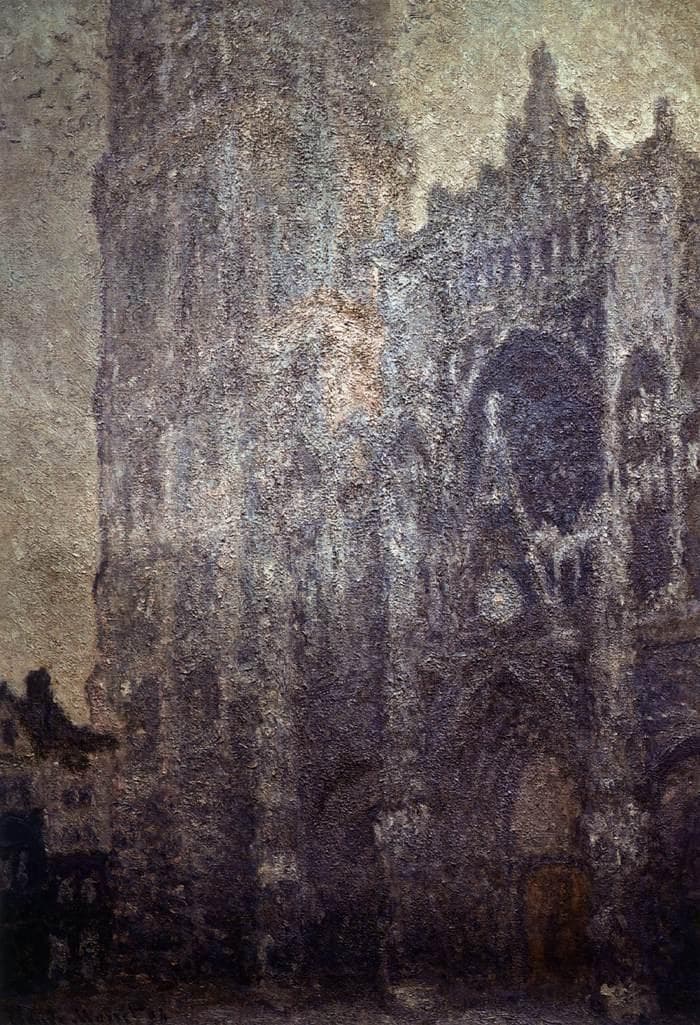
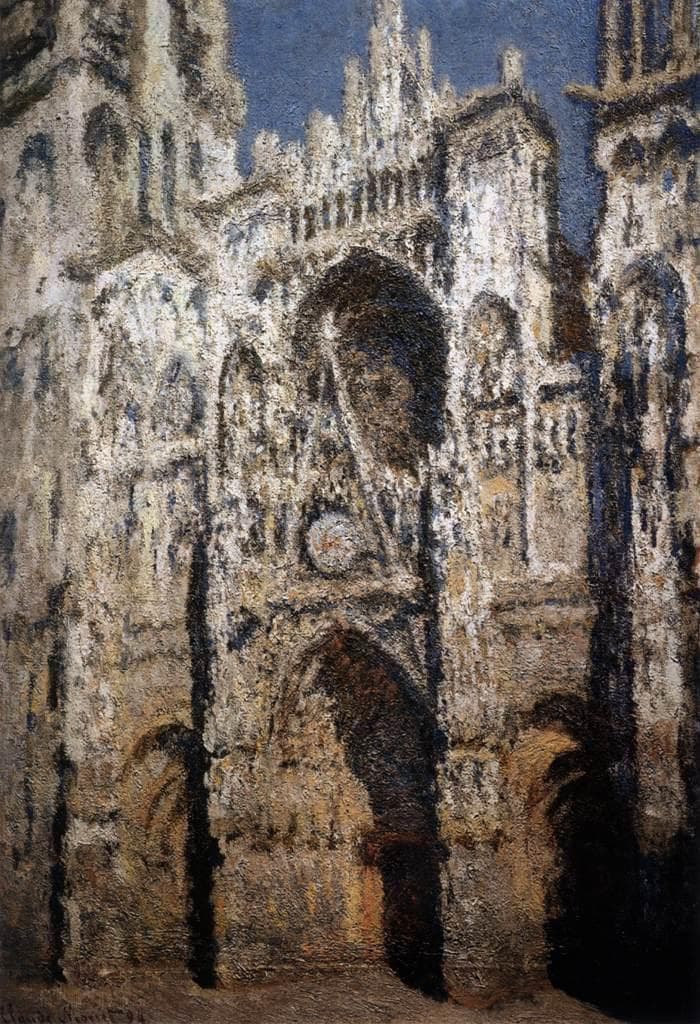
The ice campaign was short, probably a few weeks in January and February, before Monet returned to Rouen to continue the Rouen Cathedral series.
How was it painted?
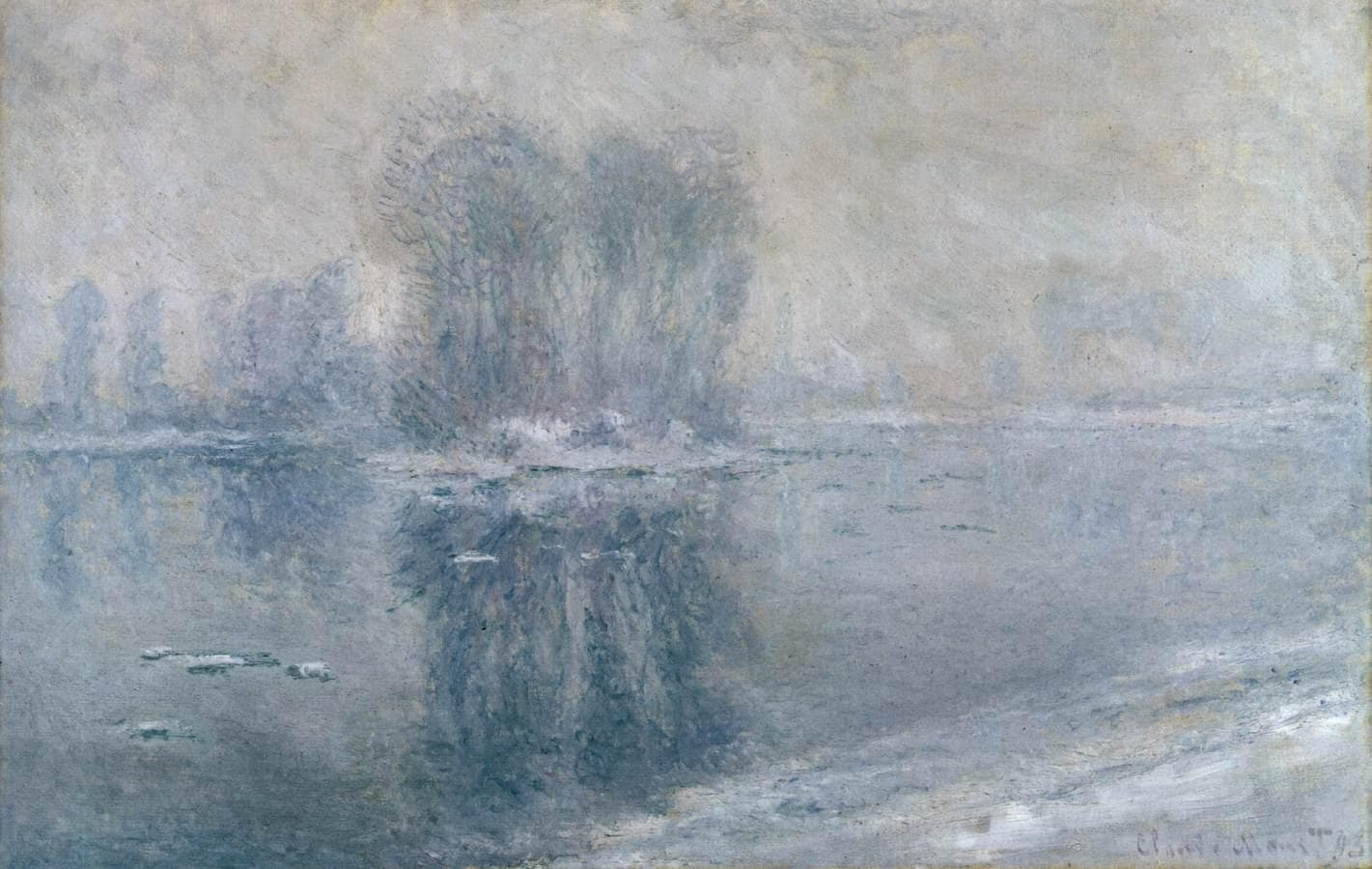
The handling is denser and more agitated than in the foggy canvas at the Metropolitan Museum, Ice Floes. There, the ice is reduced to a few plates in still water. Here it covers the whole river, and every floe is a separate mark, so the surface seems to slide and jostle. The color of the strokes shifts from cool green-white at the edges to warm silver in the glare, recording how the low light caught the ice.
The composition is lopsided by design. The heavy, dark thicket is pushed against the left edge, and the open shine of ice and haze takes up the rest. Monet would build many later water garden pictures the same way, with a mass of foliage at one side and a sheet of reflecting water beyond.
How does this version differ from the others?
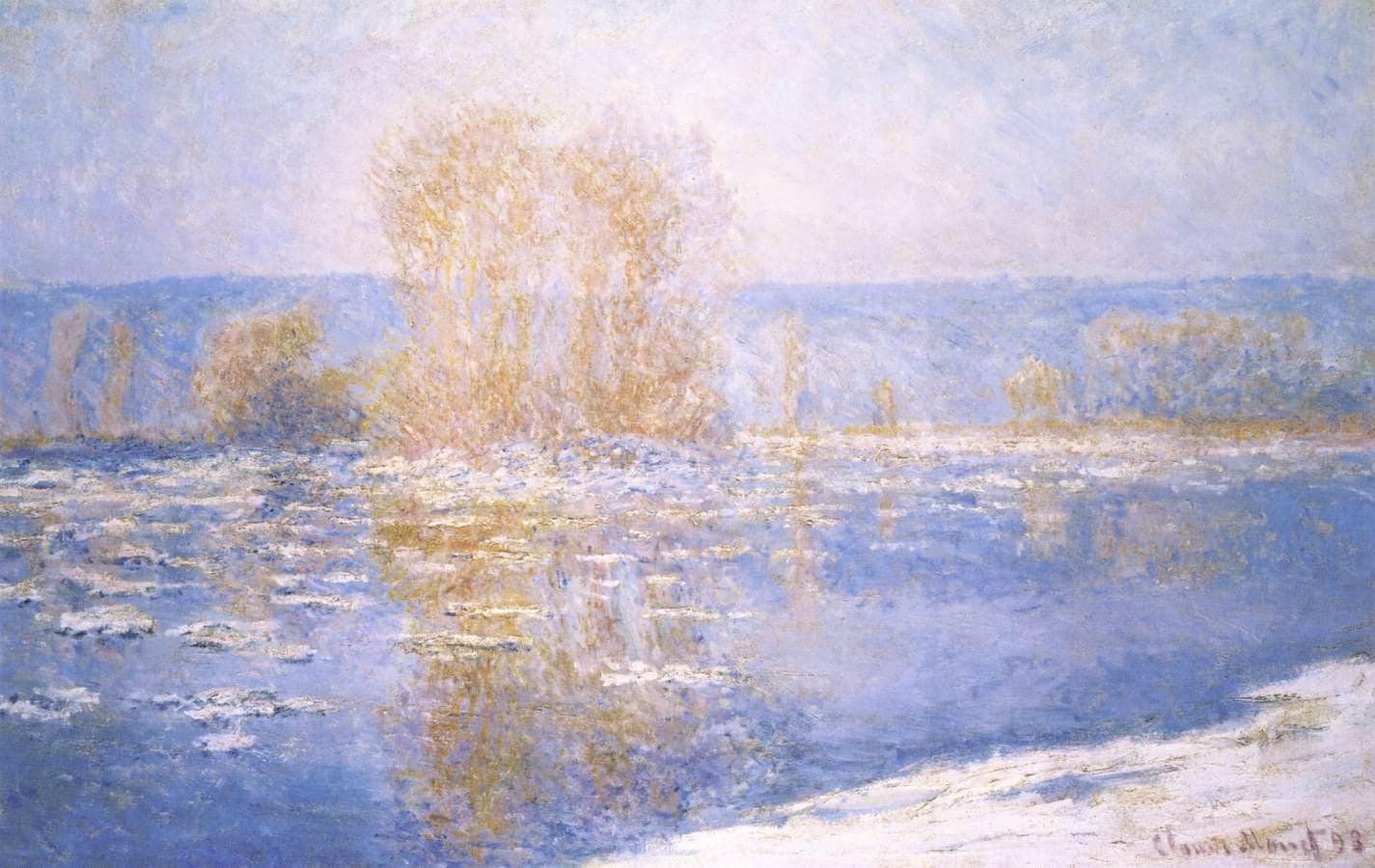
Wildenstein numbers the Bennecourt ice paintings from W 1333 to W 1344. Several focus on a small wooded island in the river, among them Floating Ice at Bennecourt, a sunny version with golden trees, and the misty Met canvas. This picture belongs to a different subgroup that looks across toward the hills with a thicket at the left.
Its nearest twin is W 1340, Ice Breaking Up on the Seine near Bennecourt, in the Walker Art Gallery in Liverpool. The two share the same thicket, the same poplar and the same line of hills, and they are the same size. The Liverpool picture is grayer and cooler, with crisper ice, while this one is bathed in mauve haze and dominated by the band of glare. The pair shows the series method at close range: the same motif painted again as the weather changed.
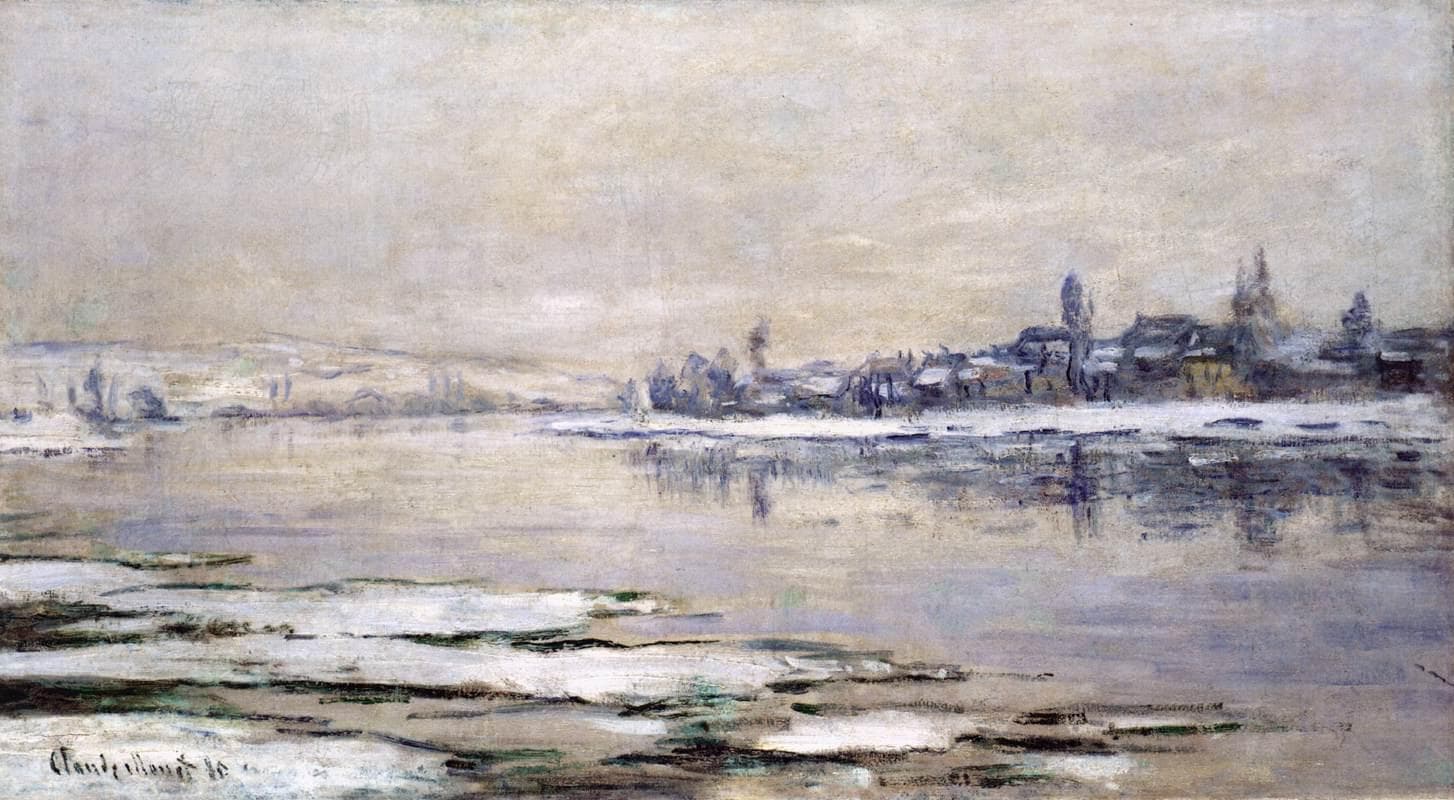
Monet had painted the breakup of the ice once before, at Vétheuil in January 1880, in darker and more turbulent canvases such as The Breakup of the Ice at Lavacourt. The 1893 pictures are calmer and lighter in key, more concerned with atmosphere than with the drama of the thaw.
Where can you see it?
The painting is privately owned and is rarely exhibited. To see Monet's 1893 ice pictures in public, go to the Metropolitan Museum in New York, the Walker Art Gallery in Liverpool, the Philadelphia Museum of Art, the Museum Barberini in Potsdam or the Museum Langmatt in Baden, Switzerland. Our guide to where to see Monet's paintings covers the major collections.
Questions & answers
Where is Monet's Ice Floes on the Seine near Bennecourt?
It is in a private collection and is rarely exhibited. The canvas, catalogued as W 1339 by Wildenstein, measures 65 by 100 centimeters. Its closest public relative is W 1340 in the Walker Art Gallery, Liverpool, which shows the same thicket and hills, and the misty Ice Floes of the same winter is at the Metropolitan Museum of Art.
When and where did Monet paint Ice Floes on the Seine near Bennecourt?
He painted it in early 1893 on the Seine near Bennecourt, a village a few miles upstream from his home at Giverny, after a hard freeze. Bennecourt lies in the Yvelines department, just across the boundary from Giverny in Normandy. Monet had painted there in 1868 and returned to the riverbank to record the ice breaking up.
What does Ice Floes on the Seine near Bennecourt show?
It shows the Seine covered with broken ice, painted as hundreds of short white and silver strokes, flowing past a dark thicket of bare trees at the left. Beyond, a low island and a line of hills dissolve into mauve haze, and a band of glare spreads across the ice where the low winter sun breaks through.
How many ice floe paintings did Monet make at Bennecourt?
About a dozen. Wildenstein's catalogue lists them as W 1333 to W 1344, painted in the winter of 1893. Some look at a wooded island in sun or fog, others, like this one, look across to the hills past a thicket. Monet had painted an earlier ice group at Vétheuil in 1880.
More by the artist
Claude Monet

Bridge over a Pond of Water Lilies
Claude Monet · 1899

Woman with a Parasol – Madame Monet and Her Son
Claude Monet · 1875

Sunset in Venice
Claude Monet · 1908–12

La Grenouillère
Claude Monet · 1869

Beach in Pourville
Claude Monet · 1882

Springtime
Claude Monet · 1872

Boating on the River Epte
Claude Monet · 1890

The Seine at Asnières (Hermitage)
Claude Monet · 1873
Also painted in 1893
The same year
Kindred works
You may also study
Ice Floes
Claude Monet · 1893
Floating Ice at Bennecourt
Claude Monet · 1893
Morning Haze
Claude Monet · 1894
The Breakup of the Ice at Lavacourt
Claude Monet · 1880
On the Bank of the Seine, Bennecourt
Claude Monet · 1868

The Scream
Edvard Munch · 1893

Ophelia
John Everett Millais · 1851–52

The Great Wave off Kanagawa
Katsushika Hokusai · c. 1830–32