Impressionism
Ice Floes
Claude Monet, 1893
Ice Floes is Claude Monet's 1893 painting of the frozen Seine near Bennecourt, a few miles from Giverny, with island trees and their reflections dissolving in white fog. It is in the Metropolitan Museum of Art, New York.
- Artist
- Claude Monet
- Date
- 1893
- Medium
- Oil on canvas
- Dimensions
- 66 × 100.3 cm
- Collection
- Metropolitan Museum of Art, New York, United States
- Movement
- Impressionism
- Catalogue
- Wildenstein W 1335
Painted at Giverny: Monet's House and GardenMore at Monet at the Met
Ice Floes (Les Glaçons) is a winter landscape that Claude Monet painted on the Seine near Bennecourt, a few miles upstream from his home at Giverny, during the hard freeze of early 1893. Signed and dated "93" at lower right, the canvas measures 66 by 100.3 centimeters. It belongs to the Metropolitan Museum of Art in New York, which received it in 1929 with the bequest of Louisine Havemeyer.
What you are looking at
At first the picture seems to be almost empty, a sheet of milky white. Then the forms come forward.
In the center a clump of tall, bare trees rises from a small island, its branches a tangle of blue-gray and violet strokes that fade upward into the fog. At its foot sits a bright patch of snow, the lightest note in the painting. To the left, a line of slimmer trees, probably poplars, recedes along the bank as paler and paler ghosts. To the right, the far shore is little more than a change in tone.
The lower half is water. Directly beneath the island its reflection drops in long, dark vertical strokes of blue, green and lilac, darker and more solid than the trees themselves. It is one of those reversals Monet loved: the reflection is easier to read than the thing reflected. A few flat slabs of ice float at lower left, each a short horizontal stroke of white with a shadow of blue-green beneath, and a thin floe drifts across the reflection in the center.
In the lower right corner a snow-covered bank slopes into the picture in quick diagonal strokes of white and pale blue. It gives us somewhere to stand, and it is the only place in the painting where the brush moves fast. The sky and the far bank merge into a single field of warm cream and gray, with no horizon line at all.
Where and when was it painted?
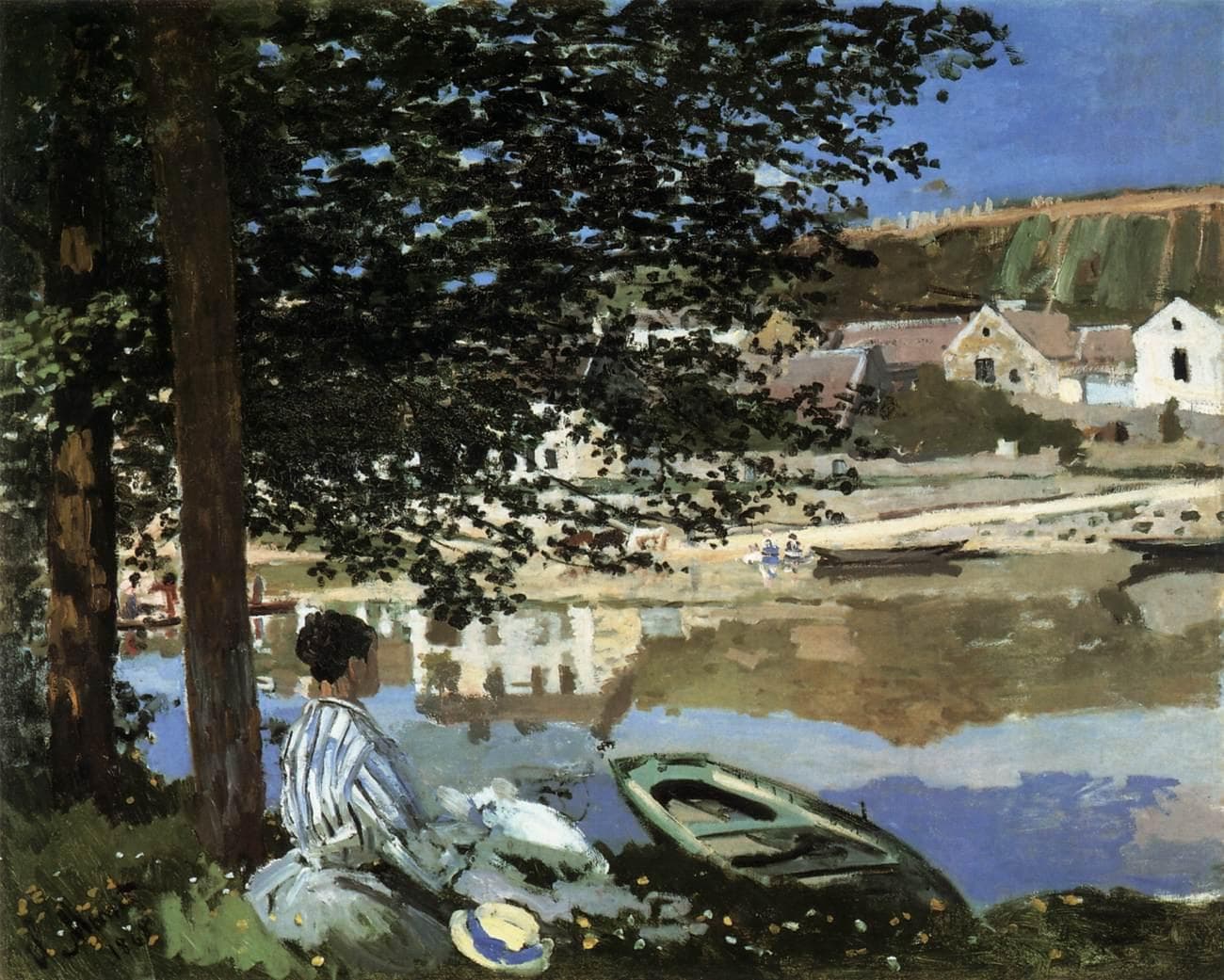
The winter of 1892–93 was unusually cold in northern France, and the Seine froze. When the ice began to break up, Monet went out to the riverbank at Bennecourt and worked on a group of about a dozen canvases, numbered W 1333 to W 1344 in Wildenstein's catalogue. Most show the same island and the same stretch of river from slightly different spots, in sun, fog, evening light and haze. He had painted at Bennecourt as a young man in 1868 and had lived nearby since moving to Giverny in 1883, so this was home ground, part of the landscape described on our Giverny page.
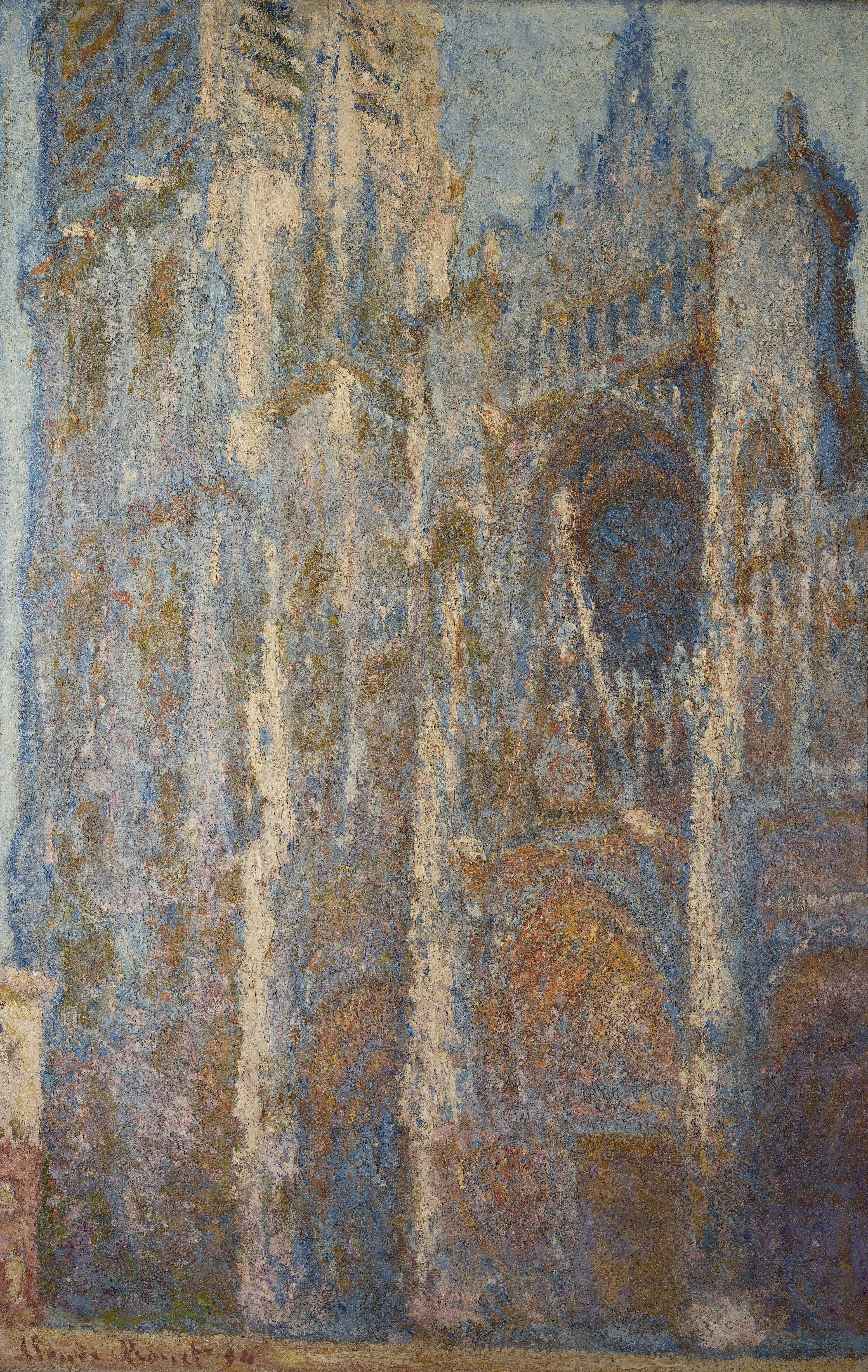
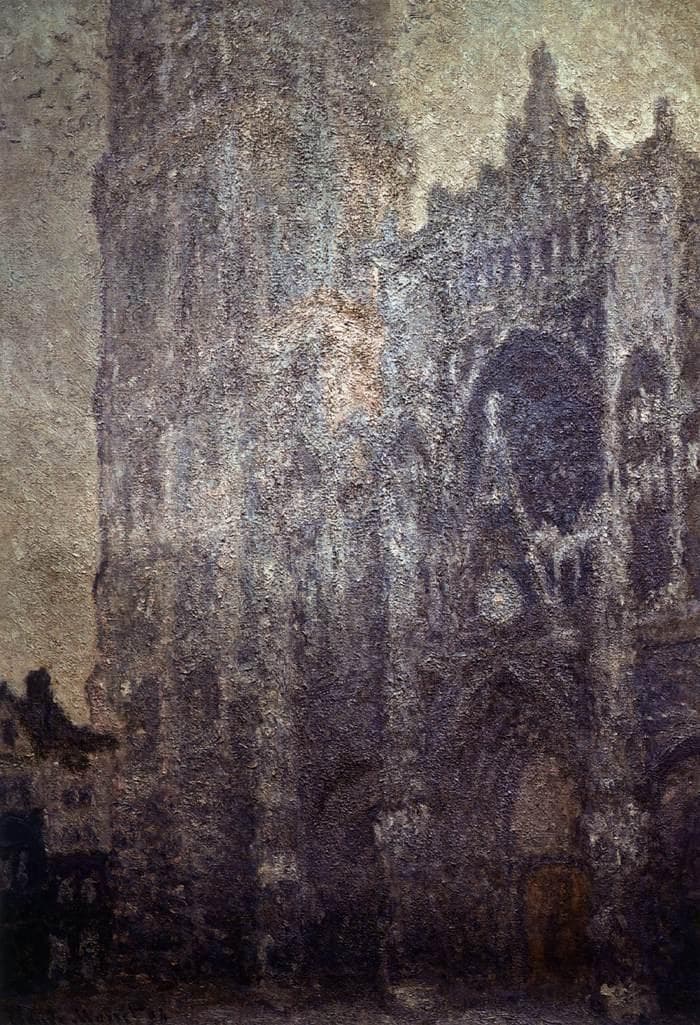
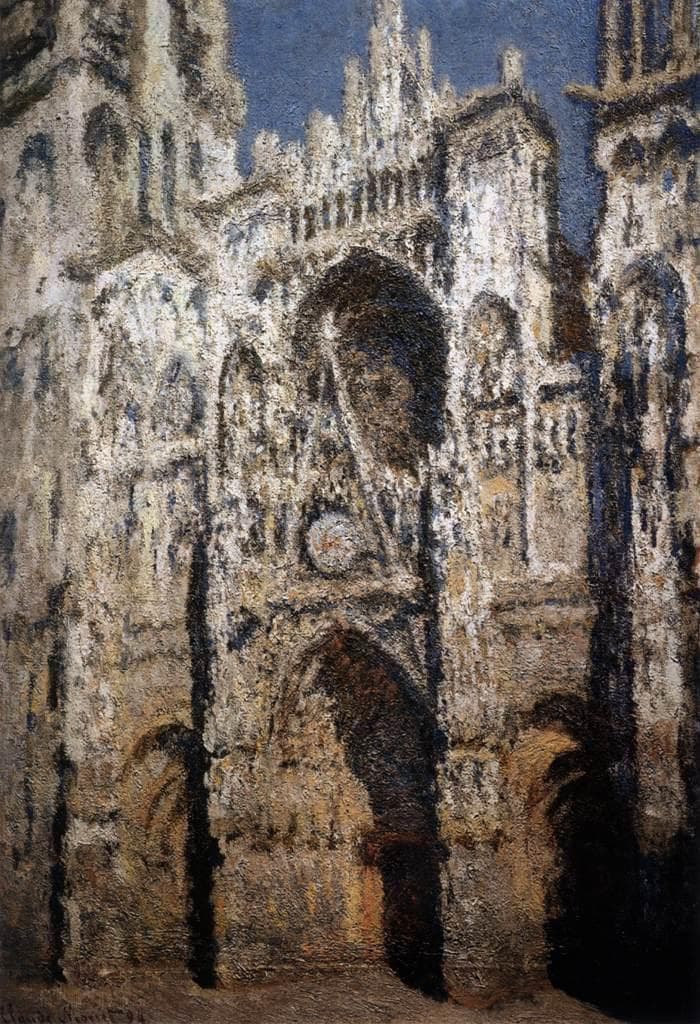
It was also a busy moment. The Poplars had been exhibited the year before, and within weeks Monet would be back in Rouen for his second winter campaign on the Rouen Cathedral series, begun in 1892. The ice pictures share the series idea: one motif, many conditions.
How it was painted
This is a painting about how little color you need. Almost everything is mixed from white with small additions of blue, violet, green and ochre, and the differences between neighboring areas are tiny. Monet lets the weave of the canvas show through the thin sky, while the island trees and their reflection carry thicker, more broken paint.
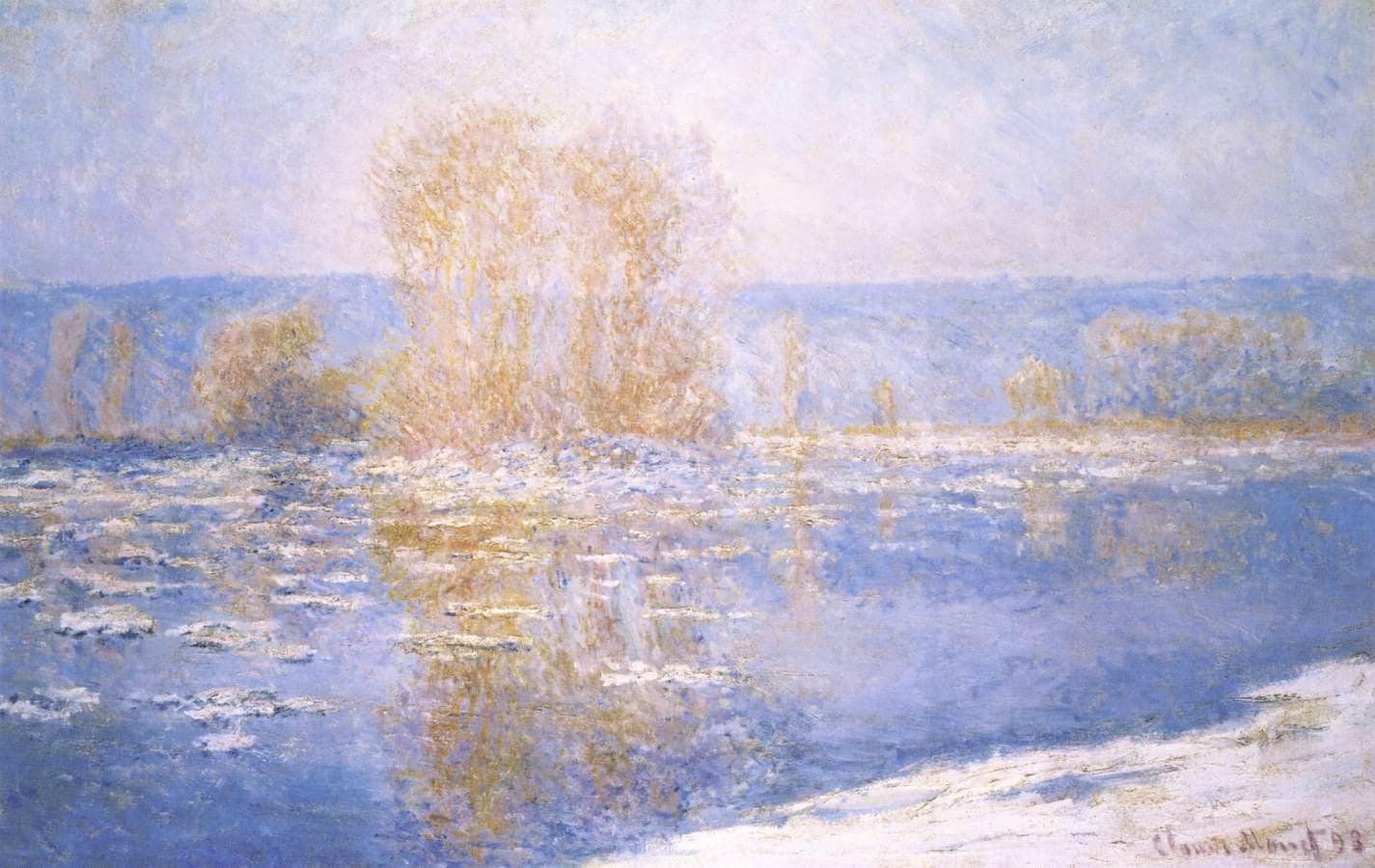
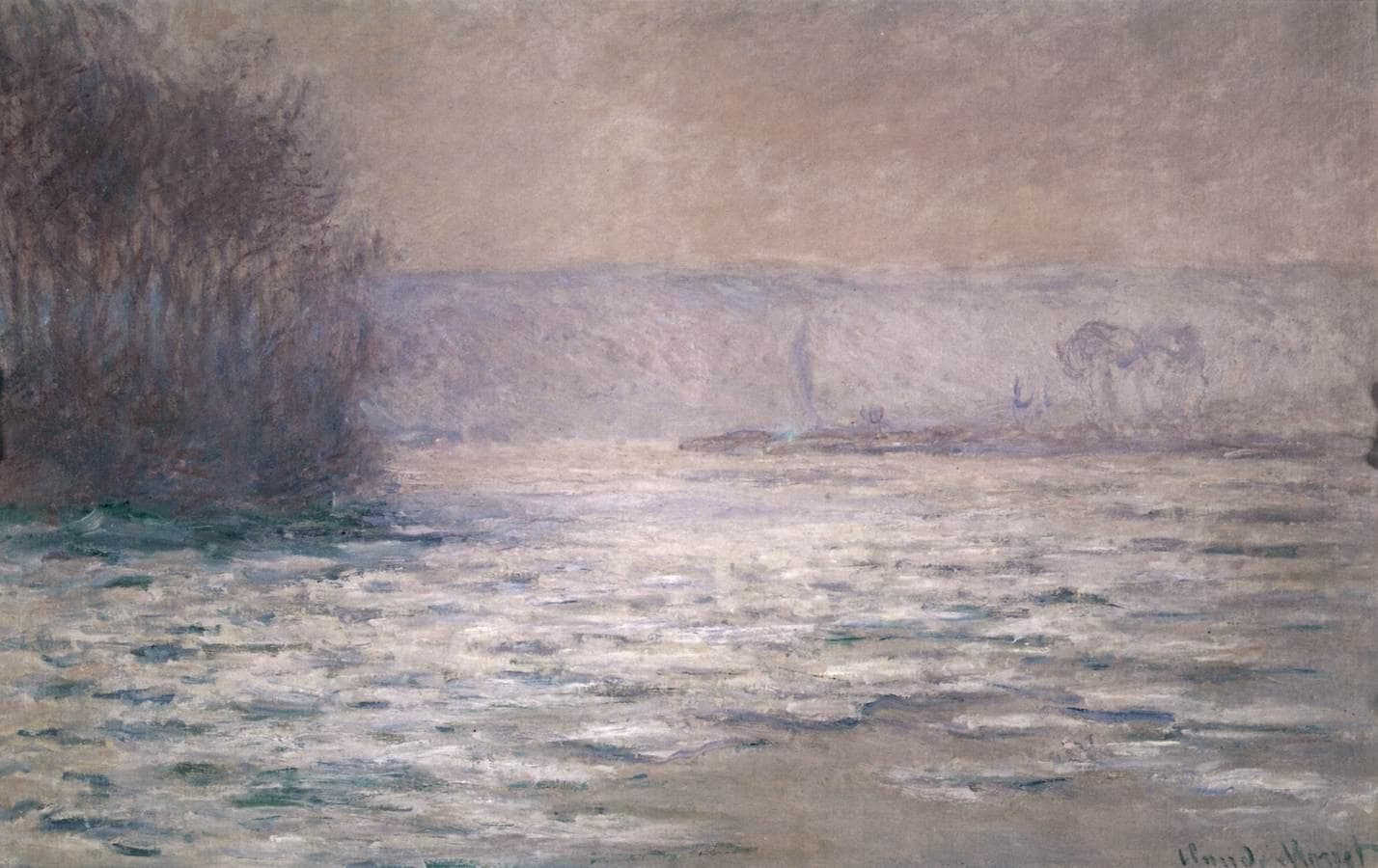
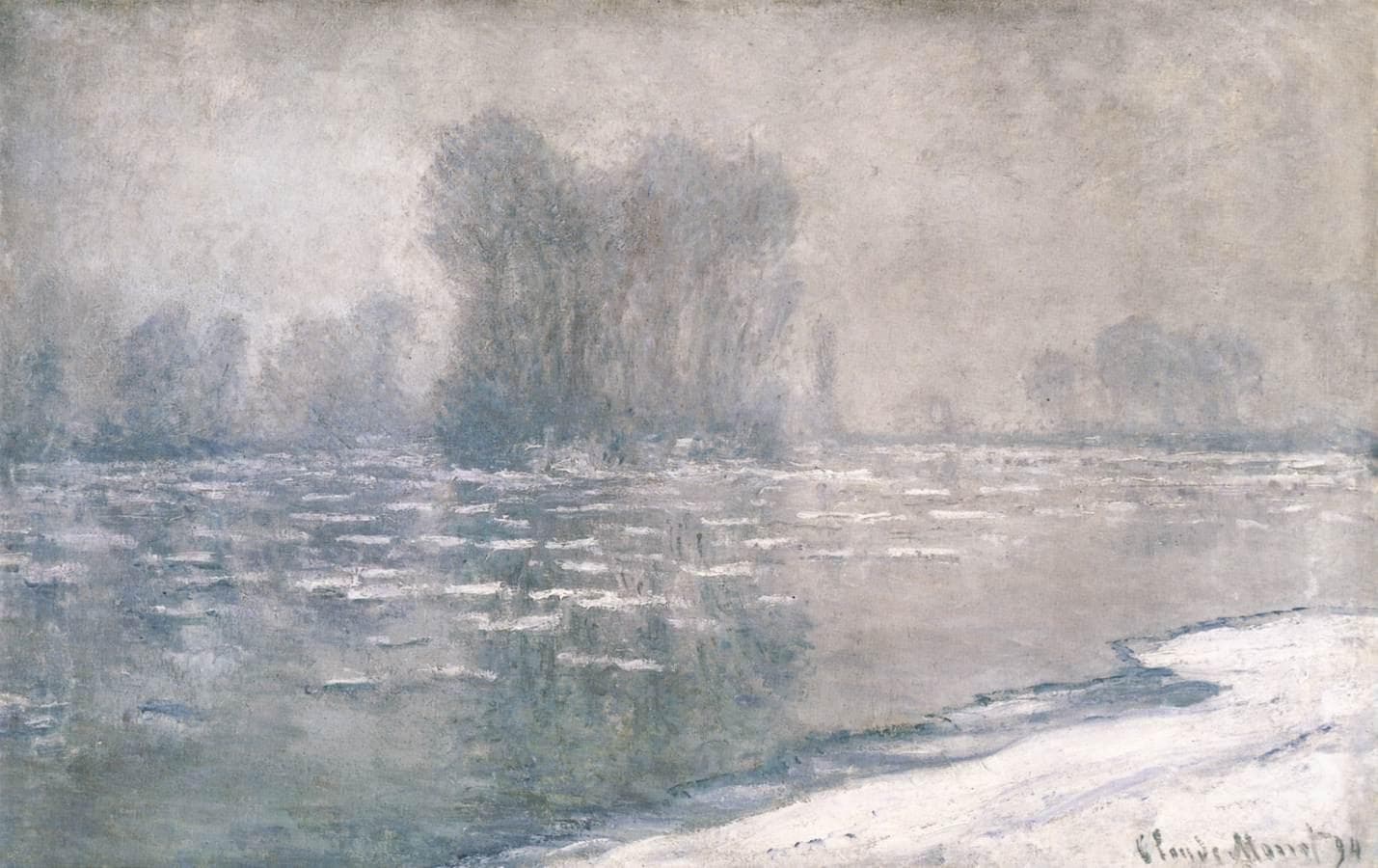
Compare it with Floating Ice at Bennecourt, which shows almost the same island under bright sun, its trees burning gold and pink against blue water. Placed side by side, the two canvases make the series method obvious: same trees, same floes, same snowy bank, and an entirely different picture. The Philadelphia Museum's Morning Haze goes further into fog than this one, while Ice Floes on the Seine near Bennecourt turns the view toward the hills and a field of glittering ice.
How do the 1893 ice paintings differ from Vétheuil?
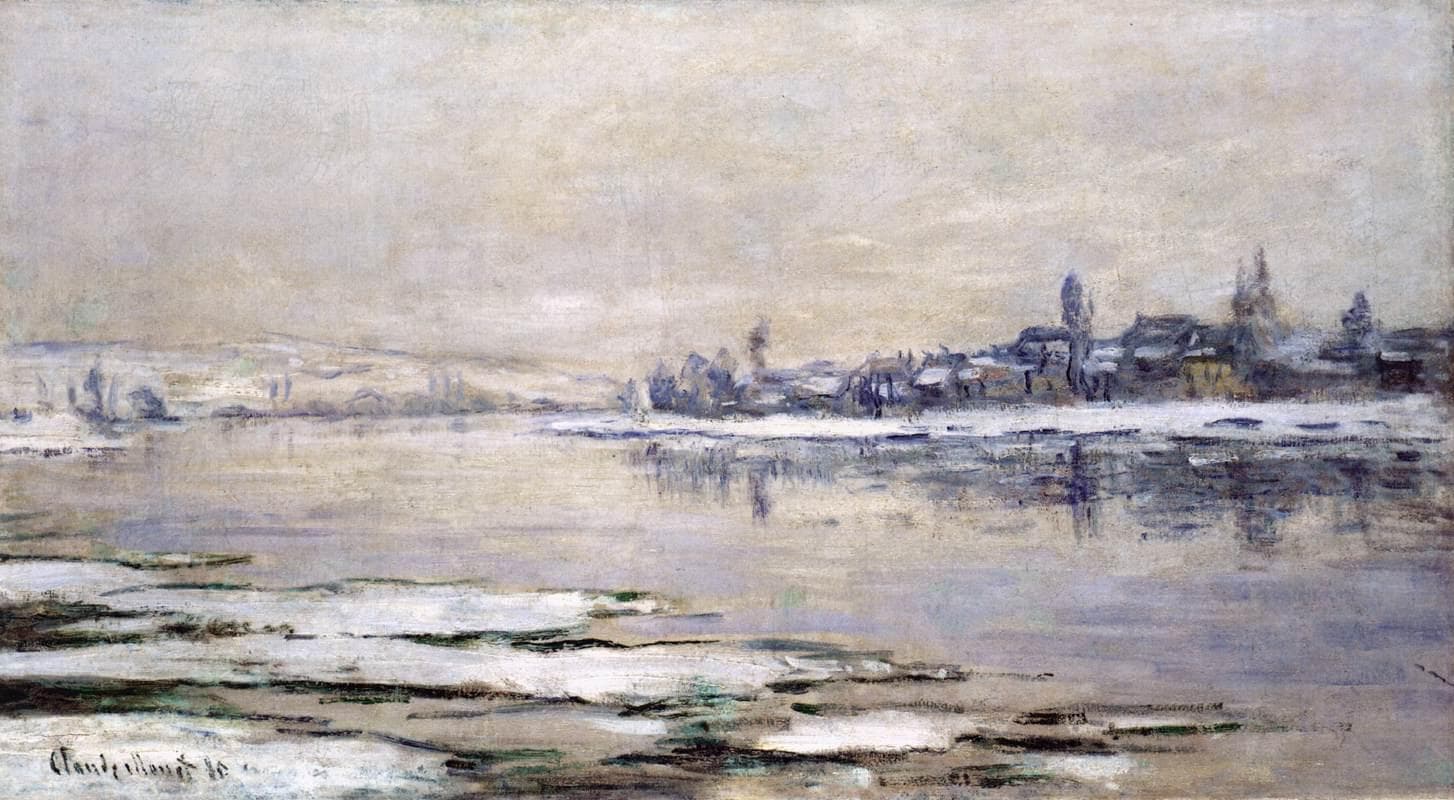
Monet had painted the breakup of the Seine once before, at Vétheuil in January 1880, a few months after the death of his first wife Camille. Those pictures, like The Breakup of the Ice at Lavacourt, are darker and more agitated, crowded with heaving floes under gray skies, and are discussed on our Vétheuil page. The 1893 group is quieter. The ice has thinned to scattered plates, and the subject has shifted from the violence of the thaw to the stillness of fog and reflection, the same mirrored symmetry that would later govern the water lily pond.
Where can you see it?
Ice Floes is in the Metropolitan Museum of Art, accession number 29.100.108, part of the H. O. Havemeyer Collection that forms the core of the museum's Impressionist holdings. It usually hangs with the Met's other Monets, which are gathered on our Monet at the Met page.
Questions & answers
Where is Monet's Ice Floes?
It is in the Metropolitan Museum of Art in New York, accession number 29.100.108. It came to the museum in 1929 with the bequest of Louisine Havemeyer, part of the H. O. Havemeyer Collection, which forms the core of the Met's Impressionist paintings. The canvas measures 66 by 100.3 centimeters.
When and where did Monet paint Ice Floes?
He painted it in early 1893 on the Seine near Bennecourt, a few miles upstream from his home at Giverny, after a severe freeze. The canvas is signed and dated 93 at lower right. Soon afterward Monet returned to Rouen to continue his cathedral series, so the ice pictures were made in the middle of his great series years.
Why does Monet's Ice Floes look almost white?
Monet was painting fog over a frozen river. He built the picture from very close tones of white, cream, gray and pale blue, so the island trees emerge only as soft shapes. Their reflection in the water is darker and clearer than the trees themselves, and a few slabs of ice and a snowy bank anchor the foreground.
How many ice floe paintings did Monet make in 1893?
About a dozen. Wildenstein's catalogue lists the Bennecourt and Port-Villez ice pictures as W 1333 to W 1344, most showing the same island and river in sun, fog, haze or evening light. Public examples include this canvas at the Met, Morning Haze in Philadelphia, and versions in Liverpool, Potsdam and Baden, Switzerland.
More by the artist
Claude Monet

Bridge over a Pond of Water Lilies
Claude Monet · 1899

Woman with a Parasol – Madame Monet and Her Son
Claude Monet · 1875

Sunset in Venice
Claude Monet · 1908–12

La Grenouillère
Claude Monet · 1869

Beach in Pourville
Claude Monet · 1882

Springtime
Claude Monet · 1872

Boating on the River Epte
Claude Monet · 1890

The Seine at Asnières (Hermitage)
Claude Monet · 1873
Also painted in 1893
The same year
Kindred works
You may also study
Floating Ice at Bennecourt
Claude Monet · 1893
Ice Floes on the Seine near Bennecourt
Claude Monet · 1893
Morning Haze
Claude Monet · 1894
The Breakup of the Ice at Lavacourt
Claude Monet · 1880
On the Bank of the Seine, Bennecourt
Claude Monet · 1868

The Scream
Edvard Munch · 1893

Ophelia
John Everett Millais · 1851–52

The Great Wave off Kanagawa
Katsushika Hokusai · c. 1830–32