Impressionism
Stormy Sea
Claude Monet, c. 1881–84
Stormy Sea (Mer agitée) is a seascape by Claude Monet painted on the Channel coast in the early 1880s: rows of breaking surf under a wind-torn sky. The 60 × 73.7 cm canvas (Wildenstein 663) is in the National Gallery of Canada, Ottawa.
- Artist
- Claude Monet
- Date
- c. 1881–84
- Medium
- Oil on canvas
- Dimensions
- 60 × 73.7 cm
- Collection
- National Gallery of Canada, Ottawa, Canada
- Movement
- Impressionism
- Catalogue
- Wildenstein 663
Painted at Étretat and the Normandy Coast
What you are looking at
There is no beach, no boat and no cliff in this picture, only water and air. Monet sets the horizon a little above the middle of the canvas and fills everything below it with surf. Rows of breaking waves stack up toward us, each one a band of churned cream, ocher and grey laid over darker blue-green troughs. Near the horizon a thin strip of darker green-blue water marks the open sea, beyond the breakers. Above, a slate-blue sky is broken by small, quickly painted clouds, puffs of white and apricot catching a light that never reaches the sea.
The brushwork changes with the motion it describes. In the sky the strokes are short dabs and commas, set at a slight diagonal as if pushed by the wind. In the sea they become long, curling horizontals, loaded with thick pale paint where the waves break, so the foam stands up from the canvas as real texture. Look at the dark line of the horizon: it is ruled almost straight, the one calm element in the picture, and it makes the turbulence below feel heavier.
The foam is not white. Monet paints it in warm creams and yellowish ochers, the color of surf churned up with sand in shallow water, and sets it against cold blue shadows in the troughs. That warm-cold contrast is what makes the sea seem to move. His signature sits low at the right, painted in dark blue, almost lost in the spray.
The Channel coast in the early 1880s
After the death of his first wife, Camille, in 1879, Monet spent long stretches of the early 1880s on the Channel coast, at Fécamp, Pourville, Varengeville and Étretat, the coastline gathered in our Normandy coast hub. He painted the sea from clifftops and beaches in all weathers, often working on several canvases at once and switching as the light changed. The National Gallery of Canada dates this picture to the early 1880s, and its Wildenstein number places it among the seascapes he painted on that coast at the start of the decade; the exact spot is not recorded.
How it was painted
The canvas is a standard size, about 60 by 74 centimeters, of the kind Monet carried along the cliffs. The sea was laid in with long, horizontal strokes of blue and green, and the breaking waves were added on top in thick, curving ribbons of pale paint, often with a single movement of the brush. The sky was painted quickly and thinly by comparison. It is the kind of picture that could be done in a few sessions, on the spot, in the wind. Step back and the separate strokes merge into rolling lines of surf; step close and they become a dense, almost abstract weave of paint.
A sea without landmarks
Pictures like this one, with nothing to anchor the eye but the horizon, are among Monet's most radical of those years. Compare Waves Breaking of 1881 in San Francisco, another canvas given over to surf, and the cliff-framed seas of Rough Sea at Étretat and The Manneporte, Étretat. They look ahead to the stripped-down seas he painted at Belle-Île in 1886, such as Storm off Belle-Île, where even the horizon disappears.
Meaning
The subject has a pedigree. Claude Monet had grown up in Le Havre and learned to paint outdoors on that coast with Eugène Boudin, and Gustave Courbet's wave paintings of the late 1860s were a direct precedent for a canvas given over entirely to breaking water. Where Courbet's waves are heavy and sculptural, Monet's are broken into light and movement, a record of a moment rather than a monument.
Where to see it
Stormy Sea is in the collection of the National Gallery of Canada in Ottawa, alongside other Monets including a Waterloo Bridge. For museums worldwide, see where to see Monet's paintings.
Questions & answers
Where is Monet's Stormy Sea?
Monet's Stormy Sea (Mer agitée, Wildenstein 663) is in the National Gallery of Canada in Ottawa. It is an oil on canvas of about 60 by 74 centimeters, painted on the Channel coast in the early 1880s, and is one of a small group of Monet paintings in the Ottawa collection.
When did Monet paint Stormy Sea?
The date is given variously between 1881 and about 1884. Both fall in the years when Monet worked repeatedly on the Channel coast, at Fécamp, Pourville and Étretat, painting the sea in changing weather. The exact place is not recorded.
What does Stormy Sea show?
Nothing but sea and sky: rows of breaking surf in cream, ocher and grey rolling toward the viewer under a slate-blue sky with small wind-blown clouds. With no boats, cliffs or beach, the subject is the movement of the water and the weather itself.
Why are there no boats or cliffs in Stormy Sea?
Monet reduced the picture to sky, horizon and breaking surf so that the subject is the motion and the weather. Thick pale paint gives the foam physical texture. This stripped-down approach anticipates his Belle-Île seascapes of 1886 and, later, the near-abstract surfaces of the Water Lilies.
More by the artist
Claude Monet

Bridge over a Pond of Water Lilies
Claude Monet · 1899

Woman with a Parasol – Madame Monet and Her Son
Claude Monet · 1875

Sunset in Venice
Claude Monet · 1908–12

La Grenouillère
Claude Monet · 1869

Beach in Pourville
Claude Monet · 1882

Springtime
Claude Monet · 1872

Boating on the River Epte
Claude Monet · 1890

The Seine at Asnières (Hermitage)
Claude Monet · 1873
Also painted in 1881
The same year
Kindred works
You may also study
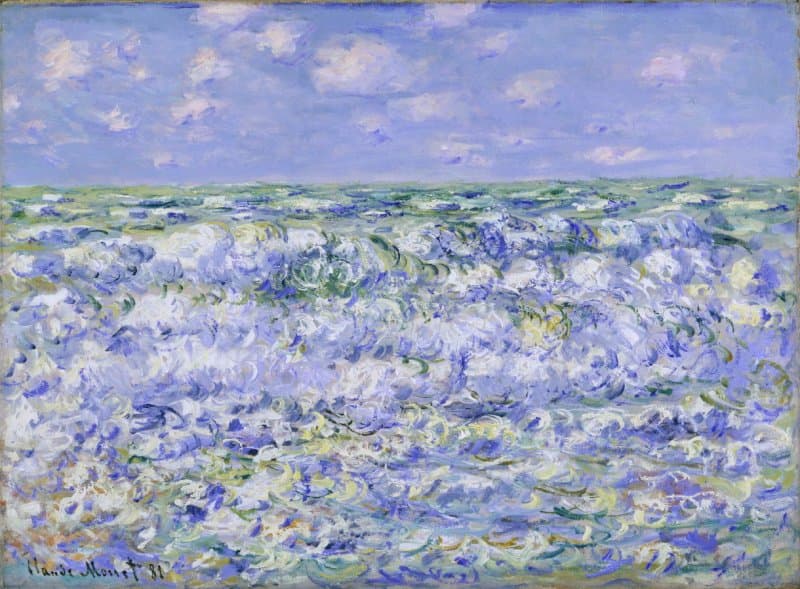
Waves Breaking
Claude Monet · 1881
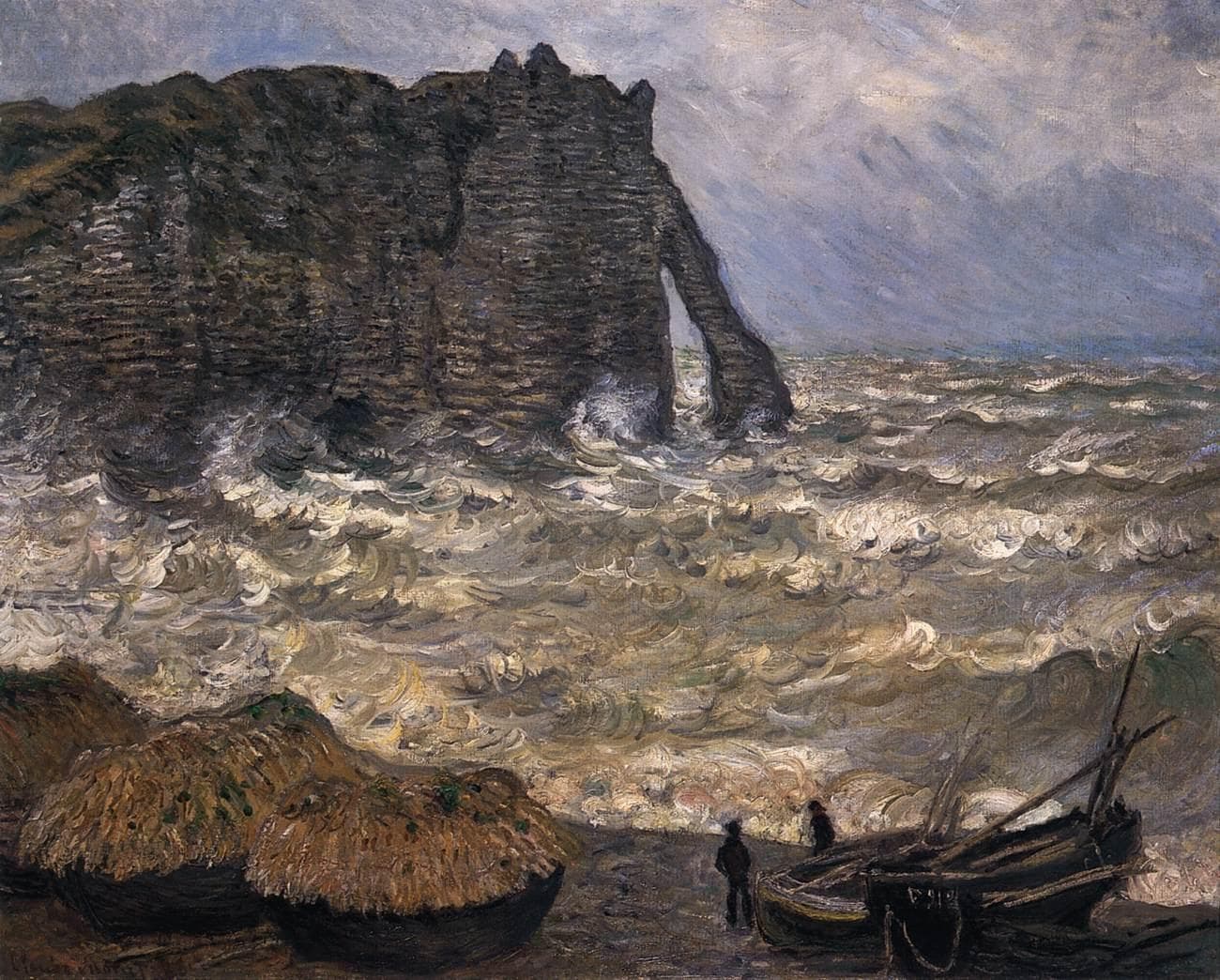
Rough Sea at Étretat
Claude Monet · 1883
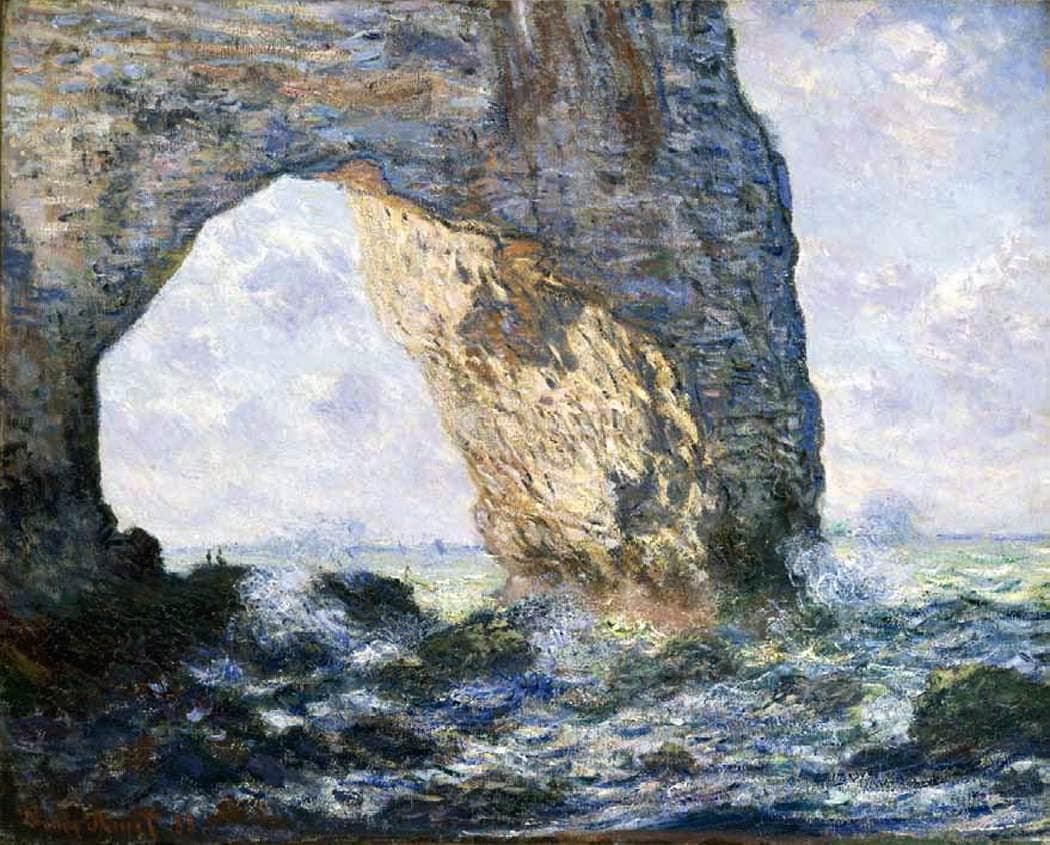
The Manneporte (Étretat)
Claude Monet · 1883
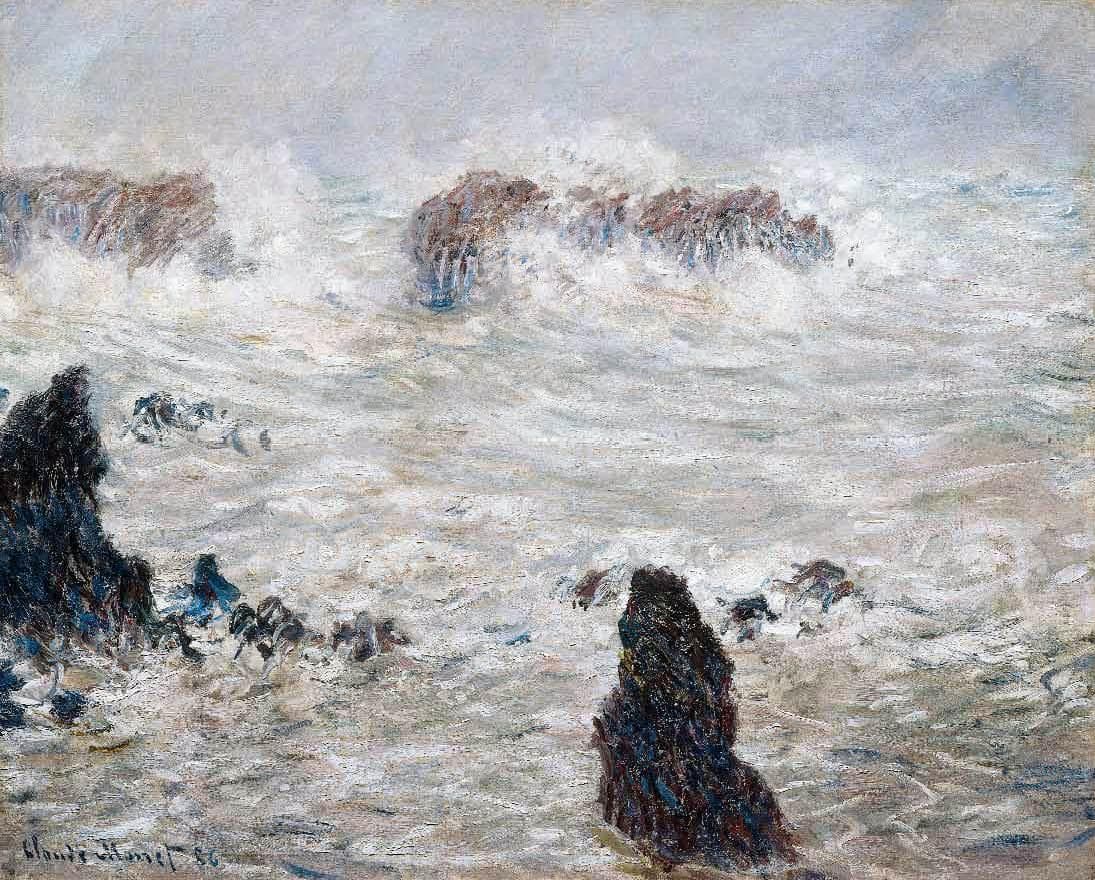
Storm off Belle-Île
Claude Monet · 1886
The Rocks of Belle-Île, the Wild Coast
Claude Monet · 1886

The Scream
Edvard Munch · 1893

Ophelia
John Everett Millais · 1851–52

The Great Wave off Kanagawa
Katsushika Hokusai · c. 1830–32