Impressionism
Bouquet of Sunflowers
Claude Monet, 1881
Bouquet of Sunflowers is an 1881 still life by Claude Monet, painted at Vétheuil from sunflowers grown along his garden path. It is in the Metropolitan Museum of Art, New York, and is the Monet that Gauguin and Van Gogh discussed in 1888.
- Artist
- Claude Monet
- Date
- 1881
- Medium
- Oil on canvas
- Dimensions
- 101 × 81.3 cm
- Collection
- Metropolitan Museum of Art, New York, United States
- Movement
- Impressionism
- Catalogue
- Wildenstein 628
Painted at Monet at VétheuilMore at Monet at the Met
What you are looking at
A great spray of sunflowers bursts out of a white vase painted with blue decoration, standing on a table covered with a rust-red cloth. Some heads face us full on, their dark centers ringed with ragged yellow petals; others turn away or droop on their stems; leaves splay out to the sides almost to the edges of the canvas. Behind them the wall is a shimmer of lavender, grey and pale blue strokes, cool colors chosen to make the yellows blaze. Monet's signature runs along the top right corner. Gauguin, who knew the picture, remembered the vase as a large Japanese one, and the whole arrangement has the slightly exotic air that Japanese ceramics brought to French interiors in these years.
Claude Monet painted Bouquet of Sunflowers in 1881, at Vétheuil, a village on the Seine northwest of Paris, using flowers that grew along the path to his garden. It is a large canvas, 101 by 81.3 centimeters, and is in the Metropolitan Museum of Art in New York, part of the H. O. Havemeyer Collection bequeathed in 1929.
Looking closely
The Met notes something that is easy to feel even in reproduction: the paint on the flower heads is applied so thickly that it forms ridges, and those ridges catch the light and cast their own tiny shadows. Monet is not drawing the sunflowers and coloring them in. He is building them out of paint, stroke by stroke, so the petals have the physical roughness of the real thing.
Look at the variety. No two flowers are painted the same way. The fully open heads are rings of short, curling strokes around a dense, dark core; the half-closed buds are tight knots of green and yellow; the older blooms sag, their petals tipped with brown. The leaves are slashed in with broad, wet strokes of several greens. The tall vase and the red cloth, flecked with darker strokes, by contrast are handled more loosely, enough to set the scene and no more. Monet clearly knew where he wanted the viewer to look, and spent his effort on the flowers.
The composition is not tidy. The bouquet leans, spills and crowds the frame. That sense of abundance, close to excess, is part of what made the picture striking in a period when flower painting was usually associated with careful, decorative arrangements.
Why Monet painted flowers at Vétheuil
Still life was not Monet's main interest, but in the years around 1880 he painted more of it than at any other time. His circumstances explain much of this. Camille, his first wife, had died at Vétheuil in September 1879, leaving him with two young sons, and the household he shared with Alice Hoschedé and her six children was perennially short of money. Flower pieces and still lifes sold more easily than landscapes, and the dealer Paul Durand-Ruel, who bought this canvas from the artist in October 1881, was willing to take them.
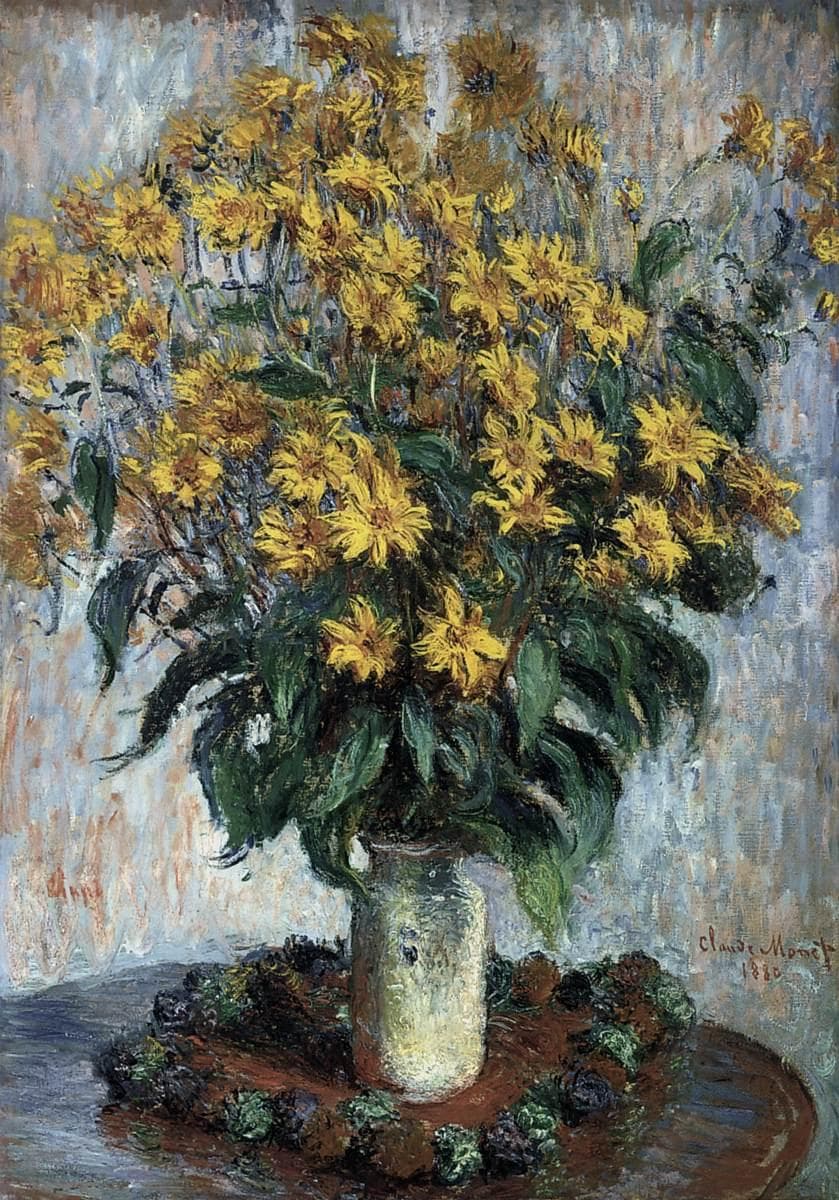
Monet showed Bouquet of Sunflowers at the seventh Impressionist exhibition in 1882, where critics singled out its handling. It hangs naturally beside his other Vétheuil flower pieces, including Jerusalem Artichoke Flowers of 1880, a picture of a close cousin of the sunflower painted at almost the same size.
Monet, Gauguin and Van Gogh's sunflowers
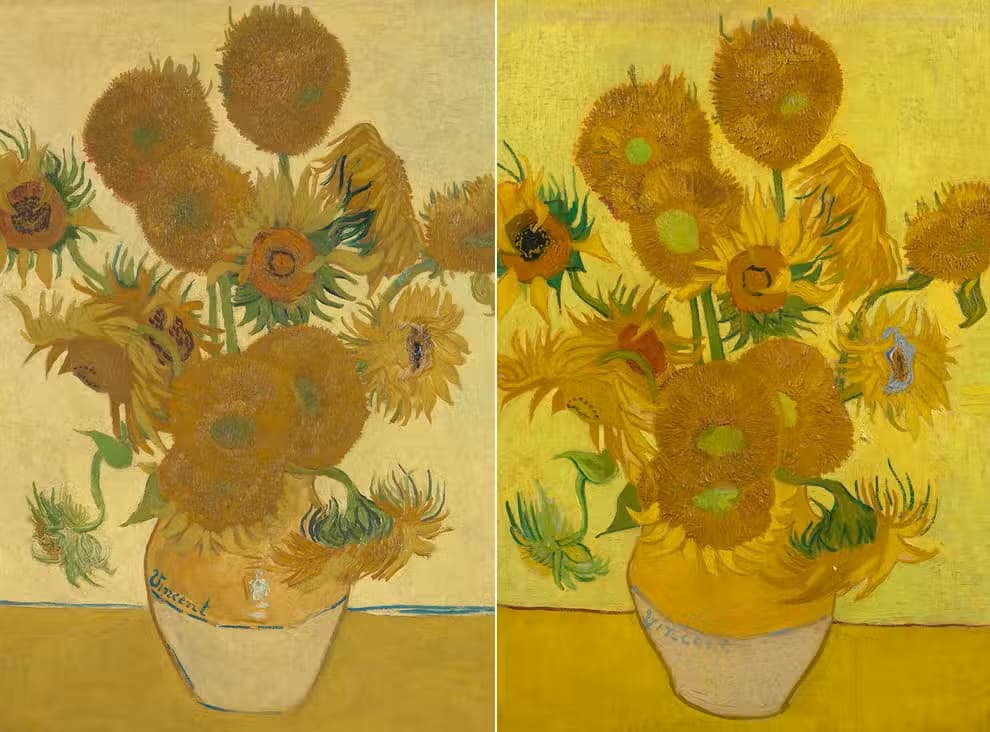
The painting has a second life in the story of Vincent van Gogh. In late 1888, while Paul Gauguin was staying with him in Arles, Van Gogh wrote to his brother Theo that Gauguin had seen a painting of sunflowers by Monet in a large Japanese vase, thought it very fine, but preferred Vincent's. The Monet Gauguin had in mind is generally identified with this canvas.
The comparison is revealing. Van Gogh's Sunflowers series turns the flowers into flat, emblematic shapes against strong grounds, outlined and almost heraldic. Monet's are looser, more tied to the moment of looking, closer to a bunch actually cut from the garden that morning. Both artists used thick paint to give the flowers body; they arrived at very different results.
Meaning and reception
Sunflowers carried old associations of devotion and constancy, from the plant's habit of turning to the sun, but there is no evidence Monet intended any symbolism here. The picture's meaning lies in its method: it shows the techniques of Impressionism, broken color, visible strokes, attention to light, applied to a subject indoors and close up. Its later fame owes a good deal to the Van Gogh connection, which has made it one of Monet's most discussed still lifes. It is also a reminder that the Impressionists did not think of flower painting as a lesser genre. Manet painted flowers in his last years, Renoir painted them constantly, and Monet would end his life as, in effect, a painter of a garden.
Where to see it
The painting is in the Metropolitan Museum of Art, New York, in the galleries of nineteenth-century European painting, which hold one of the strongest groups of Monets outside France thanks largely to the Havemeyer gift. Among the Met's other Monets is The Four Trees from the 1891 poplar series. For more, see our guide to famous Monet paintings.
Questions & answers
Where is Monet's Bouquet of Sunflowers?
It is in the Metropolitan Museum of Art in New York, part of the H. O. Havemeyer Collection bequeathed by Louisine Havemeyer in 1929. The canvas measures 101 by 81.3 centimeters and is usually displayed in the museum's nineteenth-century European paintings galleries.
When and where did Monet paint Bouquet of Sunflowers?
He painted it in 1881 at Vétheuil, on the Seine northwest of Paris, using sunflowers that grew along the path to his garden. The dealer Paul Durand-Ruel bought it from him that October, and it was shown at the 1882 Impressionist exhibition.
Did Van Gogh see Monet's sunflowers?
Van Gogh wrote in 1888 that Gauguin had seen a Monet of sunflowers in a large Japanese vase, admired it, but preferred Vincent's own. That Monet is generally identified with this painting. Whether Van Gogh himself had seen it is not documented.
How is Monet's sunflower painting different from Van Gogh's?
Monet's bouquet is loose and spontaneous, close to a freshly cut bunch from the garden. Van Gogh's Sunflowers are more stylized and emblematic, with strong outlines and flat grounds. Both used thick paint to give the flowers physical body.
More by the artist
Claude Monet

Bridge over a Pond of Water Lilies
Claude Monet · 1899

Woman with a Parasol – Madame Monet and Her Son
Claude Monet · 1875

Sunset in Venice
Claude Monet · 1908–12

La Grenouillère
Claude Monet · 1869

Beach in Pourville
Claude Monet · 1882

Springtime
Claude Monet · 1872

Boating on the River Epte
Claude Monet · 1890

The Seine at Asnières (Hermitage)
Claude Monet · 1873
Also painted in 1881
The same year
Kindred works
You may also study
Jerusalem Artichoke Flowers
Claude Monet · 1880
Sunflowers
Vincent van Gogh · 1888–89
Chrysanthemums
Claude Monet · 1878
Vase of Flowers
Claude Monet · c. 1881–82
The Gladioli
Claude Monet · c. 1876

The Scream
Edvard Munch · 1893

Ophelia
John Everett Millais · 1851–52

The Great Wave off Kanagawa
Katsushika Hokusai · c. 1830–32