Image: Pushkin State Museum of Fine Arts, Moscow · Public domain · via Wikimedia Commons
Impressionism
Rouen Cathedral, Evening
Claude Monet, 1894
Rouen Cathedral, Evening is an 1894 painting by Claude Monet of the cathedral's west portal glowing apricot and pink in late sun, from his Rouen Cathedral series. The 100 × 65 cm canvas (Wildenstein 1326) is in the Pushkin State Museum of Fine Arts, Moscow.
- Artist
- Claude Monet
- Date
- 1894
- Medium
- Oil on canvas
- Dimensions
- 100 × 65 cm
- Collection
- Pushkin State Museum of Fine Arts, Moscow, Russia
- Movement
- Impressionism
- Catalogue
- Wildenstein 1326
What you are looking at
The west portal faces us head on and fills the tall canvas. Late in the day the sun has swung round to the west, so for once the façade is lit from the front, and Monet paints the stone in apricot, peach, pale gold and pink. At the top the openwork gables and pinnacles stand against a strip of clear, deep blue sky. Below them the rose window is a dim, bluish hollow ringed with warm light, and beneath it the small round clock-like disc of the tympanum catches the sun. At the bottom the great central doorway is a pointed arch with a glowing orange-red core.
The lower third of the picture is different. A band of cool violet and blue rises across the base of the façade, as if the shadow of the houses on the square were climbing the cathedral as the sun sinks. The doorways are half drowned in it. This division, warm stone above and cold shadow below, is the subject of the picture: the last few minutes before the whole front goes into shade. At lower right a small patch of red, perhaps a shop front or awning on the square, is the only object in the picture that is not cathedral. The signature and date, "Claude Monet 94," run along the lower left.
Rouen, 1892–93
Monet worked on the series in Rouen, the Norman city on the Seine downstream from Giverny, in the late winter and spring of 1892 and again in 1893. He painted from rented rooms on the square facing the west front, keeping many canvases going and switching between them as the light changed. He reworked them in his Giverny studio and dated most of them 1894, as he did this one. Twenty were exhibited at Durand-Ruel's gallery in Paris in May 1895.
How it was painted
The canvas is about 100 by 65 centimeters, slightly smaller than most of the series. The paint is applied in thick, dry, overlapping touches, warm over cool in the lit stone and cool over warm in the shadowed base. The rose window and doorways are scumbled thinly, so their darker underlayers show through. The crusted surface makes the stone feel physical even as the color turns it into light. The sky is the one smooth passage: a flat, saturated blue laid in around the gables at the end, its coolness making the warm stone look warmer still. Monet uses the same trick of complementary color, orange against blue, that drives the noon canvases, but here it is the sky rather than the shadows that supplies the blue.
Its place in the series
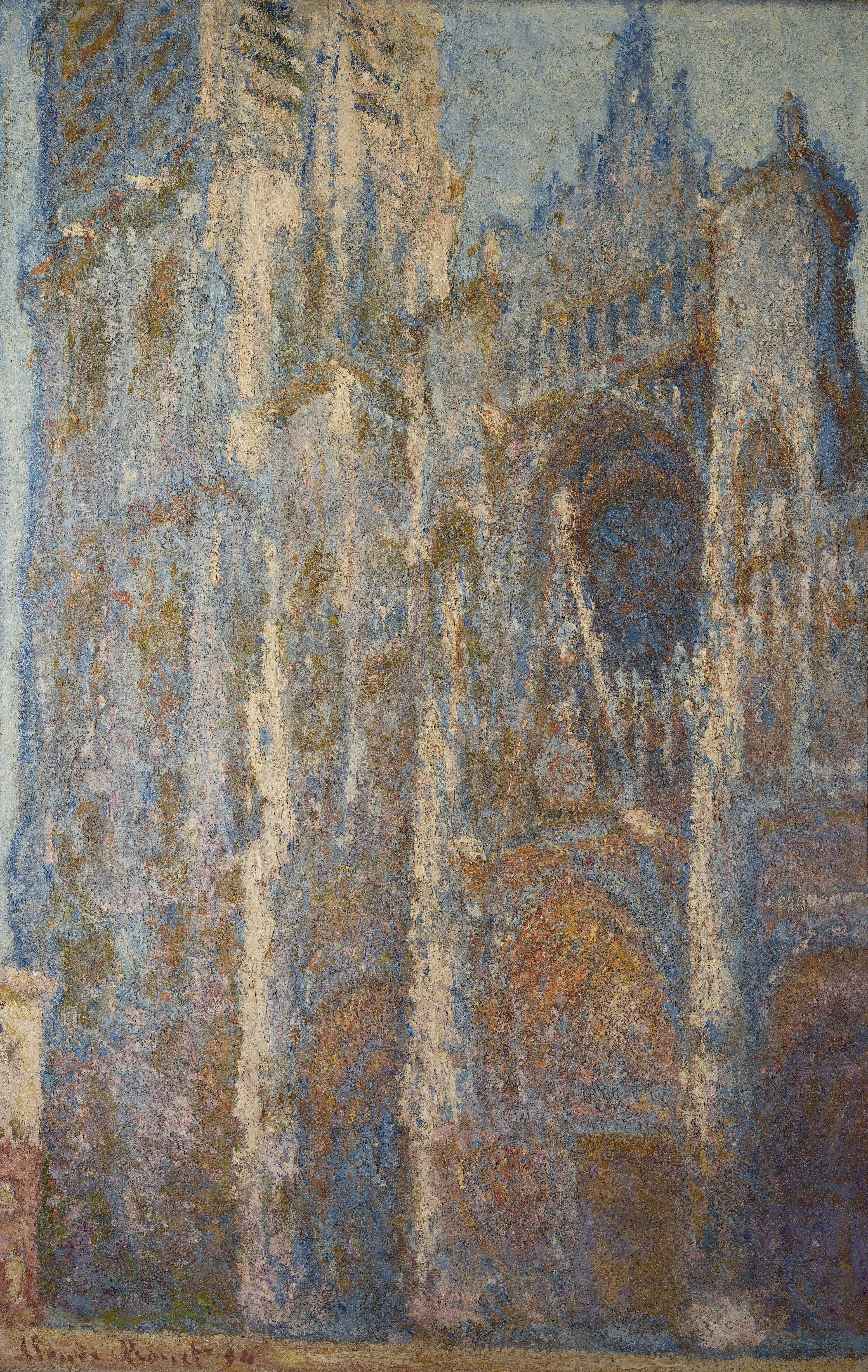
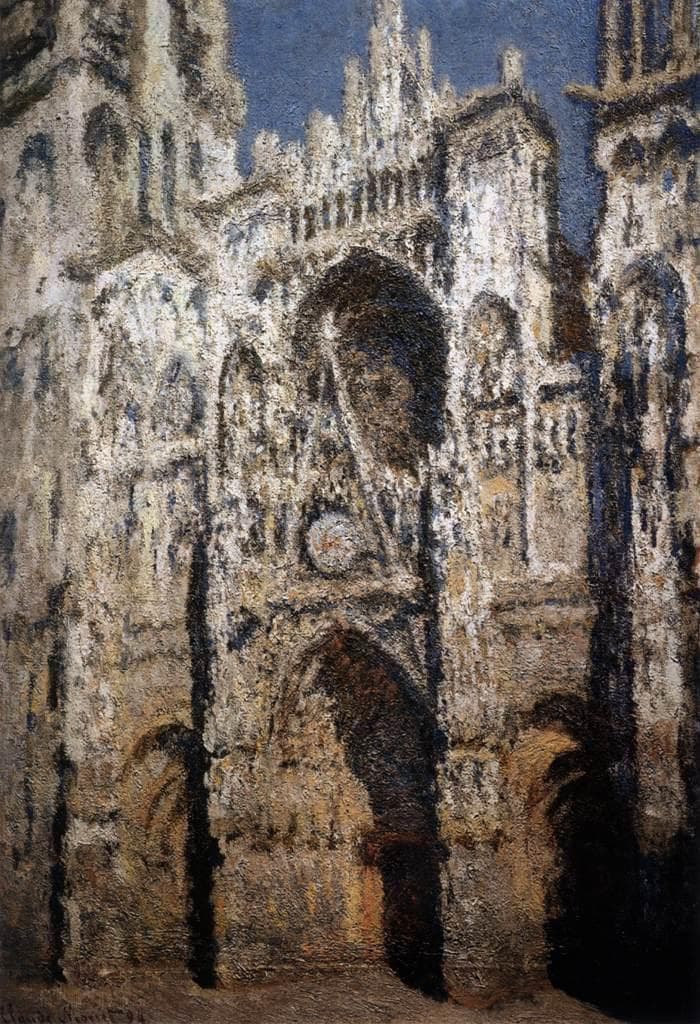
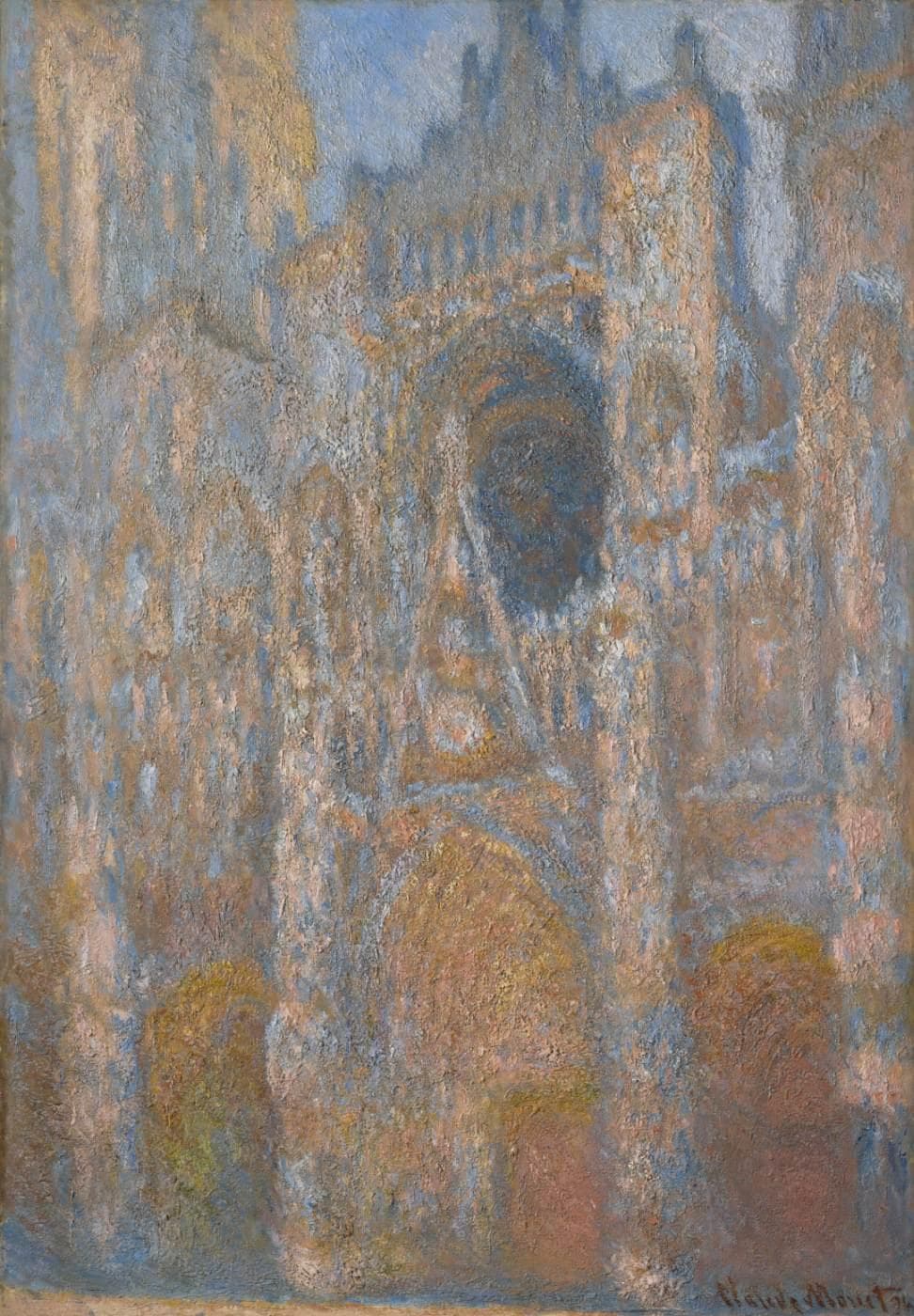
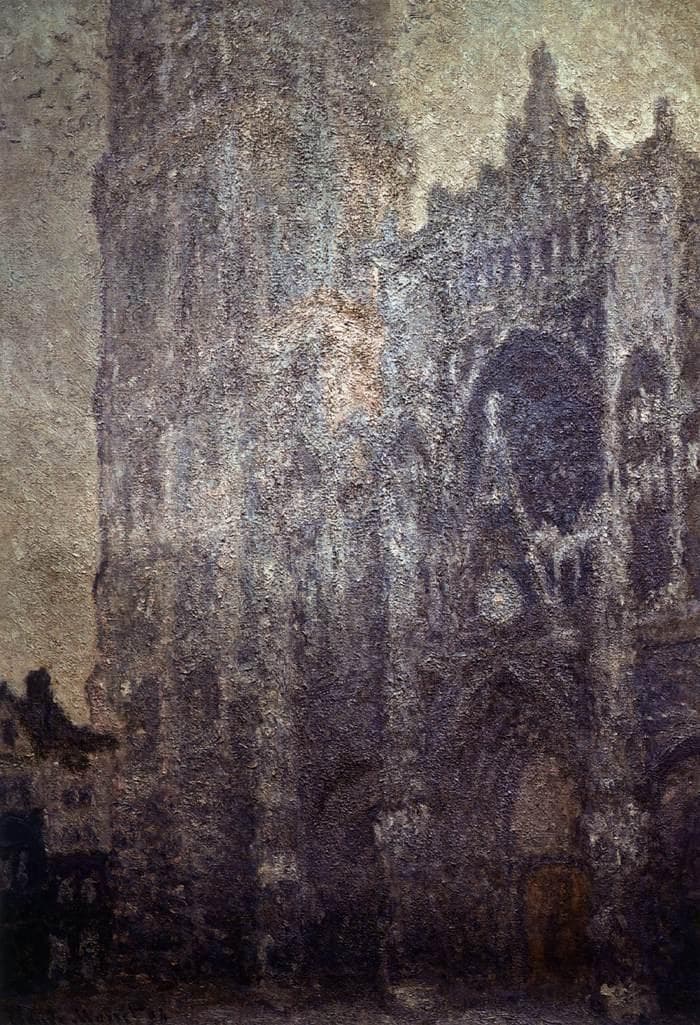
The series is gathered in our Rouen Cathedral hub. The Pushkin Museum owns two canvases from it, this frontal sunset view and an oblique noon view with the tower at left, Portal and Tower d'Albane, Midday (Wildenstein 1350). Their titles are often swapped in books and online. Compare the same frontal portal in full sun in Rouen Cathedral in Full Sunlight in Paris and in softer light in Rouen Cathedral in Sunlight at the Clark, and the dawn view of Effects of Morning Light.
Meaning
Claude Monet said he was painting the air between himself and the building rather than the building itself. A low, warm light turns the stone to embers, and the medieval cathedral becomes, for a moment, something closer to a natural phenomenon, like a cliff at sunset. The creeping shadow at the base gives the picture a sense of time passing that few of the series canvases have.
Where to see it
The painting is in the Pushkin State Museum of Fine Arts in Moscow. It belonged to the Moscow collector Sergei Shchukin, whose collection was nationalized after the 1917 Revolution. For museums elsewhere holding the series, see where to see Monet's paintings.
Questions & answers
Where is Monet's Rouen Cathedral, Evening?
It is in the Pushkin State Museum of Fine Arts in Moscow. The canvas, dated 1894, measures about 100 by 65 centimeters and is catalogued as Wildenstein 1326. It came from the collection of Sergei Shchukin, nationalized after the 1917 Revolution.
When and where was it painted?
Monet painted the cathedral from rooms facing its west front in Rouen in the springs of 1892 and 1893 and finished the canvases at Giverny. This one is signed and dated 1894. The series was exhibited at Durand-Ruel's gallery in Paris in May 1895.
What does Rouen Cathedral, Evening show?
The west portal of Rouen Cathedral lit from the front by the setting sun, glowing apricot and pink against a deep blue sky, while violet shadow climbs across the base of the façade. Monet's subject is the changing light of the last minutes of the day.
How many Rouen Cathedral paintings are in Moscow?
Two. The Pushkin Museum has this frontal view of the portal at sunset (Wildenstein 1326) and an oblique view of the portal and tower at midday (Wildenstein 1350). Their English titles are often confused in books and online.
More by the artist
Claude Monet

Bridge over a Pond of Water Lilies
Claude Monet · 1899

Woman with a Parasol – Madame Monet and Her Son
Claude Monet · 1875

Sunset in Venice
Claude Monet · 1908–12

La Grenouillère
Claude Monet · 1869

Beach in Pourville
Claude Monet · 1882

Springtime
Claude Monet · 1872

Boating on the River Epte
Claude Monet · 1890

The Seine at Asnières (Hermitage)
Claude Monet · 1873
Also painted in 1894
The same year
Kindred works
You may also study
Rouen Cathedral, Portal and Tower d'Albane, Midday
Claude Monet · 1893–94
Rouen Cathedral in Full Sunlight
Claude Monet · 1893
Rouen Cathedral in Sunlight
Claude Monet · c. 1892–94
Rouen Cathedral, Effects of Morning Light
Claude Monet · 1893
Stack of Wheat
Claude Monet · 1890–91
The Creation of Adam
Michelangelo · c. 1511–12
Lucifer
Franz von Stuck · 1890
The Garden of Earthly Delights
Hieronymus Bosch · c. 1490–1510