Image: National Gallery, Sofia (akg-images) · Public domain · via Wikimedia Commons
Symbolism
Lucifer
Franz von Stuck, 1890
Franz von Stuck's Lucifer painting of 1890 shows the fallen angel crouched in darkness, glowing eyes fixed on the viewer. The Munich Symbolist's canvas is now in the National Gallery in Sofia, Bulgaria.
- Artist
- Franz von Stuck
- Date
- 1890
- Medium
- Oil on canvas
- Dimensions
- 161 × 152.5 cm
- Collection
- National Gallery, Sofia, Sofia, Bulgaria
- Movement
- Symbolism
What you are looking at
A naked, dark-skinned figure sits hunched on a rock in near darkness. His knees are drawn up, his elbow rests on his thigh and his chin sinks into his hand. Behind him a single great wing, black and ragged, rises into the gloom. Almost nothing is lit except a faint cold glow along his limbs and, at the center of the canvas, his eyes, which burn pale and stare straight out of the picture.
That stare is the painting. Lucifer is not raging, tempting or falling. He is brooding, and he is looking at you. The square format, the crouching pose and the dark, almost monochrome palette of blue-black and greenish shadow push everything toward the face.
The Lucifer painting and its sources
The pose is borrowed from the long tradition of melancholy: the head-in-hand figure that runs from ancient tomb sculpture to Albrecht Dürer's engraving Melencolia I (1514) and Auguste Rodin's The Thinker. Stuck applies it to the fallen angel, which turns Lucifer into a figure of thought and resentment rather than spectacle.
The name Lucifer means "light-bearer" in Latin. In Christian tradition it came to identify the morning star with Satan, the angel cast out of heaven for his pride, after a reading of Isaiah 14:12 ("How art thou fallen from heaven, O Lucifer, son of the morning!"). Stuck plays on the paradox. His light-bearer sits in darkness, and the only light left in him is in his eyes. The nineteenth century had already made Satan a tragic, even heroic rebel, from John Milton's Paradise Lost as read by the Romantics to Baudelaire's poetry, and Stuck's figure belongs to that line.
Who was Franz von Stuck?
Franz Stuck (1863–1928; ennobled as "von Stuck" in 1906) was the son of a miller from Lower Bavaria who became one of the most successful painters in Munich. He was a founder of the Munich Secession in 1892, a professor at the Munich Academy, and a teacher of artists including Paul Klee and Wassily Kandinsky. He designed his own villa, the Villa Stuck, as a total work of art.
Lucifer belongs to the start of his career, when he was in his late twenties. It shares its mood with his most famous painting, The Sin (1893), in which a naked woman with a serpent coiled around her body stares out of the dark in the same way. Both pictures use deep shadow, a confrontational gaze and frank nudity, the combination that made Stuck a leading voice of German Symbolism.
What does Lucifer mean?
Stuck left no program for the painting, so interpretation rests on its imagery and its period. Three readings are common:
- Pride and exile. The angel who would not serve now sits alone, defeated but unrepentant. His stillness reads as resentment held in check.
- The modern melancholic. By borrowing the pose of melancholy, Stuck turns the devil into a psychological figure, closer to the brooding intellectual than to the horned monster of medieval art.
- The gaze as threat. Because Lucifer looks directly at us, the viewer is drawn into the picture. Anecdotes circulate that the painting's stare unsettled those who owned or saw it; they are part of its legend rather than documented history.
How it came to Sofia
The painting was acquired by Ferdinand of Saxe-Coburg and Gotha, who ruled Bulgaria as prince and later tsar, and it entered the Bulgarian national collections. It now belongs to the National Gallery in Sofia, in its holdings of foreign art. That unusual location, far from Munich, helps explain why such a striking image is less familiar than The Sin.
Reception and legacy
Stuck's reputation fell sharply after his death and recovered with the revival of interest in Symbolism and Art Nouveau from the 1960s. Lucifer has since become one of the most shared images of the fallen angel online, set beside Alexandre Cabanel's Fallen Angel (1868), whose Lucifer weeps with rage, and Konstantin Makovsky's demon in Tamara and Demon. For more, see our collections of fallen angels in art and angels and demons.
How to look at it
The painting rewards slow viewing in a dim room. At first the canvas seems almost uniformly dark; as the eye adjusts, the anatomy of the crouching body emerges, the knotted muscles of the back and the hard line of the shin, and the wing separates from the gloom. Stuck was trained as a draftsman and illustrator, and the firm contour of the figure shows it. The light does not fall on Lucifer from any visible source. It seems to come from within the body and from the eyes, an effect that turns a traditional melancholy pose into something uncanny and alive.
Where to see Lucifer
Lucifer is in the National Gallery in Sofia, Bulgaria, which displays its European collection separately from its Bulgarian art. Check the gallery's current displays before visiting, as works from the foreign collection are rotated and lent.
Questions & answers
Where is Franz von Stuck's Lucifer painting?
It belongs to the National Gallery in Sofia, Bulgaria, in its collection of foreign art. It was acquired by Ferdinand, ruler of Bulgaria, and passed into the national collections, which is why it is far from Stuck's home city of Munich.
What does Stuck's Lucifer mean?
It shows the fallen angel not raging but brooding, in the head-in-hand pose of melancholy. The only light left in the 'light-bearer' is in his staring eyes. It reads as pride, exile and resentment, and draws the viewer in through its direct gaze.
When was Lucifer by Franz von Stuck painted?
Stuck painted it in 1890, early in his career and two years before he co-founded the Munich Secession. It shares its dark palette and confrontational stare with his best-known work, The Sin of 1893.
Is the Lucifer painting cursed?
There are stories that the painting's gaze frightened its owners and viewers, but they are anecdotes without solid documentation. Its reputation comes from the image itself: a dark figure whose glowing eyes meet yours.
Kindred works
You may also study
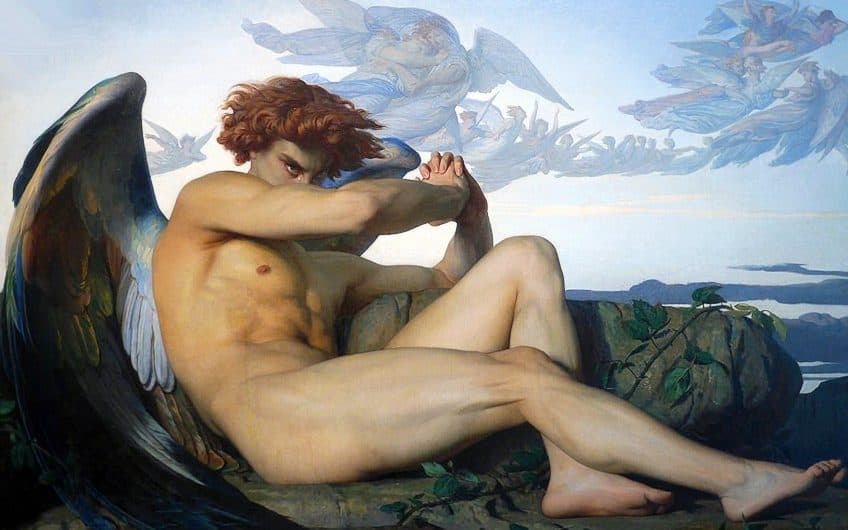
Fallen Angel
Alexandre Cabanel · 1847
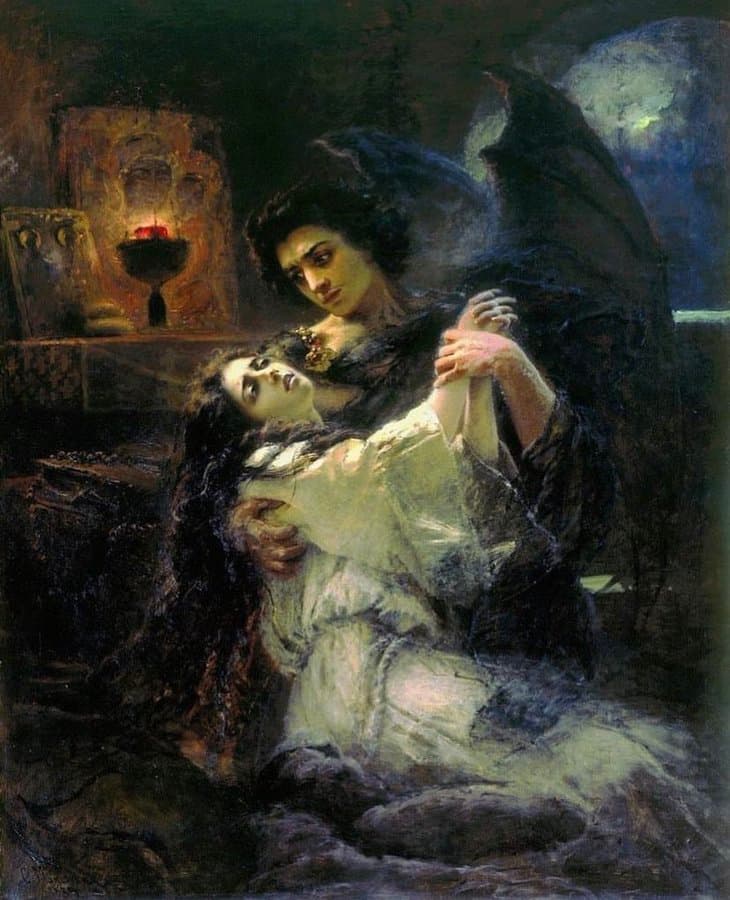
Tamara and Demon
Konstantin Makovsky · 1889
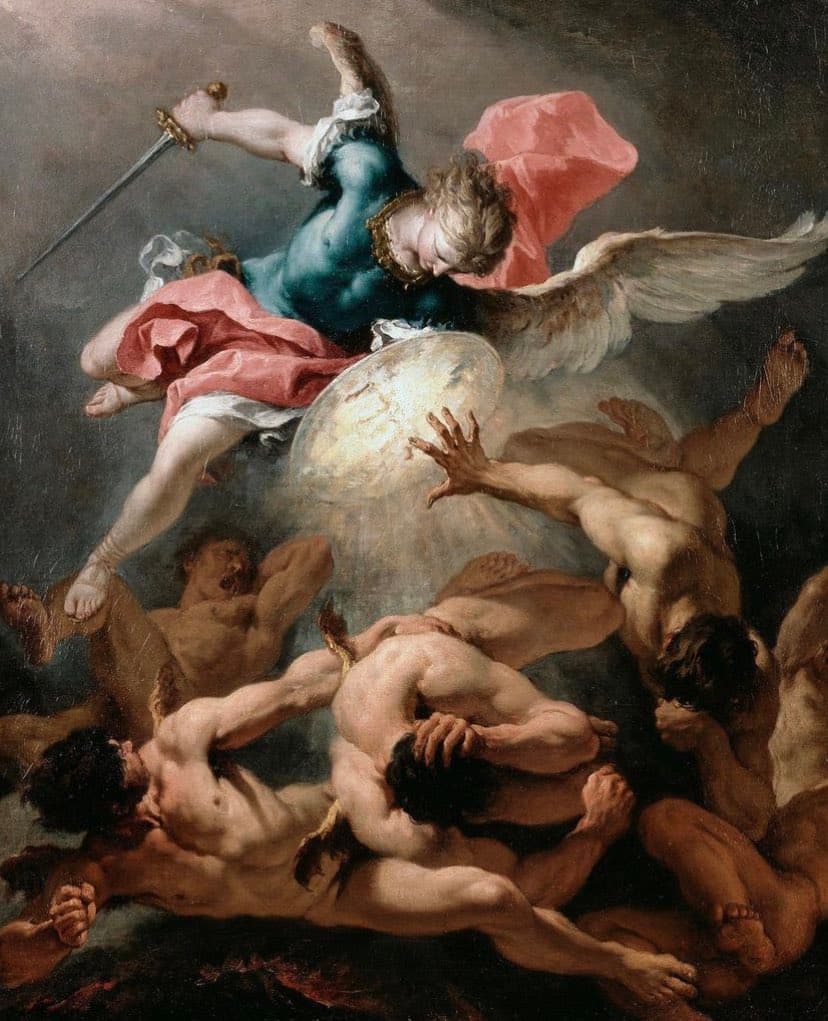
The Fall of the Rebel Angels
Sebastiano Ricci · c. 1720

The Thinker
Auguste Rodin · Modeled 1880–82; enlarged 1902–03; this cast 1904
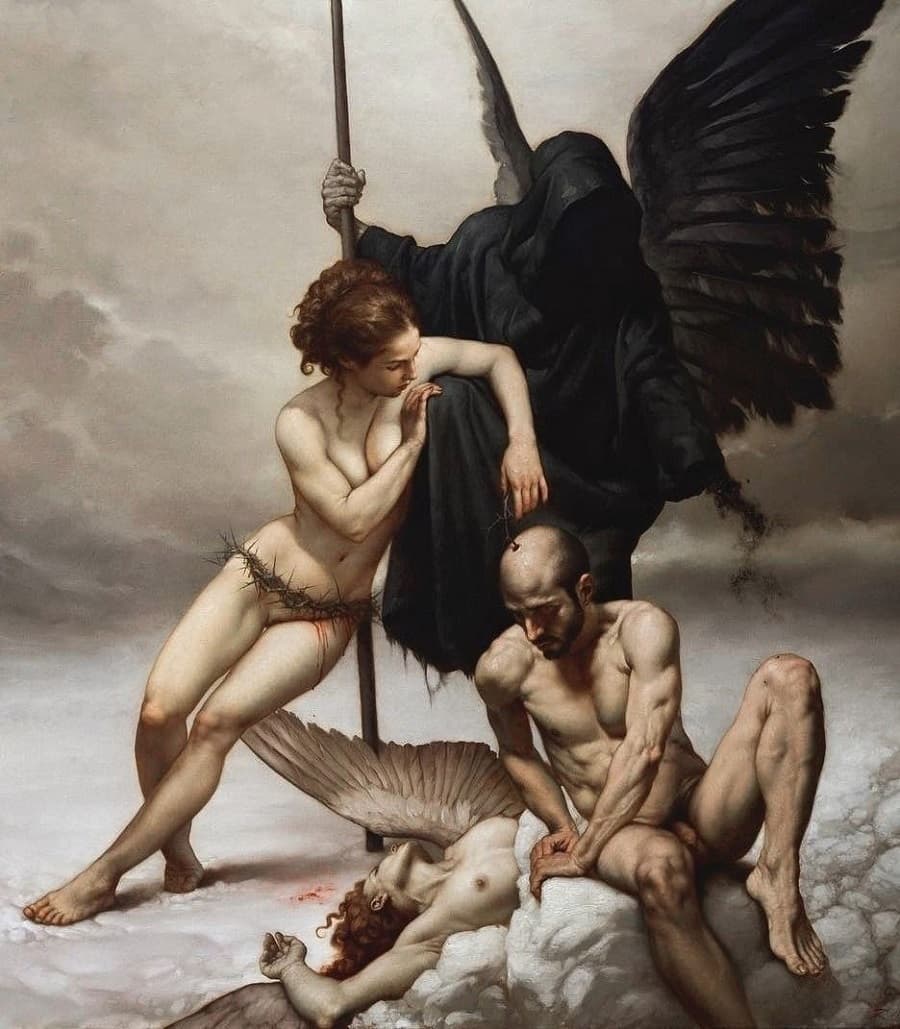
The Angel, the Death, and the Devil
Roberto Ferri · 2018

Venus de Milo
Alexandros of Antioch · c. 150–125 BC

Nymphs Dancing to Pan's Flute
Joseph Tomanek

The Scream
Edvard Munch · 1893