Image: Museo del Prado (Google Earth Prado exhibition); stitched by AxelBoldt · Public domain · via Wikimedia Commons
Early Netherlandish
The Garden of Earthly Delights
Hieronymus Bosch, c. 1490–1510
The Garden of Earthly Delights is a triptych painted by Hieronymus Bosch around 1490–1510, moving from Eden through a garden of naked pleasure-seekers to a nightmarish hell. It is in the Museo del Prado, Madrid.
- Artist
- Hieronymus Bosch
- Date
- c. 1490–1510
- Medium
- Oil on oak panels
- Dimensions
- 205.5 × 384.9 cm (open)
- Collection
- Museo del Prado, Madrid, Spain
- Movement
- Early Netherlandish
What you are looking at
Open, the triptych is almost four meters wide and holds hundreds of figures. It reads from left to right like a story.
The left panel shows Paradise. God, in the form of a young Christ, takes Eve by the wrist and presents her to the newly woken Adam. Around them is a luminous landscape with a pink fountain of life, a giraffe, an elephant and strange hybrid creatures. Already the peace is not complete: in the foreground, animals kill and eat one another, and an owl peers out of the fountain's center.
The central panel, the garden that gives the work its name, is crowded with naked men and women of every skin tone. They ride horses, camels and boars in a circle around a pool of bathing women, climb into giant strawberries and cherries, couple inside glass globes and mussel shells, and feed each other enormous fruit. No one is old, sick or working. Everything is play.
The right panel is Hell, and its light is fire against night. A city burns in the distance. In the middle ground stands the Tree-Man, a hollow body with tree-trunk legs set in boats and a broken eggshell torso, his pale face turned back toward us. Musicians are tortured by giant instruments, one sinner is crucified on a harp, and a bird-headed monster on a throne swallows the damned and excretes them into a pit.
The outer panels
Closed, the wings show a different picture in grisaille (shades of gray): a transparent globe containing the earth on the third day of Creation, before animals or people. In the upper left corner a tiny God the Father holds a book. The inscription quotes Psalm 33: "For he spake, and it was done; he commanded, and it stood fast." Opening the triptych moves from creation to the whole of human history.
Who made it, and when?
Hieronymus Bosch (c. 1450–1516) worked in 's-Hertogenbosch in the Duchy of Brabant, in today's Netherlands. He left no letters and very few dated works, so The Garden of Earthly Delights is dated by tree-ring analysis of its oak panels and by style. Most scholars place it between about 1490 and 1510.
It was almost certainly commissioned for a secular setting. It is first recorded in 1517 in the Brussels palace of the Counts of Nassau, where an Italian visitor described it with wonder. It later passed to William of Orange, was confiscated by the Duke of Alba, and in 1593 entered the collection of Philip II of Spain, who kept it at El Escorial. It moved to the Prado in 1939.
What does The Garden of Earthly Delights mean?
The most widely accepted reading is moral. The triptych traces the fall of humanity: Paradise, a world given over to lust and sensual pleasure, and the punishment that follows. Seen this way, the central panel is not a utopia but a warning, and its giant fruit (strawberries especially) stand for pleasure that is sweet and brief.
Scholars disagree about the details, and the panel has attracted unusually bold interpretations. In the twentieth century the art historian Wilhelm Fraenger argued that it was made for a heretical sect that practiced free love, a theory now largely rejected. Others have read alchemical symbolism into the glass vessels and fountains, or proverbs and puns in Middle Dutch into the odder details. What is certain is that Bosch drew on the late medieval imagination: sermons, devotional books, marginal drawings in manuscripts, and the figure of the world before the Flood, when, in the Gospel of Matthew, people were "eating and drinking, marrying and giving in marriage".
Details most viewers miss
- On the right panel, a sinner's buttocks bear a line of musical notation. It has been transcribed and performed, a short and dismal chant.
- The Tree-Man's face is sometimes said to be a self-portrait. There is no proof, but the idea is old.
- In the Hell panel a pig wearing a nun's veil tries to persuade a man to sign a document, a jab at corrupt clergy.
- Tiny figures in the central panel carry giant mussel shells and ride a fish through the air.
Reception and legacy
Bosch's inventions were copied widely in the sixteenth century, and Pieter Bruegel the Elder inherited his crowded, moralizing panoramas; compare The Triumph of Death in the same museum. The Surrealists claimed Bosch as an ancestor. Today the Hell panel in particular is a touchstone for depictions of the demonic, from album art to angels and demons imagery, and for the stranger corners of dark academia.
Where to see The Garden of Earthly Delights
The triptych is in the Museo del Prado in Madrid, in a gallery devoted to Bosch and early Netherlandish painting. Crowds gather in front of it all day; arrive at opening, look first from a distance to read the three-part story, then move close. The closed wings are sometimes displayed so you can see the grisaille globe as well.
Questions & answers
Where is The Garden of Earthly Delights?
It is in the Museo del Prado in Madrid. Philip II of Spain acquired it in 1593 and kept it at El Escorial; it was transferred to the Prado in 1939 and now hangs with the museum's other works by Bosch.
What is the meaning of The Garden of Earthly Delights?
The most common reading is a moral sequence: Eden on the left, humanity lost in sensual pleasure in the center, and the punishment of Hell on the right. The giant fruit and lovers suggest pleasure that is sweet but fleeting. Scholars still debate many details.
When was The Garden of Earthly Delights painted?
Bosch left no date on it. Tree-ring dating of the oak panels and stylistic comparison place it between about 1490 and 1510. It is first documented in 1517 in the Nassau palace in Brussels.
What is on the outside of the triptych?
Closed, the wings show the earth in a transparent globe on the third day of Creation, painted in grays. God appears small in the upper left, and the inscription quotes Psalm 33 on God speaking the world into being.
Is there music written on The Garden of Earthly Delights?
Yes. In the Hell panel a line of musical notation is painted on a sinner's buttocks. Modern musicians have transcribed and performed it, and it is one of the triptych's most talked-about details.
Kindred works
You may also study
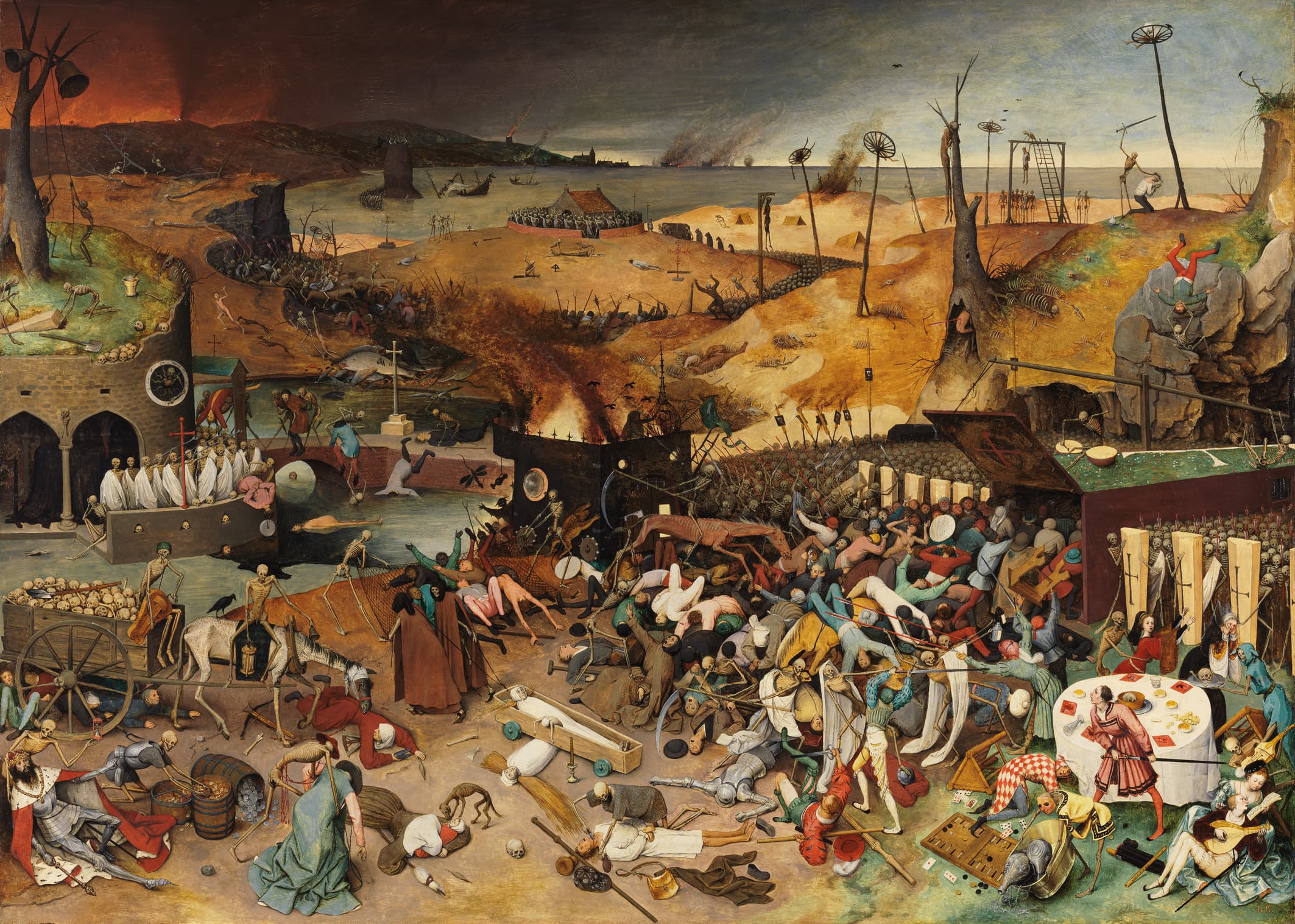
The Triumph of Death
Pieter Bruegel the Elder · c. 1562

Saturn Devouring His Son
Francisco Goya · c. 1819–1823
The Fall of the Rebel Angels
Sebastiano Ricci · c. 1720
Dante and Virgil in Hell
Gustave Courtois · 1879
The Ambassadors
Hans Holbein the Younger · 1533

Venus de Milo
Alexandros of Antioch · c. 150–125 BC

Nymphs Dancing to Pan's Flute
Joseph Tomanek

The Scream
Edvard Munch · 1893