Image: Private collection; image via Christie's / Wikimedia Commons · Public domain · via Wikimedia Commons
Impressionism
Les Tilleuls à Poissy
Claude Monet, 1882
Les Tilleuls à Poissy is an 1882 painting by Claude Monet of sunlit lime trees along the riverside boulevard at Poissy, seen from the house where he lived in 1881–83. It is in a private collection.
- Artist
- Claude Monet
- Date
- 1882
- Medium
- Oil on canvas
- Dimensions
- 80.7 × 65 cm
- Collection
- Private collection
- Movement
- Impressionism
- Catalogue
- Wildenstein 747
What you are looking at
A row of lime (linden) trees fills most of the canvas, their leafy crowns painted as a dense, glittering mass of green, yellow, orange and red. The colors suggest late summer or early autumn, when the foliage begins to turn. Beneath the trees, slender gray trunks rise from a sunlit path, and long violet and blue shadows stripe the ground in diagonal bands toward the lower right.
Beyond the trees, at the top of the picture, the pale walls and roofs of town houses catch the sun: a row of buildings with tall chimneys on the right, smaller rooftops on the left. The sky above is blue streaked with gray clouds. The vertical format and the high viewpoint make us look down on the path and across the tops of the trees.
Where and when it was painted
In December 1881 Monet moved from Vétheuil to Poissy, a town on the Seine west of Paris, with Alice Hoschedé and the eight children of their two families. They rented the Villa Saint-Louis on the riverfront. Monet never liked Poissy, and in April 1883 the household moved on to Giverny. During his time there, he spent long periods painting on the Normandy coast at Pourville and Varengeville.
This canvas shows the Boulevard de la Seine, the riverside promenade lined with lime trees that the town had planted in the 1820s (it is now the Cours du 14-Juillet). Monet painted it from a window of the Villa Saint-Louis, looking down on the trees and across to the houses on the other side.
How it was painted
The view from above flattens the space. The trees form a single wall of color, and the eye moves from the bright foliage down to the striped path and up to the rooftops without a clear sense of depth. The composition is almost decorative, a vertical panel of leaves, light and shadow.
The brushwork is energetic. The foliage is made of countless short, curving strokes in yellow, green, orange and red, laid one over another so that the colors mix in the eye. The shadows on the path are long strokes of violet and blue, laid diagonally, and they give the picture its structure. Between them the ground is a warm, sunlit yellow. The trunks are thin vertical lines of gray and white, like the bars of a fence. The rooftops are painted in a few pale, blocky strokes, with chimneys as small verticals.
The vertical format is unusual for a Monet landscape of this time and suggests he was thinking of the scene as a single motif, the trees themselves, rather than as a wide view.
The light comes low from the left, which points to late afternoon. Monet makes the most of it: the right side of each crown glows orange and yellow, while the undersides of the leaves, in shadow, turn blue-green. The same raking light picks out the edges of the roofs and leaves the facades facing us pale and flat. A tree-lined promenade seen from a window would be a favorite subject of the Impressionists in Paris; Monet here finds it in a provincial riverside town.
Monet in 1882
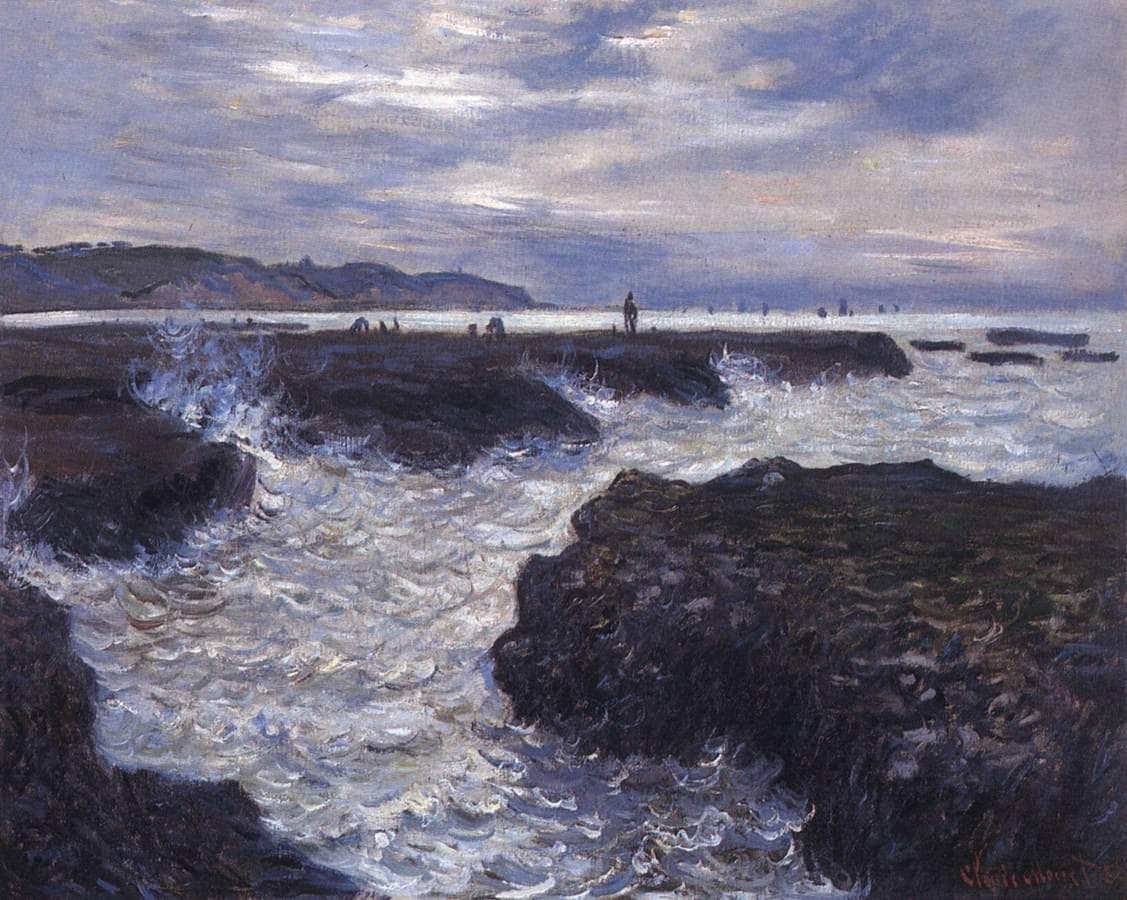
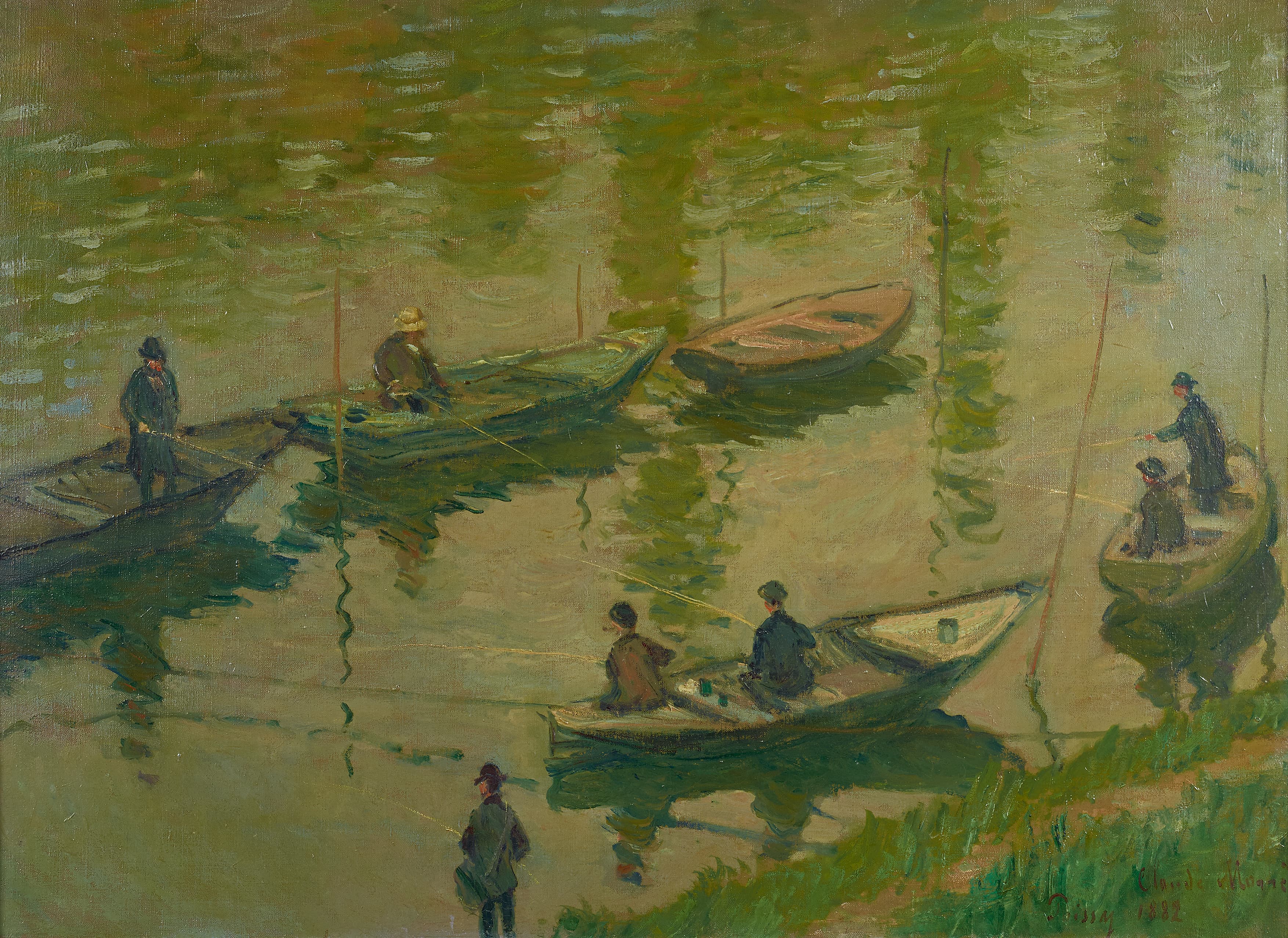
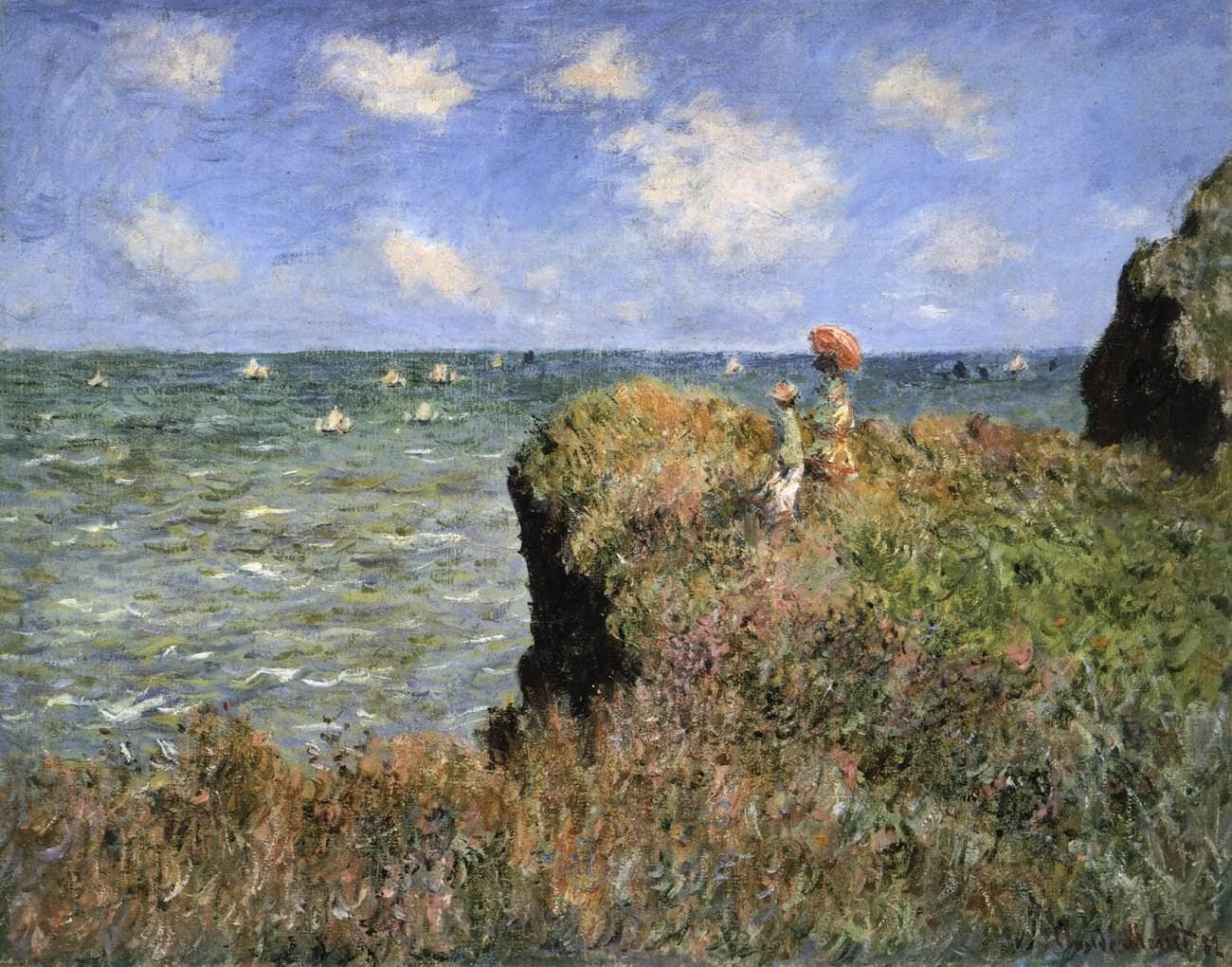
The Poissy months were an unsettled period. Monet painted little in the town itself and spent much of 1882 on the coast, where he made some of his finest cliff pictures, such as The Cliff Walk at Pourville and Beach in Pourville. Among the few Poissy subjects is Fishermen at Poissy, a drawing-like picture of anglers on the river.
Ownership
The painting stayed in the Hoschedé family, in the collection of Jean-Pierre Hoschedé, Alice's youngest son, until 1951. It was sold at Christie's in New York in November 2008 for $1,650,500 and is in a private collection.
Where to see it
Les Tilleuls à Poissy is privately owned and not on public view. For the decade around it, see Monet's life in paintings, and for public collections, where to see Monet's paintings.
Questions & answers
Where is Monet's Les Tilleuls à Poissy?
It is in a private collection. It remained with the Hoschedé family until 1951 and was sold at Christie's New York in November 2008 for $1,650,500. It is not on public display.
When and where was Les Tilleuls à Poissy painted?
Monet painted it in 1882 at Poissy, west of Paris, where he lived from December 1881 to April 1883. He painted the riverside boulevard from a window of the Villa Saint-Louis.
What does Les Tilleuls à Poissy show?
A row of lime trees in late summer or autumn color along a riverside boulevard, with long blue and violet shadows on the sunlit path below and the rooftops of town houses beyond.
Why did Monet live in Poissy?
He moved there from Vétheuil in December 1881 with Alice Hoschedé and their children, looking for better schools and connections to Paris. He disliked the town and moved to Giverny in April 1883.
More by the artist
Claude Monet

Bridge over a Pond of Water Lilies
Claude Monet · 1899

Woman with a Parasol – Madame Monet and Her Son
Claude Monet · 1875

Sunset in Venice
Claude Monet · 1908–12

La Grenouillère
Claude Monet · 1869

Beach in Pourville
Claude Monet · 1882

Springtime
Claude Monet · 1872

Boating on the River Epte
Claude Monet · 1890

The Seine at Asnières (Hermitage)
Claude Monet · 1873
Also painted in 1882
The same year
Kindred works
You may also study
Anglers on the Seine at Poissy
Claude Monet · 1882
Cliff Walk at Pourville
Claude Monet · 1882
Cliffs near Dieppe
Claude Monet · 1882

The Scream
Edvard Munch · 1893

Ophelia
John Everett Millais · 1851–52

The Great Wave off Kanagawa
Katsushika Hokusai · c. 1830–32

Liberty Leading the People
Eugène Delacroix · 1830

Wanderer above the Sea of Fog
Caspar David Friedrich · c. 1817