Realism
Farmyard in Normandy
Claude Monet, c. 1863
Farmyard in Normandy, also called Farm in Normandy, is an early painting by Claude Monet of about 1863 showing half-timbered barns, a pond, a cow and poultry under apple trees. It is in the Musée d'Orsay, Paris.
- Artist
- Claude Monet
- Date
- c. 1863
- Medium
- Oil on canvas
- Dimensions
- 65 × 80 cm
- Collection
- Musée d'Orsay, Paris, France
- Movement
- Realism
- Catalogue
- Wildenstein 16
Farmyard in Normandy (Cour de ferme en Normandie) is one of Claude Monet's earliest surviving paintings, made around 1863, when he was in his early twenties. The canvas, 65 by 80 centimeters and number 16 in Wildenstein's catalogue, is signed "C. Monet" at lower right and belongs to the Musée d'Orsay in Paris.
What you are looking at
A Normandy farmyard opens in front of us on a bright, hazy afternoon. At the left stand two farm buildings: a low cottage with whitewashed walls crossed by dark timber framing, and behind it a big barn with plank-sided walls and a steep roof. In the center a pond reflects the barn and the sky in a long, dark mirror, with a few white ducks swimming on it. A brown-and-white cow stands in the lower left, head down, and in the lower right a man stands at the water's edge with a small child beside him, while ducks and chickens wander on the grass at their feet.
The right half is given to an orchard of old apple trees, their gnarled trunks leaning and their crowns spreading in a dark green canopy that arches over the picture. In the shade beneath, a second cow grazes. The sky is pale and milky, with soft streaks of cloud. Everything is still and ordinary: no story, only a working farm on a summer day.
How it was painted
This is Monet before Impressionism. The handling is solid and carefully modeled, with smooth gradations of tone and dark, warm shadows, close to the Barbizon painters he admired, such as Charles-François Daubigny and Camille Corot, and to the Dutch landscapes of the seventeenth century, where animals and buildings are arranged like this around a pool. The trees are painted as dense masses of dark green with only their edges broken against the sky.
Yet some passages hint at what was coming. The reflections in the pond are laid in with broken horizontal strokes, the light on the barn wall is warm and direct, and the whitewashed cottage is built from blocks of cream and pale gray with almost no drawing. The figures and animals are small and sketchy, placed to give scale rather than to tell a story, which is how Monet would use figures for the rest of his life.
The composition is carefully built. The barn roof, the line of the pond and the arch of the apple boughs all lead toward the center, where the reflection of the barn sits in the dark water. The two cows mark the near and far edges of the yard, and the man and child stand at the point where the eye comes to rest. It is a traditional arrangement, learned from older pictures, and Monet would soon abandon it for the open, uncentered compositions of his maturity.
Early years in Normandy
Monet grew up in Le Havre and learned to paint out of doors from Eugène Boudin, who persuaded the teenage caricaturist to take landscape seriously, and later from the Dutch painter Johan Barthold Jongkind. In the early 1860s, between periods of study in Paris at the studio of Charles Gleyre, he worked around Honfleur and the countryside of the Seine estuary, where artists gathered at the Saint-Siméon farm inn. His very first exhibited picture, View at Rouelles, Le Havre of 1858, is in the same spirit as this farmyard.
Later views of that same countryside, such as Road by Saint-Siméon Farm in Winter and A Cart on the Snowy Road at Honfleur, and the Honfleur street of Rue de la Bavolle, show how quickly his style loosened over the next few years. Our hub on Étretat and the Normandy coast follows his work in the region where he grew up.
Where to see it
The painting is in the Musée d'Orsay, where it gives a useful starting point for Monet's development before pictures such as Women in the Garden and the Déjeuner sur l'herbe fragments. For the full arc of his career, see Monet's life in paintings. More on Claude Monet.
Questions & answers
Where is Monet's Farmyard in Normandy?
The painting is in the Musée d'Orsay in Paris. Painted around 1863, it is among the earliest works by Monet in the museum's collection and shows his style before Impressionism, when he was still close to the Barbizon landscape painters such as Daubigny and Corot.
When did Monet paint Farmyard in Normandy?
It is dated to about 1863, when Monet was around 22 or 23 and dividing his time between Paris and the Normandy coast near Le Havre and Honfleur. It predates his first Salon successes of 1865 and 1866 and his move toward the broken brushwork of Impressionism.
What does Farmyard in Normandy show?
A Normandy farmyard with a timber-framed cottage and a plank-sided barn at left, a pond with ducks in the center, a cow drinking at lower left, a man and a child by the water, and old apple trees shading another cow at right, under a pale summer sky.
Is Farmyard in Normandy an Impressionist painting?
Not really. It is an early, realist landscape with careful modeling and dark shadows, closer to the Barbizon school and Dutch painting than to Impressionism. Only the broken reflections in the pond and the bright light on the walls hint at the direction Monet would take.
More by the artist
Claude Monet

Bridge over a Pond of Water Lilies
Claude Monet · 1899

Woman with a Parasol – Madame Monet and Her Son
Claude Monet · 1875

Sunset in Venice
Claude Monet · 1908–12

La Grenouillère
Claude Monet · 1869

Beach in Pourville
Claude Monet · 1882

Springtime
Claude Monet · 1872

Boating on the River Epte
Claude Monet · 1890

The Seine at Asnières (Hermitage)
Claude Monet · 1873
Kindred works
You may also study
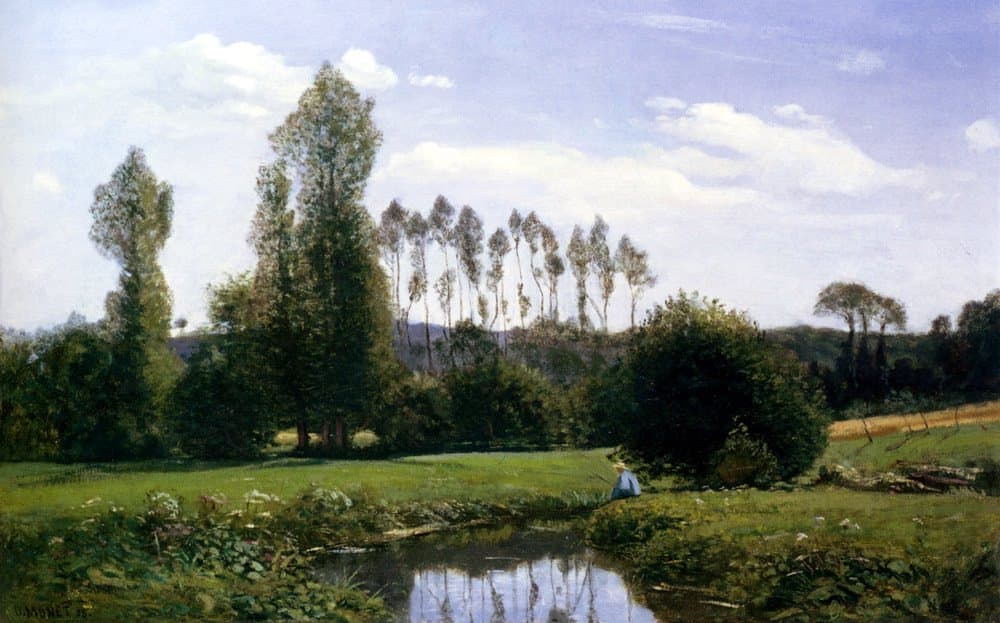
View at Rouelles, Le Havre
Claude Monet · 1858
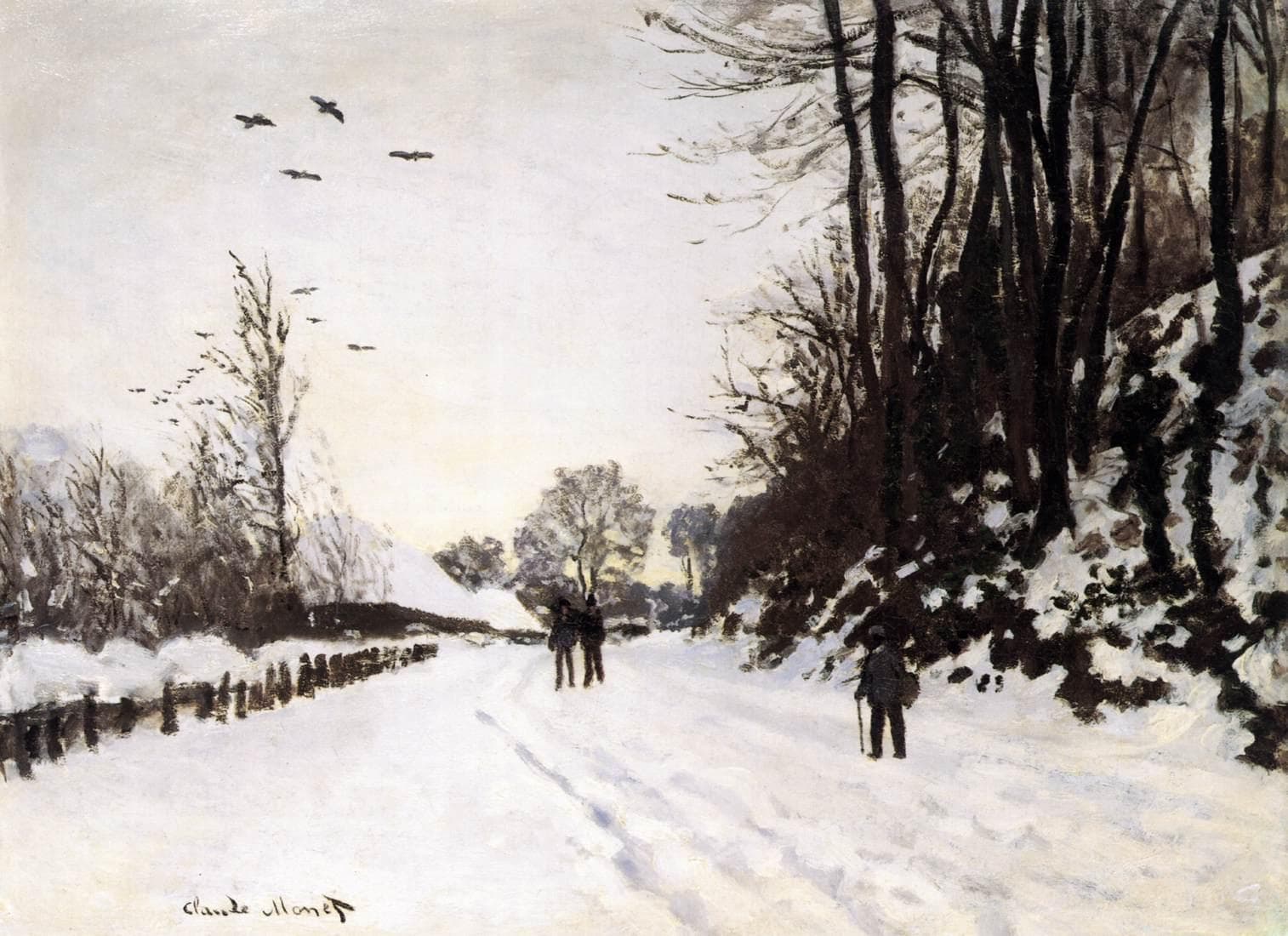
Road by Saint-Siméon Farm in Winter
Claude Monet · 1867
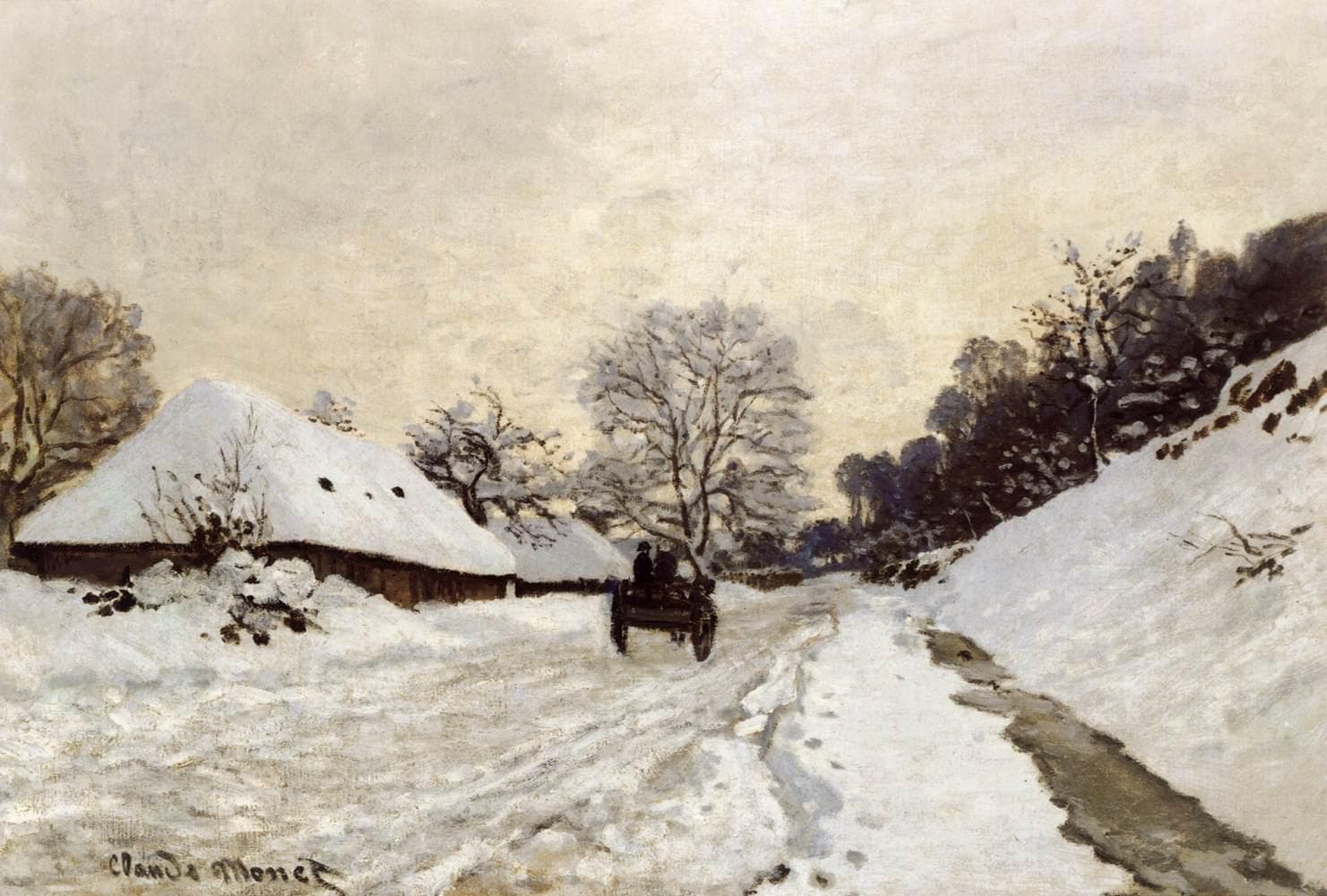
A Cart on the Snowy Road at Honfleur
Claude Monet · c. 1867
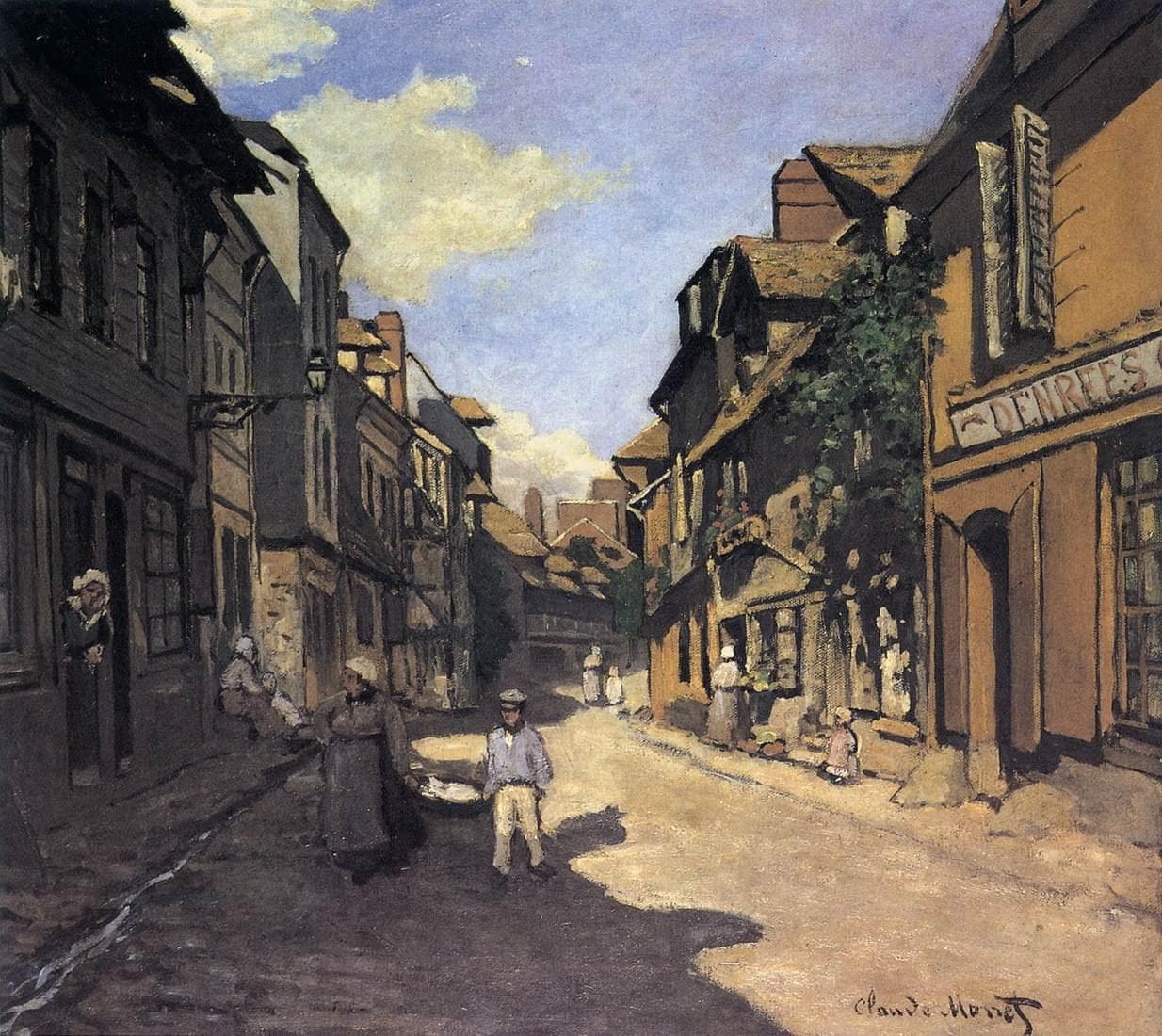
Rue de la Bavolle, Honfleur
Claude Monet · 1864
The Bodmer Oak, Fontainebleau Forest
Claude Monet · 1865

The Scream
Edvard Munch · 1893

Ophelia
John Everett Millais · 1851–52

The Great Wave off Kanagawa
Katsushika Hokusai · c. 1830–32