Image: Petit Palais, Musée des Beaux-Arts de la Ville de Paris (Paris Musées, public domain) · Public domain · via Wikimedia Commons
Impressionism
Sunset on the Seine at Lavacourt, Winter Effect
Claude Monet, 1880
Sunset on the Seine at Lavacourt, Winter Effect is a large 1880 painting by Claude Monet of a red winter sun setting over the ice-strewn Seine, made for the Salon but never sent. It is in the Petit Palais, Paris.
- Artist
- Claude Monet
- Date
- 1880
- Medium
- Oil on canvas
- Dimensions
- c. 100 × 150 cm
- Collection
- Petit Palais, Musée des Beaux-Arts de la Ville de Paris, Paris, France
- Movement
- Impressionism
- Catalogue
- Wildenstein 576
Painted at Monet at Vétheuil
What you are looking at
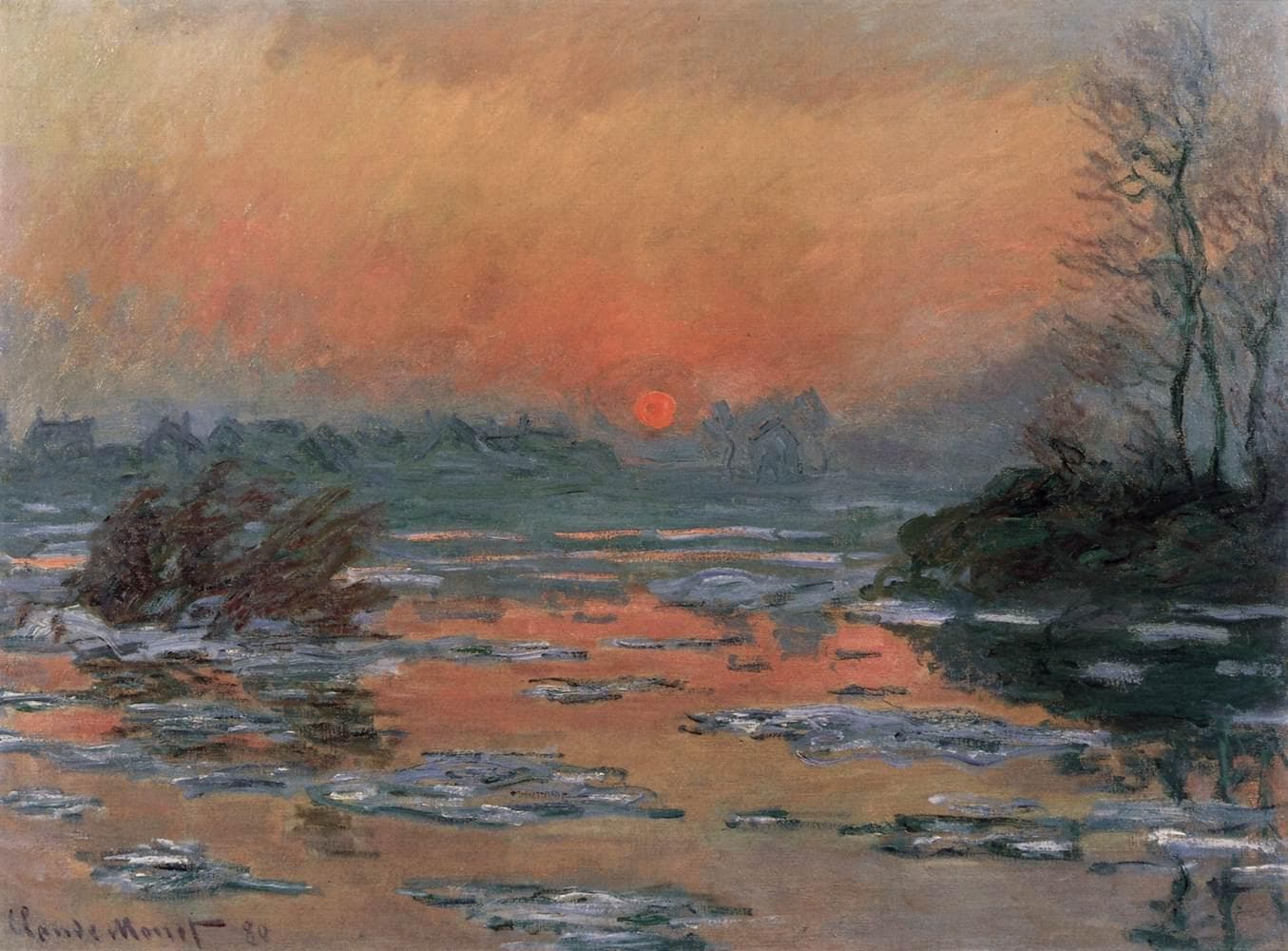
A small red sun hangs in an orange-pink haze above a faint line of houses on the far bank. Its reflection drops straight down the river in broken strokes of red and gold. The Seine is wide and calm here, streaked with the colors of the sky, and a few slabs of ice drift on it. On the left a low island of bare, rust-brown brush pushes into the water; on the right a darker bank rises into a tall, leafless tree whose branches are drawn in thin blue-green lines against the glow. In the middle of the river, small and dark, a boat carries two figures toward the light.
The palette is built on a single contrast: warm orange, salmon and red in the sky and its reflections, cold blue-green and grey in the water, the island and the trees. Everything is softened by the mist, so even the darkest bank has color in it.
The boat is easy to miss and it matters. It is the only sign of people, and it gives the river its scale: without it the canvas could be a tidal estuary or a lake.
Where and when it was painted
Monet painted this view of the Seine at Lavacourt, the hamlet across the river from his house at Vétheuil, after the great freeze of the winter of 1879–80. His wife Camille had died in September 1879. In early 1880, short of money and urged by friends and collectors such as Théodore Duret, he decided to submit work to the official Salon again for the first time in a decade, a move that earned him mockery from former allies.
This was one of three large canvases he prepared for the Salon of 1880, and its size, about a meter by a meter and a half, was meant for the walls of the Salon. Unlike most of his pictures, it was painted in the studio at Vétheuil from earlier studies, not in front of the motif. In the end Monet judged it too much to his own taste and not enough to the jury's, and he held it back, sending two other river views instead. One was accepted and one refused.
How it was painted
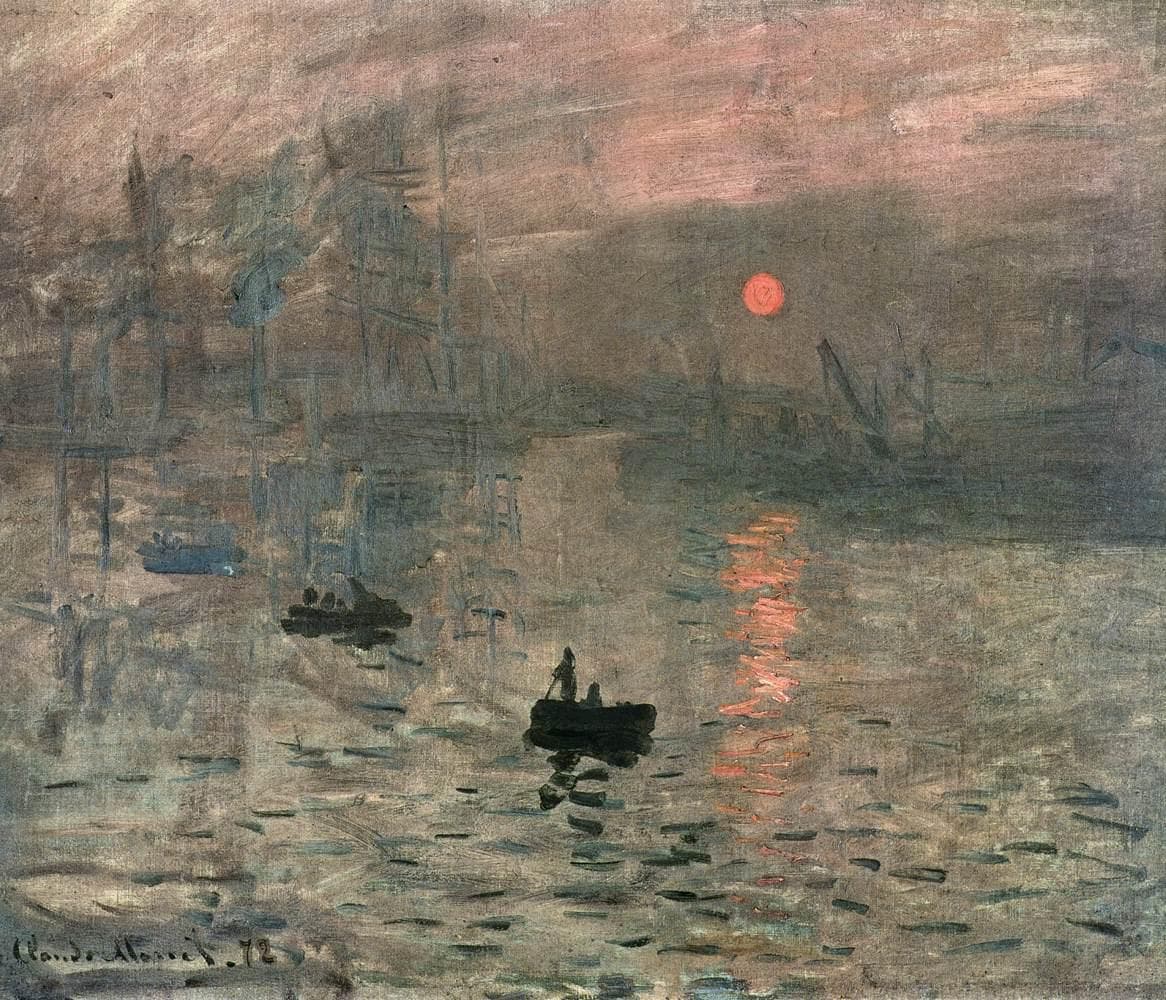
The picture deliberately recalls Impression, Sunrise of 1872: the same small disc of sun, the same vertical streak of reflection, the same dissolving shoreline. Here the handling is broader and more finished, the color richer, and the composition more balanced, with the dark island and the dark bank framing the sun like wings on a stage. Critics have also seen the influence of Turner and of Daubigny's river views.
A smaller and looser version of the same composition, painted in front of the motif, is in the Pola Museum of Art in Hakone: see Sunset on the Seine in Winter. Comparing the two shows exactly what Monet did when he worked a study up for exhibition: he simplified, enlarged and steadied it.
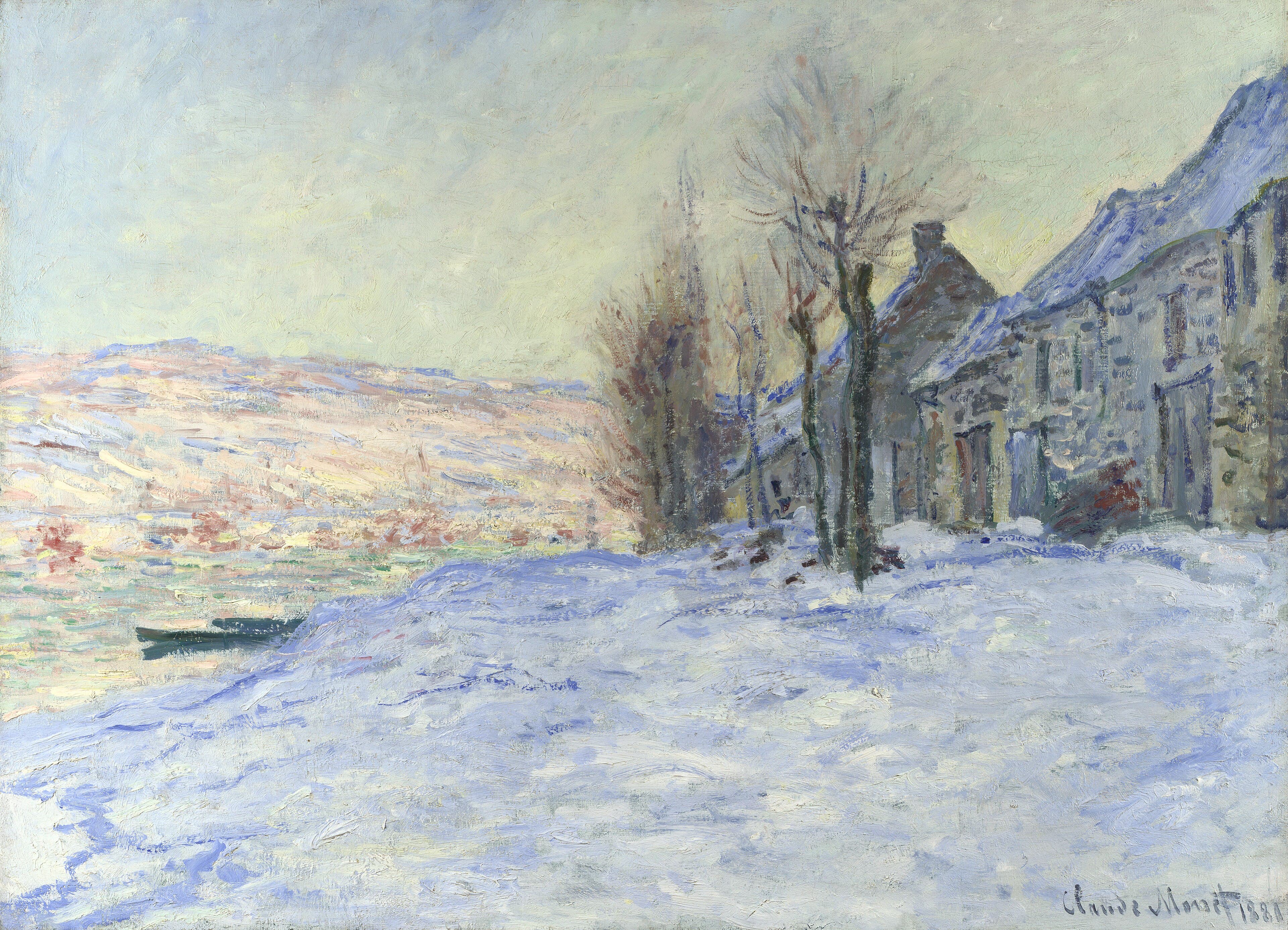
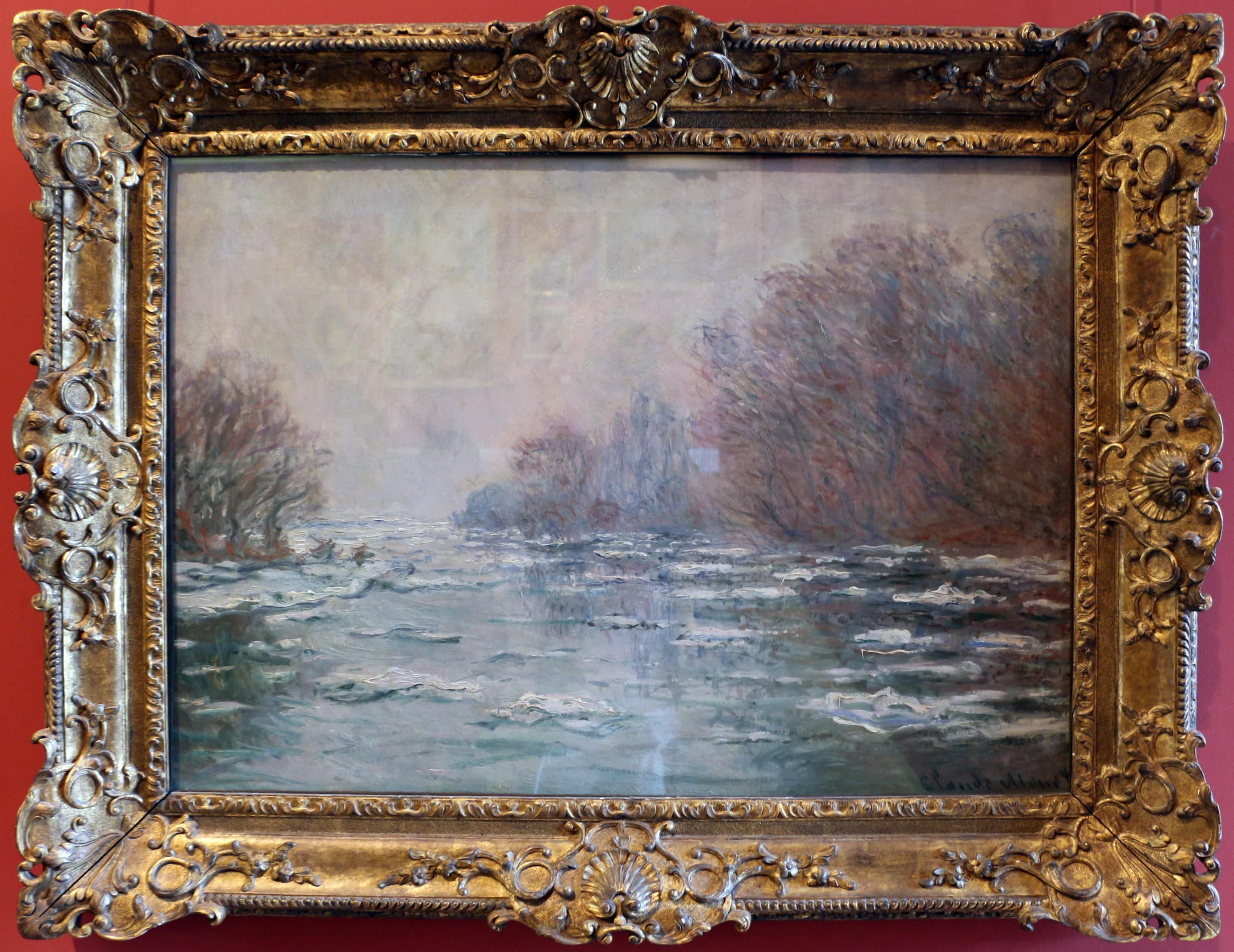
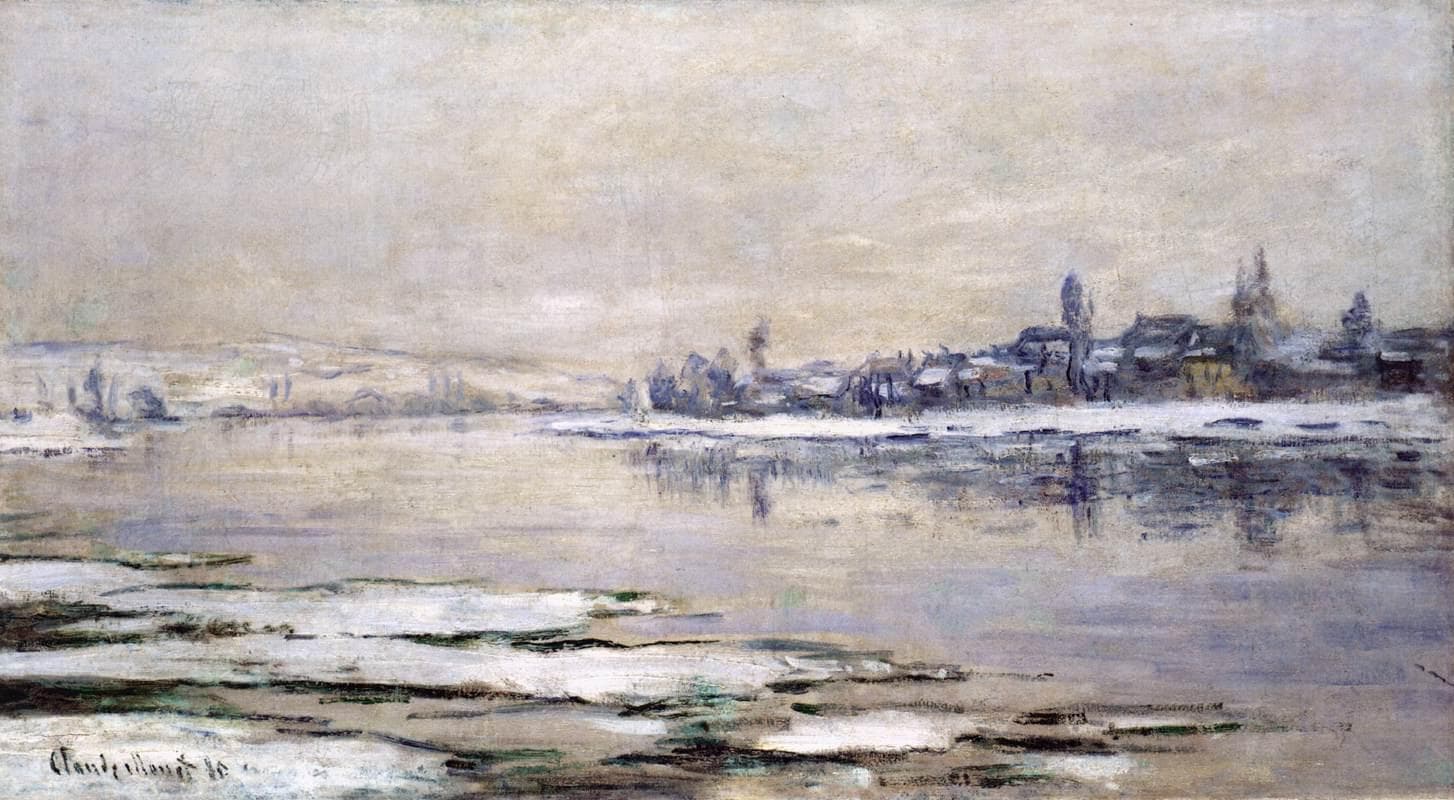
The mood is harder to pin down. Painted months after Camille's death, in a winter of debt, the picture is often read as an elegy, and the setting sun invites that reading. Monet himself said nothing about it in those terms. What the canvas does show is a painter recommitting to the effect that had defined Impressionism, at the very moment he was preparing to return to the Salon. For the daylight pictures of the same winter, see The Breaking Up of the Ice near Vétheuil and Lavacourt under Snow, and for the place, Monet at Vétheuil.
Ownership and where to see it
Monet sold the painting to the dealer Paul Durand-Ruel in 1881, and it was shown at the seventh Impressionist exhibition in 1882. It came to the Petit Palais, the Musée des Beaux-Arts de la Ville de Paris, as a gift in the first years of the twentieth century (inventory PPP439). It has been lent to Turner, Whistler, Monet in 2004–05 and the Grand Palais Monet retrospective of 2010–11. The Petit Palais is free to visit for its permanent collection. See where to see Monet's paintings and the Claude Monet page.
Questions & answers
Where is Monet's Sunset on the Seine at Lavacourt?
It is in the Petit Palais, the Musée des Beaux-Arts de la Ville de Paris (inventory PPP439), opposite the Grand Palais. The permanent collection is free to visit. The canvas measures about 100 by 150 centimeters.
Why did Monet not send it to the Salon of 1880?
He painted it in his studio from studies as one of three large canvases for the Salon of 1880, but decided it suited his own taste more than the jury's and kept it back, sending two other views of the Seine instead.
What does the painting show?
A red winter sun setting in an orange haze over the Seine at Lavacourt, near Vétheuil, with ice on the river, a dark island of brush at left, bare trees at right and a small boat with two figures in mid-stream.
Is there another version of this sunset?
Yes. A smaller, looser version painted in front of the motif, Sunset on the Seine in Winter (60.6 × 81.1 cm), is in the Pola Museum of Art in Hakone, Japan. The Petit Palais canvas is the large exhibition version.
More by the artist
Claude Monet

Bridge over a Pond of Water Lilies
Claude Monet · 1899

Woman with a Parasol – Madame Monet and Her Son
Claude Monet · 1875

Sunset in Venice
Claude Monet · 1908–12

La Grenouillère
Claude Monet · 1869

Beach in Pourville
Claude Monet · 1882

Springtime
Claude Monet · 1872

Boating on the River Epte
Claude Monet · 1890

The Seine at Asnières (Hermitage)
Claude Monet · 1873
Also painted in 1880
The same year
Lavacourt under Snow
Claude Monet · c. 1878–81
View of Vétheuil
Claude Monet · 1880
The Breaking Up of the Ice near Vétheuil
Claude Monet · c. 1880
Jerusalem Artichoke Flowers
Claude Monet · 1880
View of Vétheuil
Claude Monet · 1880
Vétheuil in Summer
Claude Monet · 1880
Woman Seated under the Willows
Claude Monet · 1880
Still-Life with Pears and Grapes
Claude Monet · 1880
Kindred works
You may also study
Sunset on the Seine in Winter
Claude Monet · 1880
The Breaking Up of the Ice near Vétheuil
Claude Monet · c. 1880
The Breakup of the Ice at Lavacourt
Claude Monet · 1880
Lavacourt under Snow
Claude Monet · c. 1878–81
Impression, Sunrise
Claude Monet · 1872

The Scream
Edvard Munch · 1893

Ophelia
John Everett Millais · 1851–52

The Great Wave off Kanagawa
Katsushika Hokusai · c. 1830–32