Impressionism
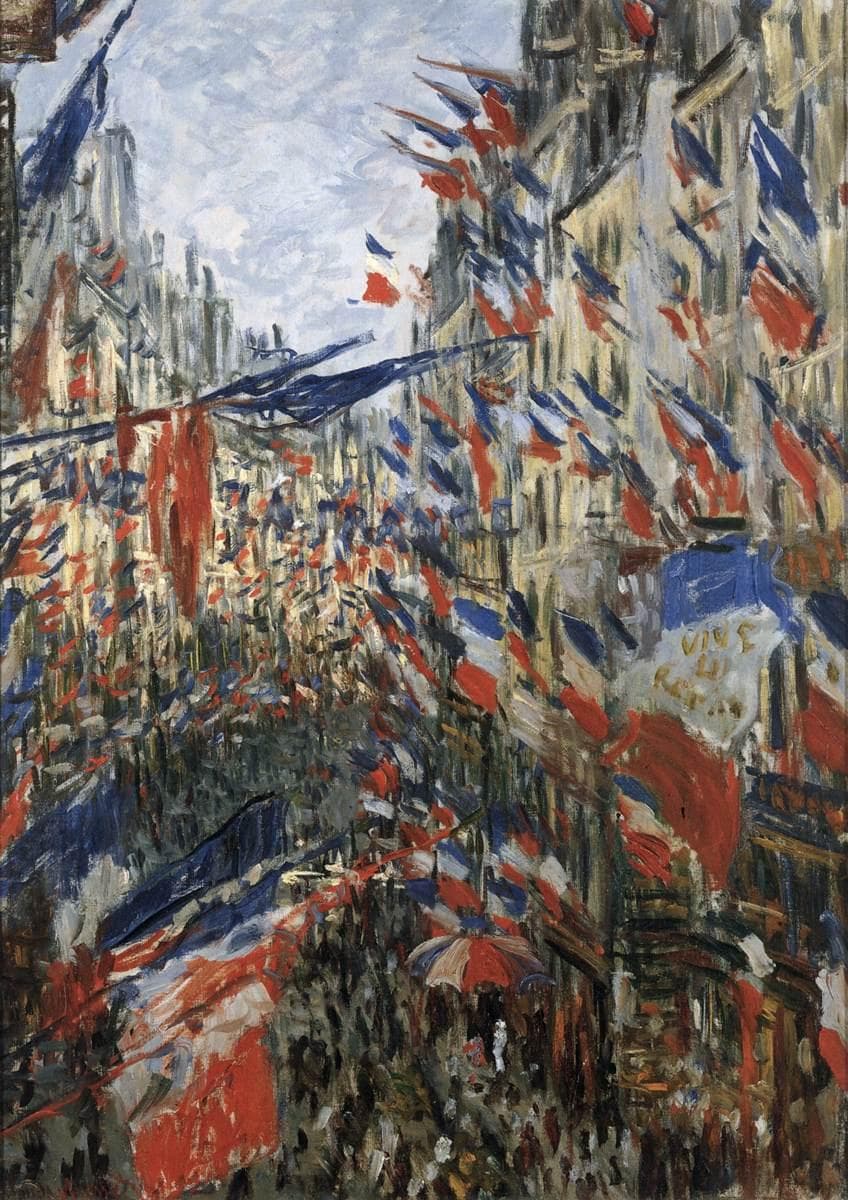
Rue Montorgueil in Paris, Celebration of 30 June 1878
Claude Monet, 1878
Rue Montorgueil in Paris, Celebration of 30 June 1878 is Claude Monet's view of a Paris street hung with tricolor flags for a national festival of peace and work. Painted that day in 1878, it is now in the Musée d'Orsay, Paris.
- Artist
- Claude Monet
- Date
- 1878
- Medium
- Oil on canvas
- Dimensions
- 81 × 50 cm
- Collection
- Musée d'Orsay, Paris, France
- Movement
- Impressionism
- Catalogue
- Wildenstein 469
More at Monet at the Musée d'Orsay
What you are looking at
A narrow Paris street drops away from us, packed from wall to wall with people and hung from nearly every window with French flags. The flags are not drawn so much as flicked onto the canvas: quick strokes of blue, white and red that crowd the upper half of the picture and flutter down the street toward a pale, hazy distance. Below them the crowd is a dark river of tiny marks. You cannot pick out a single face. That is the point.
Claude Monet painted the picture on 30 June 1878, from a window or balcony above the Rue Montorgueil, a market street in the center of Paris. It is in the Musée d'Orsay, which gives its size as 81 by 50 centimeters, a tall, narrow canvas that suits the canyon of the street.
What was being celebrated?
The painting is often described as a Bastille Day scene, but it is not. The 14th of July became France's national holiday only in 1880. The festival of 30 June 1878 was a one-off: a fête de la Paix et du Travail, a celebration of peace and work, declared by the government during the Exposition Universelle, the world's fair that had opened in Paris that spring.
The occasion mattered. Seven years earlier France had lost the Franco-Prussian War, and Paris had lived through the siege and the bloody suppression of the Commune. The 1878 fair was meant to show the world that the young Third Republic had recovered. The flags in Monet's picture are the flags of a republic that was still proving it could last.
Looking closely
Stand back and the picture reads as a deep street in perspective. Come close and it falls apart into marks. The flags are made with strokes of pure color laid side by side, the white often just bare, creamy paint. Monet does not stop to describe a pole or a fold; the cloth seems to move because the brushwork does.
Notice how he handles the crowd. The figures are short vertical dabs, darker toward the bottom edge and paler as the street recedes, so the throng thins into light. A few horizontal strokes suggest awnings and balconies. The buildings themselves barely exist, their facades dissolved behind the flags. The color is carried almost entirely by the tricolor and by the glowing, washed-out sky at the end of the street.
The high viewpoint is a modern one. Monet and his friend Gustave Caillebotte, among others, liked to look down on Paris from upper windows, turning the boulevard crowd into pattern. Here the angle compresses the street and stacks the flags, so the whole canvas becomes a field of color with a single deep channel through it.
Monet's twin painting and Manet's flags
On the same day Monet painted a second view, The Rue Saint-Denis, Celebration of 30 June 1878, now in the Musée des Beaux-Arts in Rouen; see Rue Saint-Denis in Paris. The two canvases are close in size and treatment and were clearly conceived together.
Édouard Manet also painted the holiday from his studio window, producing The Rue Mosnier with Flags (J. Paul Getty Museum, Los Angeles). Manet's street is emptier and quieter, with a one-legged man on crutches at the edge of the scene, a pointed reminder of the war that the festival was meant to put behind the nation. Monet's version has no such note. It is all motion and color.
Why it matters
The picture sits at an interesting point in Monet's career. In 1878 he was short of money and between homes. He had left Argenteuil in January and taken an apartment in Paris, where his second son, Michel, was born in March; by late summer the family had moved to Vétheuil, on the Seine, sharing a house with Ernest and Alice Hoschedé and their children. The festival pictures were made during those few Paris months. Paris street scenes were rare in his work after the early Boulevard des Capucines and the Gare Saint-Lazare pictures, and this is one of the last.
It is also one of the most extreme examples of how far Impressionism could push toward pure painting. Many twentieth-century viewers saw in its flickering field of color something close to abstraction, and it is often reproduced next to later flag pictures by painters such as Childe Hassam, who painted New York's flag-hung avenues during the First World War.
Where to see it
The painting is in the Musée d'Orsay in Paris, which acquired it in 1982 by dation, the French system that allows taxes to be paid with works of art. It usually hangs with the museum's Impressionist collection. The Rouen companion, Rue Saint-Denis, is a little over an hour away by train. More of Monet's Paris and Normandy work is gathered in our guide to famous Monet paintings.
Questions & answers
Where is Monet's Rue Montorgueil painting?
It is in the Musée d'Orsay in Paris, which acquired it in 1982. The canvas measures about 81 by 50 centimeters. Its companion, The Rue Saint-Denis, painted the same day, belongs to the Musée des Beaux-Arts in Rouen.
Is Monet's Rue Montorgueil a Bastille Day painting?
No. It shows the festival of 30 June 1878, a national celebration of peace and work held during the Paris Exposition Universelle. The 14th of July only became France's national holiday in 1880, two years later.
Why are there so many flags in the painting?
The government asked Parisians to decorate for the festival, and the streets were hung with tricolor flags. For a republic recovering from defeat in 1870–71 and the Commune, the flags were a public statement of national recovery.
Did Manet paint the same celebration?
Yes. Édouard Manet painted The Rue Mosnier with Flags from his studio window on the same day. It is now in the J. Paul Getty Museum. Manet's street is quieter, and includes a disabled veteran on crutches.
More by the artist
Claude Monet

Bridge over a Pond of Water Lilies
Claude Monet · 1899

Woman with a Parasol – Madame Monet and Her Son
Claude Monet · 1875

Sunset in Venice
Claude Monet · 1908–12

La Grenouillère
Claude Monet · 1869

Beach in Pourville
Claude Monet · 1882

Springtime
Claude Monet · 1872

Boating on the River Epte
Claude Monet · 1890

The Seine at Asnières (Hermitage)
Claude Monet · 1873
Also painted in 1878
The same year
Kindred works
You may also study
Rue Saint-Denis in Paris, Celebration of 30 June 1878
Claude Monet · 1878
Boulevard des Capucines
Claude Monet · 1873–74
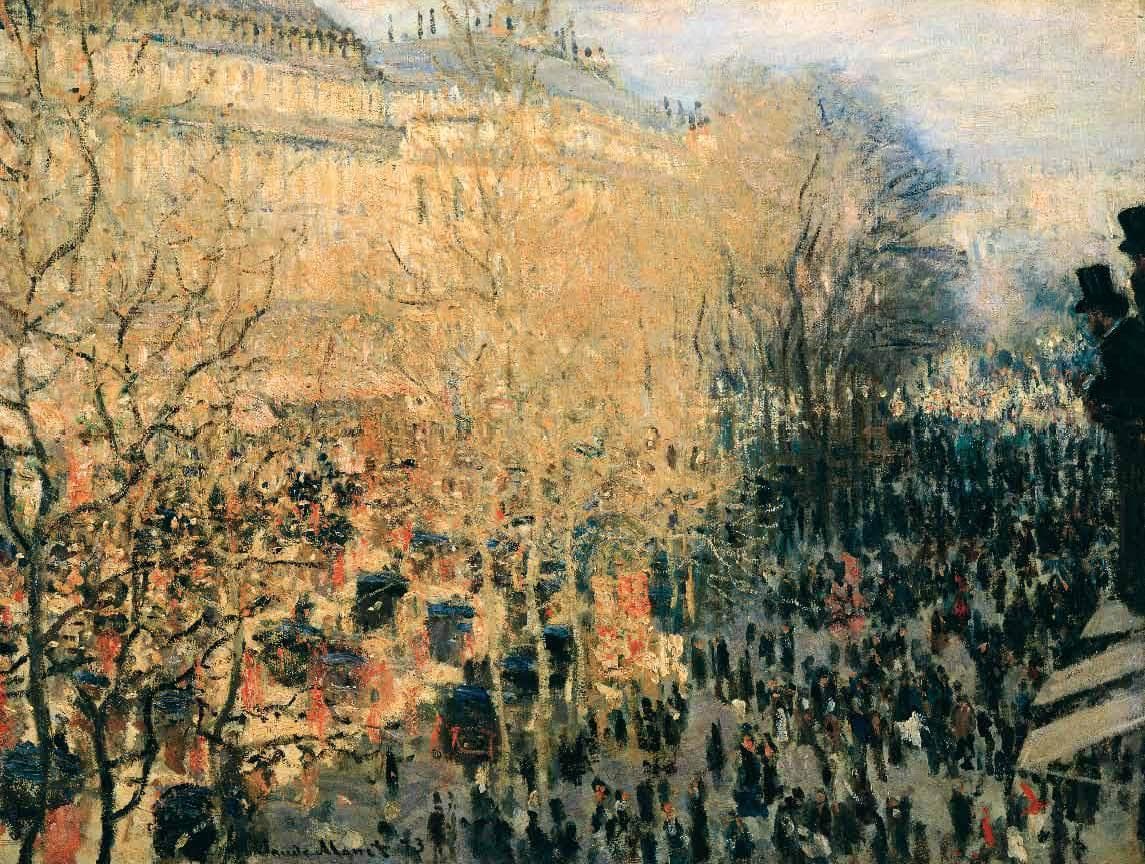
The Boulevard des Capucines in Paris
Claude Monet · 1873
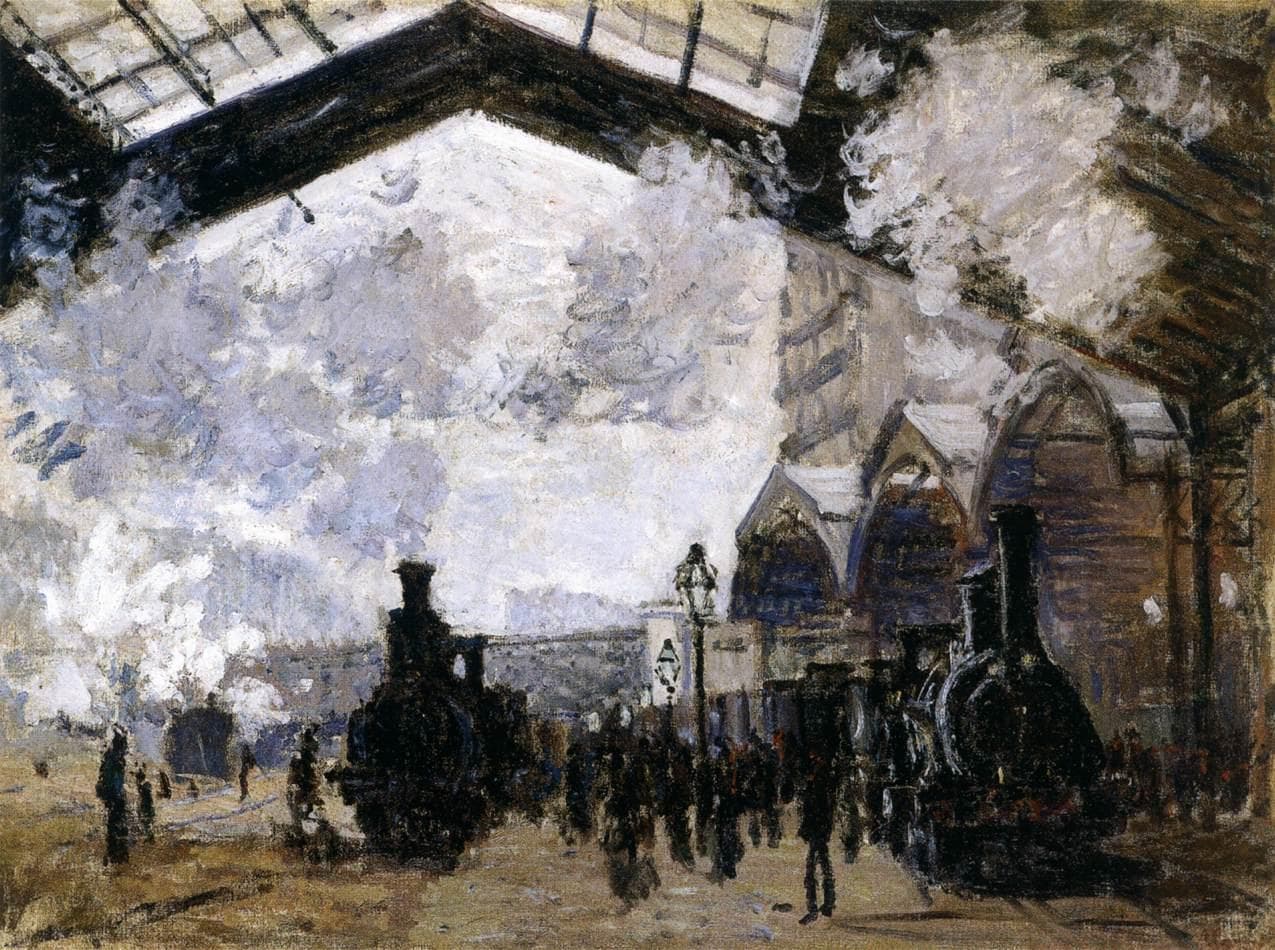
The Gare Saint-Lazare
Claude Monet · 1877
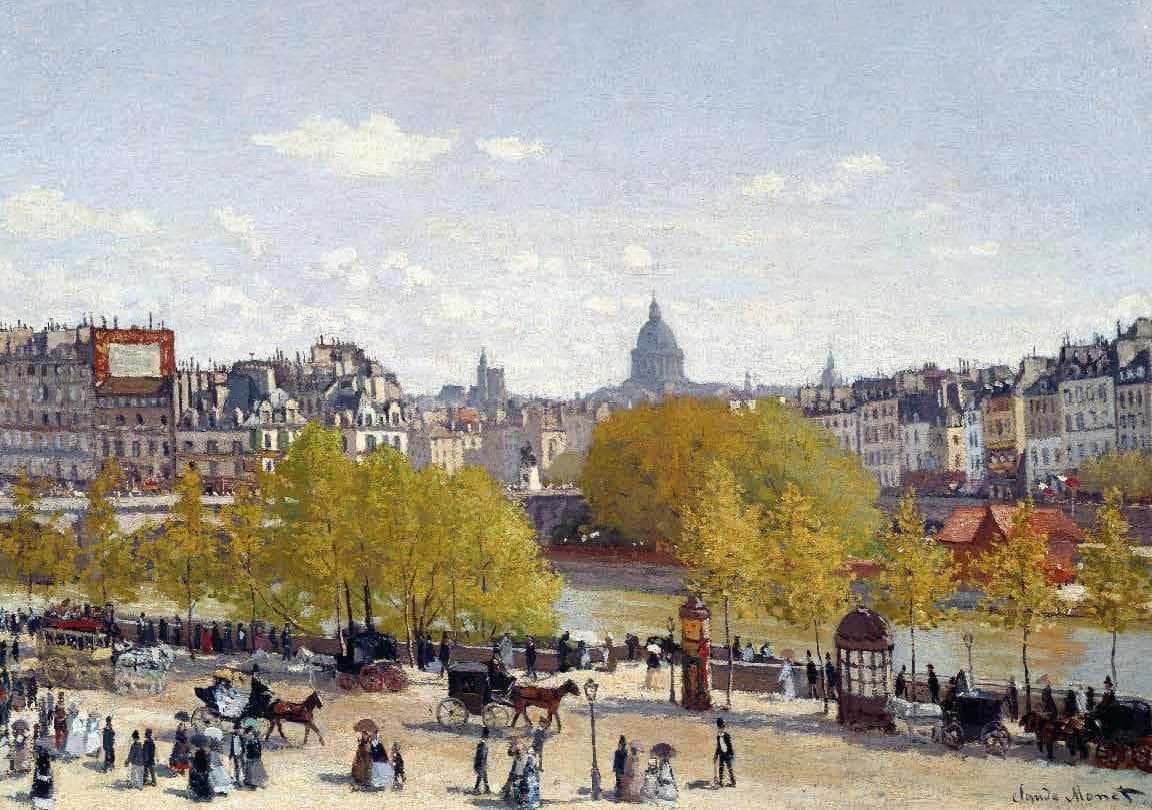
Quai du Louvre, Paris
Claude Monet · 1867
Las Meninas
Diego Velázquez · 1656
The School of Athens
Raphael · 1509–1511
Liberty Leading the People
Eugène Delacroix · 1830