Impressionism
Rue Saint-Denis in Paris, Celebration of 30 June 1878
Claude Monet, 1878
Rue Saint-Denis, Celebration of 30 June 1878 is a painting by Claude Monet of a Paris street hung with tricolor flags for the national festival of 1878. It measures 76 × 52 cm (Wildenstein 470) and is in the Musée des Beaux-Arts de Rouen.
- Artist
- Claude Monet
- Date
- 1878
- Medium
- Oil on canvas
- Dimensions
- 76 × 52 cm
- Collection
- Musée des Beaux-Arts de Rouen, Rouen, France
- Movement
- Impressionism
- Catalogue
- Wildenstein 470
What you are looking at
Looking down a narrow Paris street from a window or balcony, we see almost nothing but flags. They hang from every window on both sides, red, white and blue, painted as quick slashes of color that flutter, overlap and recede into the distance in a dense, jostling crowd of their own. The buildings are reduced to pale grey-blue and cream verticals behind them, their windows a few dark marks. Far below, the street is a dark, churning mass of tiny strokes, the crowd itself, with a few touches of color for parasols and hats. At lower center a striped parasol or umbrella shows as a small red-and-white dome.
At right, a large banner stretched across a façade carries painted lettering that appears to read "Vive la République", a slogan that was far from neutral in 1878. The narrow strip of sky at the top is white and blue, streaked with cloud, and a few flags cut across it on poles reaching out from the buildings.
The tall format makes the street feel like a canyon. Monet's touch is at its fastest here: each flag is two or three strokes, red and blue on either side of a stripe of bare light. The effect is of noise and motion, wind in the bunting and sound rising from the street.
The festival of 30 June 1878
The occasion was the Fête de la Paix, a national celebration held in Paris on 30 June 1878 during the Exposition Universelle. It was the first great public festival of the Third Republic, seven years after the defeat by Prussia and the suppression of the Commune, and the government encouraged Parisians to decorate their streets. Monet, who was then living in Paris before his move to Vétheuil later that summer, went out with his painting equipment and found a high viewpoint.
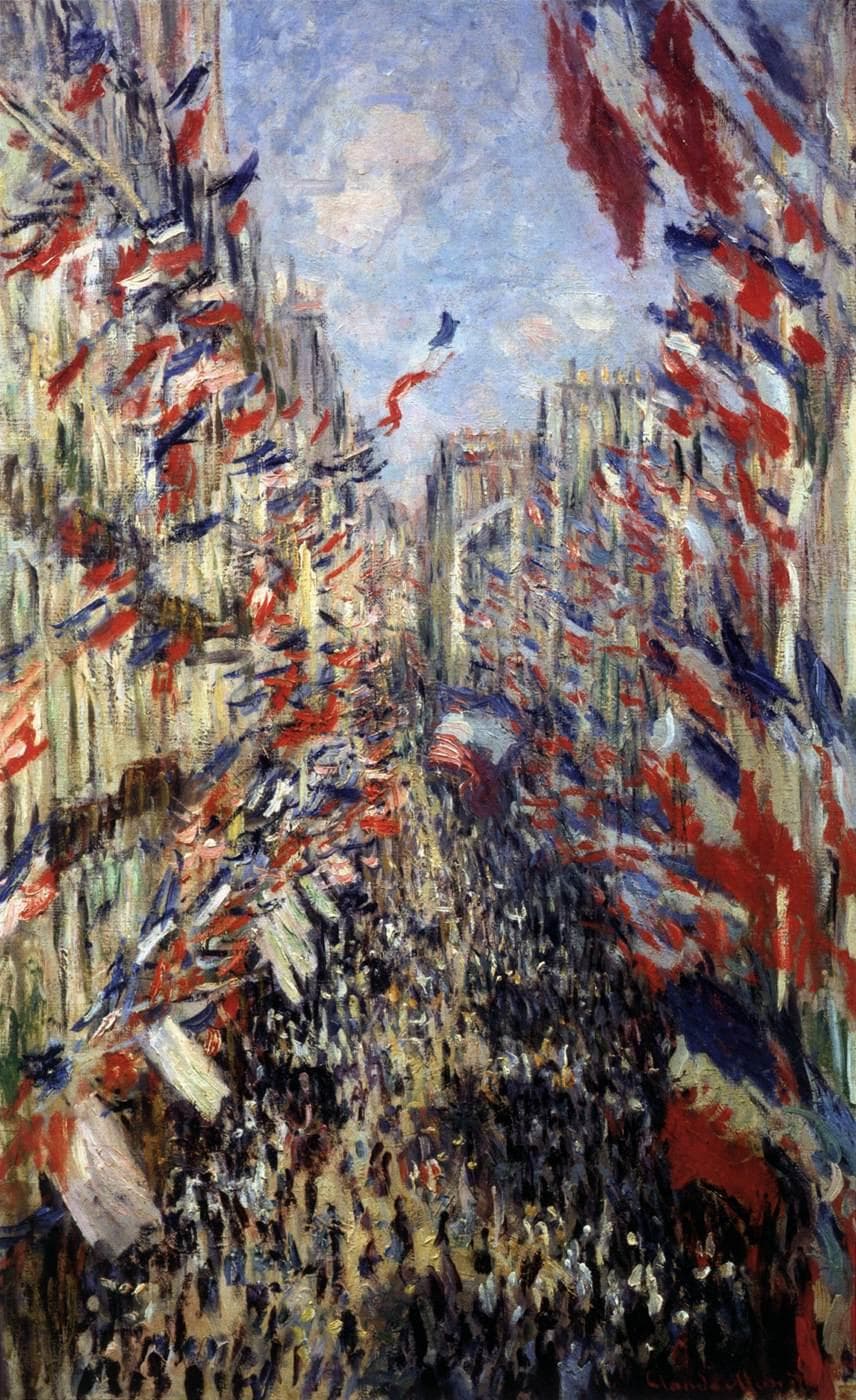
He painted two views of the festival: this one of the Rue Saint-Denis, and Rue Montorgueil, now in the Musée d'Orsay. The 14 July national holiday was established only in 1880, so this picture is sometimes wrongly connected to Bastille Day.
How it was painted
The canvas is about 76 by 52 centimeters, upright, and it was clearly painted fast, probably in a single session on the day. Monet lays in the pale buildings first, then the flags over them in loaded, slashing strokes of pure red, blue and white, wet into wet, so that colors drag into one another at the edges. The crowd is a scrubbed band of dark paint enlivened with flecks. There is no drawing in the usual sense: the perspective of the street is carried entirely by the diminishing size of the flags. Up close, the canvas looks almost abstract, a field of red and blue marks; from a few steps back the street snaps into depth.
Monet's Paris
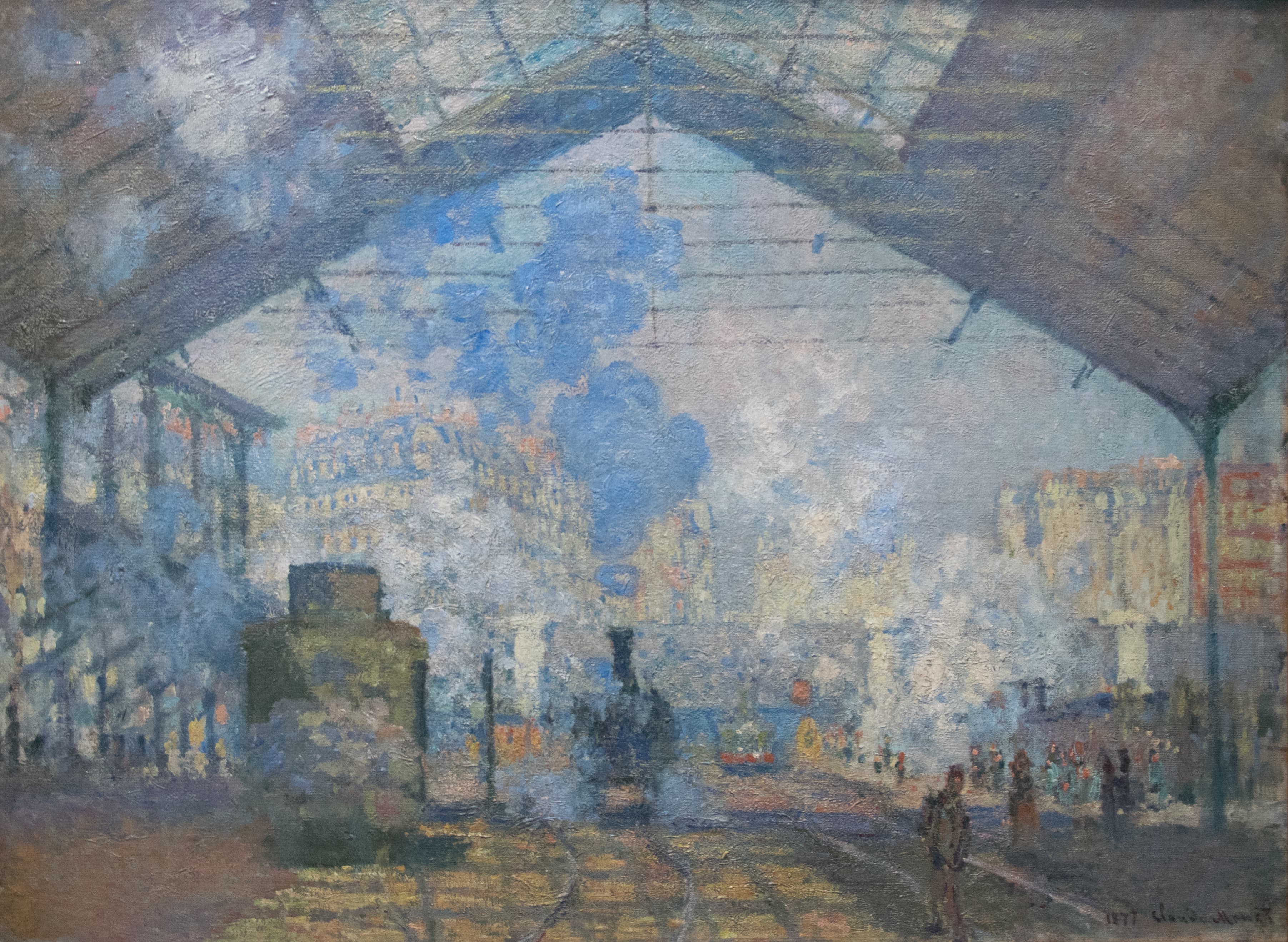
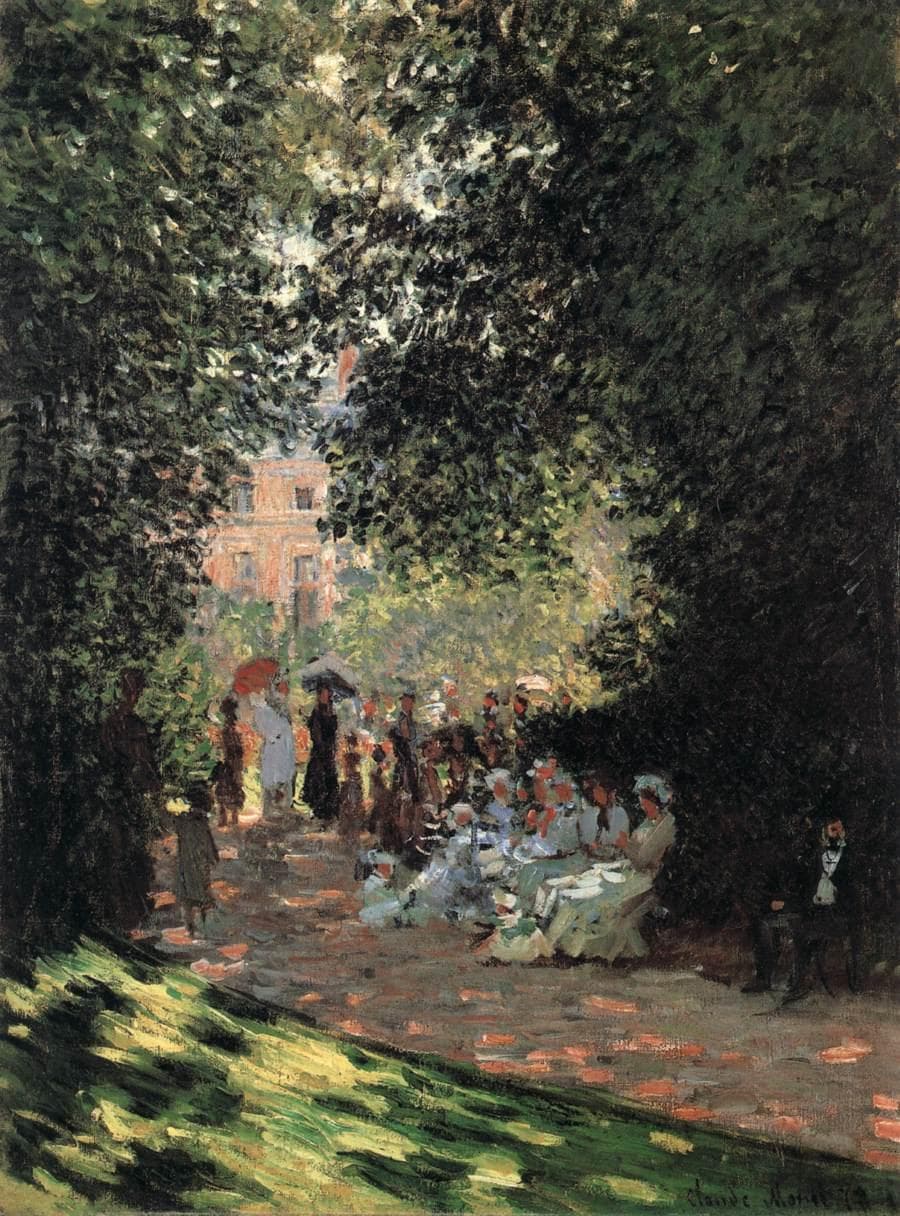
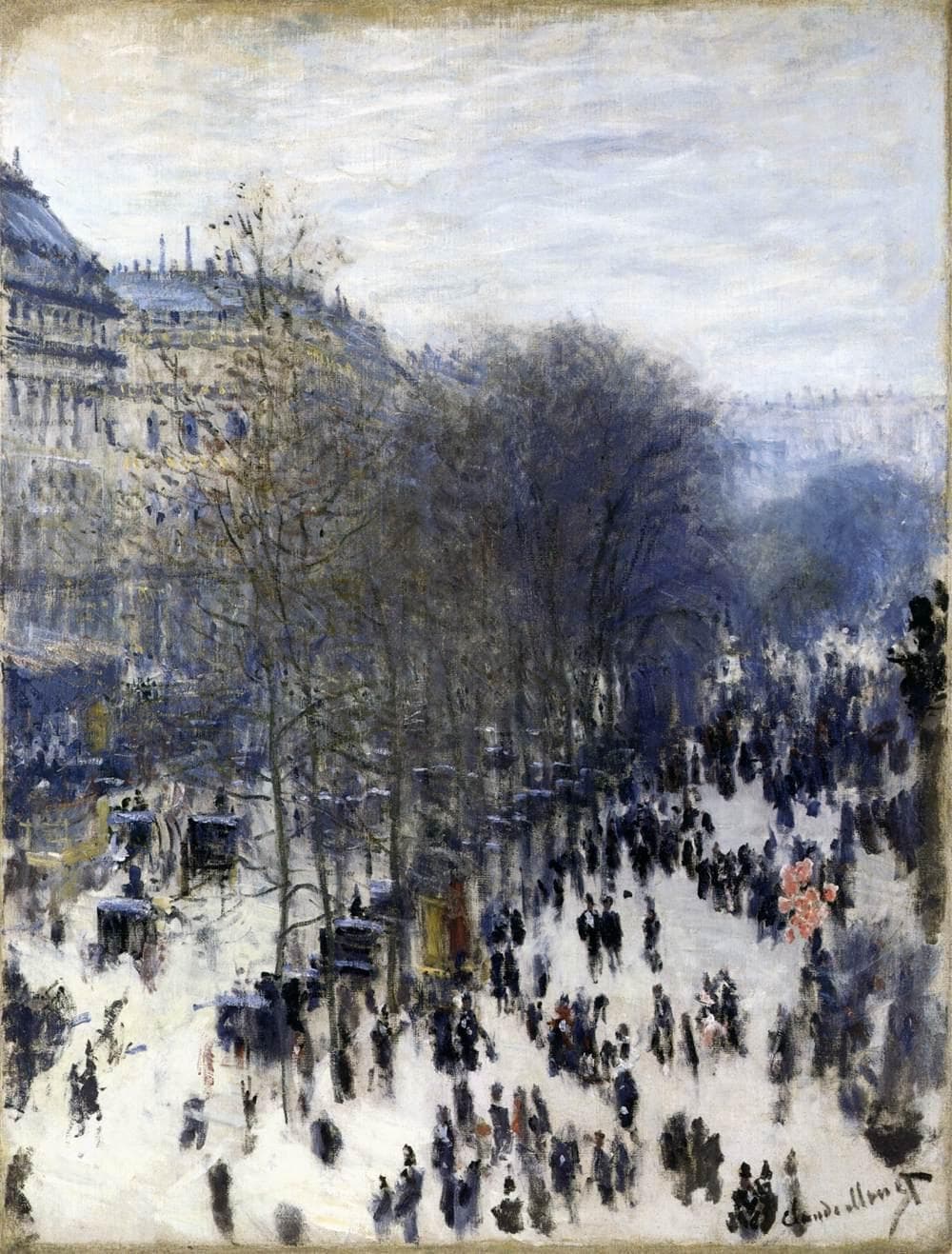
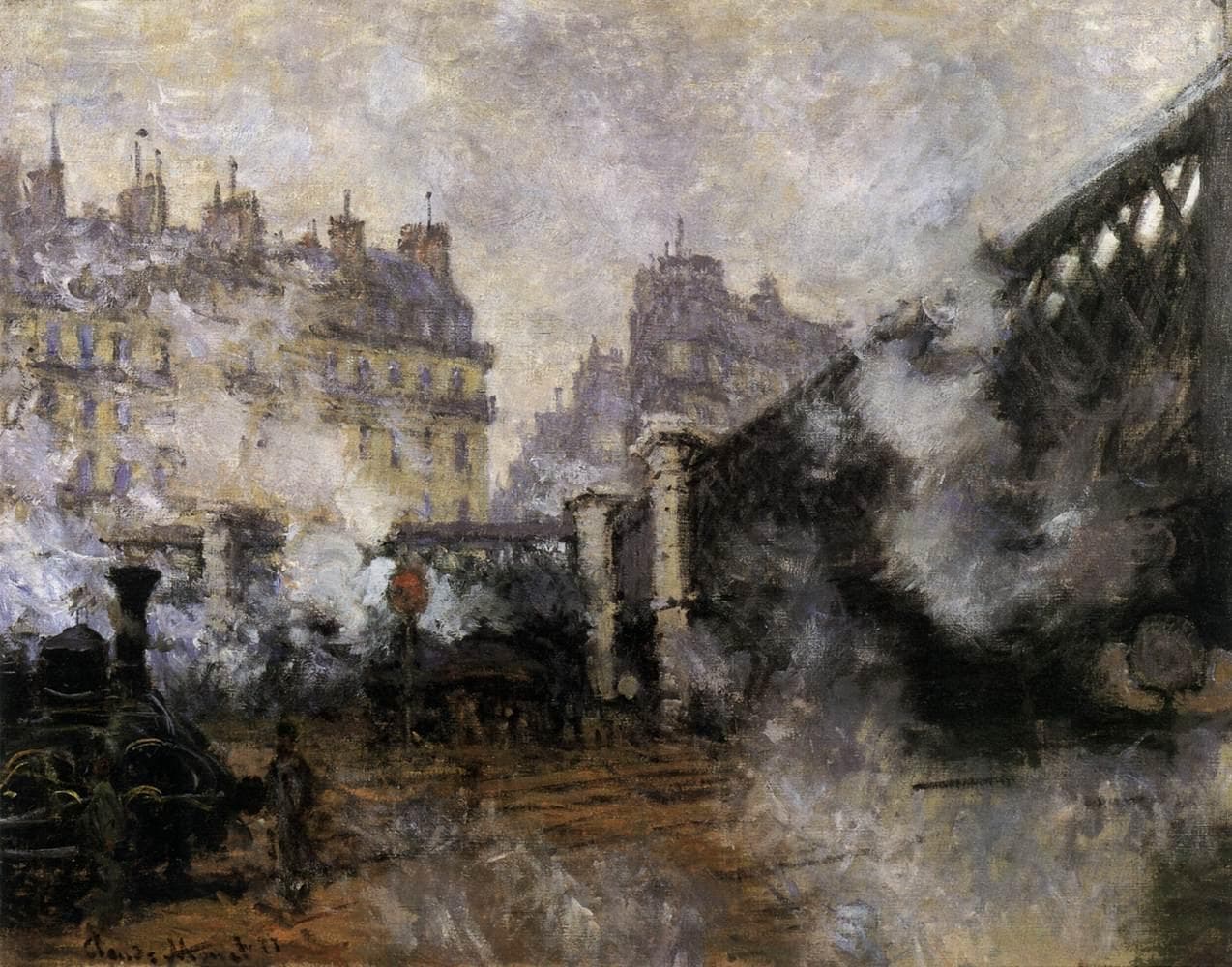
The picture belongs to the last stretch of Claude Monet's years painting the capital. The year before he had painted the station in La Gare Saint-Lazare and its sister canvases, and in 1878 he also painted the Parc Monceau. The high viewpoint over a crowded street recalls Boulevard des Capucines of 1873. Paris has no dedicated hub of its own in our archive, but these pictures together trace his view of the modern city.
Meaning
Monet was not a political painter, but this is about as close as he came. The tricolor was the symbol of the republic and of national recovery, and the picture records a moment of collective celebration in the modern city. The flags, rather than any monument or official, are the protagonists. Later painters, among them Albert Marquet, Raoul Dufy and Childe Hassam, took up the flag-decked street as a subject of their own.
Where to see it
The painting is in the Musée des Beaux-Arts de Rouen. It came to the museum in 1909 with the gift of the Rouen collector François Depeaux, a major early patron of the Impressionists. For museums worldwide, see where to see Monet's paintings.
Questions & answers
Where is Monet's Rue Saint-Denis, 30 June 1878?
The painting is in the Musée des Beaux-Arts de Rouen in Normandy, France. It measures 76 by 52 centimeters and is catalogued as Wildenstein 470. It entered the museum in 1909 with the gift of the collector François Depeaux. Its companion, the Rue Montorgueil, is in the Musée d'Orsay.
What was the celebration of 30 June 1878?
It was the Fête de la Paix, a national festival of peace held in Paris during the 1878 Exposition Universelle. It was the first major public celebration of the Third Republic after the Franco-Prussian War and the Commune, and Parisians covered their streets with tricolor flags.
What does the painting show?
A narrow Paris street seen from above, packed with red, white and blue flags hanging from every window, with a crowd filling the street below. A banner at right carries a republican slogan. Monet painted it at speed, so each flag is just a few strokes of color.
Is Rue Saint-Denis a Bastille Day painting?
No. Although it is often described that way, 14 July only became France's national holiday in 1880. The flags celebrate the festival of 30 June 1878, held during that year's world's fair in Paris. Monet painted a second view that day, of the nearby Rue Montorgueil.
More by the artist
Claude Monet

Bridge over a Pond of Water Lilies
Claude Monet · 1899

Woman with a Parasol – Madame Monet and Her Son
Claude Monet · 1875

Sunset in Venice
Claude Monet · 1908–12

La Grenouillère
Claude Monet · 1869

Beach in Pourville
Claude Monet · 1882

Springtime
Claude Monet · 1872

Boating on the River Epte
Claude Monet · 1890

The Seine at Asnières (Hermitage)
Claude Monet · 1873
Also painted in 1878
The same year
Kindred works
You may also study
Rue Montorgueil in Paris, Celebration of 30 June 1878
Claude Monet · 1878
La Gare Saint-Lazare
Claude Monet · 1877
The Parc Monceau
Claude Monet · 1878
Boulevard des Capucines
Claude Monet · 1873–74
Pont de l'Europe, Gare Saint-Lazare
Claude Monet · 1877
Las Meninas
Diego Velázquez · 1656
The School of Athens
Raphael · 1509–1511
Liberty Leading the People
Eugène Delacroix · 1830