Baroque
Bejeweled Skeleton of Saint Deodatus
Artist Unknown & Paul Koudounaris, Translated from Rome 1690
The bejeweled skeleton of Saint Deodatus is a catacomb saint in the former abbey church of Rheinau, Switzerland: Roman bones brought north in 1690, dressed as a Roman soldier with a wax face mask. It was photographed by Paul Koudounaris for his book Heavenly Bodies.
- Artist
- Artist Unknown & Paul Koudounaris
- Date
- Translated from Rome 1690
- Medium
- Human skeleton with wax, textiles, metal armor, gilding, glass and paste jewels
- Collection
- Klosterkirche Rheinau (Rheinau Abbey church), Rheinau, Switzerland
- Movement
- Baroque
Saint Deodatus of Rheinau is one of the "catacomb saints": skeletons taken from the early Christian catacombs of Rome in the seventeenth and eighteenth centuries, declared to be martyrs and sent to churches north of the Alps, where they were dressed in gold, armor and jewels. A painted cartouche at his feet reads SANCTUS DEODATUS MARTYR ROMA TRANSLATUS 1690, "Saint Deodatus, martyr, brought from Rome, 1690." He sits enthroned in a niche of the Baroque abbey church at Rheinau, on an island in the Rhine in the canton of Zurich. The photograph that made him famous was taken by the historian Paul Koudounaris for his 2013 book Heavenly Bodies.
What you're looking at
Deodatus sits upright in a carved and painted chair, as if holding court. His skeleton is fully clothed. A breastplate of embossed silver-colored metal covers the ribs, with gilded shoulder pieces; below it hangs a deep fringed skirt of crimson cloth worked with gold braid and set with colored stones. His arms are sleeved in rose-pink fabric embroidered with flowers, ending in frilled cuffs, and the bones of his feet show through open-work sandals or greaves of metal thread.
The head is the most striking part. Behind it rises a gilded sunburst halo of long, sharp rays. The upper half of the skull is covered by a molded wax face, with modeled brows and nose, while the lower half, around the mouth and jaw, is wrapped in a mesh of fine metal thread, so that the teeth are not visible. One hand raises a gilt object, perhaps a reliquary or ornament; the other holds a long staff angled across his body. The niche around him is painted with swirling red and orange foliage, and draped with gold brocade.
The detail most viewers miss is the label. The small gilt cartouche is the only text in the image, and it records not a birth or death date but the year the relic was "translated," the technical term for the formal transfer of a saint's remains.
Who was Deodatus?
Almost certainly not the person his name suggests. Deodatus ("given by God") was a common early Christian name and was also borne by a seventh-century bishop of Nevers who founded a monastery at what is now Saint-Dié in the Vosges. The Rheinau skeleton has nothing to do with him. Like other catacomb saints, it was an anonymous body from a Roman burial gallery, identified as a martyr by church officials and given a name, sometimes from an inscription near the grave and sometimes by assignment.
From the 1570s, when the catacombs were rediscovered, the Roman church allowed such remains to be exported. Demand was strongest in Catholic Germany, Austria and Switzerland, where churches had lost relics and images during the Reformation. A glittering, armored saint was a powerful answer to Protestant critiques: proof, in bone and gold, of the glory awaiting the faithful.
How it was made
Decorating a catacomb saint could take years. The work was usually done by nuns in convents with skilled needlework traditions, sometimes with goldsmiths and painters. Bones were wired into position, wrapped in fine gauze, and covered in embroidered textiles, metal-thread lace, glass and paste stones, and occasionally real gems. According to Koudounaris, Deodatus's wax face mask over the upper skull and his fabric-wrapped mouth make him an unusual example of how artisans "reconstructed" a face for a saint.
Armor of the kind he wears was a common choice: it identified the saint as a soldier of Christ, and by extension an early martyr from the Roman army.
Fall and revival
By the late eighteenth century, Enlightenment reformers found the cult embarrassing, and many catacomb saints were stripped, hidden or destroyed. Rheinau Abbey itself was dissolved in 1862, but its church and much of its Baroque furnishing survived. Deodatus survived in place.
Koudounaris spent years tracking surviving skeletons across Europe, and Heavenly Bodies: Cult Treasures and Spectacular Saints from the Catacombs (Thames & Hudson, 2013) brought them to a global audience. The book's photographs, including this one, are why queries such as "bejeweled skeleton" and "saint felix skeleton" now lead to images like this. See also Saint Felix, Saint Albertus, Saint Munditia and the overview in The Catacomb Saints.
Meaning
To the people who commissioned him, Deodatus was not macabre. He was a heavenly body in the literal sense: a glimpse of the resurrected saint as he would appear in glory, enthroned, armored and crowned with light. To modern eyes the effect is closer to a memento mori, with the luxury of the costume heightening, not hiding, the reality of the bones.
Where to see it
The former Benedictine abbey church (Klosterkirche) of Rheinau, canton of Zurich, Switzerland, near the German border and the Rhine Falls. The church is open to visitors; check local opening times before traveling.
Questions & answers
Where is the skeleton of Saint Deodatus?
It is in the Baroque church of the former Benedictine abbey of Rheinau, on an island in the Rhine in the canton of Zurich, Switzerland. A cartouche at the base records that the relic was brought from Rome in 1690. Paul Koudounaris photographed it for his book Heavenly Bodies (2013).
What are the bejeweled skeletons?
They are 'catacomb saints': anonymous early Christian remains taken from Rome's catacombs from the late sixteenth century, declared martyrs, and sent to churches mainly in Germany, Austria and Switzerland. Nuns and craftsmen dressed them in armor, embroidered textiles and jewels as images of saints in heavenly glory.
Is Saint Deodatus the same as the bishop of Nevers?
No. The seventh-century Saint Deodatus, bishop of Nevers and founder of the monastery at Saint-Dié, is a different figure. The Rheinau skeleton is a catacomb saint, an unidentified body from a Roman burial gallery that was given the name Deodatus when it was sent north.
Why does Saint Deodatus wear a mask?
His face was reconstructed: a molded wax mask covers the upper half of the skull, and the mouth area is wrapped in fabric and metal-thread mesh. Paul Koudounaris cites it as an unusual example of how decorators gave catacomb saints a more lifelike, idealized face.
More by the artist
Artist Unknown
Winged Victory of Samothrace
Artist Unknown · c. 200–190 BC
Angels and Demons – The Movie Prop
Artist Unknown & Gian Lorenzo Bernini · 2008
Tombstone of Silvia Marini nei De Rogati
Artist Unknown · After 1947
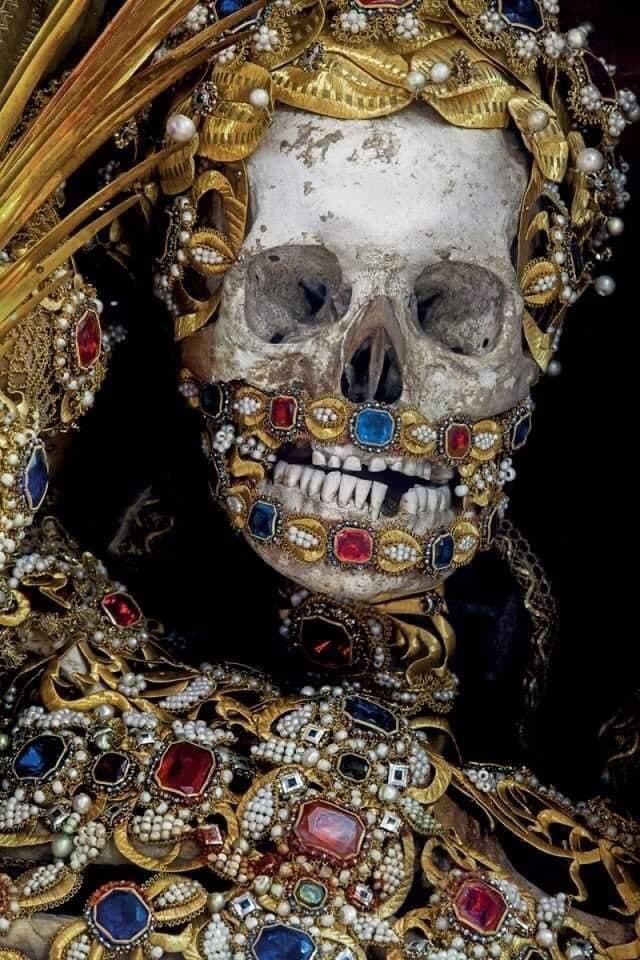
Bejeweled Skeleton of Saint Maximus
Paul Koudounaris · Late 17th century (relics acquired 1677)
Bejeweled Skeleton of Saint Albertus
Paul Koudounaris · Arrived 1723; decoration 18th century
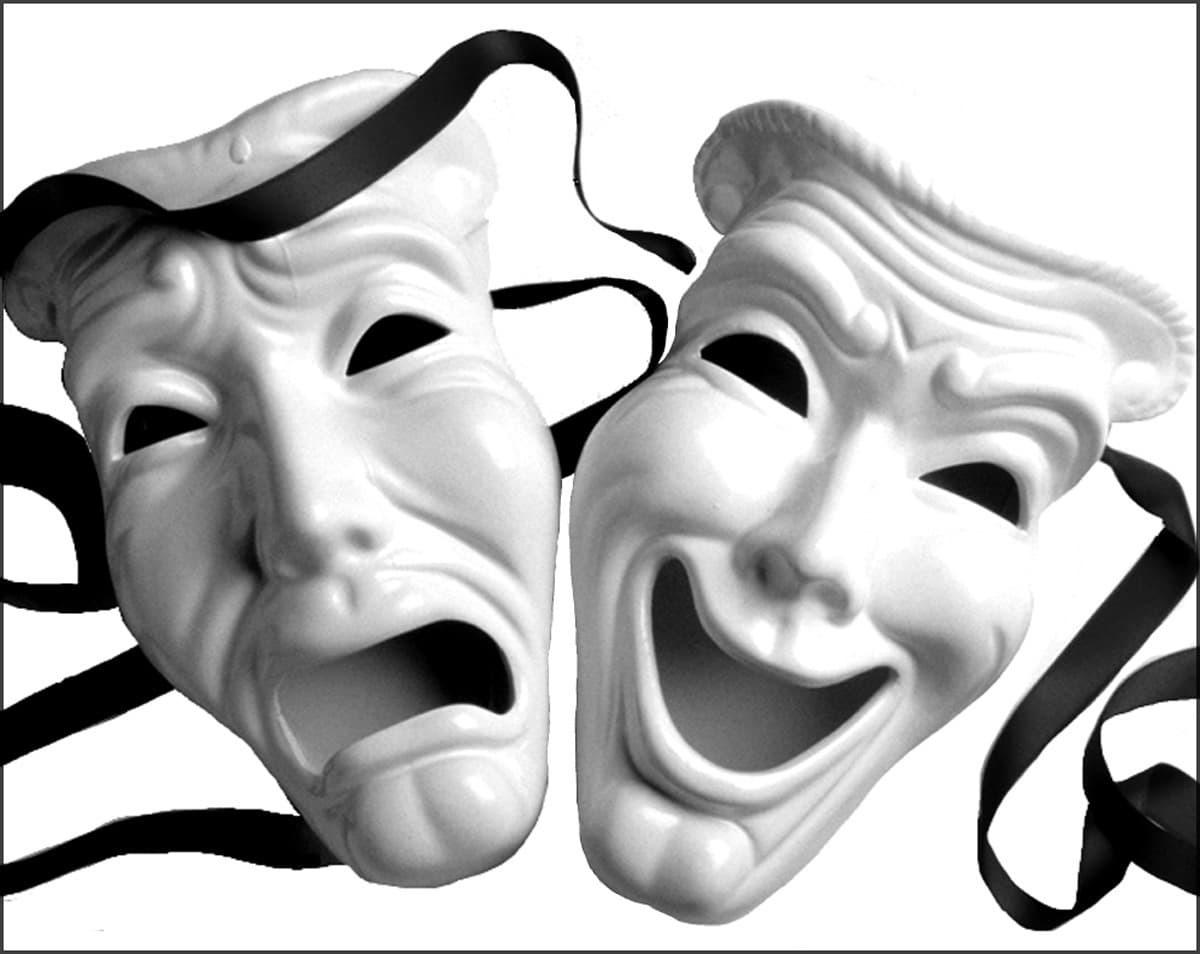
Sock and Buskin
Artist Unknown
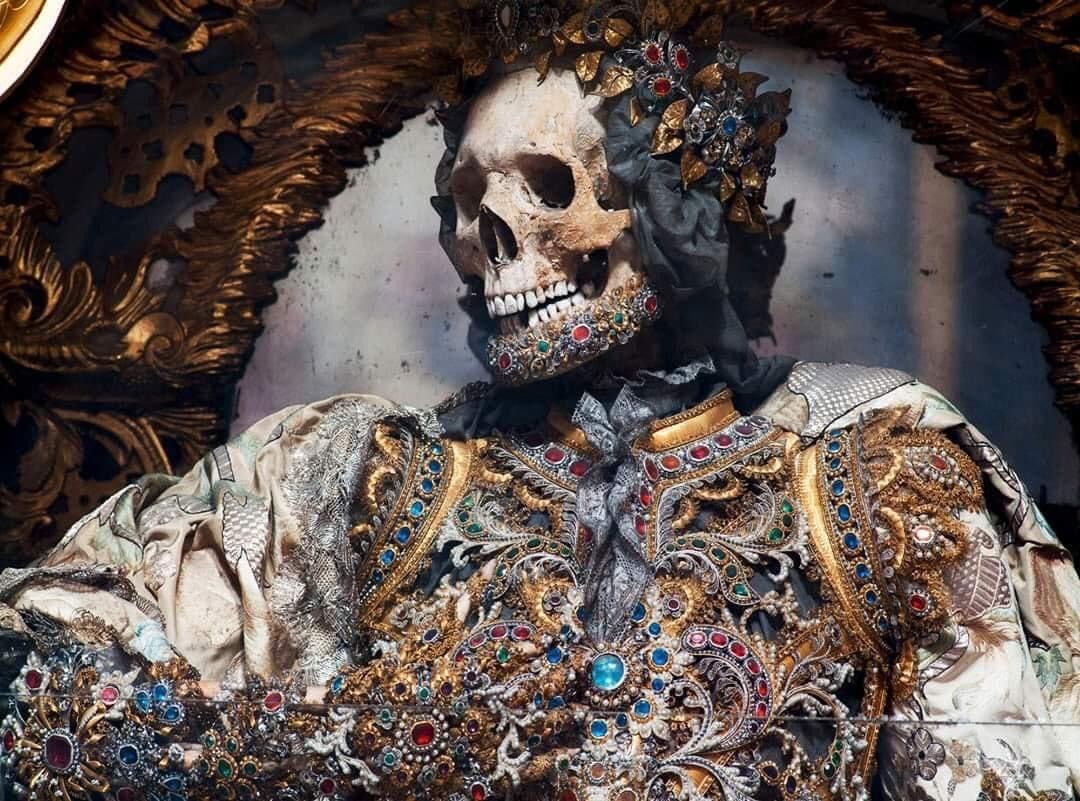
Bejeweled Skeleton of Saint Gratian
Adalbart Eder & Paul Koudounaris · 18th century (decoration); photographed by Paul Koudounaris, published 2013
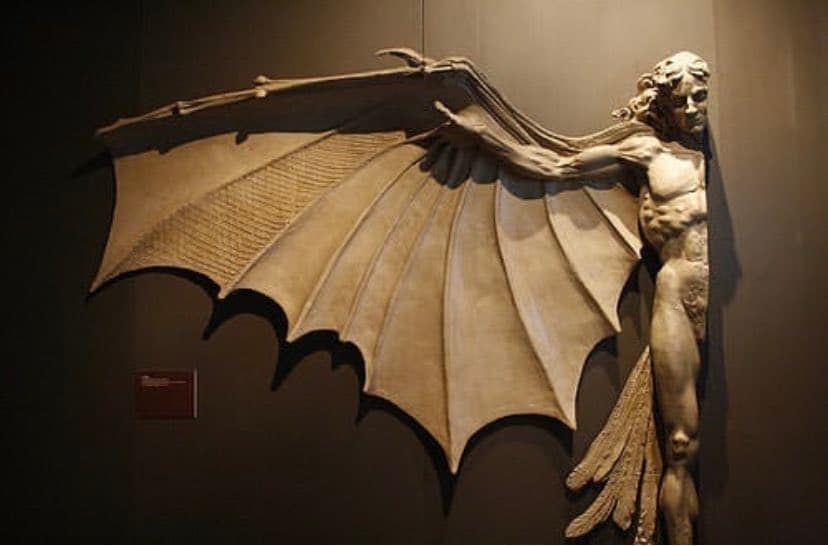
Artificial Wings
Artist Unknown · c. 2008
Kindred works
You may also study
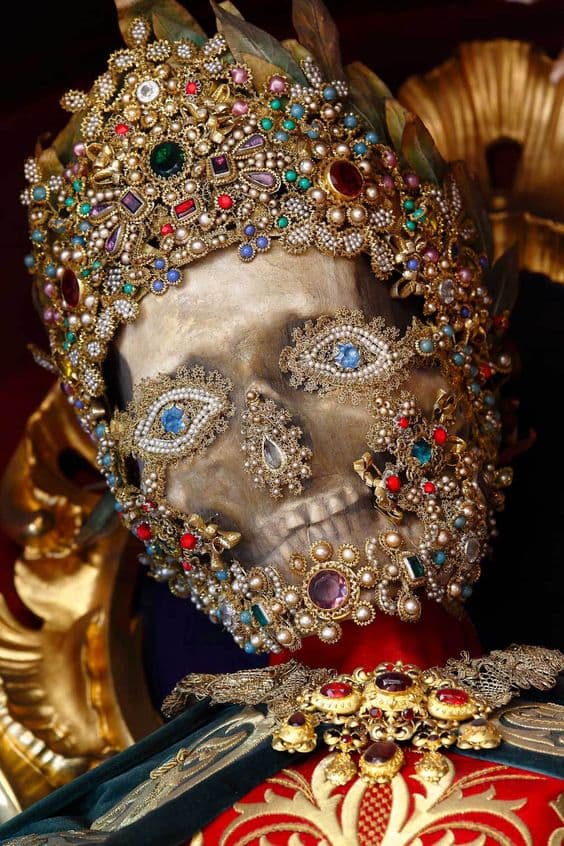
Bejeweled Skeleton of Saint Felix
Paul Koudounaris & Eastern Orthodox Church & St. Peter's Church
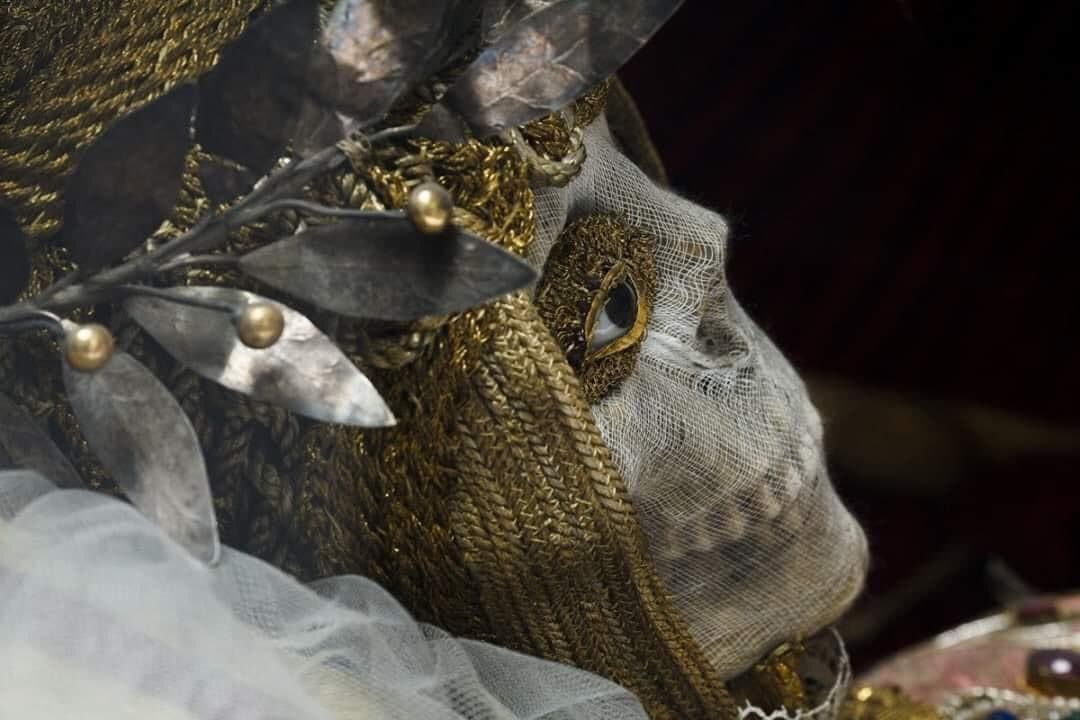
Bejeweled Skeleton of Saint Munditia
St. Peter's Church & Paul Koudounaris · 1675–77

The Scream
Edvard Munch · 1893

Saturn Devouring His Son
Francisco Goya · c. 1819–1823
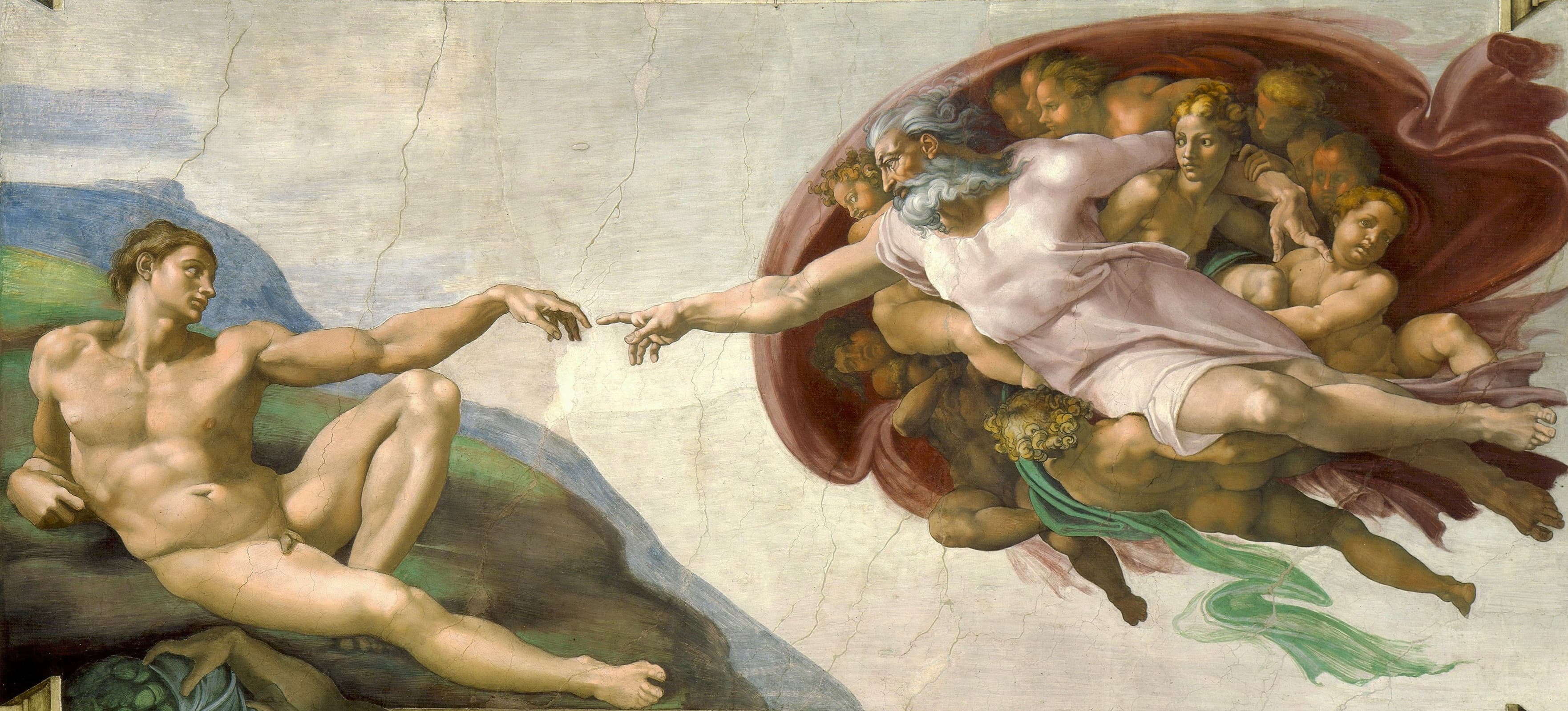
The Creation of Adam
Michelangelo · c. 1511–12

Ophelia
John Everett Millais · 1851–52
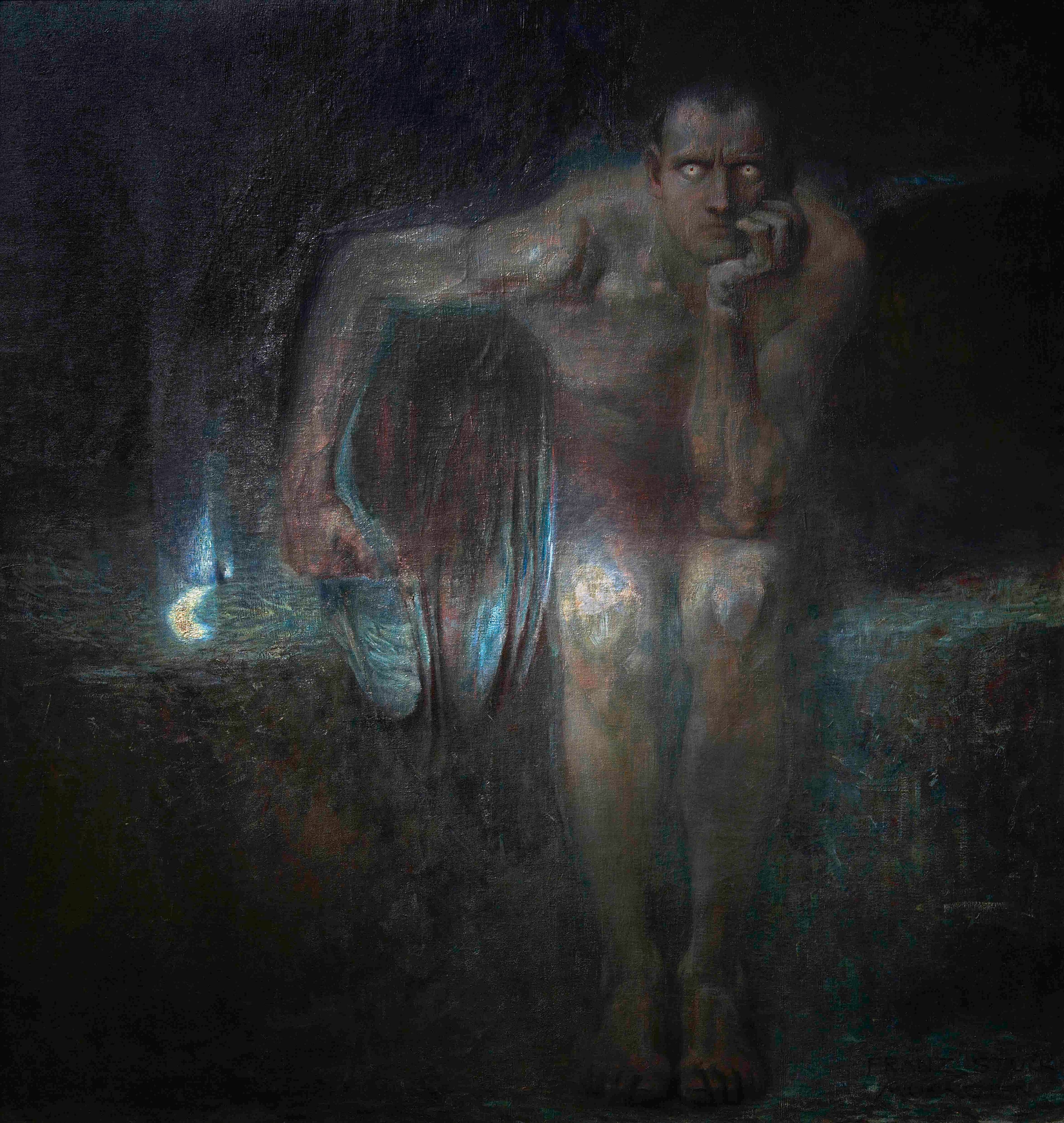
Lucifer
Franz von Stuck · 1890
Head of a Skeleton with a Burning Cigarette
Vincent van Gogh · 1886