Theme
The Catacomb Saints: Bejeweled Skeletons of Baroque Europe
Anonymous bones from Rome, dressed in gold and gems by nuns, and sent north to stand in for the saints the Reformation had smashed.
The catacomb saints are human skeletons taken from the catacombs of Rome from 1578 onward, identified, often on thin evidence, as early Christian martyrs, and sent to Catholic churches north of the Alps, where they were dressed in jewels, gold wire and embroidered silk and displayed as holy relics. Hundreds reached Germany, Austria and Switzerland in the seventeenth and eighteenth centuries. Many still sit upright or recline in glass shrines today, among them Saint Munditia in St. Peter's Church in Munich.
These bejeweled skeletons are religious objects first, but they are also some of the strangest works of Baroque craft: collaborative pieces made by nuns and lay brothers who spent years on a single body. The photographer and historian Paul Koudounaris brought them to a wide audience with his 2013 book Heavenly Bodies, the source of the images in this collection.
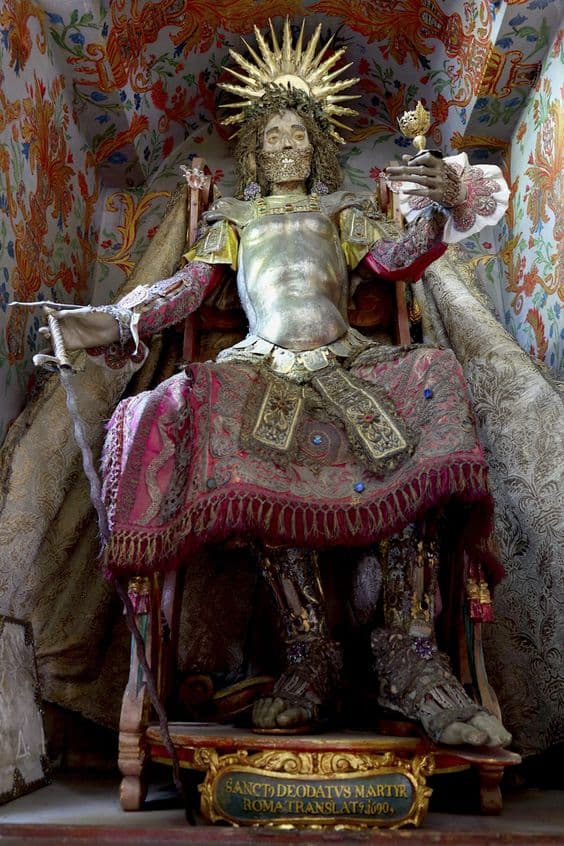
Bejeweled Skeleton of Saint Deodatus
Artist Unknown & Paul Koudounaris · Translated from Rome 1690
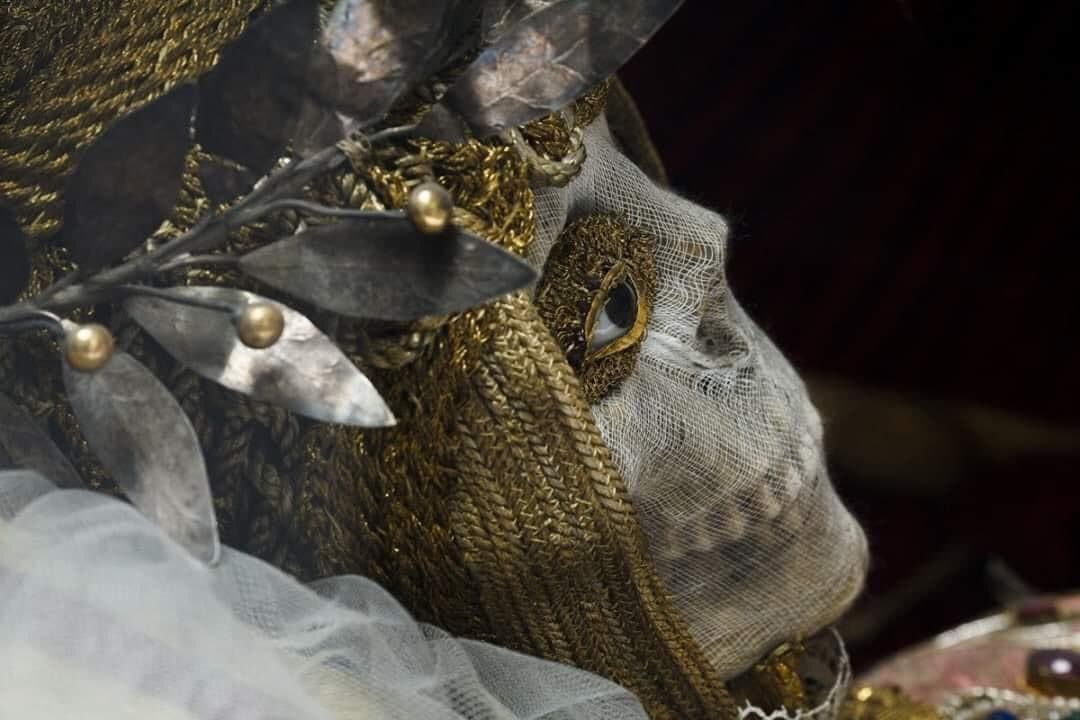
Bejeweled Skeleton of Saint Munditia
St. Peter's Church & Paul Koudounaris · 1675–77
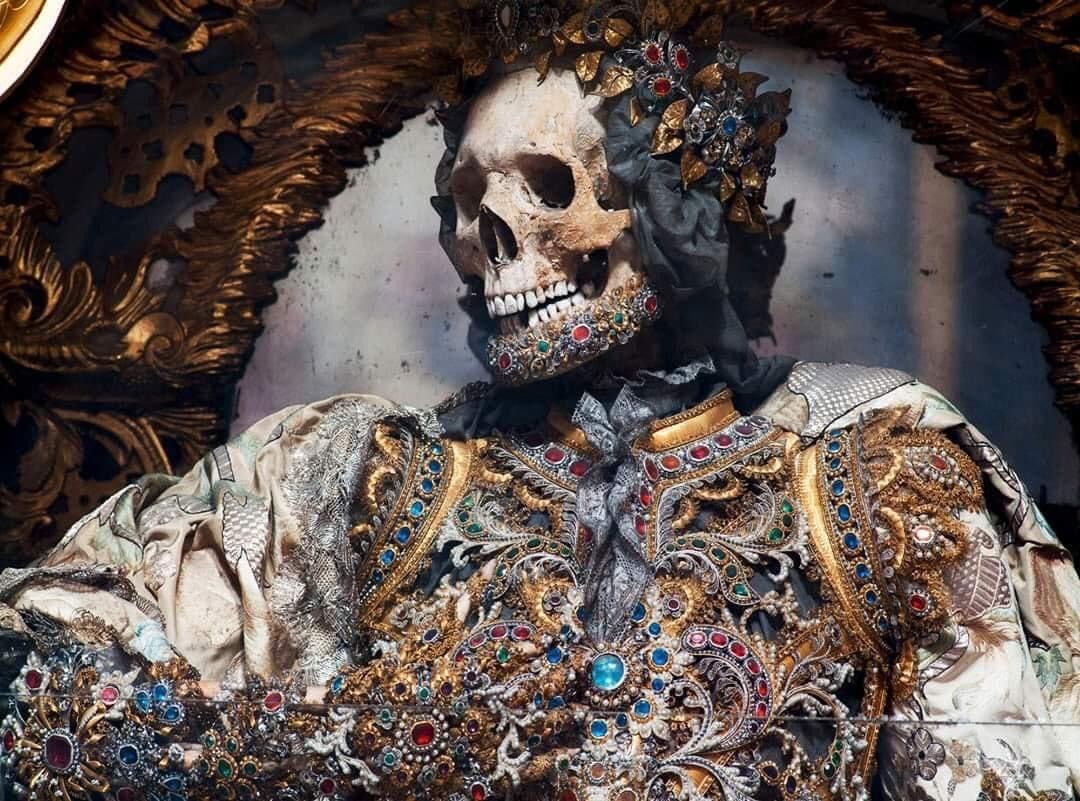
Bejeweled Skeleton of Saint Gratian
Adalbart Eder & Paul Koudounaris · 18th century (decoration); photographed by Paul Koudounaris, published 2013
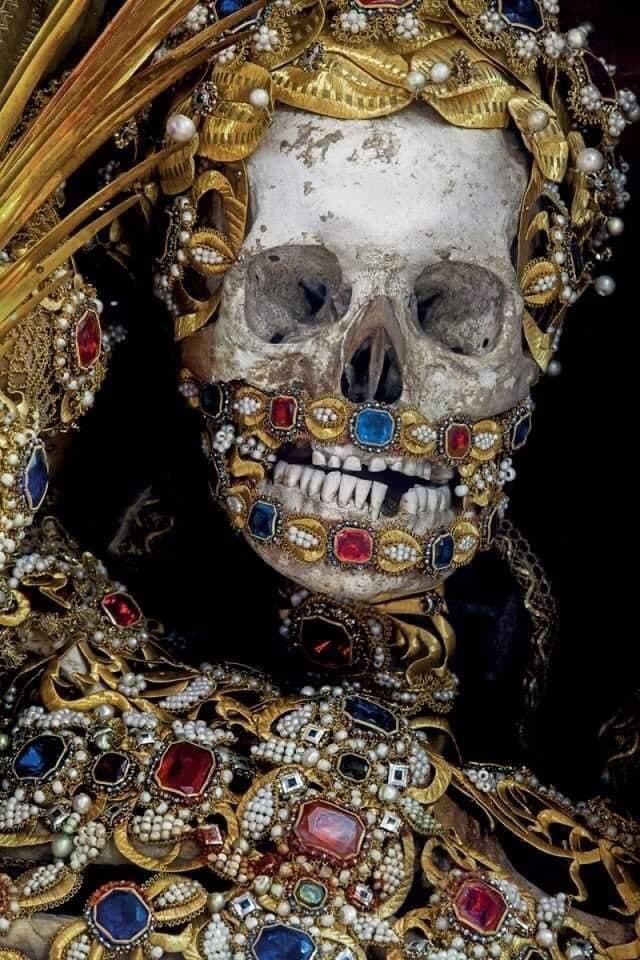
Bejeweled Skeleton of Saint Albertus
Paul Koudounaris · Arrived 1723; decoration 18th century
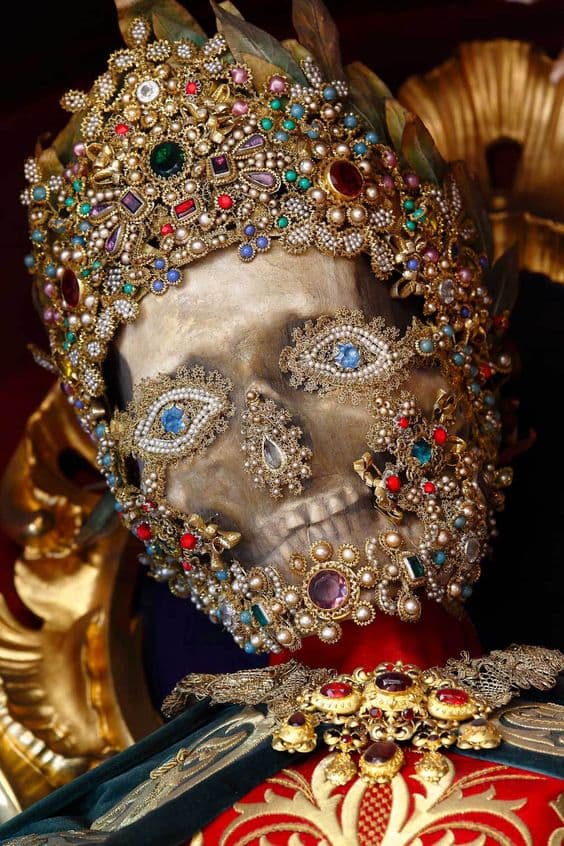
Bejeweled Skeleton of Saint Felix
Paul Koudounaris & Eastern Orthodox Church & St. Peter's Church
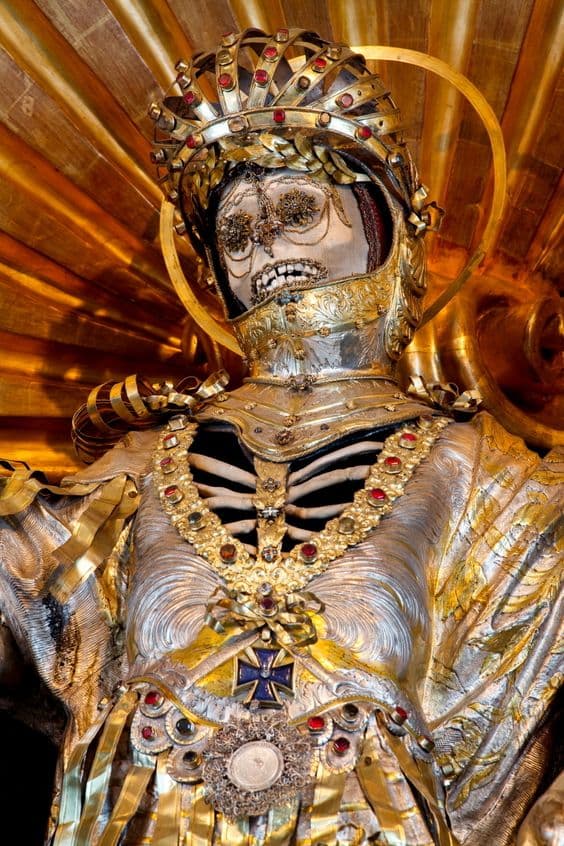
Bejeweled Skeleton of Saint Maximus
Paul Koudounaris · Late 17th century (relics acquired 1677)
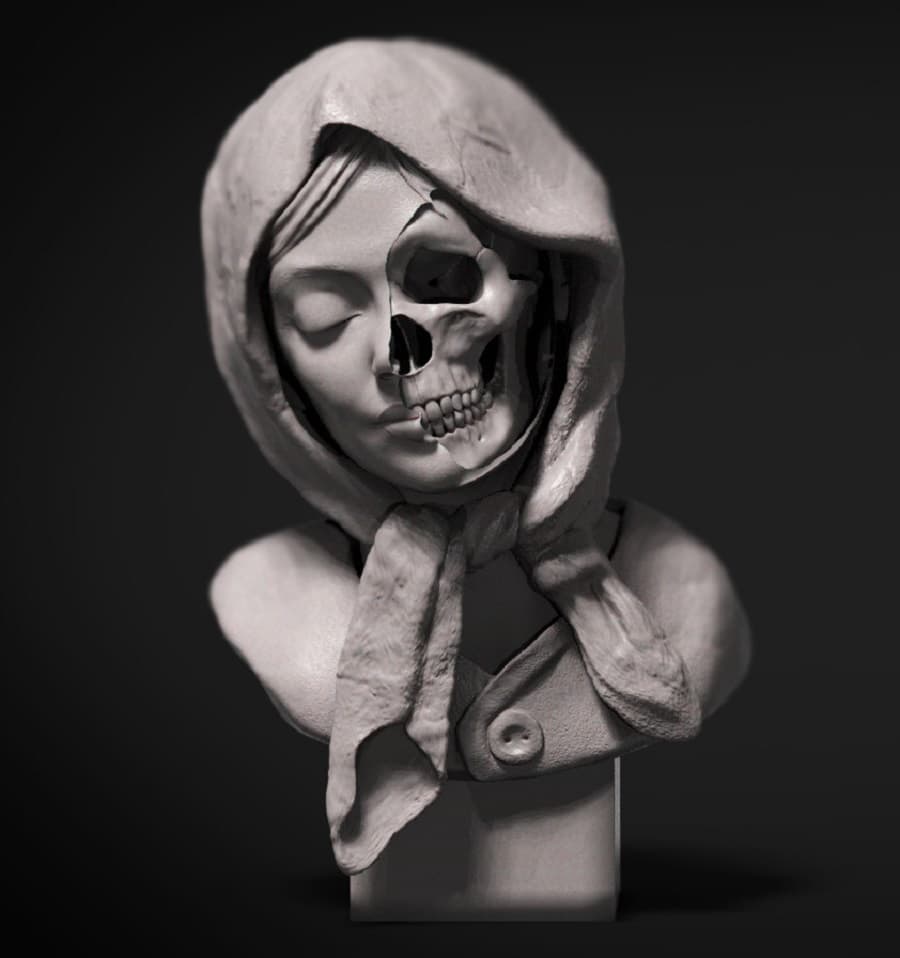
Vanitas Sculpture (Hooded Bust with Skull)
Various Artists or Collaborations
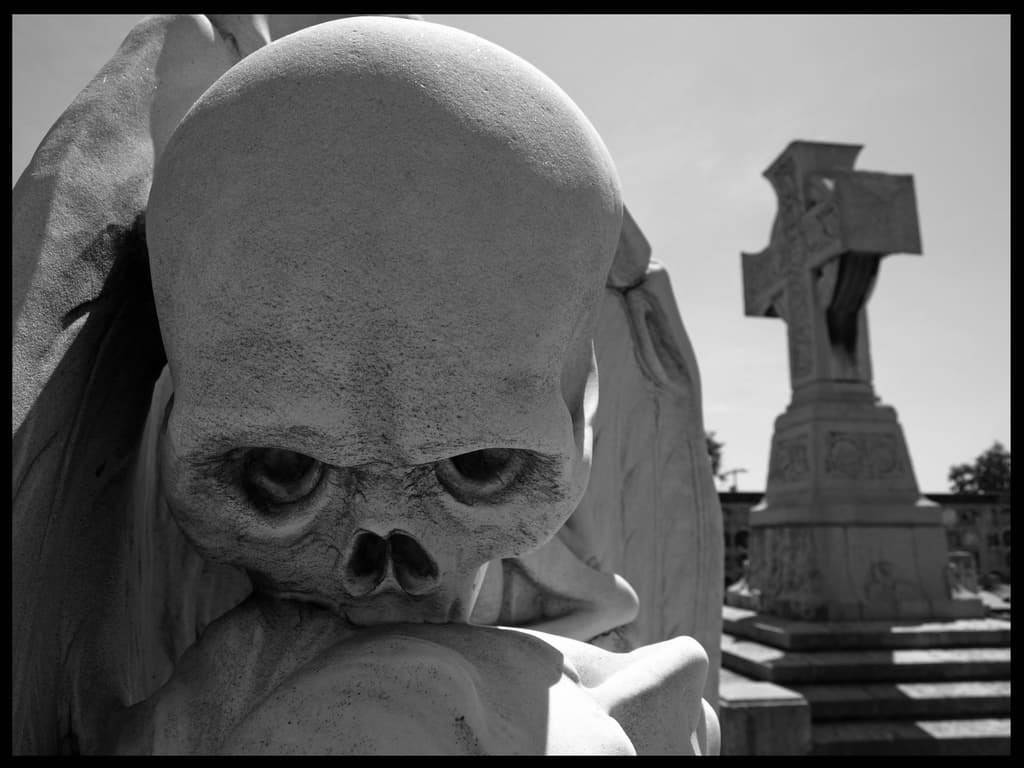
The Kiss of Death (El Petó de la Mort)
Jaume Barba & Joan Fontbernat · 1930
Where did the catacomb saints come from?
On 31 May 1578, workers digging in a vineyard on the Via Salaria, just outside Rome, broke into a forgotten underground cemetery. It was one of the early Christian catacombs, the long galleries of burial niches used by Rome's Christian community, and by many non-Christians, from the second to the fifth century. The discovery was electrifying. To Counter-Reformation Rome, the galleries seemed full of the remains of the first martyrs, killed in the persecutions before Constantine.
The timing mattered. North of the Alps, Protestant reformers had spent the previous half-century stripping churches of relics and images, and Catholic parishes in Bavaria, Swabia, Austria and Switzerland wanted their holy objects back. The catacombs offered an apparently endless supply. Papal officials authenticated bones as those of martyrs, issued certificates, and sent them north, sometimes as gifts to aristocrats and religious houses, sometimes in exchange for fees and favors.
Who were they really?
Almost certainly not who their labels say. The criteria used to identify a martyr were generous: a carved palm branch, the letter M, or a small glass vessel in the tomb, read as holding the martyr's blood, could be enough. Most of the dead in the catacombs were ordinary Romans, and there is no way to know which, if any, died for their faith.
Names were often supplied by the Church when none could be read. A skeleton might receive a name from a nearby inscription or simply a suitable Latin one. That is why so many catacomb saints share names with famous saints without being them. The skeleton venerated as Saint Albertus is not the medieval scholar Albert the Great, and the Saint Felix in this collection is not Felix of Nola. The person on display was an anonymous Roman given a new identity and a new purpose.
How were the skeletons decorated?
When a skeleton arrived, often in a box with its certificate, it went to a convent or to skilled lay brothers for dressing. The work could take one to five years. Nuns with no formal training as artists, but long practice in fine needlework and gold embroidery, assembled the body on a frame, then covered it with:
- Gauze and mesh wrapped around individual bones, holding them together and creating a surface for ornament.
- Gold and silver wire, coiled into filigree flowers and scrolls in the technique German speakers call Klosterarbeit, convent work.
- Gems and glass: real pearls, garnets and amethysts from donors alongside paste jewels and colored glass.
- Clothing: Roman armor for male martyrs, imagined from Baroque paintings; court gowns, crowns and veils for women.
- Faces: some saints received wax masks or glass eyes, while others kept their bare skulls framed in jewels.
The finest group is at Waldsassen Basilica in Bavaria, where a lay brother named Adalbert Eder spent years in the eighteenth century dressing ten holy bodies. His Saint Gratian wears a full parade-armor fantasy of breastplate, shoulder guards and lace-up sandals, all worked in metal thread and gems. Other figures recline on cushions like sleeping courtiers.
Close looking: what most people miss
Look at the hands. Decorators often covered finger bones in jeweled rings or wrapped them in gauze sleeves so the skeleton appears to hold a palm frond, the attribute of martyrdom, or a vial of supposed blood. Look at the joints, where wire cuffs hide the frame that keeps the skeleton upright. And look for the small parchment labels and seals attached to bones and clothing, which record the authentication and sometimes the name of the person who dressed it.
The skull is usually the focus. In figures such as Saint Deodatus and Saint Maximus, the ornament crowds close around the bare skull, as if the decorators wanted to cover death completely without hiding it. That tension between splendor and bone makes the catacomb saints the most extreme expression of memento mori: the body of a Christian shown as already glorified, and still unmistakably dead.
Saint Munditia and the shrines of Munich
Munditia's relics left the Roman catacombs for Munich in 1675 and were installed in a Baroque shrine in St. Peter's, near the Marienplatz, consecrated in 1677. Her inscription calls her a martyr and gives a date of death in the early fourth century, but she appears in no official list of saints.
She has glass eyes, a jeweled crown and a tilt of the head that suggests sleep. In 1804, at the height of Enlightenment distaste for such displays, her shrine was boarded over. She was uncovered again in 1883 and is now one of the best-known catacomb saints in Germany, often visited around her feast day in November.
Decline, neglect and rediscovery
By the late eighteenth century, the catacomb saints had become an embarrassment to reforming Catholics as much as to Protestants. Under Emperor Joseph II in Austria, and in the secularizations that followed in Bavaria and elsewhere around 1803, many shrines were dismantled. Skeletons were removed from altars, stored in attics and crypts, sold off, or stripped of their jewels. In some villages parishioners hid their saints to protect them.
Koudounaris spent years tracking down survivors in churches across German-speaking Europe and photographing them, some for the first time in generations. His book revived interest among historians and a new audience drawn to the macabre. Several parishes have since restored their figures, and conservators now treat them as textile and metalwork objects as well as relics, cleaning the gauze, re-securing loose stones and stabilizing the wire frames.
Seeing them today
Many catacomb saints are still in the churches that received them. The best places to start are Waldsassen Basilica in Bavaria, St. Peter's in Munich, and the abbey church of Rheinau in Switzerland. Others are scattered through rural churches in Bavaria, Swabia and Austria, often displayed in glass cases on side altars. They remain objects of devotion in working churches, so visit as you would any shrine.
For the wider tradition of images that confront mortality, from still lifes with skulls to cemetery sculpture like El Petó de la Mort in Barcelona, see Death in Art and Danse Macabre.
Questions & answers
What are catacomb saints?
Catacomb saints are skeletons removed from the catacombs of Rome after 1578, declared to be early Christian martyrs and sent as relics to Catholic churches, mostly in Germany, Austria and Switzerland. There they were dressed in jewels, gold wire and costume and displayed in shrines.
Are the bejeweled skeletons real?
Yes. They are real human skeletons from Roman burial galleries of roughly the second to fifth centuries. What is doubtful is their identity: the evidence used to call them martyrs was weak, and most names were assigned by Church officials, so they were probably ordinary Romans.
Who decorated the catacomb saints?
Mostly nuns, working in convents near the receiving church, along with some lay brothers such as Adalbert Eder at Waldsassen. Dressing one skeleton in gauze, gold filigree, gems and costume could take up to five years. Donors often supplied real jewels.
Where can you see catacomb saints today?
Waldsassen Basilica in Bavaria has ten dressed skeletons, St. Peter's Church in Munich displays Saint Munditia, and Rheinau Abbey in Switzerland holds several more. Others survive in smaller churches across Bavaria, Swabia, Austria and Switzerland.
Why were so many catacomb saints hidden or removed?
From the late 1700s, Enlightenment reformers inside the Catholic Church saw the skeletons as superstitious and embarrassing. Reforms under Joseph II and the secularization of church property around 1803 led many to be dismantled, stored away, sold or stripped of their jewels.