Baroque
Bejeweled Skeleton of Saint Felix
Paul Koudounaris & Eastern Orthodox Church & St. Peter's Church
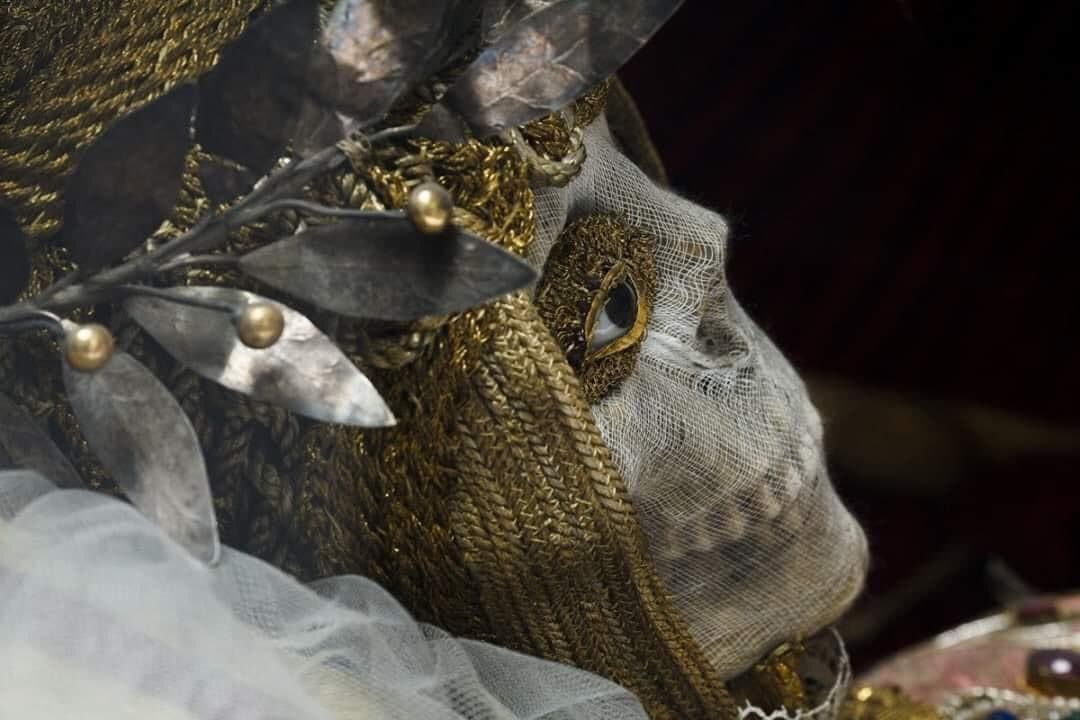
The Bejeweled Skeleton of Saint Felix is one of the catacomb saints of southern Germany: a skeleton from the Roman catacombs dressed in jewels and embroidered armor, photographed by Paul Koudounaris.
- Medium
- Human skeleton with jewels, gold and silver thread, glass and textiles
- Collection
- Germany
- Movement
- Baroque
The Bejeweled Skeleton of Saint Felix is a catacomb saint: the bones of an unknown person taken from the catacombs of Rome, identified as a martyr, named Felix and sent north to be venerated in a German-speaking church. Like dozens of others, it was elaborately decorated with jewels, gold wire and fine textiles. The image here comes from the work of the American art historian and photographer Paul Koudounaris, whose book Heavenly Bodies (2013) brought these relics to a wide audience. The skeleton is reported to be at Aulendorf in Upper Swabia, southern Germany, though its exact church has not been confirmed.
What you are looking at
The skull fills the frame, turned slightly toward us. Its forehead is crowned by a dense band of colored stones, red, green, blue and violet, set in gilt mounts and threaded with seed pearls. More jewels ring the eye sockets, where glass or crystal eyes set in rosettes stare out with an uncanny blue gaze. Ornaments sit in the nasal cavity, along the cheekbones and around the jaw, and the teeth are still visible.
Below, the body is dressed in a costume of red and gold, with a gilded, jeweled collar and fragments of what may be armor or a vestment glittering in the lower part of the picture. Behind, carved gold scrollwork, probably part of the reliquary shrine, glows in the dark.
Not Felix of Nola
Despite the name, this is not Saint Felix of Nola, the 3rd-century priest venerated in southern Italy. After a vast network of catacombs was rediscovered in Rome in 1578, the Church identified thousands of anonymous skeletons as early Christian martyrs, often on very slight evidence, and gave them names, Felix (meaning lucky or blessed) being a popular choice. From the late 16th to the 18th century these relics were sent to Catholic churches in Germany, Austria and Switzerland to replace those lost in the Reformation. Nuns, often in convents with skilled embroiderers, spent years dressing them.
Where to see them
Catacomb saints survive in churches across Bavaria, Swabia and Switzerland. Related examples in the catalogue include Saint Deodatus and Saint Maximus. See the full story in catacomb saints and memento mori, and the photographer's page, Paul Koudounaris.
Questions & answers
Who was Saint Felix the catacomb saint?
He was not a known historical person. His skeleton was taken from the Roman catacombs, declared to be an early Christian martyr and given the name Felix, a common choice for such relics. He should not be confused with Saint Felix of Nola, a 3rd-century priest venerated in Campania.
Why are catacomb saints covered in jewels?
After the Reformation, Catholic churches in German-speaking Europe imported relics from the Roman catacombs to replace those destroyed by Protestants. Decorating them with jewels, gold thread and rich clothing honored them as martyrs already enjoying heavenly glory, and impressed the faithful. Nuns usually did the work.
Who photographed the jeweled skeletons?
Paul Koudounaris, an American art historian and photographer, documented dozens of catacomb saints in churches across Germany, Austria and Switzerland for his 2013 book Heavenly Bodies: Cult Treasures and Spectacular Saints from the Catacombs, which made these largely forgotten relics famous worldwide.
More by the artist
Paul Koudounaris
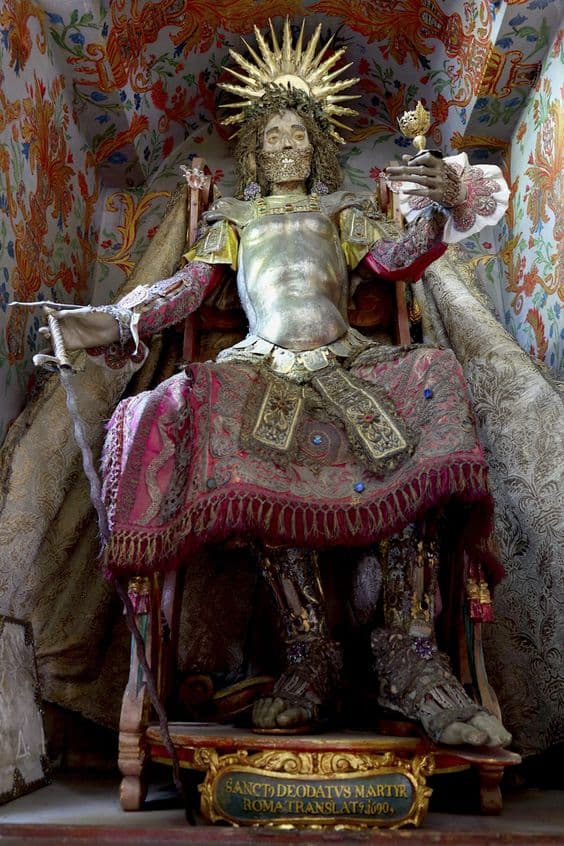
Bejeweled Skeleton of Saint Deodatus
Artist Unknown & Paul Koudounaris · Translated from Rome 1690
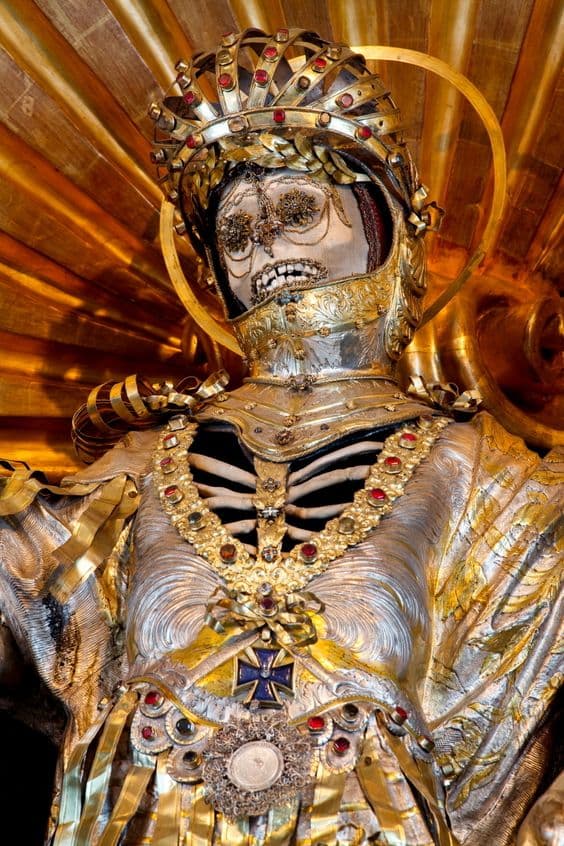
Bejeweled Skeleton of Saint Maximus
Paul Koudounaris · Late 17th century (relics acquired 1677)
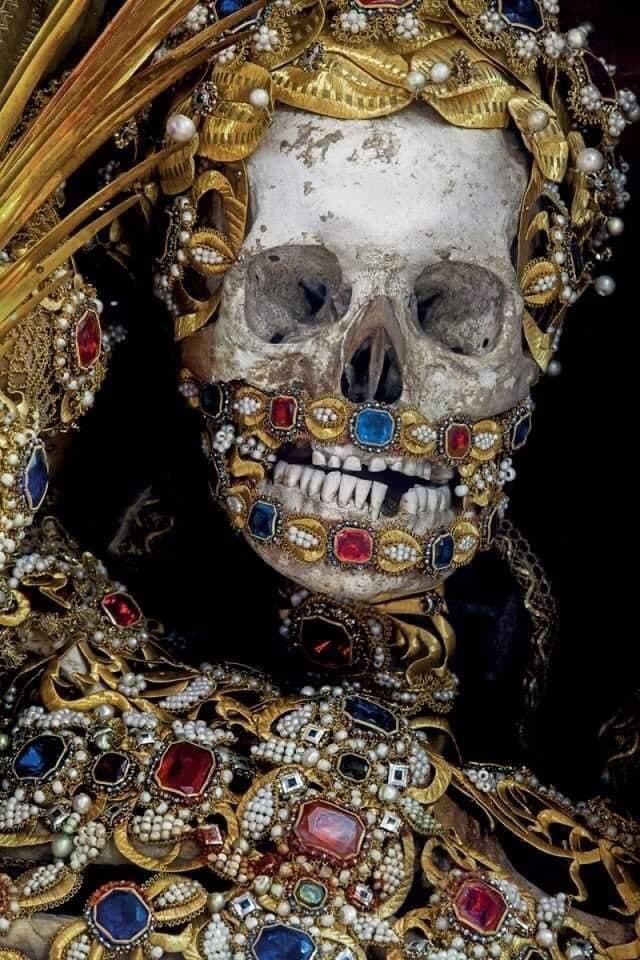
Bejeweled Skeleton of Saint Albertus
Paul Koudounaris · Arrived 1723; decoration 18th century
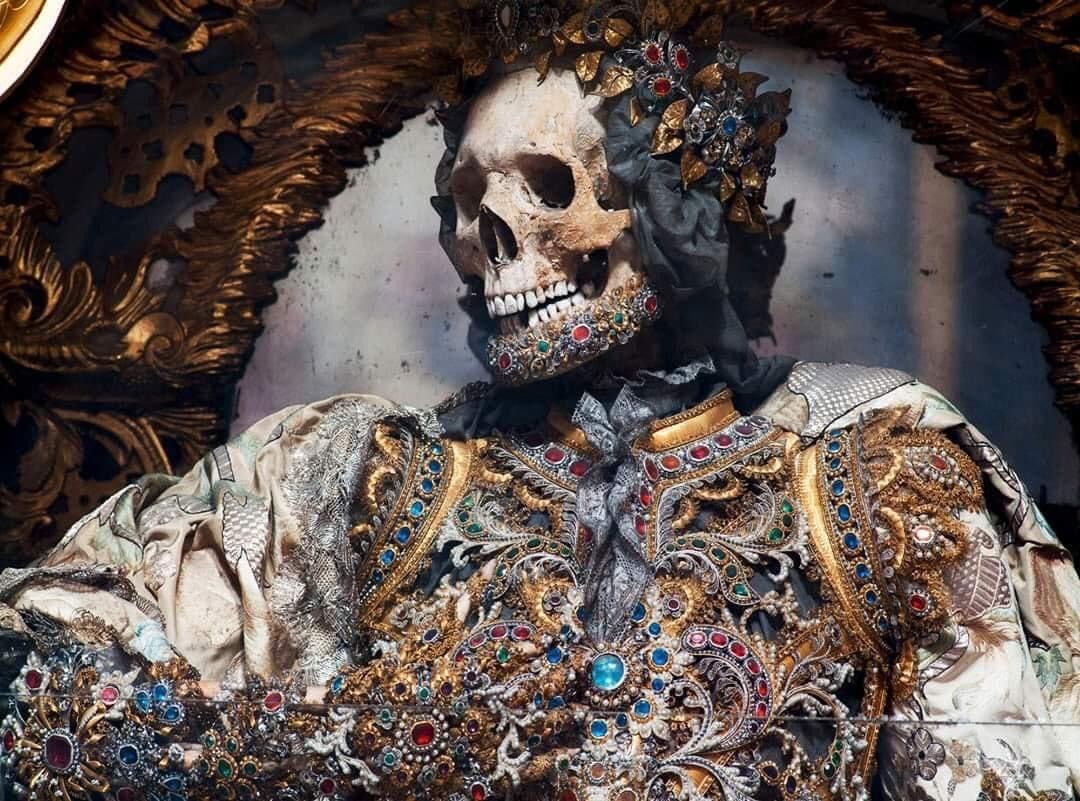
Bejeweled Skeleton of Saint Gratian
Adalbart Eder & Paul Koudounaris · 18th century (decoration); photographed by Paul Koudounaris, published 2013
Bejeweled Skeleton of Saint Munditia
St. Peter's Church & Paul Koudounaris · 1675–77
Kindred works
You may also study

The Scream
Edvard Munch · 1893

Saturn Devouring His Son
Francisco Goya · c. 1819–1823
The Creation of Adam
Michelangelo · c. 1511–12

Ophelia
John Everett Millais · 1851–52
Lucifer
Franz von Stuck · 1890
Head of a Skeleton with a Burning Cigarette
Vincent van Gogh · 1886
The Garden of Earthly Delights
Hieronymus Bosch · c. 1490–1510
The Angel, the Death, and the Devil
Roberto Ferri · 2018