Baroque
Bejeweled Skeleton of Saint Gratian
Adalbart Eder & Paul Koudounaris, 18th century (decoration); photographed by Paul Koudounaris, published 2013
The Bejeweled Skeleton of Saint Gratian is a catacomb saint: Roman bones dressed as a soldier-martyr in jewels and armor-like finery, decorated in the 18th century by lay brother Adalbart Eder for Waldsassen Basilica in Bavaria and photographed by Paul Koudounaris.
- Artist
- Adalbart Eder & Paul Koudounaris
- Date
- 18th century (decoration); photographed by Paul Koudounaris, published 2013
- Medium
- Skeletal relic dressed with fabric, metalwork, glass and gems
- Collection
- Waldsassen Basilica, Waldsassen, Germany
- Movement
- Baroque
What you are looking at
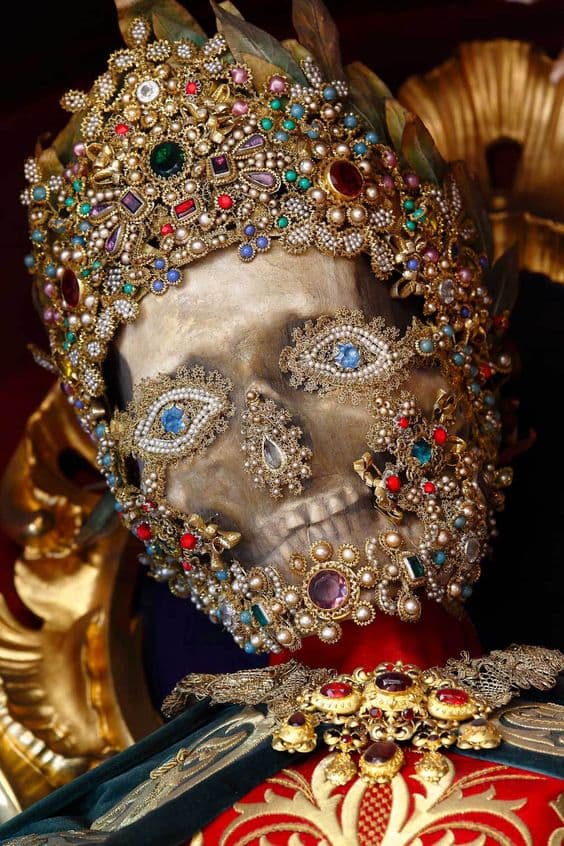
A skull turns slightly toward us from behind glass, framed by carved and gilded Baroque scrollwork. A wreath of gilt leaves and jeweled rosettes sits on the cranium, tied with dark gauze. Below the jaw, a band of red, green and blue stones runs along the mandible like a jeweled beard. The chest is covered by a breastplate built entirely of ornament: gold scrolls, silver filigree and rows of colored glass and gemstones, with a large blue cabochon at the center.
Over the shoulders falls a pale silk mantle patterned with flowers. The skull looks out from this splendor with empty sockets. That collision, of a bare skull and a courtier's finery, is why images of these figures spread so widely online.
This is one of the "holy bodies" (Heilige Leiber) of the Basilica of Waldsassen in the Upper Palatinate, Bavaria. The modern photographs that made it famous were taken by Paul Koudounaris for his book Heavenly Bodies: Cult Treasures and Spectacular Saints from the Catacombs (2013).
What is a catacomb saint?
In 1578 workers in Rome rediscovered a network of ancient underground burial galleries. Church authorities assumed that many of the dead were early Christian martyrs, and over the following two centuries thousands of skeletons were removed and sent across Catholic Europe as relics. The demand was strongest in German-speaking lands, where churches and monasteries had lost relics during the Protestant Reformation and wanted visible, physical saints to answer it.
The identities of these bodies were almost never known. A name, and sometimes the label "martyr," was usually assigned by the church officials who sent them. That is worth stating plainly for Saint Gratian. The early martyrs Felinus and Gratian are venerated as patrons of Arona on Lake Maggiore, where their relics are kept; there is no evidence that the Waldsassen skeleton is that Gratian. It is a catacomb body that received the name.
How it was made
At Waldsassen the bodies arrived over many decades; a local source gives the span 1688 to 1765 for ten whole skeletons. They were dressed by Adalbart (also spelled Adalbert) Eder, a lay brother of the Cistercian abbey trained as a goldsmith. Decorating a holy body was slow, devotional work.
The bones were cleaned, wired into a pose, and padded where necessary. Fabric was cut and fitted, and ornament was built up in layers: metallic thread, filigree, sequins, glass cabochons and stones. In many German shrines this work was done by nuns; at Waldsassen it was largely the achievement of one man.
Eder gave each skeleton a costume that signaled its role. Saint Valentinus, the best known of the group, wears a deacon's vestments and a biretta. Gratian is presented as a soldier of Rome, one of the martyrs imagined as legionaries who refused to give up their faith; the photograph here concentrates on the head and armored chest, while descriptions of the full figure mention shoulder and arm guards and laced sandals. The Baroque instinct was theatrical: the martyr appears not in the poverty of his death but in heavenly glory.
Close looking
The detail worth slowing down for is the breastplate. It is not metal plate. It is a dense construction of gilt scrollwork, wire filigree and set stones, shaped to suggest a cuirass, much closer to a costume for opera or a court pageant than to real Roman armor. The scrolls are arranged symmetrically around the central blue stone, like the ornament on a monstrance or reliquary, which is in effect what the body has become.
Then look at the jaw. The row of jewels along the mandible sits exactly where a beard would grow, a small, almost tender gesture that gives the saint back a face. Above it, the skull itself is left bare, which makes the point of the whole display. This is a dead man, and he is also, in the logic of the shrine, a citizen of heaven.
Meaning: death dressed for glory
For eighteenth-century worshippers these were not macabre curiosities. They were proof that the saints were present, physically, in the local church, and that the body would be raised and glorified. The jewels are a picture of that promised glory. Their meaning sits close to the memento mori tradition, but reversed: rather than reminding the viewer that wealth ends in bones, they show bones clothed in the riches of the resurrection.
Enlightenment reformers found the cult embarrassing, and many shrines were stripped or hidden in the late eighteenth and nineteenth centuries. Waldsassen kept its bodies, which is why it now holds what is often called the largest such display in Europe.
Saint Felix and the other skeletons
Many readers arrive looking for the Saint Felix skeleton, another catacomb saint photographed by Koudounaris. You can see him on his own page: Bejeweled Skeleton of Saint Felix. Related figures in the catalogue include Saint Deodatus, Saint Maximus and Saint Munditia. The full story of the phenomenon is told in The Catacomb Saints, and Koudounaris's wider work on ossuaries is on his artist page.
Where to see it
The holy bodies are displayed along the nave of the Stiftsbasilika in Waldsassen, near the Czech border. The church, built between 1685 and 1704 to designs by Abraham Leuthner and Georg Dientzenhofer, is an active parish church; visitors should check opening times and respect services.
Questions & answers
Where is the skeleton of Saint Gratian?
The skeleton dressed as Saint Gratian is one of the holy bodies of Waldsassen Basilica in Bavaria, Germany, according to the source of this image. The basilica displays ten decorated catacomb skeletons, adorned in the 18th century by Cistercian lay brother Adalbart Eder.
Who decorated the Waldsassen skeletons?
They were dressed by Adalbart (or Adalbert) Eder, a lay brother of Waldsassen Abbey trained as a goldsmith. He fitted each skeleton with fabric costumes, metallic thread, filigree and glass or stone jewels, giving each saint a costume that signaled a role such as soldier or deacon.
Is the Saint Felix skeleton the same as Saint Gratian?
No. Saint Felix is a separate catacomb saint, also photographed by Paul Koudounaris, and has his own page in our catalogue. Both are Roman catacomb skeletons that were named, dressed in jeweled finery and displayed as martyrs in German-speaking churches.
Are the catacomb saints really martyrs?
Almost certainly not all of them. The skeletons came from Roman catacombs rediscovered in 1578, and officials assumed many were early martyrs. Names were usually assigned when the relics were sent out, so the true identities of bodies like Saint Gratian are unknown.
What book are the bejeweled skeleton photos from?
The best-known photographs come from Paul Koudounaris's book Heavenly Bodies: Cult Treasures and Spectacular Saints from the Catacombs, published by Thames & Hudson in 2013. Koudounaris spent years documenting decorated skeletons in churches across Germany, Austria and Switzerland.
More by the artist
Adalbart Eder
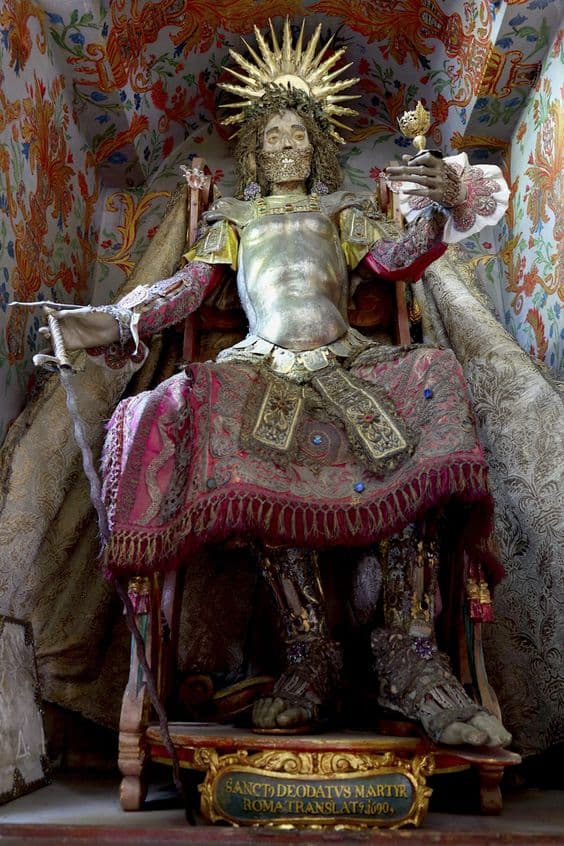
Bejeweled Skeleton of Saint Deodatus
Artist Unknown & Paul Koudounaris · Translated from Rome 1690
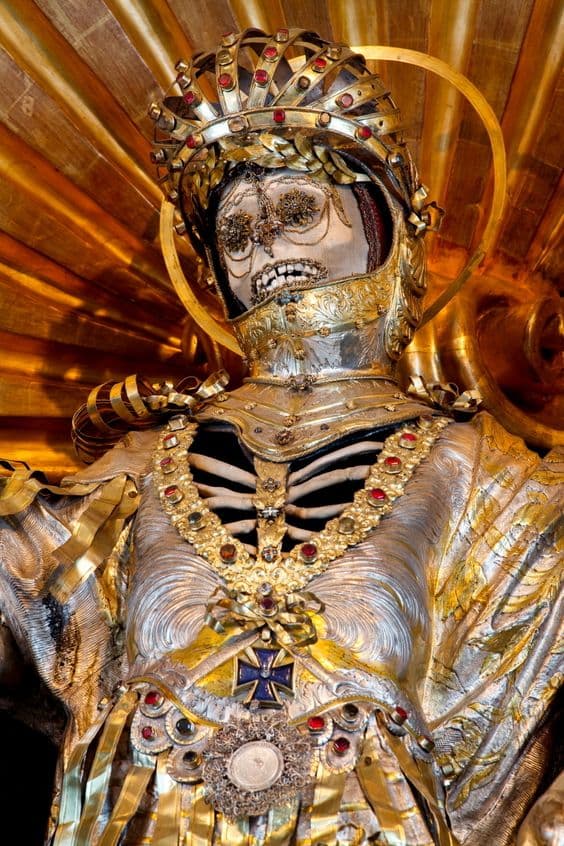
Bejeweled Skeleton of Saint Maximus
Paul Koudounaris · Late 17th century (relics acquired 1677)
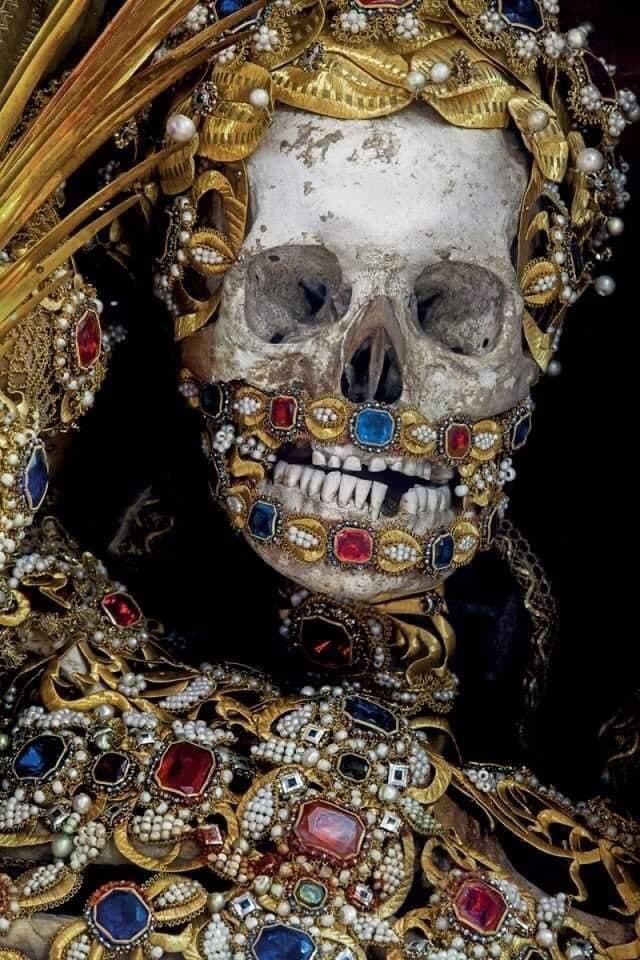
Bejeweled Skeleton of Saint Albertus
Paul Koudounaris · Arrived 1723; decoration 18th century
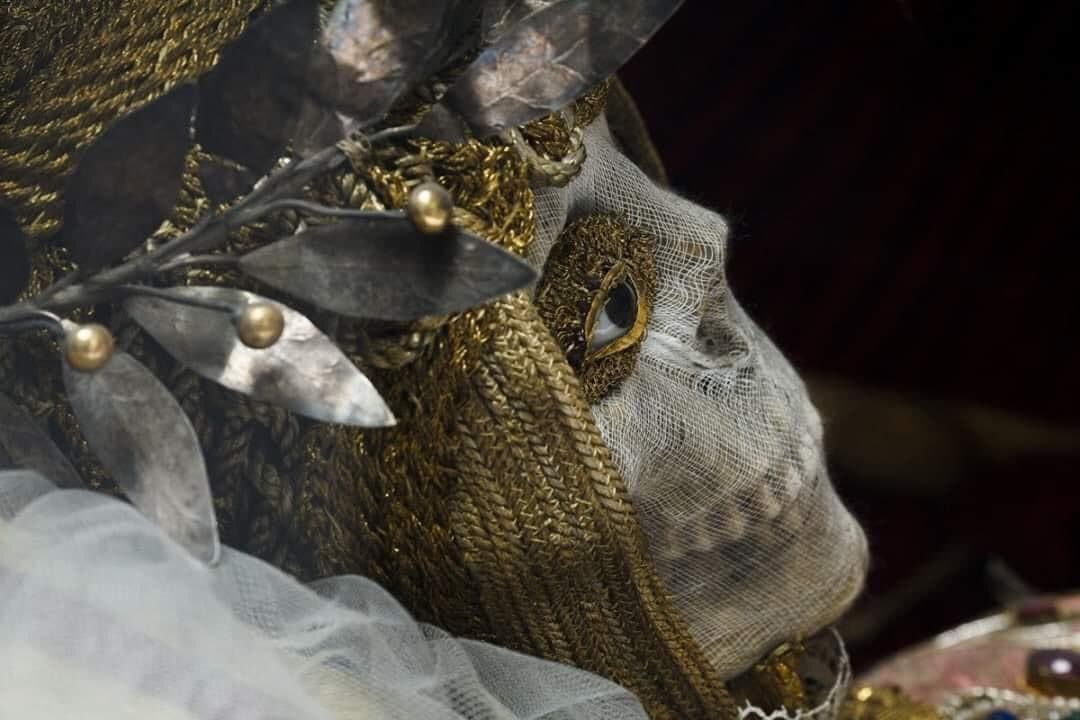
Bejeweled Skeleton of Saint Munditia
St. Peter's Church & Paul Koudounaris · 1675–77
Bejeweled Skeleton of Saint Felix
Paul Koudounaris & Eastern Orthodox Church & St. Peter's Church
Kindred works
You may also study

The Scream
Edvard Munch · 1893

Saturn Devouring His Son
Francisco Goya · c. 1819–1823
The Creation of Adam
Michelangelo · c. 1511–12

Ophelia
John Everett Millais · 1851–52
Lucifer
Franz von Stuck · 1890
Head of a Skeleton with a Burning Cigarette
Vincent van Gogh · 1886
The Garden of Earthly Delights
Hieronymus Bosch · c. 1490–1510
The Angel, the Death, and the Devil
Roberto Ferri · 2018