Baroque
Bejeweled Skeleton of Saint Albertus
Paul Koudounaris, Arrived 1723; decoration 18th century
The Bejeweled Skeleton of Saint Albertus is a catacomb saint: an anonymous Roman skeleton sent in 1723 to St. George's church in Burgrain, Bavaria, and dressed in gold and jewels. It is known from Paul Koudounaris's photographs.
- Artist
- Paul Koudounaris
- Date
- Arrived 1723; decoration 18th century
- Medium
- Human skeleton with gilded metalwork, pearls, glass paste and gemstones
- Collection
- Church of St. George (Schlosskirche St. Georg), Burgrain, Isen (Burgrain), Bavaria, Germany
- Movement
- Baroque
What you are looking at
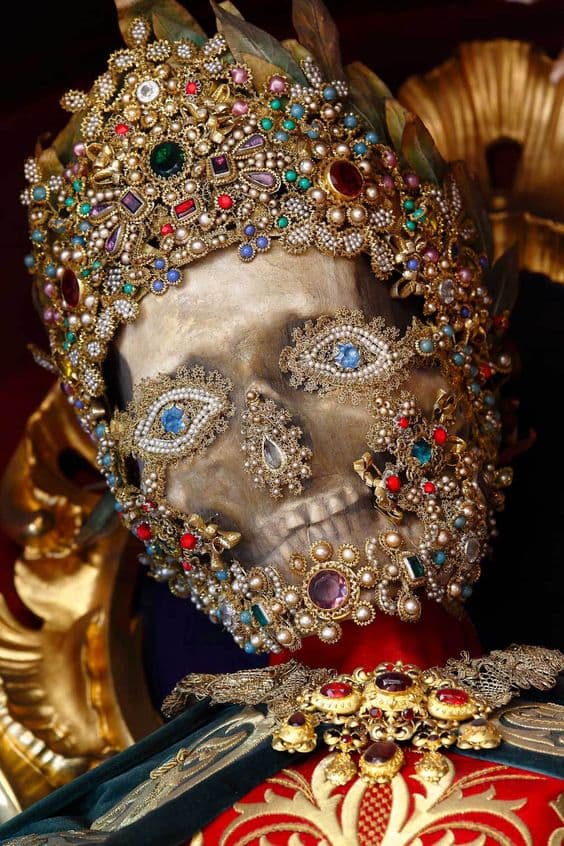
This is a human skull, real bone, set in a cloud of jewelry. A diadem of gilded metal leaves and seed pearls frames the forehead and falls in loops beside the empty eye sockets. The most startling detail is around the mouth: a band of gold set with square-cut red and blue stones and lines of pearls traces the upper and lower jaw, so that the teeth appear to grin out from inside a jeweled frame.
Below, the neck and chest disappear under a breastplate of gold scrollwork crowded with large faceted stones in ruby red, sapphire blue and emerald green, ringed with clusters of small pearls. Most of these "gems" in catacomb-saint decoration are colored glass paste set in foil, mixed with some genuine stones and freshwater pearls. In the upper left corner a fan of gold blades rises past the skull. This is a gilded palm frond, the traditional emblem of martyrdom, and it tells the viewer how this anonymous body was understood: as a Christian who died for the faith.
Notice too the condition of the bone. The forehead is mottled and flaking, and a front tooth is missing. The decorators did not hide the skull or give it a wax face, as was done for some catacomb saints. They let death show through the splendor.
Who were the catacomb saints?
On 31 May 1578, vineyard workers on the Via Salaria outside Rome broke into a forgotten underground burial gallery. It was one of the early Christian catacombs, and over the following decades Church authorities came to treat the thousands of anonymous skeletons in these tunnels as a vast reserve of martyrs from the age of Roman persecution. The test applied was loose: a palm frond carved beside a grave, or a small glass vessel thought to have held blood, was enough to declare the occupant a martyr. Most of the dead had no known name.
At the same time, Catholic parishes in Bavaria, Austria and Switzerland were rebuilding after the Reformation and the Thirty Years' War, and many had lost their relics to Protestant iconoclasm. Rome could supply complete bodies. From the late sixteenth to the early nineteenth century, hundreds of skeletons were sent north, given saints' names (sometimes from an inscription, often simply chosen) and received in procession by the towns that had paid for their transport.
On arrival the bones were cleaned, wired together and dressed. Much of this work was done by nuns in convent workshops, who wrapped each bone in fine gauze, covered the body in gold and silver thread, glass paste and real stones, and set it upright or reclining in a glass shrine on an altar. The finished figure was meant to show the martyr as he or she would appear in heaven, already glorified.
From the late eighteenth century the cult fell out of favor. Enlightenment reformers, the church reforms of Emperor Joseph II in Austria and the secularization of Bavaria in 1803 sent many of these bodies to auction, storage or destruction. Those that survive are scattered through small parish and pilgrimage churches.
Saint Albertus of Burgrain
According to Koudounaris, a fully articulated skeleton identified as Saint Albertus arrived in 1723 at the small church of St. George in Burgrain, near Isen in Upper Bavaria, about 35 km east of Munich. Burgrain is a castle estate, and its church is the castle church (Schlosskirche) of St. George. The arrival of a whole martyr's body gave a modest rural church a heavenly patron of its own.
Local belief attached a very practical power to him. Koudounaris reports that Albertus was believed able to sterilize animals: farmers would hold a domestic animal by the hind legs before the saint and ask for his help. Where the belief came from is not known. Miracle traditions like this, closely tied to the needs of a farming parish, were typical of the catacomb saints.
He is not Albertus Magnus
Older versions of this page confused this skeleton with Albertus Magnus (Saint Albert the Great, c. 1200–1280), the Dominican philosopher and teacher of Thomas Aquinas. They are not the same person. Albertus Magnus is a documented medieval scholar whose remains lie in the church of St. Andreas in Cologne. The Burgrain Albertus is an unknown individual from an early Christian burial in Rome, given the name Albertus when he was sent north. Nothing is known of his life, and his name is a later label, not a historical identity.
Paul Koudounaris and Heavenly Bodies
The photograph reproduced here is by Paul Koudounaris, a Los Angeles art historian and photographer who spent several years tracking down the surviving catacomb saints. His book Heavenly Bodies: Cult Treasures and Spectacular Saints from the Catacombs (Thames & Hudson, 2013) is the standard popular account of them, and its photographs are the reason most people online know these figures at all. Koudounaris is the author of the image, not of the object: the skeleton was dressed by anonymous craftspeople some three centuries earlier. Earlier versions of this page also credited the "Eastern Orthodox Church". That is mistaken. Catacomb saints belong entirely to the Roman Catholic world of the Counter-Reformation.
Why it fascinates
To modern eyes the bejeweled skeleton sits between devotion and memento mori. Its makers intended a vision of glory, the body of a martyr already dressed for the Resurrection. Today's viewers often see the opposite, a gorgeous reminder that every face ends as a skull. Both readings are possible because the decorators chose to keep the bone visible.
Where to see it
The skeleton belongs to the church of St. George at Burgrain (Isen, Bavaria). Like many surviving catacomb saints it is kept in a small church that is not always open, so it is best to check with the parish before visiting. Other dressed skeletons in the catalogue include Saint Maximus, Saint Deodatus and Saint Munditia, gathered in The Catacomb Saints.
Questions & answers
Where is the bejeweled skeleton of Saint Albertus?
According to Paul Koudounaris, the skeleton arrived in 1723 at the small church of St. George in Burgrain, a castle estate near Isen in Upper Bavaria, Germany, east of Munich. It remains a church relic rather than a museum object, so access depends on the parish.
Is Saint Albertus the same as Albertus Magnus?
No. Albertus Magnus (c. 1200–1280) was a Dominican scholar buried in Cologne. The Burgrain Albertus is a catacomb saint: unidentified bones taken from an early Christian burial in Rome and given the name Albertus when they were sent to Bavaria. Nothing is known of the person's life.
Are the jewels on catacomb saints real?
Partly. The decorators, often nuns, used a mix of genuine gemstones, freshwater pearls, gold and silver thread, and a great deal of colored glass paste set in metal foil, which sparkles like real stones. Wealthy donors sometimes gave their own jewelry to adorn a parish saint.
Why were skeletons decorated with jewels?
After 1578, bones from Rome's catacombs were treated as the relics of early Christian martyrs and sent to Catholic churches north of the Alps. Dressing them in gold and jewels presented each martyr as already glorified in heaven, a visible promise of the Resurrection for the parish.
Is this the skeleton of Saint Felix?
No. Saint Felix is a different catacomb saint, also photographed by Paul Koudounaris and often shared online as “the bejeweled skeleton of Saint Felix”. Like this one, he was an anonymous body from the Roman catacombs given a saint's name and dressed in jewels. See the separate page on the Bejeweled Skeleton of Saint Felix.
More by the artist
Paul Koudounaris
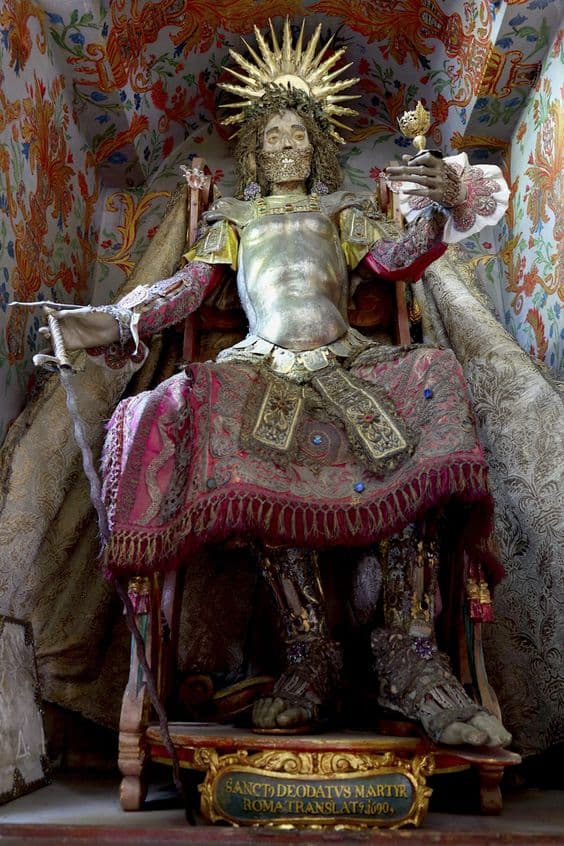
Bejeweled Skeleton of Saint Deodatus
Artist Unknown & Paul Koudounaris · Translated from Rome 1690
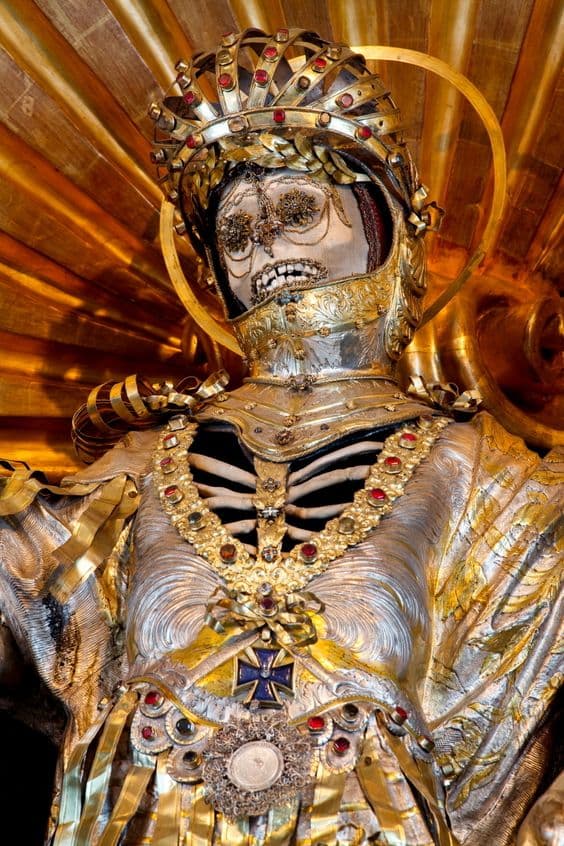
Bejeweled Skeleton of Saint Maximus
Paul Koudounaris · Late 17th century (relics acquired 1677)
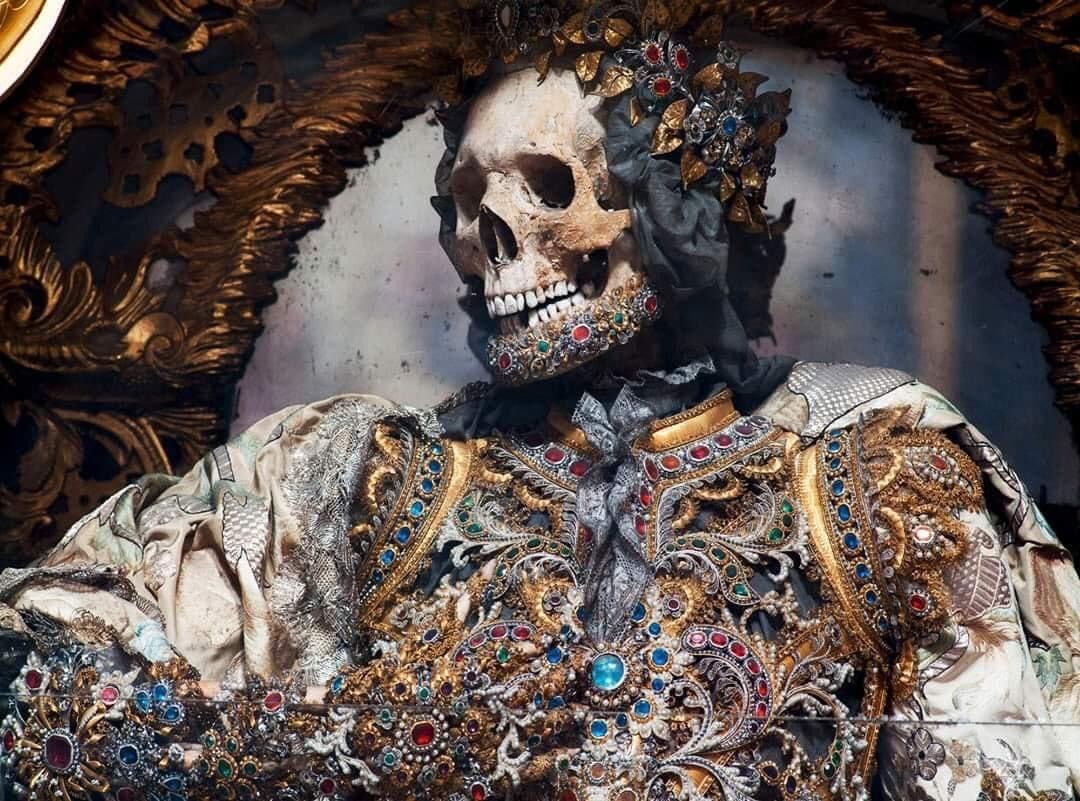
Bejeweled Skeleton of Saint Gratian
Adalbart Eder & Paul Koudounaris · 18th century (decoration); photographed by Paul Koudounaris, published 2013
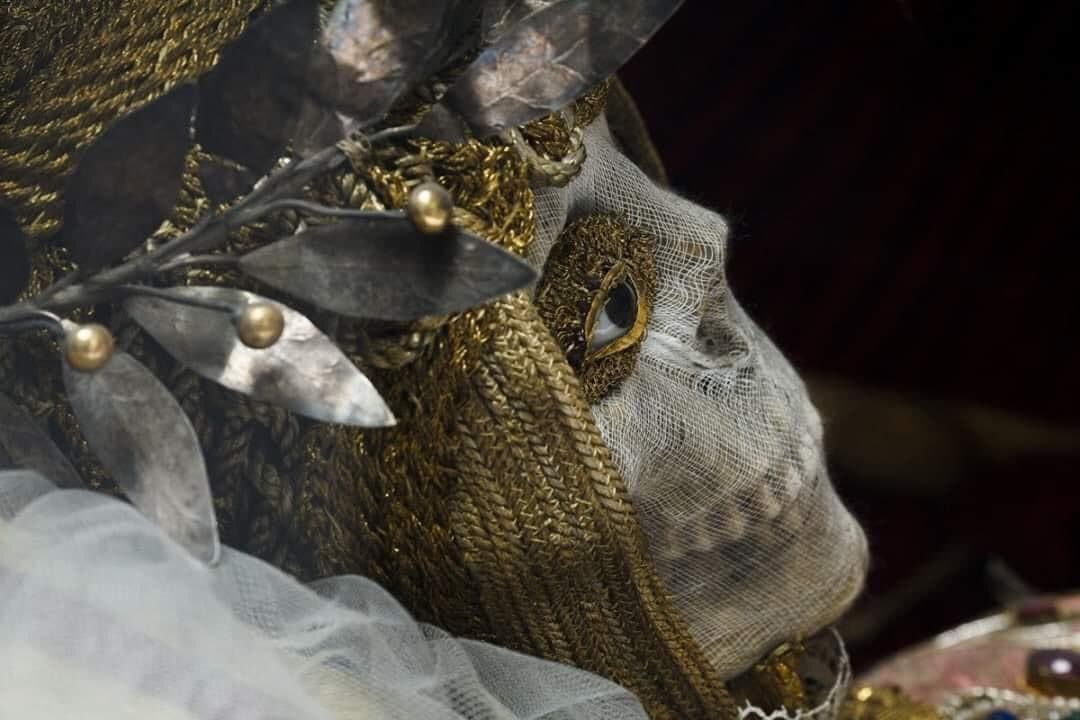
Bejeweled Skeleton of Saint Munditia
St. Peter's Church & Paul Koudounaris · 1675–77
Bejeweled Skeleton of Saint Felix
Paul Koudounaris & Eastern Orthodox Church & St. Peter's Church
Kindred works
You may also study
Vanitas Sculpture (Hooded Bust with Skull)
Various Artists or Collaborations

The Scream
Edvard Munch · 1893

Saturn Devouring His Son
Francisco Goya · c. 1819–1823
The Creation of Adam
Michelangelo · c. 1511–12

Ophelia
John Everett Millais · 1851–52
Lucifer
Franz von Stuck · 1890
Head of a Skeleton with a Burning Cigarette
Vincent van Gogh · 1886
The Garden of Earthly Delights
Hieronymus Bosch · c. 1490–1510