Baroque
Bejeweled Skeleton of Saint Maximus
Paul Koudounaris, Late 17th century (relics acquired 1677)
The Bejeweled Skeleton of Saint Maximus is a catacomb saint in armor: an anonymous skeleton from Rome's catacombs, brought to the parish church of Bürglen, Switzerland, in the late 1600s and dressed as a soldier of Christ.
- Artist
- Paul Koudounaris
- Date
- Late 17th century (relics acquired 1677)
- Medium
- Human skeleton with armor, gilded and silvered metalwork, glass paste and gemstones
- Collection
- Parish Church of Saints Peter and Paul, Bürglen, Bürglen, Uri, Switzerland
- Movement
- Baroque
What you are looking at
Saint Maximus is a skeleton dressed as a soldier. His skull sits inside a burnished steel-and-gilt helmet with the visor raised, so that the face of bone looks out through the opening. On top of the helmet rides an open crown of gilded bands set with red stones, and behind it a thin gold ring stands for a halo. The whole figure is backed by a gilded sunburst, its rays fanning out like the inside of a shell.
Look into the face. The eye sockets are not empty: each holds a rosette of gold filigree, and fine gold wire is drawn across the nose and cheekbones like a veil. The teeth grin under a strip of gold. Below, a polished breastplate is opened at the center to show the ribs, a deliberate reminder that inside the armor is a real body. A heavy chain of gilt links and red stones hangs across the chest, and below it sits a dark blue cross outlined in gold above a round medallion of silver filigree. Silvered drapery, chased with swirling patterns, falls from the shoulders.
The armor is not a costume borrowed from a sculpture. Dressing male catacomb saints as Roman soldiers followed the belief that many early martyrs had been legionaries who refused to renounce their faith. The armor turns an anonymous skeleton into a miles Christi, a soldier of Christ.
Who were the catacomb saints?
On 31 May 1578, vineyard workers on the Via Salaria outside Rome broke into a forgotten underground burial gallery. It was one of the early Christian catacombs, and over the following decades Church authorities came to treat the thousands of anonymous skeletons in these tunnels as a vast reserve of martyrs from the age of Roman persecution. The test applied was loose: a palm frond carved beside a grave, or a small glass vessel thought to have held blood, was enough to declare the occupant a martyr. Most of the dead had no known name.
At the same time, Catholic parishes in Bavaria, Austria and Switzerland were rebuilding after the Reformation and the Thirty Years' War, and many had lost their relics to Protestant iconoclasm. Rome could supply complete bodies. From the late sixteenth to the early nineteenth century, hundreds of skeletons were sent north, given saints' names (sometimes from an inscription, often simply chosen) and received in procession by the towns that had paid for their transport.
On arrival the bones were cleaned, wired together and dressed. Much of this work was done by nuns in convent workshops, who wrapped each bone in fine gauze, covered the body in gold and silver thread, glass paste and real stones, and set it upright or reclining in a glass shrine on an altar. The finished figure was meant to show the martyr as he or she would appear in heaven, already glorified.
From the late eighteenth century the cult fell out of favor. Enlightenment reformers, the church reforms of Emperor Joseph II in Austria and the secularization of Bavaria in 1803 sent many of these bodies to auction, storage or destruction. Those that survive are scattered through small parish and pilgrimage churches.
Saint Maximus of Bürglen
This skeleton stands in the parish church of Saints Peter and Paul in Bürglen, in the Swiss canton of Uri, the village that tradition names as the home of William Tell. The relics were brought from Rome in the late seventeenth century. Local records cited by the canton date their purchase to 1677, by the chaplain Johann Jakob Scolar, who also designed the new Baroque parish church built in 1682–84. Other accounts give 1682 as the year the saint arrived. Maximus became a secondary patron of the church.
He is one of only two catacomb saints in Switzerland known to survive in armor, the other being Saint Pancratius in Wil. Koudounaris recounts the local traditions that grew around him: after his arrival the bones were said to seep a sweet-smelling yellow liquid, and villagers spoke of a large white cat that hid in the altar beside the saint and visited the homes of the poor, bringing unexpected money wherever it appeared. Maximus became known as a protector of poor households.
He is not Maximus the Confessor
Older versions of this page described this figure as Saint Maximus the Confessor (c. 580–662), the Byzantine theologian who defended the teaching that Christ had both a divine and a human will and died in exile in the Caucasus. The skeleton in Bürglen has nothing to do with him. It is an unidentified body from an early Christian burial in Rome, given the name Maximus, a common Roman name, when it was sent north. No biography survives because none was ever known.
Paul Koudounaris and Heavenly Bodies
The photograph reproduced here is by Paul Koudounaris, a Los Angeles art historian and photographer who spent several years tracking down the surviving catacomb saints. His book Heavenly Bodies: Cult Treasures and Spectacular Saints from the Catacombs (Thames & Hudson, 2013) is the standard popular account of them, and its photographs are the reason most people online know these figures at all. Koudounaris is the author of the image, not of the object: the skeleton was dressed by anonymous craftspeople some three centuries earlier. Earlier versions of this page also credited the "Eastern Orthodox Church". That is mistaken. Catacomb saints belong entirely to the Roman Catholic world of the Counter-Reformation.
Devotion or memento mori?
The Bürglen Maximus was made to inspire confidence: a heavenly soldier, armed and crowned, guarding a mountain parish. To many modern viewers he reads as the opposite, a splendid memento mori in which armor and gold only sharpen the contrast with the bare skull. Both responses are rooted in the object. Its makers left the bone visible on purpose, because the relic's power lay in its being a real body.
Where to see it
The skeleton is displayed in the parish church of St. Peter and Paul, Bürglen, Uri, Switzerland. Opening hours are those of a working church. Other dressed skeletons on this site include Saint Albertus, Saint Deodatus and Saint Gratian, collected in The Catacomb Saints.
Questions & answers
Where is the skeleton of Saint Maximus?
It is in the parish church of Saints Peter and Paul in Bürglen, canton of Uri, Switzerland. The relics came from Rome in the late seventeenth century (local records give 1677 for their purchase). It is one of only two surviving armored catacomb saints in Switzerland.
Is this Saint Maximus the Confessor?
No. Maximus the Confessor was a Byzantine theologian who died in 662. The Bürglen Maximus is a catacomb saint: unidentified bones from an early Christian burial in Rome, given the name Maximus and declared a martyr when they were sent north. Nothing is known of the person's life.
Why is Saint Maximus wearing armor?
Many male catacomb saints were dressed as Roman soldiers, reflecting the belief that early martyrs included legionaries who refused to give up their faith. The helmet, breastplate and crown present Maximus as a soldier of Christ, victorious in heaven.
Who photographed the bejeweled skeletons?
The best-known photographs are by Paul Koudounaris, an American art historian, published in Heavenly Bodies: Cult Treasures and Spectacular Saints from the Catacombs (Thames & Hudson, 2013). He photographed the image, but the skeletons were dressed by anonymous craftspeople, often nuns, centuries earlier.
Is this the skeleton of Saint Felix?
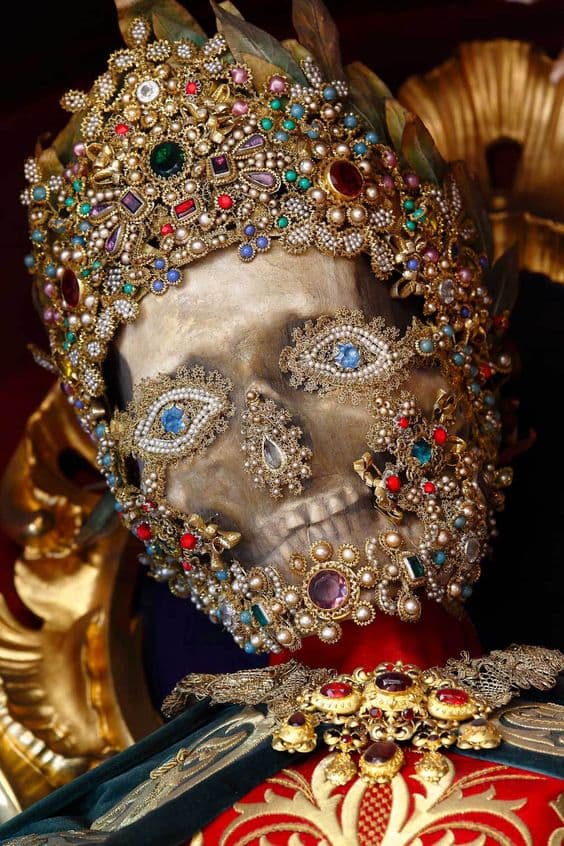
No. Saint Felix is a different catacomb saint, also photographed by Paul Koudounaris and often shared online as “the bejeweled skeleton of Saint Felix”. Like this one, he was an anonymous body from the Roman catacombs given a saint's name and dressed in jewels. See the separate page on the Bejeweled Skeleton of Saint Felix.
More by the artist
Paul Koudounaris
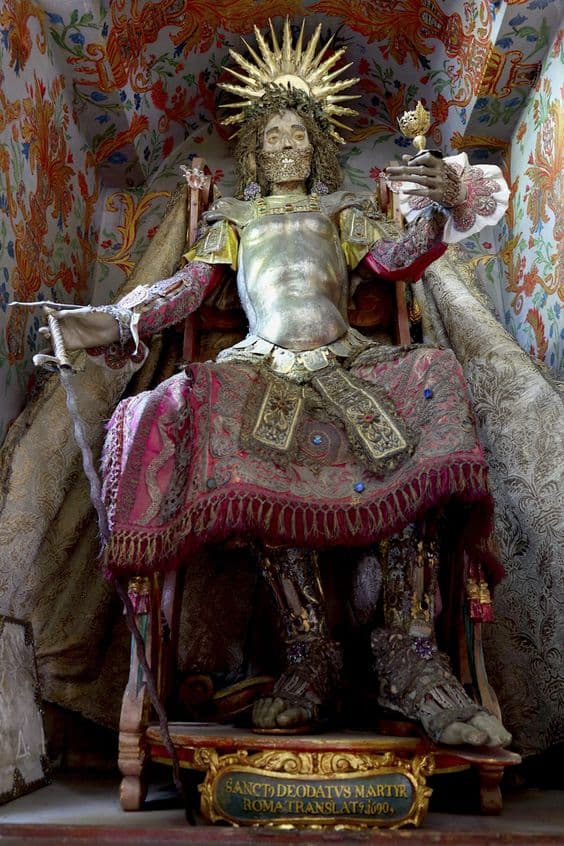
Bejeweled Skeleton of Saint Deodatus
Artist Unknown & Paul Koudounaris · Translated from Rome 1690
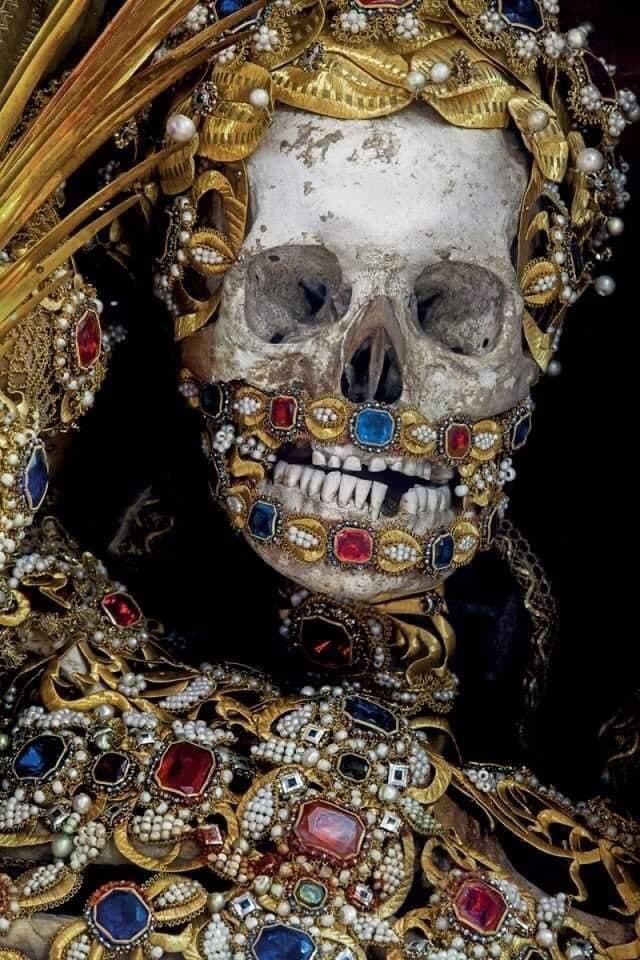
Bejeweled Skeleton of Saint Albertus
Paul Koudounaris · Arrived 1723; decoration 18th century
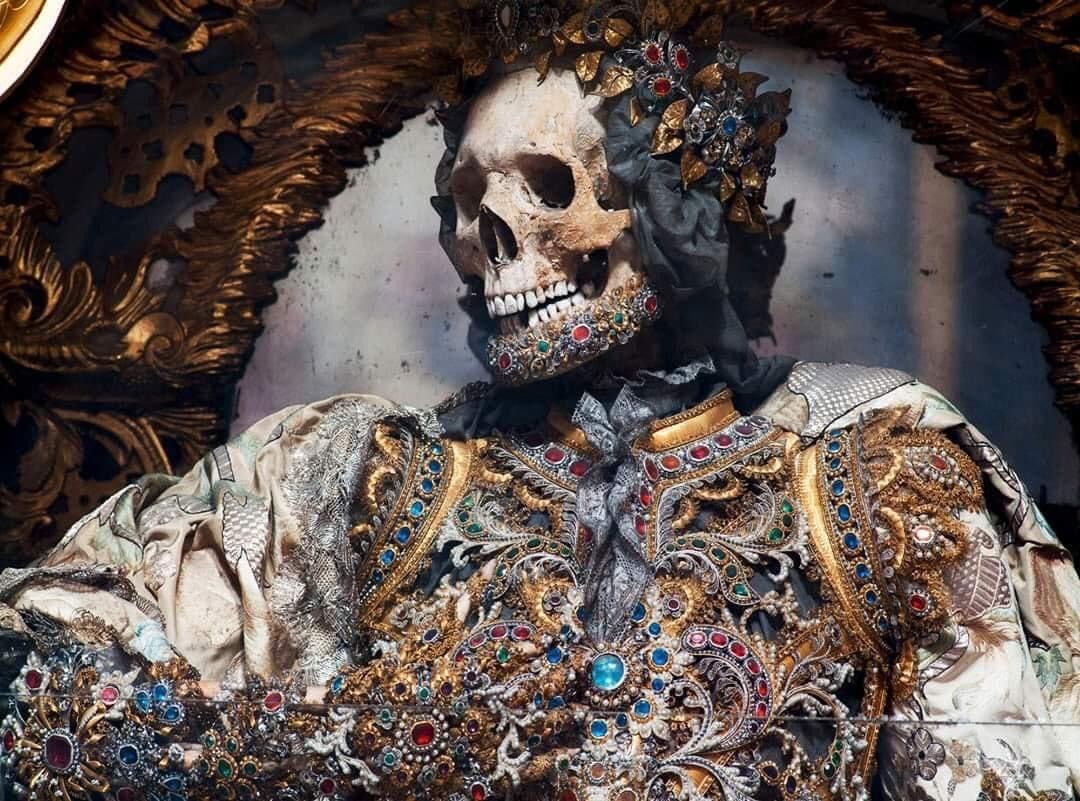
Bejeweled Skeleton of Saint Gratian
Adalbart Eder & Paul Koudounaris · 18th century (decoration); photographed by Paul Koudounaris, published 2013
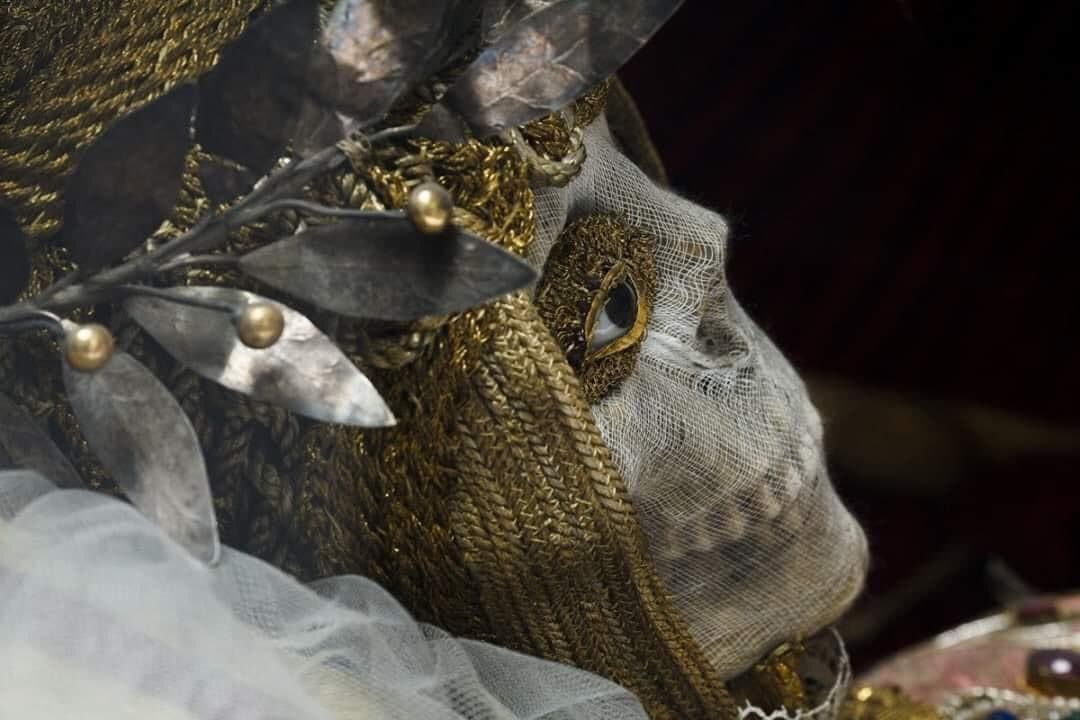
Bejeweled Skeleton of Saint Munditia
St. Peter's Church & Paul Koudounaris · 1675–77
Bejeweled Skeleton of Saint Felix
Paul Koudounaris & Eastern Orthodox Church & St. Peter's Church
Kindred works
You may also study
The Kiss of Death (El Petó de la Mort)
Jaume Barba & Joan Fontbernat · 1930

The Scream
Edvard Munch · 1893

Saturn Devouring His Son
Francisco Goya · c. 1819–1823
The Creation of Adam
Michelangelo · c. 1511–12

Ophelia
John Everett Millais · 1851–52
Lucifer
Franz von Stuck · 1890
Head of a Skeleton with a Burning Cigarette
Vincent van Gogh · 1886
The Garden of Earthly Delights
Hieronymus Bosch · c. 1490–1510