Baroque
Bejeweled Skeleton of Saint Munditia
St. Peter's Church & Paul Koudounaris, 1675–77
The Bejeweled Skeleton of Saint Munditia is a Baroque relic display in St. Peter's Church, Munich: a skeleton from the Roman catacombs, dressed in gold and jewels, with glass eyes, lying in a glass shrine since 1677. She is venerated as patron of unmarried women.
- Artist
- St. Peter's Church & Paul Koudounaris
- Date
- 1675–77
- Medium
- Human skeleton with gold, gemstones, glass eyes, textiles and netting, in a glass shrine
- Collection
- St. Peter's Church (Peterskirche), Munich, Germany
- Movement
- Baroque
What you are looking at
A skeleton lies in a glass case, propped as if resting, dressed in gold. The skull wears a fine veil of gauze netting, stretched across the bone like a second skin, through which the teeth and nasal cavity show. In each eye socket sits a glass eye, set in a ring of gold embroidery, gazing sideways. Around the head is a wreath of silver laurel leaves studded with pearls or gilt beads; heavy braided gold cords and lace frame the face. Elsewhere on the body, jewels, gilded metalwork and rich fabrics turn the bones into an image of heavenly splendor.
This is the relic of Saint Munditia, displayed in the Peterskirche (St. Peter's Church), the oldest parish church in Munich, near the Marienplatz. Her remains were brought from the catacombs of Rome in 1675 and placed in a Baroque shrine consecrated on 5 September 1677. The photograph shown here comes from the work of the American art historian and photographer Paul Koudounaris, who documented her for his book Heavenly Bodies: Cult Treasures and Spectacular Saints from the Catacombs (2013).
Who was Saint Munditia?
Very little is known about her. According to tradition she was a Christian martyr who died in Rome around 310. Her remains were found sealed in an arcosolium, an arched burial niche, in the catacomb of Cyriaca on the Via Tiburtina. The stone slab that closed her tomb came with her to Munich and now lies beneath the skull. Its Latin inscription names her as Mundicia Protogenia. One abbreviation on the slab was read by the Roman authorities as a reference to beheading with an axe, which helped establish her as a martyr; modern scholars have suggested it may simply record a date.
In Munich she is venerated as the patron saint of single women, and she is often described as the patron of spinsters. Her feast day is 17 November, marked each year with a High Mass and a candlelit procession.
The catacomb saints
Munditia is one of the so-called catacomb saints. In 1578, workers in Rome rediscovered a vast network of early Christian burial tunnels along the Via Salaria. The Church identified thousands of the bodies inside as martyrs, often on slender evidence, and over the following two centuries many were sent north to Catholic churches and monasteries in Germany, Austria and Switzerland. After the Protestant Reformation had stripped many churches of their relics, these "holy bodies" were a powerful statement of Catholic faith and continuity with the early Church.
On arrival, the skeletons were decorated, often over years, by nuns and skilled craftspeople, with gold wire, jewels, embroidery and fine fabrics. The decoration was meant to show the saint already clothed in heavenly glory, awaiting the resurrection. See our guide to The Catacomb Saints, and other examples on this site, including Saint Felix, Saint Deodatus and Saint Albertus.
Looking closely
The details reward close attention. The netting over the skull is not decoration alone; it holds fragile bone together while softening the skeleton's appearance. The glass eyes are what make Munditia unforgettable. Set slightly askew, they give the skull an uncanny alertness, as if she were watching visitors from her case. The gold embroidery around the sockets imitates eyelids or lashes.
The silver leaves of the wreath echo the laurel crown of victory, the traditional reward of martyrs in Christian art. The braided gold work falling around the face suggests hair or a headdress. Everything works toward one idea: the martyr has triumphed over death and is now adorned as a bride of Christ.
Hidden and rediscovered
Tastes changed. In the Enlightenment, such displays came to look superstitious or grotesque to many churchmen. In 1804, during a period of secularizing reform in Bavaria, Munditia's relics were hidden behind a wooden panel, and she remained concealed for decades. The covering was removed in 1883, and her cult revived. Many other catacomb saints across Europe were less lucky: they were sold, stored in attics or discarded.
Meaning today
To modern visitors, the jeweled skeletons can seem macabre, even gothic, and they have found a large audience online for that reason. For the communities that received them, they were objects of devotion, not horror: tangible proof of the communion of saints and of the promise of bodily resurrection. Koudounaris's photographs did much to bring them back to public attention, presenting them as works of art in their own right. They belong with the broader tradition explored in our Memento Mori & Vanitas collection.
Where to see it
Saint Munditia lies in a glass shrine in St. Peter's Church, Rindermarkt 1, in central Munich, in a side area near the north entrance, behind a wrought-iron grille. Above her is a smaller reliquary with the skull of Saint Erasmus. The church is free to enter; its tower offers one of the best views over the city.
Questions & answers
Where is the skeleton of Saint Munditia?
Saint Munditia's jeweled skeleton is displayed in a glass shrine in St. Peter's Church (Peterskirche) in central Munich, Germany, near the Marienplatz. It has been there since her Baroque shrine was consecrated in 1677, apart from a period when it was hidden from view in the nineteenth century.
Who was Saint Munditia?
She is venerated as an early Christian martyr who died in Rome around 310. Her remains came from the catacomb of Cyriaca and were brought to Munich in 1675. Little is known of her life, and she is regarded as patron of unmarried women.
Why are catacomb saints covered in jewels?
After their remains arrived from Rome, communities decorated the skeletons with gold, gems and fine fabrics to show the martyrs already clothed in heavenly glory. The display also asserted Catholic faith after the Reformation had removed many relics from churches.
Is Saint Munditia the same as the Saint Felix skeleton?
No. Saint Felix and Saint Munditia are different catacomb saints, both skeletons from Roman catacombs that were decorated and displayed in churches north of the Alps. Both were photographed by Paul Koudounaris; see our separate page on Saint Felix.
Why does Saint Munditia have glass eyes?
The glass eyes were added when her skeleton was decorated for display in the seventeenth century. They were meant to make the saint seem present and watchful, part of an effort to present the martyr as a living, glorified figure rather than mere remains.
More by the artist
St. Peter's Church
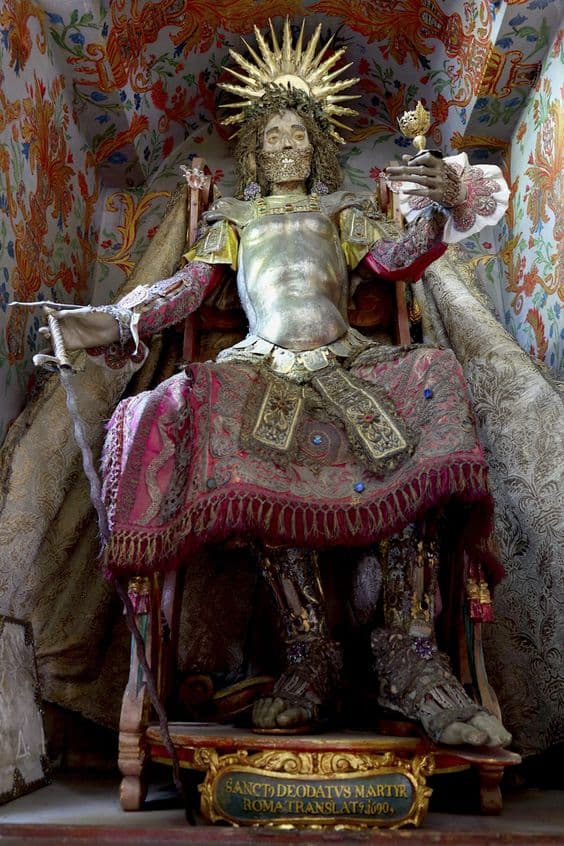
Bejeweled Skeleton of Saint Deodatus
Artist Unknown & Paul Koudounaris · Translated from Rome 1690
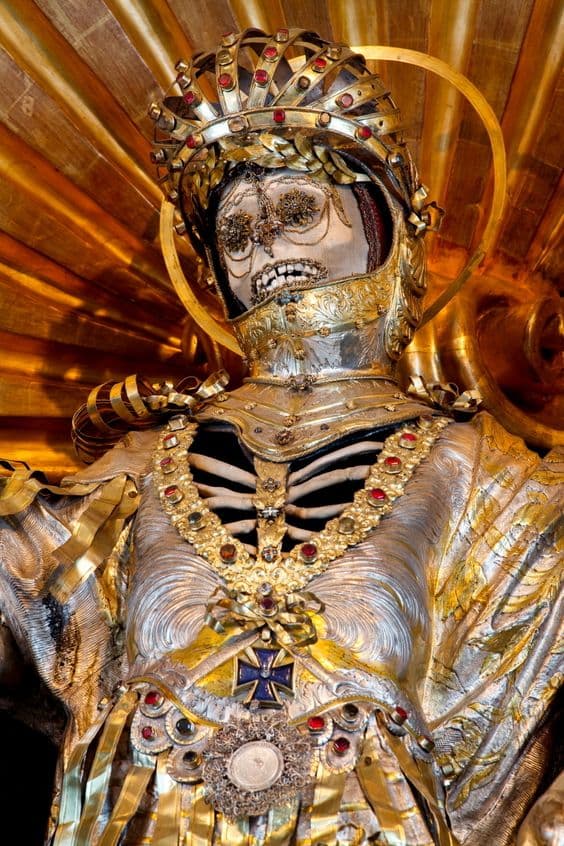
Bejeweled Skeleton of Saint Maximus
Paul Koudounaris · Late 17th century (relics acquired 1677)
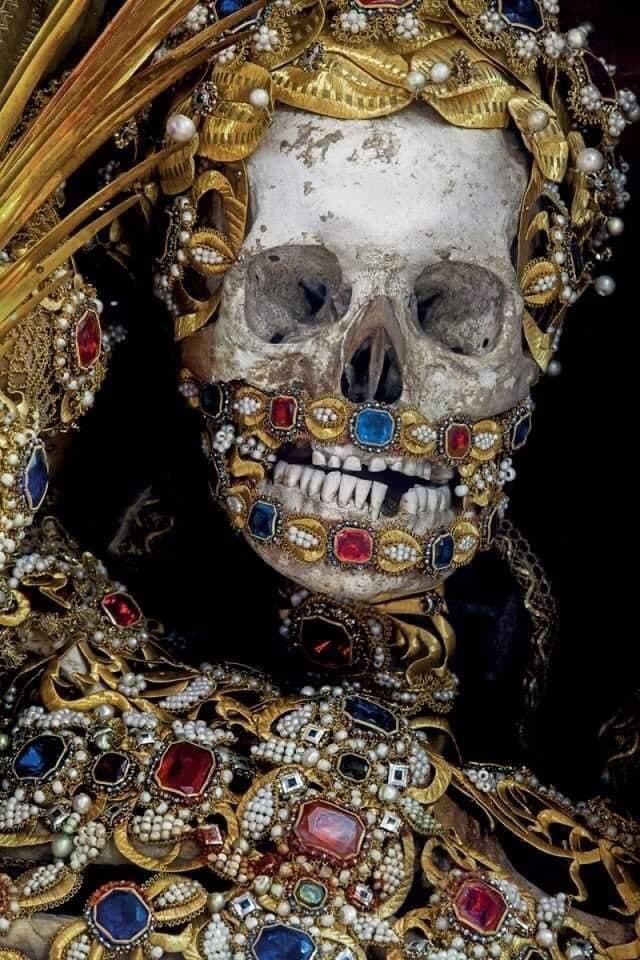
Bejeweled Skeleton of Saint Albertus
Paul Koudounaris · Arrived 1723; decoration 18th century
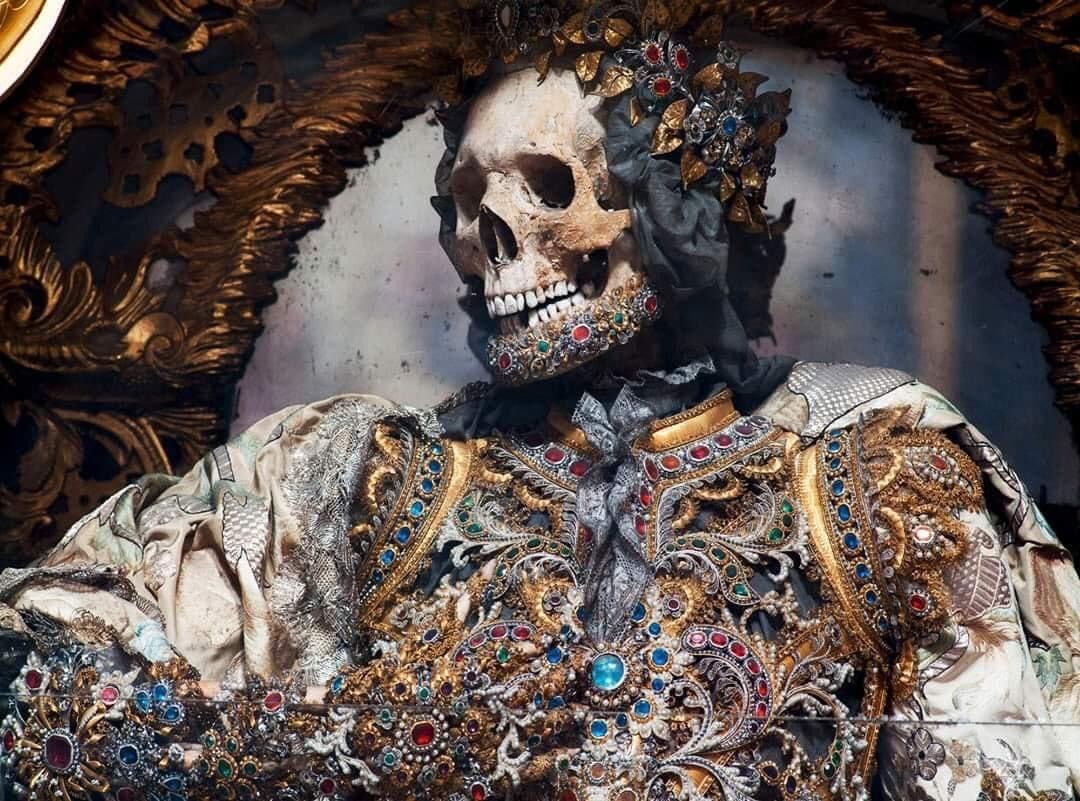
Bejeweled Skeleton of Saint Gratian
Adalbart Eder & Paul Koudounaris · 18th century (decoration); photographed by Paul Koudounaris, published 2013
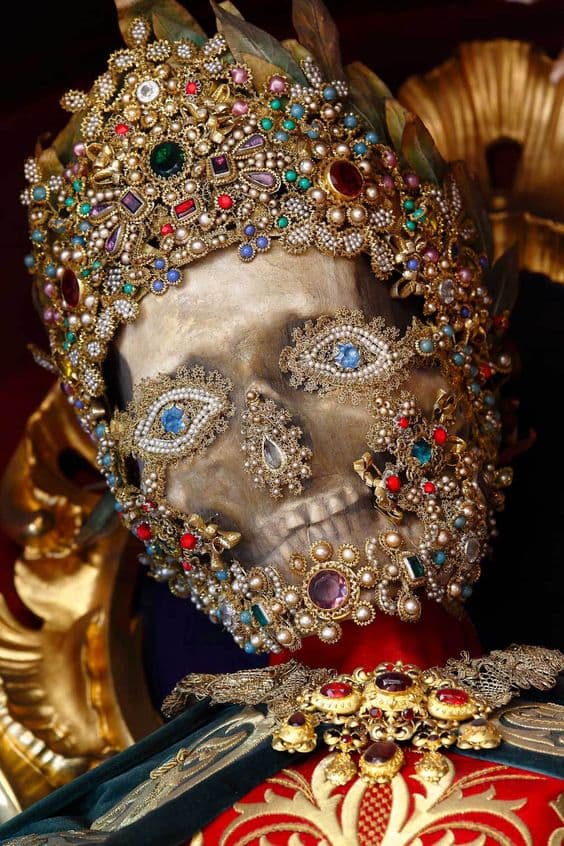
Bejeweled Skeleton of Saint Felix
Paul Koudounaris & Eastern Orthodox Church & St. Peter's Church
Kindred works
You may also study

Venus de Milo
Alexandros of Antioch · c. 150–125 BC

The Scream
Edvard Munch · 1893

Saturn Devouring His Son
Francisco Goya · c. 1819–1823
The Creation of Adam
Michelangelo · c. 1511–12

Ophelia
John Everett Millais · 1851–52

Woman with a Parasol – Madame Monet and Her Son
Claude Monet · 1875
Las Meninas
Diego Velázquez · 1656
Lucifer
Franz von Stuck · 1890