
Collection
Goya's Black Paintings: The 14 Murals of the Quinta del Sordo
Fourteen images an old, deaf painter made for his own walls, and never meant anyone else to see.
Goya's Black Paintings are fourteen murals that Francisco Goya painted in oil directly onto the plaster walls of his country house outside Madrid, the Quinta del Sordo, between about 1819 and 1823. He was in his seventies, profoundly deaf, and living through a period of political repression in Spain. The images he made there, among them Saturn Devouring His Son, a witches' coven gathered around a goat, two men clubbing each other while sinking into the ground, and a dog's head lost in an empty field, are some of the darkest pictures in Western art.
Goya gave them no titles, never exhibited them and never wrote about them. The names they carry today come from inventories made after he left Spain. Since 1881 the murals, transferred to canvas, have belonged to the Museo del Prado in Madrid, where they hang together in a single room.
01
Saturn Devouring His Son
Francisco Goya · c. 1819–1823
Saturn Devouring His Son is one of Francisco Goya's Black Paintings, painted directly onto a wall of his house outside Madrid around 1819–1823. Transferred to canvas, it now hangs in the Museo del Prado.
02
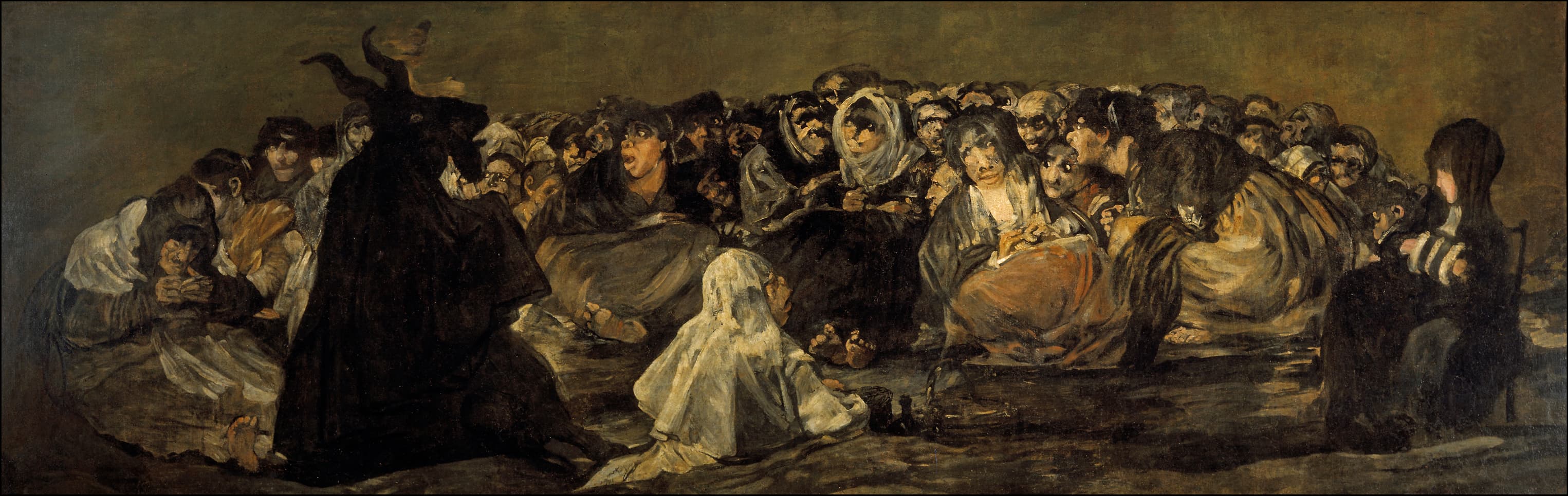
Witches' Sabbath (The Great He-Goat)
Francisco Goya · c. 1819–1823
Witches' Sabbath (The Great He-Goat) is a Black Painting by Francisco Goya, painted on a wall of his house near Madrid around 1819–1823. A goat-headed devil preaches to a crowd of terrified women at night. It is now in the Prado.
03
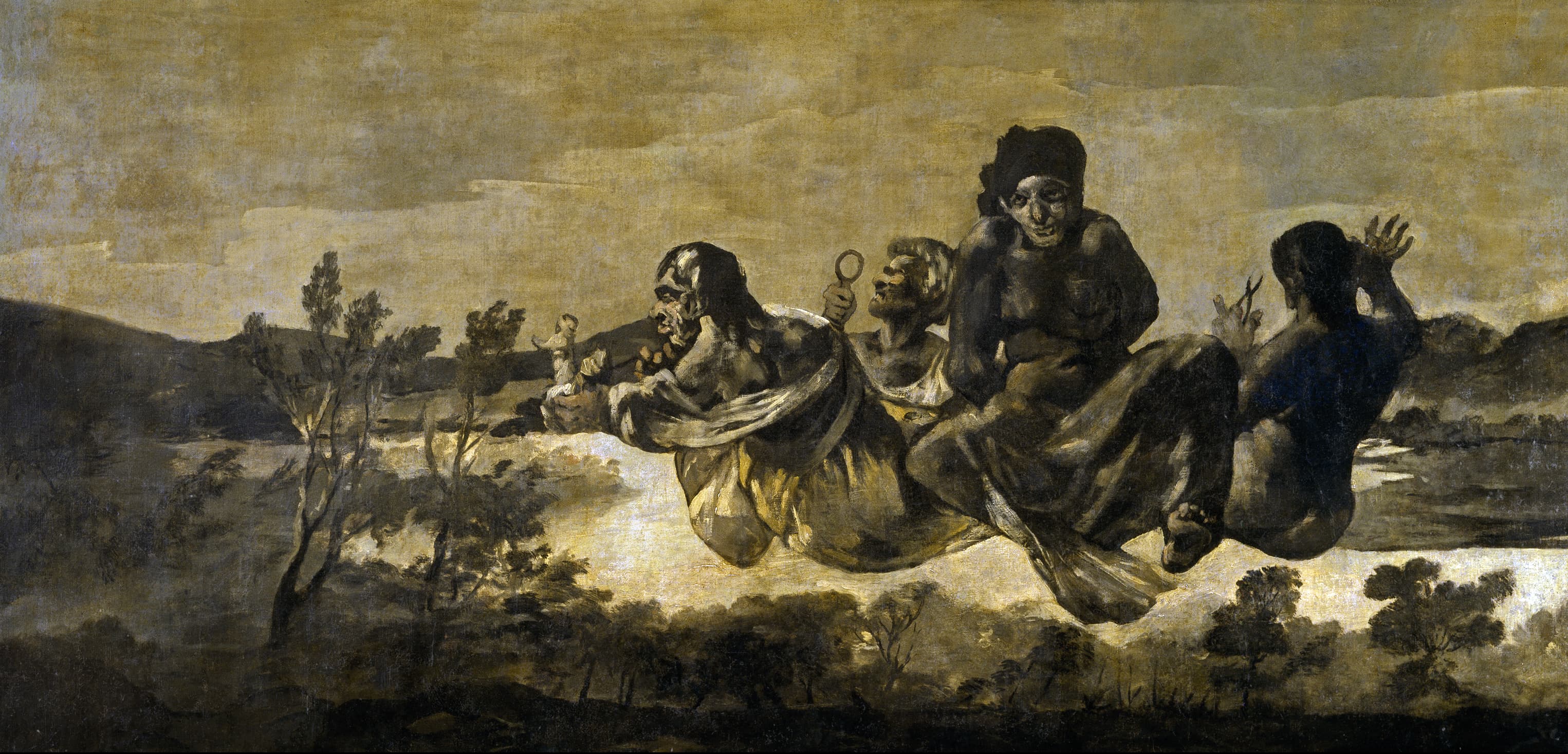
Atropos (The Fates)
Francisco Goya · c. 1819–1823
Atropos (The Fates) is one of Francisco Goya's Black Paintings, painted on a wall of his house outside Madrid around 1819–1823. It shows the three Fates and a bound man floating over a valley, and is now in the Prado.
04
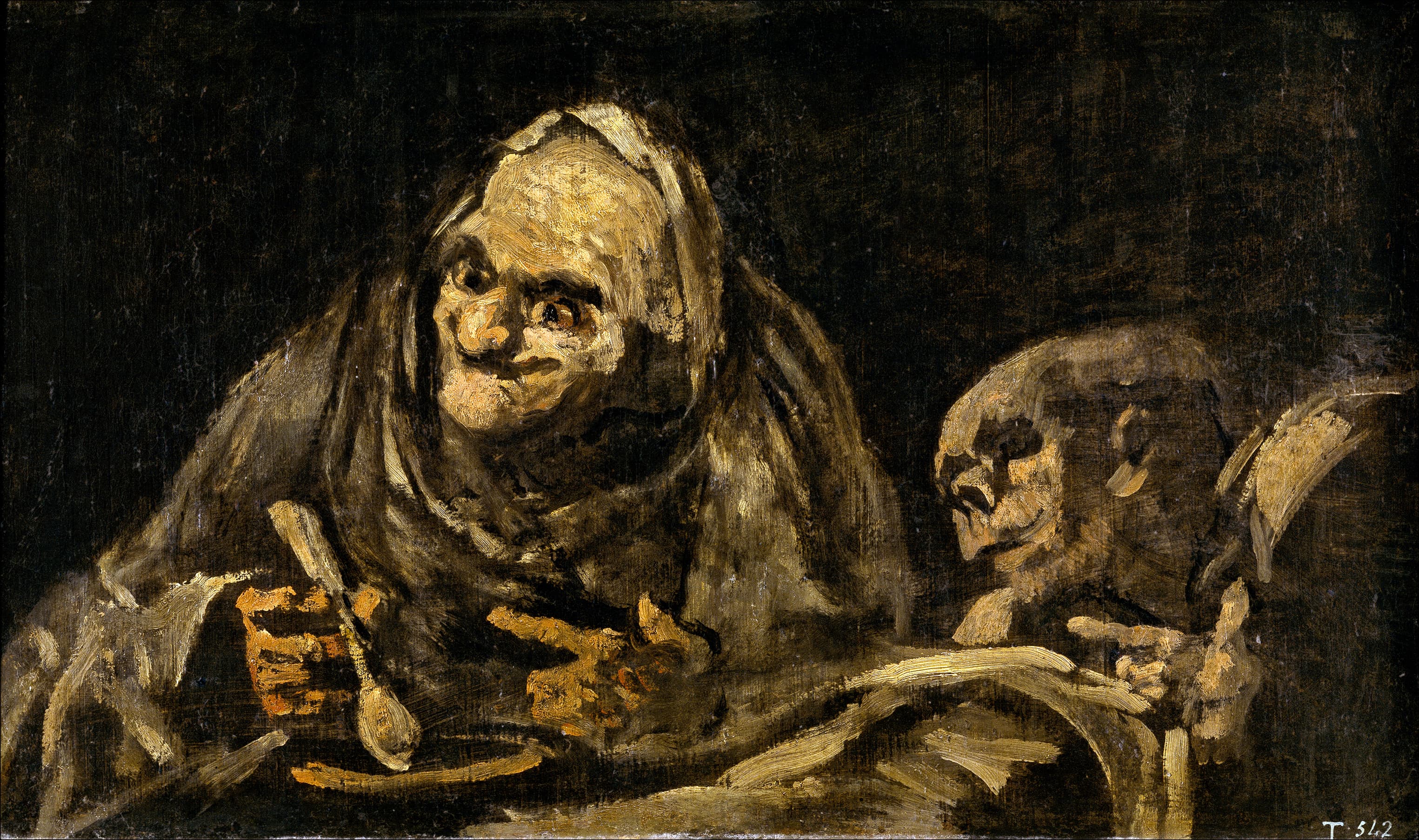
Two Old Men Eating Soup
Francisco Goya · c. 1819–1823
Two Old Men Eating Soup is a small Black Painting by Francisco Goya, painted on a wall of his house near Madrid around 1819–1823. Two toothless, skull-like figures lean over a bowl in the dark. It is now in the Prado.
05
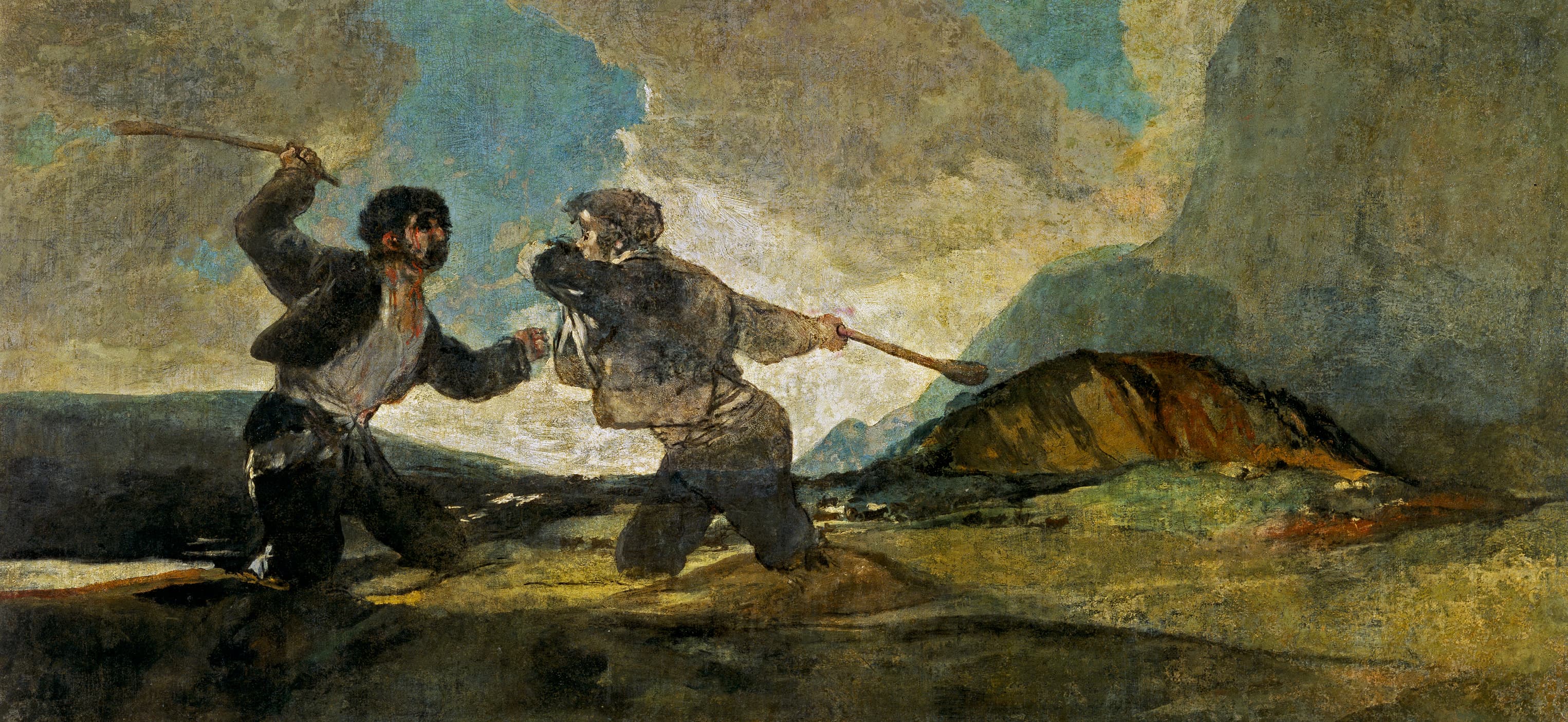
Fight with Cudgels
Francisco Goya · c. 1819–1823
Fight with Cudgels is one of Francisco Goya's Black Paintings, painted on a wall of his house near Madrid around 1819–1823. Two men, sunk to the knees in the ground, club each other in an empty landscape. It is now in the Prado.
06
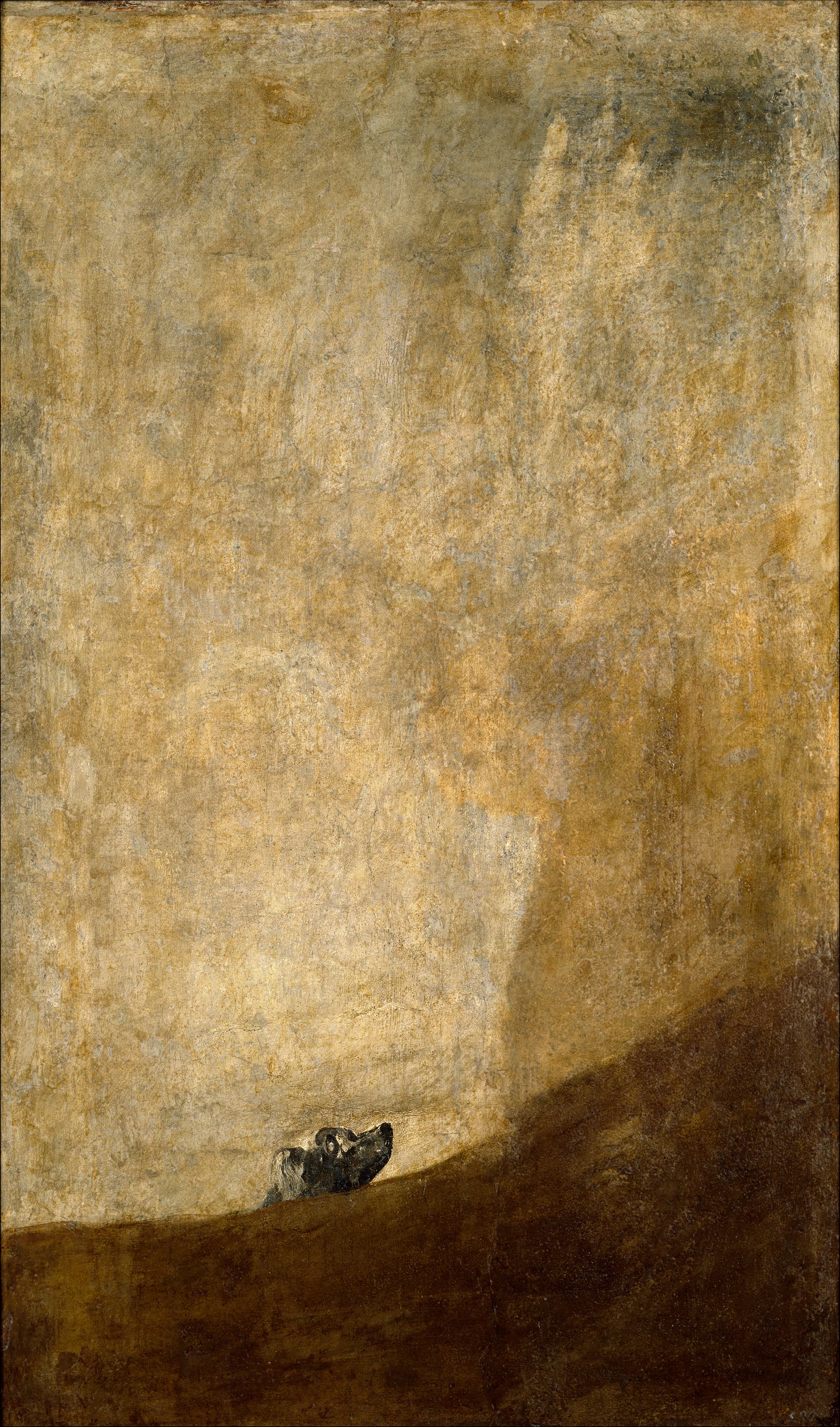
The Dog
Francisco Goya · c. 1819–1823
The Dog, or Half-Submerged Dog, is one of Francisco Goya's Black Paintings, painted on a wall of his house near Madrid around 1819–1823. A dog's head peers up from a dark slope into an empty ocher sky. It is in the Prado.
07
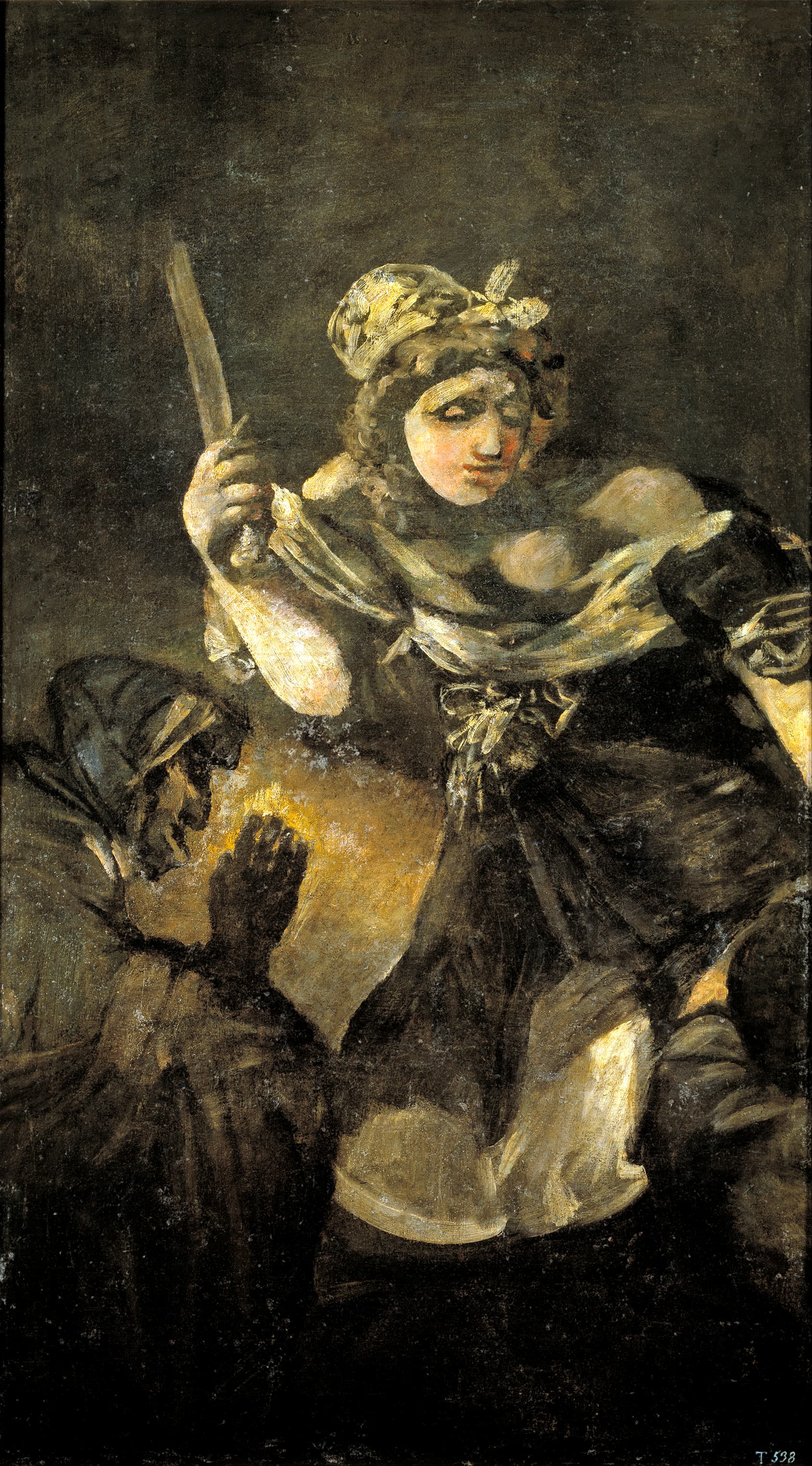
Judith and Holofernes
Francisco Goya · c. 1819–1823
Judith and Holofernes is a Black Painting by Francisco Goya, painted on a wall of his house near Madrid around 1819–1823. Judith raises her blade in torchlight while her maid prays. It hung near Saturn and is now in the Prado.
08
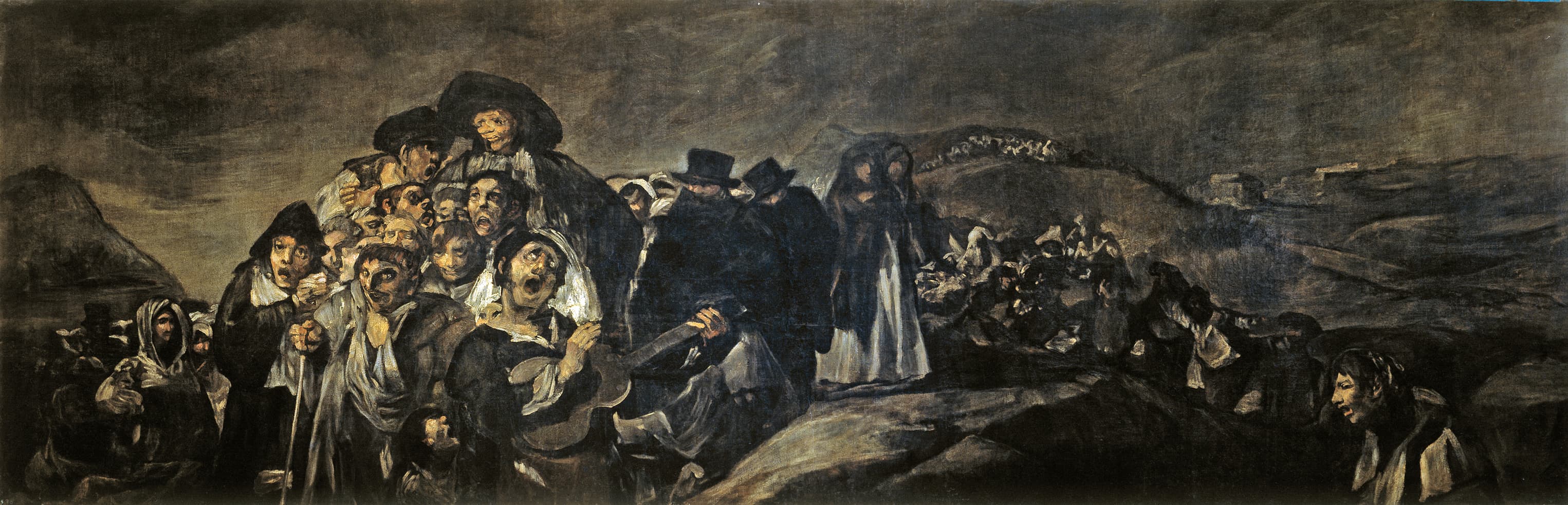
A Pilgrimage to San Isidro
Francisco Goya · c. 1819–1823
A Pilgrimage to San Isidro is one of Francisco Goya's Black Paintings, painted on a wall of his house near Madrid around 1819–1823. A dark crowd of singing pilgrims winds through a nocturnal landscape. It is in the Prado.
09
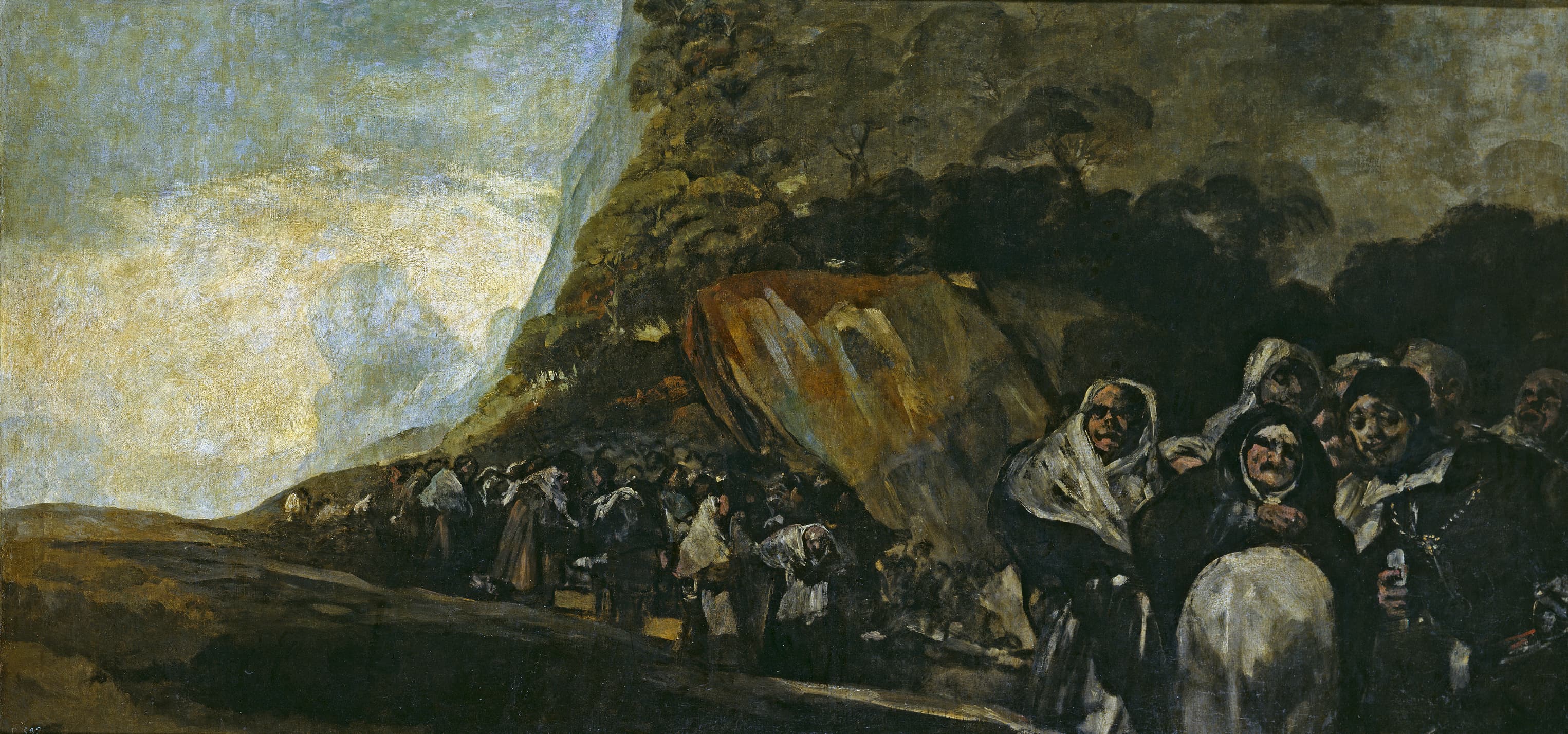
The Holy Office (Pilgrimage to the Fountain of San Isidro)
Francisco Goya · c. 1819–1823
The Holy Office (Pilgrimage to the Fountain of San Isidro) is a Black Painting by Francisco Goya, painted on a wall of his house near Madrid around 1819–1823. Grim figures stand before a procession and a dark hill. It is in the Prado.
10
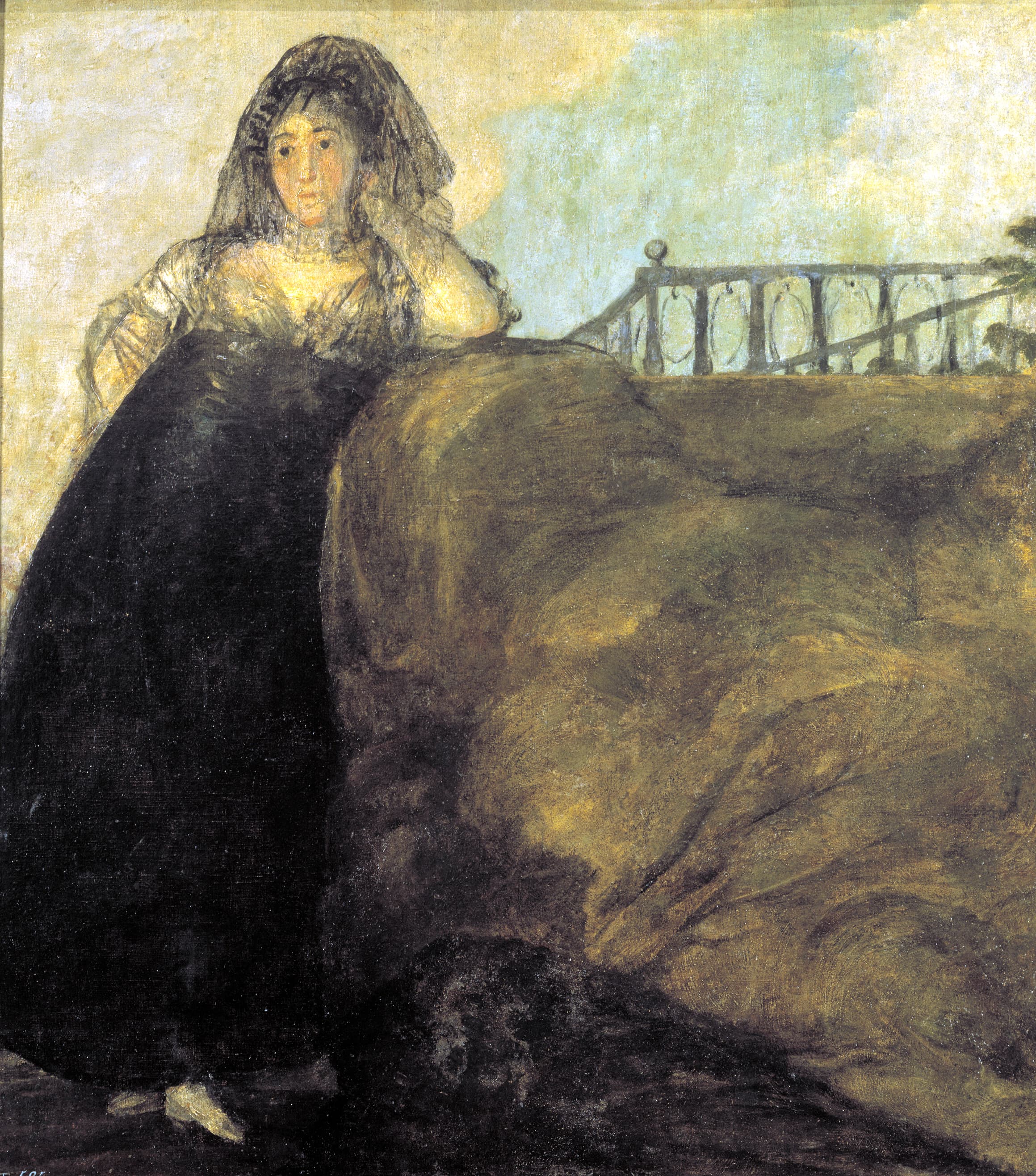
La Leocadia
Francisco Goya · c. 1819–1823
La Leocadia is a Black Painting by Francisco Goya, painted on a wall of his house near Madrid around 1819–1823. A woman in black, probably his companion Leocadia Zorrilla, leans on a railed mound. It is now in the Prado.
11
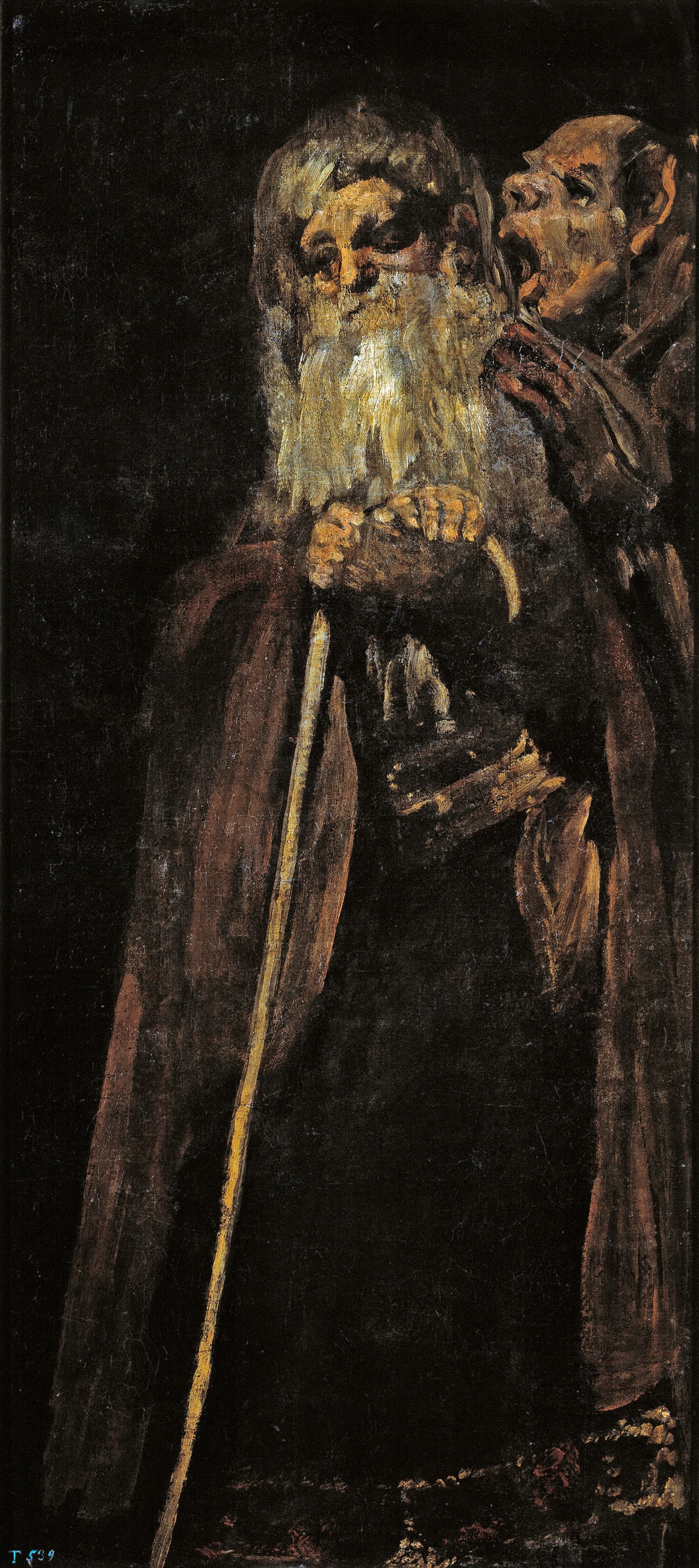
Two Old Men
Francisco Goya · c. 1819–1823
Two Old Men is a Black Painting by Francisco Goya, painted on a wall of his house near Madrid around 1819–1823. A bearded old man leans on a staff while a grotesque figure shouts in his ear. It is now in the Prado.
12
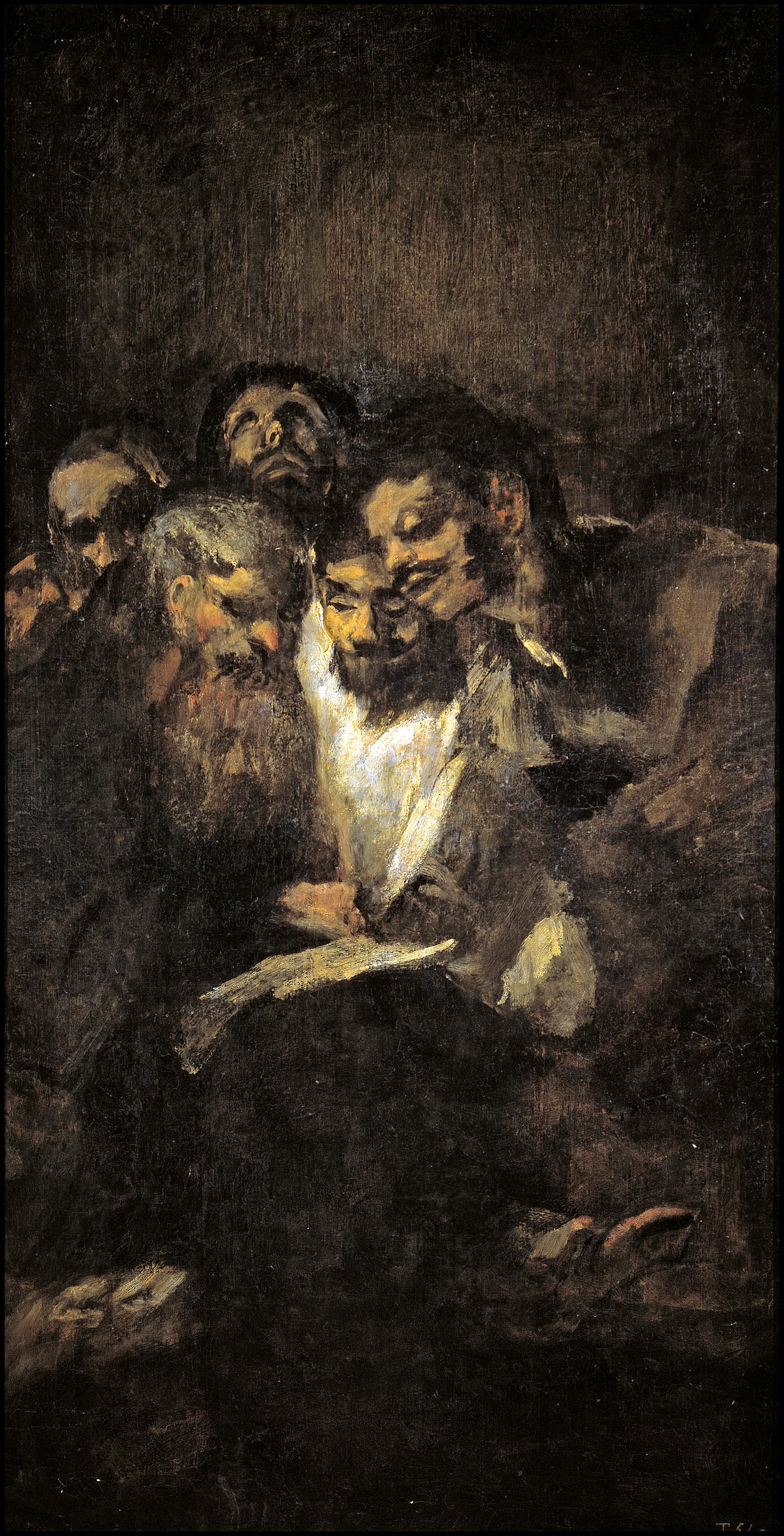
Men Reading
Francisco Goya · c. 1819–1823
Men Reading is a Black Painting by Francisco Goya, painted on a wall of his house near Madrid around 1819–1823. Six men crowd in the dark around a page held by a bearded reader. It is now in the Museo del Prado.
13
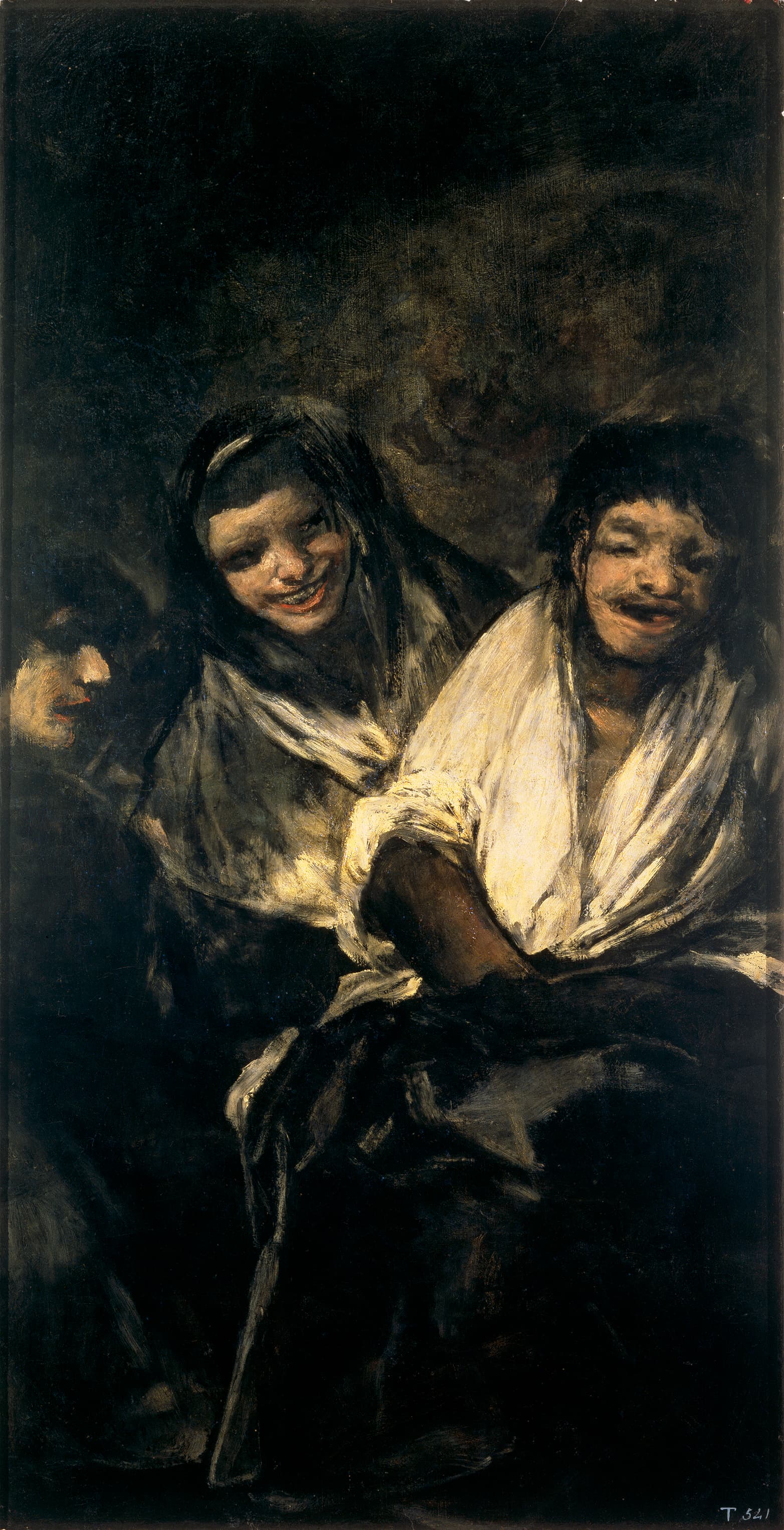
Women Laughing
Francisco Goya · c. 1819–1823
Women Laughing, also called Man Mocked by Two Women, is a Black Painting by Francisco Goya, painted on a wall of his house near Madrid around 1819–1823. Two women leer at a grinning man in the dark. It is in the Prado.
14
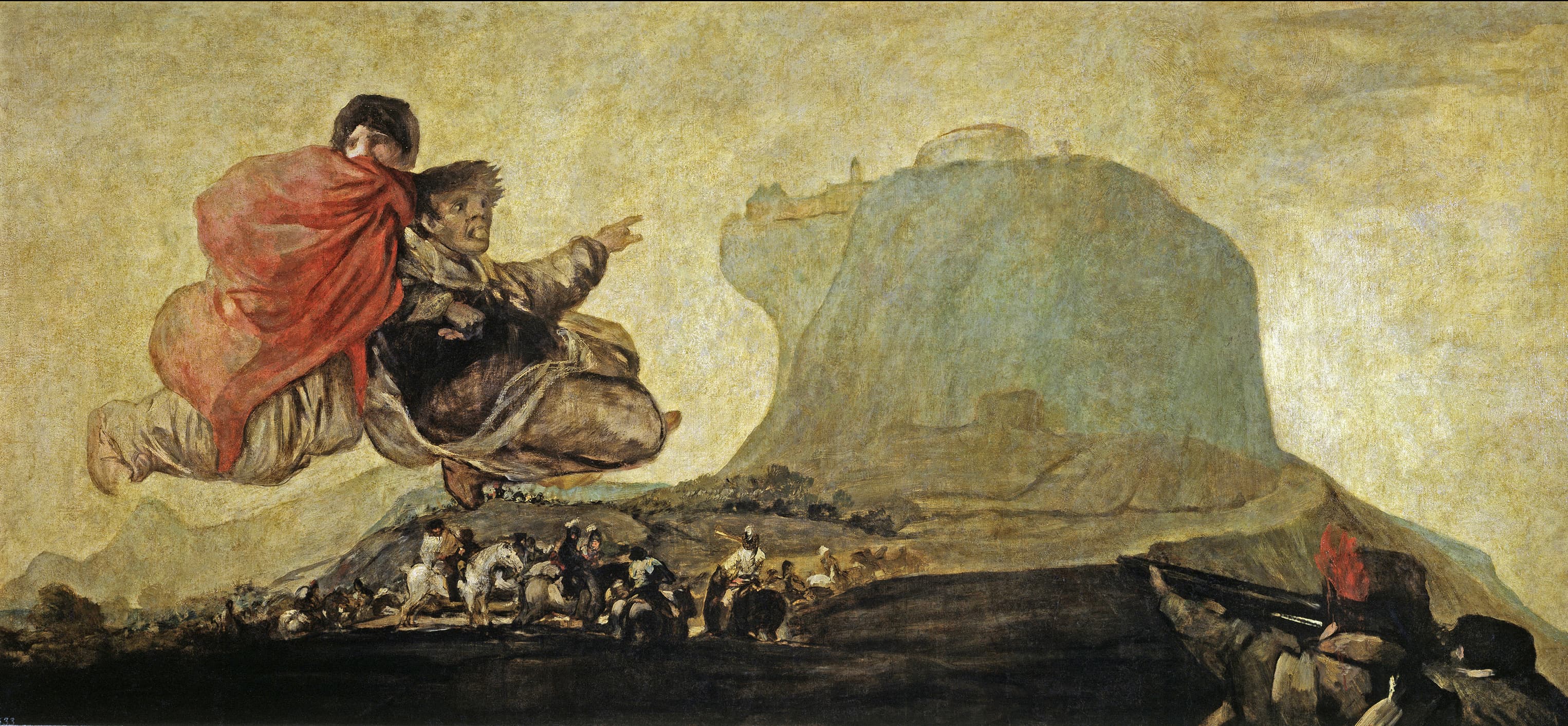
Fantastic Vision (Asmodea)
Francisco Goya · c. 1819–1823
Fantastic Vision (Asmodea) is a Black Painting by Francisco Goya, painted on a wall of his house near Madrid around 1819–1823. Two figures fly toward a rock-top town as soldiers fire below. It is now in the Prado.
15
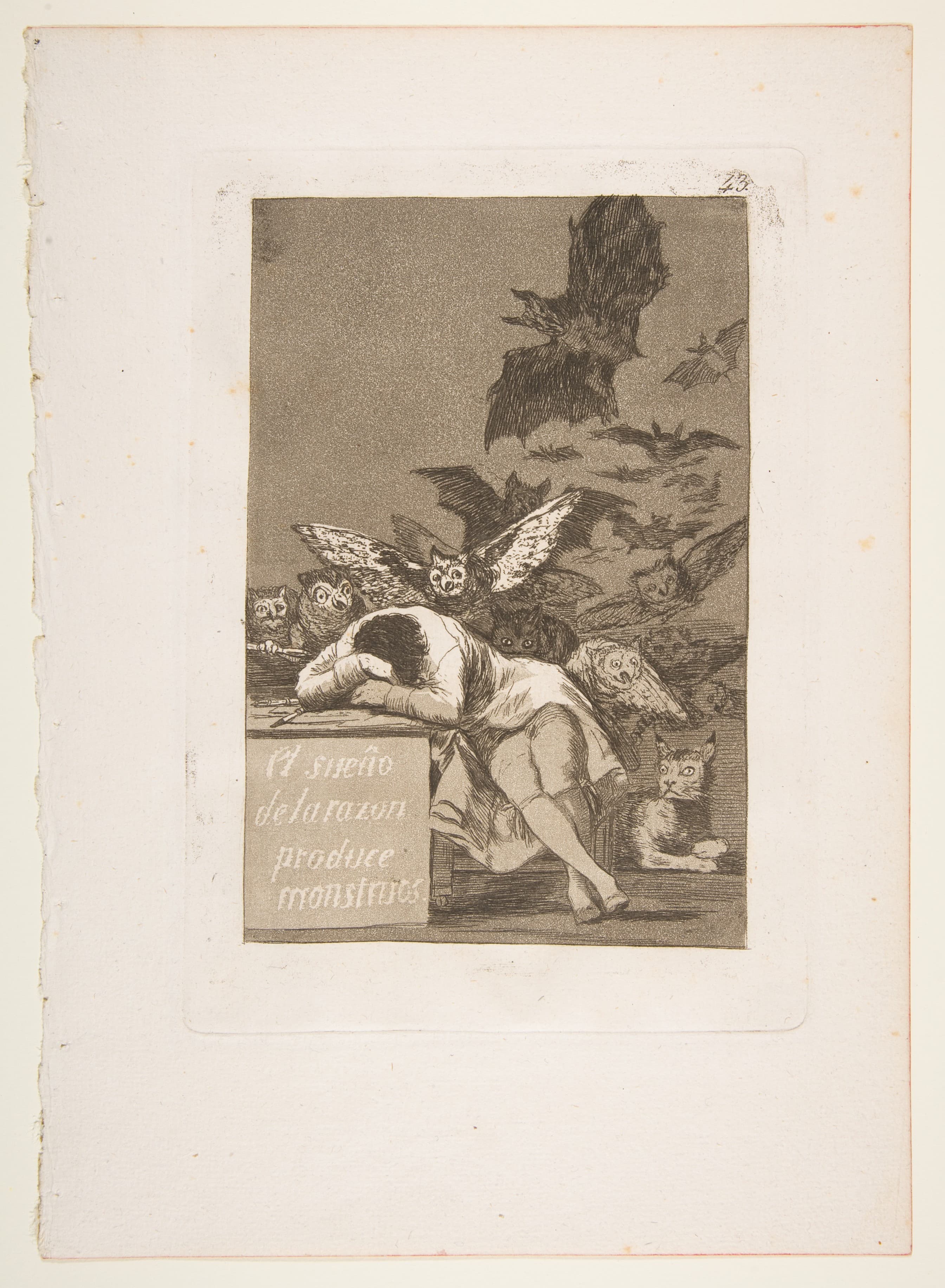
The Sleep of Reason Produces Monsters
Francisco Goya · 1797–99 (published 1799)
The Sleep of Reason Produces Monsters is Francisco Goya's etching of about 1797–99, plate 43 of his series Los Caprichos: an artist asleep at his desk while owls, bats and a lynx swarm out of the dark behind him. Impressions are held by many museums, including the Prado and the Met.
16
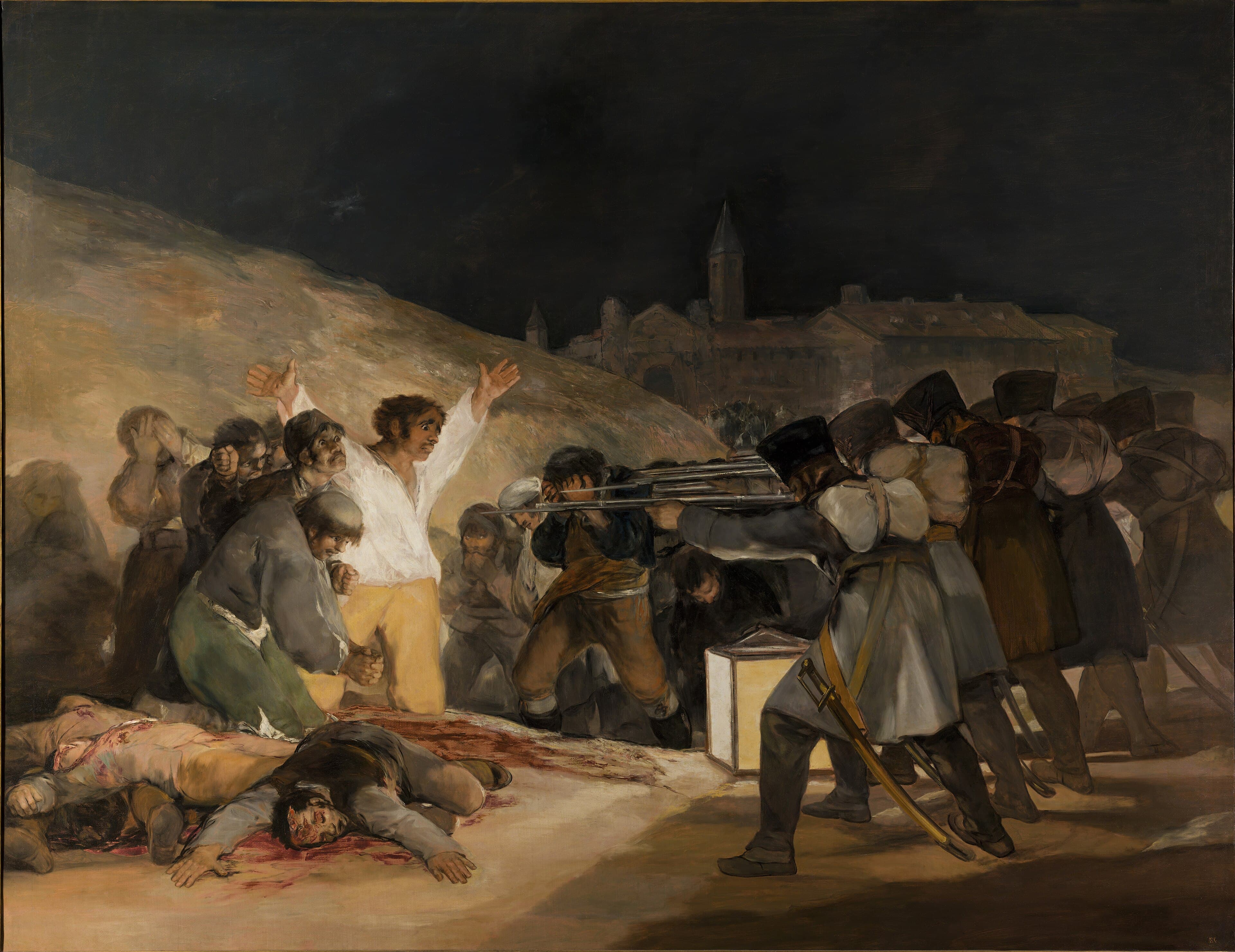
The Third of May 1808
Francisco Goya · 1814
The Third of May 1808 is Francisco Goya's 1814 painting of Spanish civilians being shot by a French firing squad the morning after the Madrid uprising against Napoleon's troops. It hangs in the Museo del Prado in Madrid.
What are the Black Paintings?
In February 1819 Goya bought a two-story farmhouse on the west bank of the Manzanares river, across from Madrid. Locals already called it the Quinta del Sordo, the House of the Deaf Man, after a previous owner who was also deaf; the coincidence has fed legends ever since. Over the next few years Goya covered the walls of two main rooms, one on the ground floor and one upstairs, with paintings worked in oil over the plaster.
The name pinturas negras refers to the palette as much as the mood. Goya worked largely in black, umber, ochre and dirty whites, with flashes of red that read like wounds. Many scenes appear to have been painted over earlier, brighter landscapes, which scholars have detected under the surface. The brushwork is fast and loose, sometimes scraped or smeared, closer to the late Titian or to Expressionism a century later than to anything else painted in 1820.
The fourteen paintings
The catalogue now holds the most famous of them, Saturn Devouring His Son. The full set, with the titles that later inventories gave them, is:
- Saturn Devouring His Son (Saturn)
- Judith and Holofernes
- Witches' Sabbath (also called The Great He-Goat)
- A Pilgrimage to San Isidro
- Procession of the Holy Office
- La Leocadia, a woman in black leaning on what may be a grave mound
- Two Old Men
- Two Old Ones Eating Soup
- Fight with Cudgels
- The Dog
- Atropos (The Fates)
- Fantastic Vision (Asmodea)
- Women Laughing
- Men Reading
According to the 1828 inventory drawn up by Goya's friend Antonio Brugada and later reconstructions of the house, the ground-floor room held Saturn, Judith, Leocadia, the Witches' Sabbath, the Pilgrimage to San Isidro and the two old men. The upper room held The Dog, Atropos, Fight with Cudgels, Fantastic Vision and the remaining scenes. Pairings matter: Saturn and Judith, both images of devouring and beheading, faced each other near the dining area.
Saturn and the logic of the room
Saturn is the image everyone knows, and the one most worth looking at slowly. The god does not eat a baby, as Rubens painted the myth for Philip IV's hunting lodge in 1636. He grips an adult body, already headless, and tears at the arm. His eyes are wide with something closer to terror than appetite. The body in his hands is pale and almost classical, the god around it a smear of gray and black; the only strong color is the red of the torn flesh.
Read against its neighbors, Saturn stops being a single horror picture. The ground floor sets the father who devours his children opposite Judith, the woman who kills a tyrant; it sets the crowd at the Witches' Sabbath, gathered around a goat-headed devil, against the drunken, singing pilgrims of San Isidro. Goya painted the same festival in bright daylight in 1788, as a full-size cartoon for the royal weaving workshop. Here the pilgrims are gaping, toothless and lit by nothing. The comparison is a measure of how far his view of Spain had darkened.
Why did Goya paint them?
Goya left no explanation, so every reading is a reconstruction. Three strands recur in the scholarship.
Illness and age. In 1792–93 a severe illness left him permanently deaf, and in 1819 he nearly died again; his Self-Portrait with Dr. Arrieta (1820, Minneapolis Institute of Art) records the second crisis. Sickness, old age and death run through the murals, from the gumming old men to the Fates holding their scissors.
Politics. In 1814 Ferdinand VII returned to the throne, abolished the liberal Constitution of 1812 and restored the Inquisition. Goya, a liberal sympathizer, had already recorded the brutality of war in The Third of May 1808 and the Disasters of War prints. The Procession of the Holy Office and the Fight with Cudgels, often read as an image of Spaniards destroying each other, belong to the same disillusioned view. When absolutism was restored again in 1823, Goya transferred the house to his grandson Mariano, and in 1824 he left for France. He died in Bordeaux in 1828.
The private imagination. Goya had been drawing witches, monsters and dreams for decades. The famous print The Sleep of Reason Produces Monsters (1799) from Los Caprichos already shows the artist asleep at his desk while owls and bats rise behind him. The Black Paintings carry that vocabulary off the page and onto the walls of a home, with no patron, buyer or censor to answer to.
From the walls to the Prado
The murals survived Goya by luck. In 1873–74 the house was bought by the French-born banker Baron Émile d'Erlanger, who had the paintings lifted off the plaster and transferred to canvas under the supervision of Salvador Martínez Cubells, the Prado's restorer. The process saved them but cost them: areas of paint were lost and retouched, and the original compositions were cropped to fit the canvases. Photographs taken by Jean Laurent around 1874, before the transfer, are now the main evidence for how the murals originally looked.
D'Erlanger showed the paintings at the Exposition Universelle in Paris in 1878, where they attracted little interest, and then gave them to the Spanish state. A royal decree of 1881 accepted the gift. The house itself was demolished in 1909.
The authorship debate
In 2003 the historian Juan José Junquera argued that the Black Paintings could not be by Goya, partly on the grounds that the upper floor of the Quinta did not exist when Goya lived there, and suggested his son Javier as the painter. The Prado and most Goya specialists rejected the theory after reviewing documentary evidence, including the 1828 inventory and the house's building history. The attribution to Goya is the accepted position.
Their legacy
The Black Paintings were barely known until the late nineteenth century. Once the public could see them, they changed how Goya was understood: no longer only a court painter of elegant portraits but a forerunner of modern art. Symbolists, Expressionists and Surrealists all claimed him, and the murals' rough handling and refusal of a clear story anticipate much of the painting of the twentieth century. For a broader look at how artists have pictured mortality and terror, see Death in Art and Dark Academia.
Questions & answers
How many Black Paintings did Goya make?
There are fourteen Black Paintings. Goya painted them in oil directly onto the walls of two rooms in his house, the Quinta del Sordo, outside Madrid, between about 1819 and 1823. All fourteen are now in the Museo del Prado in Madrid, transferred to canvas in the 1870s.
Where are Goya's Black Paintings today?
The Black Paintings hang together in a dedicated room at the Museo del Prado in Madrid. Baron Émile d'Erlanger had them transferred from the walls to canvas around 1874, showed them in Paris in 1878 and gave them to the Spanish state, which accepted the gift in 1881.
Why are they called the Black Paintings?
The name, pinturas negras in Spanish, comes from their dark palette of black, brown and ochre and from their bleak subjects: witches, devouring gods, violence and old age. Goya himself gave them no titles and no collective name; both were applied after his death.
What do Goya's Black Paintings mean?
Goya left no explanation. Scholars connect them to his deafness and illness, to his old age, and to the political repression under Ferdinand VII, when the liberal constitution was abolished and the Inquisition restored. They also continue the witches and nightmares of his earlier prints, especially Los Caprichos.
Is Saturn Devouring His Son one of the Black Paintings?
Yes. Saturn Devouring His Son is the best known of the fourteen. It hung on the ground floor of the Quinta del Sordo, facing Judith and Holofernes, and measures about 143.5 by 81.4 cm. It is in the Prado in Madrid.