High Renaissance
Bacchus (Saint John the Baptist)
Leonardo da Vinci, c. 1510–15; altered 1683–93
Bacchus is a painting from Leonardo da Vinci's workshop, c. 1510–15, in the Louvre, Paris. It began as Saint John the Baptist in the wilderness and was overpainted in 1683–93 to become the Roman god of wine, with a vine wreath, a leopard skin and a thyrsus.
- Artist
- Leonardo da Vinci
- Date
- c. 1510–15; altered 1683–93
- Medium
- Oil on walnut panel, transferred to canvas
- Dimensions
- 177 × 115 cm
- Collection
- Musée du Louvre, Paris, France
- Movement
- High Renaissance
The painting known as Bacchus in the Musée du Louvre is a picture with two identities. It was made around 1510–15 in the circle of Leonardo da Vinci as an image of Saint John the Baptist seated in the wilderness, and between 1683 and 1693, while in the French royal collection, it was repainted to turn the saint into Bacchus, the Roman god of wine. The design is generally connected with Leonardo's late ideas, but the painting itself is attributed to his workshop, with Francesco Melzi, Cesare da Sesto, Marco d'Oggiono and Cesare Bernazzano among the pupils proposed. It measures 177 × 115 cm.
What you're looking at
A young man sits on a rocky outcrop at the edge of a wood, naked except for a spotted animal skin draped across his lap. His body is soft and smooth, his curly hair crowned with a wreath of vine leaves, and he looks out at us with a faint, knowing smile. With his right hand he points across his own chest, toward his left; with his left hand, resting on his thigh, he points down at the ground. A long thin staff leans against his shoulder.
Behind him, the right half of the picture is closed by a dark mass of rock and trees. The left half opens onto one of those misty, blue-gray Leonardesque landscapes: a river valley, a lake and a jagged mountain fading into haze. A slender sapling rises in the middle ground. The detail most viewers miss is the small deer resting at the lower left, half hidden in the shadowed grass, and the clump of carefully drawn leaves in the bottom corner; such plant studies are typical of Leonardo's circle.
How a saint became a god
The changes made in the late seventeenth century were small but decisive. The Baptist's traditional long cross-shaped staff was converted into a Bacchic thyrsus, the vine wreath was added to his head, and the camel-hair or fur garment of the desert prophet was painted over with leopard spots. The result reads at first glance as a pagan scene, but underneath it the composition is still a Christian one: the double pointing gesture, up and across toward heaven or the coming Christ and down to the earth, belongs to the iconography of John the Baptist, the forerunner who points the way.
Why was it altered? Seventeenth-century viewers were troubled by the image. When the Italian scholar Cassiano dal Pozzo saw it at Fontainebleau in 1625, he complained that it had neither devotion nor decorum; the sensual, androgynous youth did not look like the gaunt prophet of the desert. Converting him into Bacchus resolved the problem by giving the figure a subject that suited its appearance.
The Leonardo question
The painting is closely related to Leonardo's half-length Saint John the Baptist, also in the Louvre, which shows a similar smiling, pointing youth emerging from darkness, and to a lost drawing of a seated Baptist. Most scholars see the Bacchus as a workshop work produced from Leonardo's designs during his last years in Milan or Rome rather than as a work from his own hand. Its present surface, after the overpainting and its later transfer from panel to canvas, also makes stylistic judgment difficult. Leonardo's assistant Salaì is often named as the model for this type of ambiguous, smiling youth, though that identification is traditional rather than documented.
Condition
The picture has had a hard life. Besides the seventeenth-century overpainting, it was later transferred from its original walnut panel to canvas, a drastic procedure once used to save paintings on failing wood, and it has darkened considerably. That is why the figure seems to emerge from a murky, greenish gloom and why the right half of the landscape reads as an almost uniform shadow. Copies by Leonardo's followers, such as a small panel attributed to Bernardino Lanino in Edinburgh, show the seated figure as Saint John, though in different settings.
Meaning
Both identities share a theme: a mediator between worlds. John the Baptist points from the earthly wilderness toward the divine; Bacchus, god of wine and ecstasy, stands between the human and the wild. The painting's ambiguity, saint or god, male or almost female, sacred or sensual, is exactly what made it uncomfortable in the seventeenth century and what makes it fascinating now.
Related works
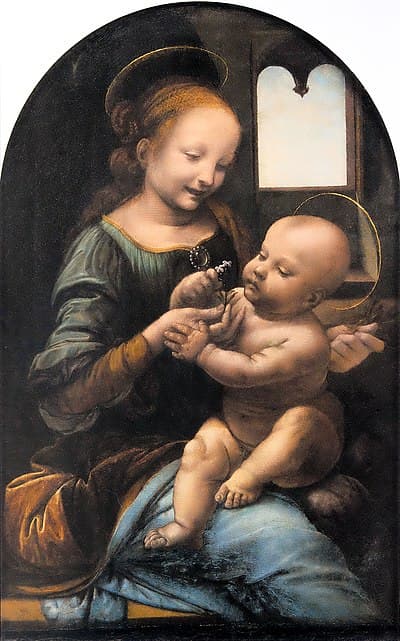
See Leonardo's Mona Lisa, with its similar smile and misty landscape, the Baptism of Christ he painted with Verrocchio, and Benois Madonna. For the wider period, see Renaissance Paintings and Greek Mythology in Art.
Where to see it
Musée du Louvre, Paris (INV 780), among the Italian paintings of the Denon wing. The Louvre rehangs and lends its Leonardesque pictures periodically, so check the online collection for its current room. The work is in the public domain.
Questions & answers
Did Leonardo da Vinci paint Bacchus?
Not entirely. The Louvre's Bacchus, c. 1510–15, is attributed to Leonardo's workshop, working from his designs. Pupils such as Francesco Melzi, Cesare da Sesto and Marco d'Oggiono have been proposed as the painter. It is closely related to Leonardo's own Saint John the Baptist, also in the Louvre.
Why was the Bacchus painting changed from Saint John the Baptist?
Seventeenth-century viewers found the sensual, androgynous youth unsuitable for the ascetic prophet; Cassiano dal Pozzo criticized its lack of devotion in 1625. Between 1683 and 1693 it was overpainted with a vine wreath, leopard spots and a thyrsus, turning the saint into Bacchus, god of wine.
Where is the Bacchus painting by Leonardo?
It is in the Musée du Louvre in Paris (inventory INV 780), among the museum's Italian Renaissance paintings. It entered the French royal collection early and was at Fontainebleau by 1625, where it was later overpainted. It measures 177 × 115 cm.
What is the meaning of Bacchus pointing?
The double gesture comes from the original subject, Saint John the Baptist: one hand points across toward heaven or the coming Christ, the other down to the earth. It marks John as the forerunner who points the way to salvation, a meaning that survives beneath the Bacchic disguise.
More by the artist
Leonardo da Vinci
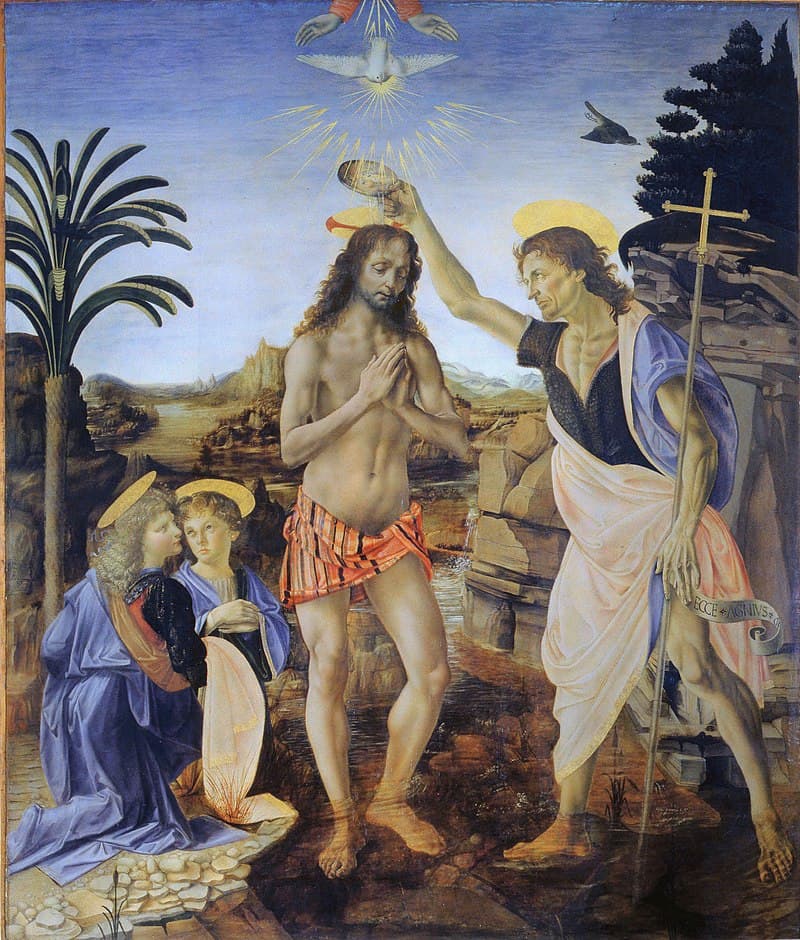
The Baptism of Christ
Andrea del Verrocchio & Leonardo da Vinci · c. 1470–75
The Last Supper
Leonardo da Vinci · c. 1495–98
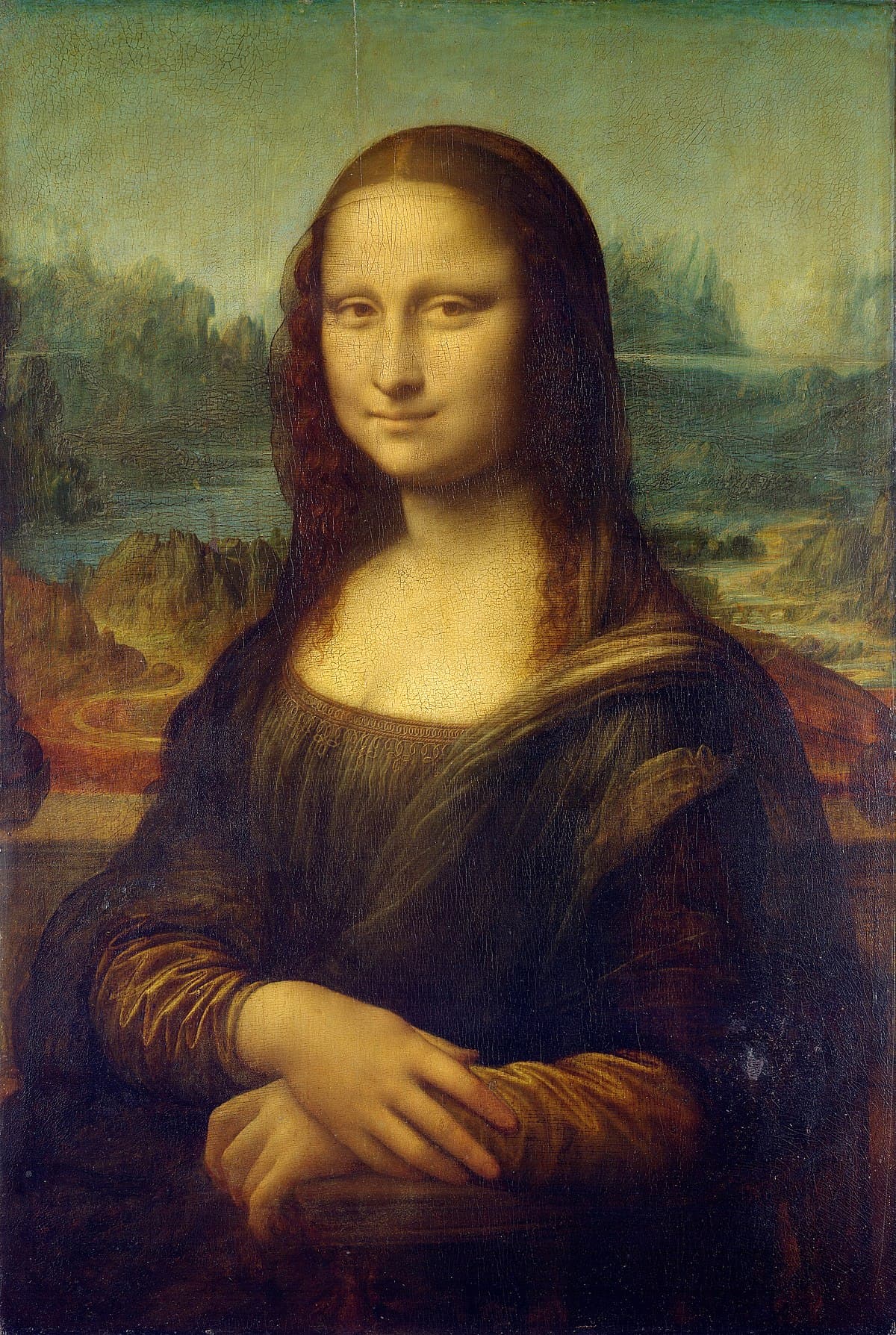
Mona Lisa
Leonardo da Vinci · c. 1503–1519
Portrait of a Man in Red Chalk
Leonardo da Vinci · c. 1512
Benois Madonna
Leonardo da Vinci · c. 1478–80
Study of Hands
Leonardo da Vinci · c. 1474–76
Kindred works
You may also study

Bridge over a Pond of Water Lilies
Claude Monet · 1899

Venus de Milo
Alexandros of Antioch · c. 150–125 BC

Nymphs Dancing to Pan's Flute
Joseph Tomanek

The Scream
Edvard Munch · 1893

The Thinker
Auguste Rodin · Modeled 1880–82; enlarged 1902–03; this cast 1904

Saturn Devouring His Son
Francisco Goya · c. 1819–1823
The Creation of Adam
Michelangelo · c. 1511–12

Ophelia
John Everett Millais · 1851–52