Academic art
Nymphs Dancing to Pan's Flute
Joseph Tomanek
Nymphs Dancing to Pan's Flute is an oil painting by the Czech-American artist Joseph Tomanek (1889–1974) showing a ring of nude nymphs dancing around a bonfire at night while a satyr-like Pan plays his pipes. Its date and current owner are not publicly recorded.
- Artist
- Joseph Tomanek
- Medium
- Oil on canvas
- Movement
- Academic art
Nymphs Dancing to Pan's Flute is a night scene by Joseph Tomanek, a painter born in Moravia who spent his career in Chicago. A ring of nude and half-draped women whirls around a roaring bonfire in a dark wood, while at the far left a crouching, goat-legged figure, Pan, plays a pipe. The picture is undated and does not belong to a public museum; it is known today mainly through reproductions and the auction market, which is why the image circulates so widely online with so little information attached.
What you're looking at
The fire is the real subject. It sits just right of center and supplies the only light in the picture, so every figure is lit from inside the circle. Bodies nearest the blaze glow orange and gold; the dancers at the edges are rim-lit, their outlines traced in hot color while their fronts fall into shadow. Sparks and smoke pour upward into the treetops, and Tomanek paints them with loose, flicked strokes that contrast with the smooth modeling of the skin.
There are about ten dancers, and no two poses repeat. In the center a nymph seen from behind stretches both arms to her neighbors, her hair swinging; to the right a figure bends sharply forward, almost silhouetted against the flames; at the left a woman raises a pale veil above her head, catching the light like a banner. Hands link and unlink along the ring, so the eye travels around it the way the dance itself would.
The detail most viewers miss is Pan himself. He is easy to overlook, crouched low in the bottom-left corner, half swallowed by the cool blue-green darkness of the wood, his face turned to his pipe. He is the cause of the whole scene, yet Tomanek gives him the least light. The cold, moonlit left side of the canvas and the hot right side split the picture into two temperatures, and the music seems to cross from one into the other.
The myth behind it
In Greek myth, nymphs are female nature spirits bound to particular places: springs, trees, mountains and groves. Pan, the goat-legged god of shepherds and wild country, was their constant companion and pursuer. His pipe, the syrinx, was said to have been made from the reeds into which the nymph Syrinx was transformed as she fled him, a story told in Ovid's Metamorphoses. Ancient and later artists often show nymphs dancing to his music as an image of nature's untamed rhythm.
Tomanek adds the bonfire, which has no fixed source in the myths. It turns a pastoral daytime subject into a nocturnal revel, closer to the bacchanals and witches' sabbaths of nineteenth-century painting.
The artist
Joseph Tomanek was born in 1889 in Strážnice, then in Austria-Hungary and now in the Czech Republic, and arrived in Chicago in 1910. He trained at the Academy of Fine Arts in Prague and at the School of the Art Institute of Chicago, where his teachers included Albert Krehbiel, Antonin Sterba and Karl Buehr, and he was active in the city's Bohemian Arts Club. He admired the French academic painter William-Adolphe Bouguereau, and like Bouguereau he specialized in idealized female nudes in landscape settings, alongside portraits, still lifes and religious commissions. He died in Berwyn, Illinois, in 1974.
The Bouguereau connection is visible here in the smooth, polished flesh and the classical subject. Compare Bouguereau's La Naissance de Vénus, where nude figures likewise circle a central point. Tomanek's handling of the fire and foliage is freer, though, closer to the loose brushwork of the early twentieth century than to the porcelain finish of the French academy.
Meaning
The painting is best read as a celebration of release rather than as a moral lesson. The nymphs dance without spectators other than Pan and us, and the composition, with its unbroken ring and upward rush of sparks, suggests energy that cannot be contained. The fire also carries a hint of danger: the dancers come very close to it, and the darkness at the edges is deep. Some viewers see a pagan midsummer rite in it; Tomanek left no statement, so such readings belong to the viewer rather than to the artist.
Why it is so widely shared
The image has become a favorite on social media and in "dark academia" mood boards, where it is often reposted without the artist's name. Its pull is easy to understand: firelight, nocturnal woods, nudity and myth in one frame. For related nocturnal and mythological pictures, see The Knight with the Flower Nymphs, Greek Mythology in Art and Dark Academia.
Where is it today?
No museum lists the painting in its collection, and its date, dimensions and current owner have not been published in any source we could verify. It appears to have passed through the art market, and it should be treated as in private hands until a catalogue or sale record confirms otherwise.
Questions & answers
Who painted Nymphs Dancing to Pan's Flute?
The painting is by Joseph Tomanek (1889–1974), a Czech-American artist born in Strážnice, Moravia, who worked in Chicago from 1910. He trained in Prague and at the Art Institute of Chicago and modeled his style on the French academic painter William-Adolphe Bouguereau, specializing in idealized female nudes.
Where is Nymphs Dancing to Pan's Flute today?
It is not in any public museum collection, and its current owner, date and size have not been published in sources we could verify. The painting appears to have passed through the art market and is best described as being in private hands.
What does Nymphs Dancing to Pan's Flute mean?
It draws on Greek myth, in which nature spirits called nymphs dance to the pipes of Pan, god of the wild. Tomanek sets the dance around a bonfire at night, turning it into an image of untamed energy and release. The artist left no explanation, so deeper symbolic readings are the viewer's own.
Where is Pan in the painting?
Pan is easy to miss: he crouches in the bottom-left corner, half hidden in the cool blue darkness of the wood, playing his pipe. Tomanek gives him almost no firelight, so the figure who sets the whole dance in motion is the least visible one in the picture.
Kindred works
You may also study
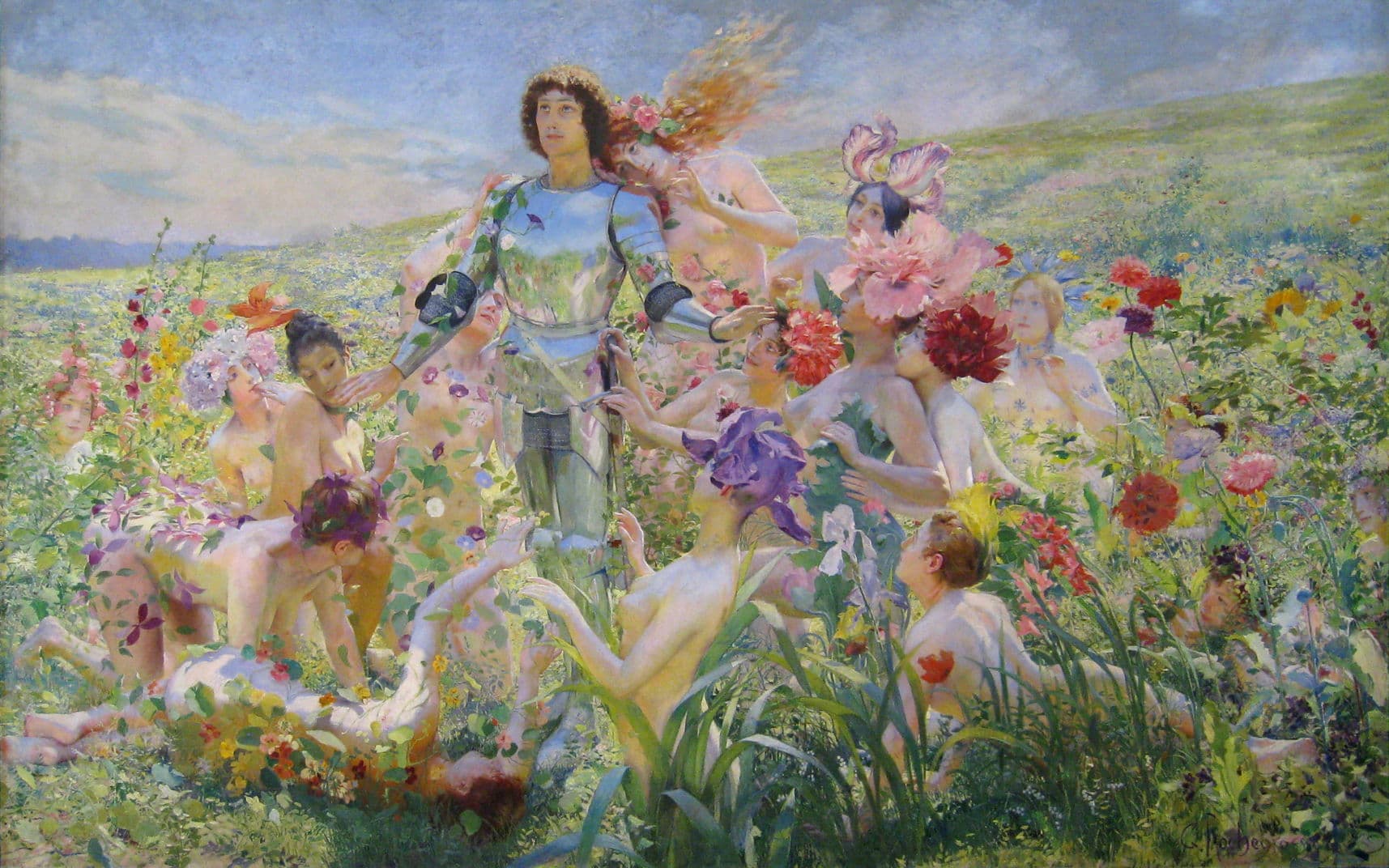
The Knight of the Flowers
Georges Rochegrosse · 1894
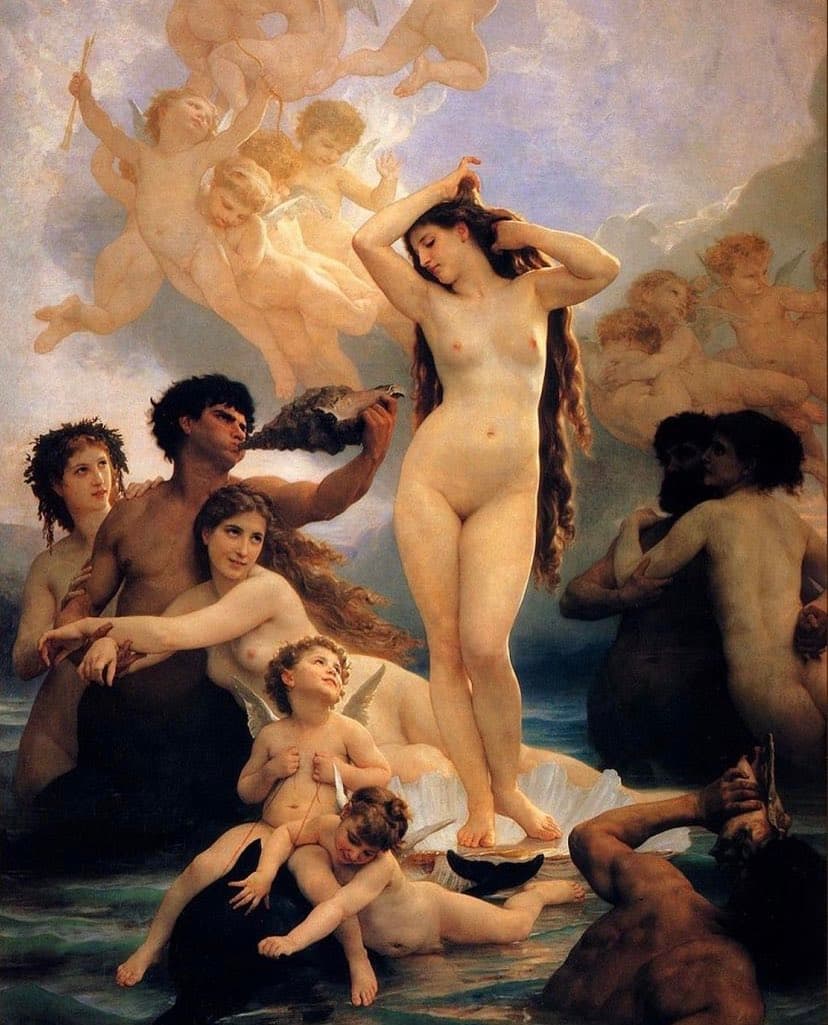
The Birth of Venus
William-Adolphe Bouguereau · 1879
Allegory of Summer
František Bohumil Doubek · c. 1905
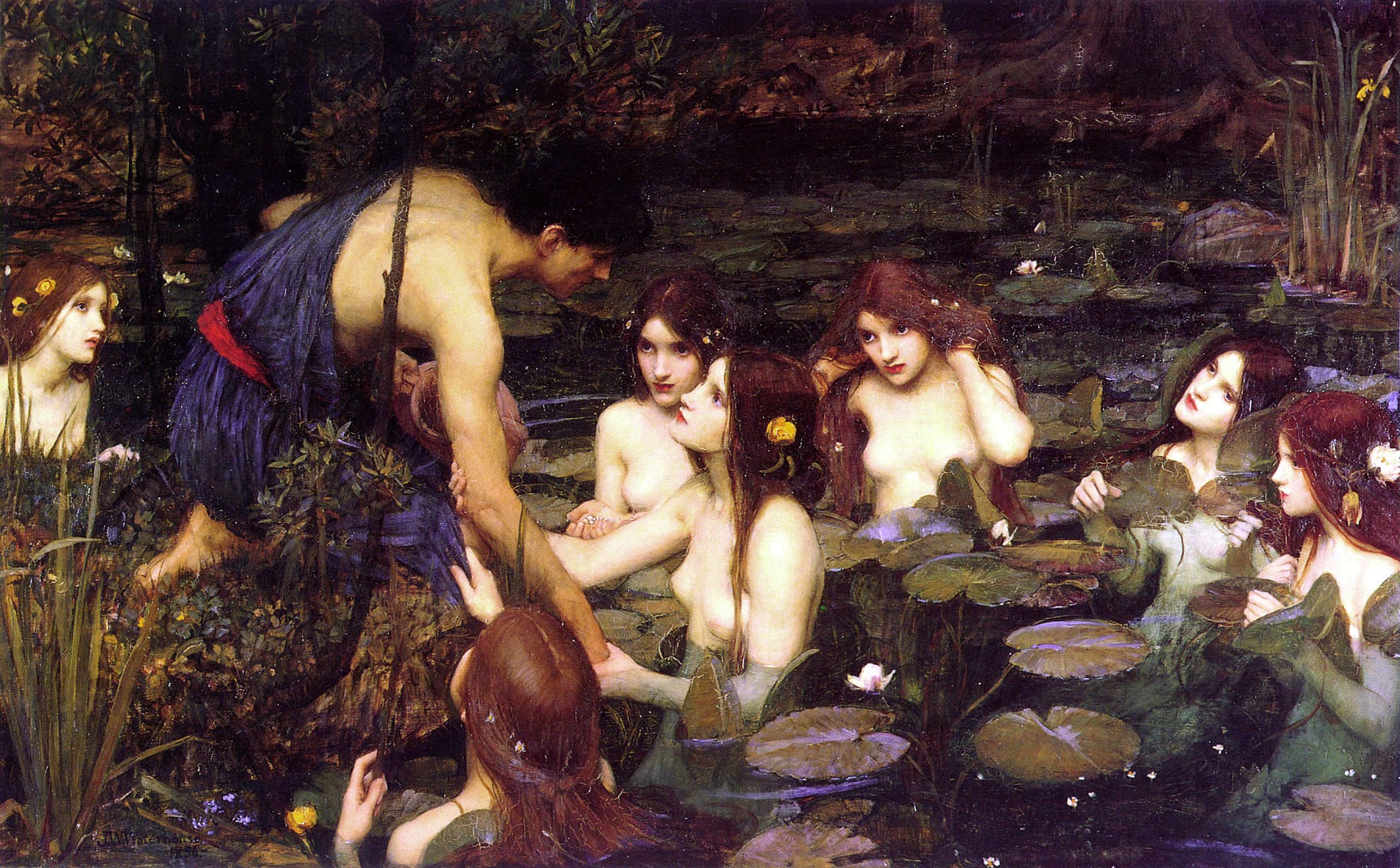
Hylas and the Nymphs
John William Waterhouse · 1896
Clyties of the Mist
Herbert James Draper · 1912

Venus de Milo
Alexandros of Antioch · c. 150–125 BC

The Scream
Edvard Munch · 1893

The Thinker
Auguste Rodin · Modeled 1880–82; enlarged 1902–03; this cast 1904