Image: Photo: Wikimedia Commons contributor (CC0); Musée Rodin, Paris · CC0 · via Wikimedia Commons
Modern sculpture
The Thinker
Auguste Rodin, Modeled 1880–82; enlarged 1902–03; this cast 1904
The Thinker (Le Penseur) is Auguste Rodin's bronze of a nude man seated on a rock, chin on hand, lost in thought. Conceived in 1880 for The Gates of Hell, it was enlarged in 1902–03; the first monumental cast stands in the garden of the Musée Rodin, Paris.
- Artist
- Auguste Rodin
- Date
- Modeled 1880–82; enlarged 1902–03; this cast 1904
- Medium
- Bronze
- Dimensions
- c. 180 cm high (monumental version); original model c. 72 cm
- Collection
- Musée Rodin, Paris, France
- Movement
- Modern sculpture
What you are looking at
A naked man sits on a rough block of rock, bent forward, his chin resting on the back of his right hand. His body is heavy and powerful: broad back, thick neck, huge hands and feet. Everything about him is compressed and inward.
His shoulders hunch, his toes grip the edge of the rock, his brow is lowered and his eyes are shadowed. He is not dreaming or resting. He is working, and the effort runs through every muscle.
Look closely at the pose and something odd appears. His right elbow rests not on his right knee but on his left thigh, so that the whole upper body twists across itself. Try it, and it is surprisingly uncomfortable. Rodin chose the awkward pose on purpose: it locks the figure into a tight spiral and makes thinking look like physical strain.
The surface of the bronze is not smooth. Rodin left the marks of his modeling, the dents and ridges of clay pressed by his fingers, so that light breaks across the body in flickers. In the garden of the Musée Rodin, where this cast sits on a tall stone pedestal, the green patina against the sky makes him look like part of the landscape.
The detail most visitors overlook is the inscription on the pedestal. It records that this Thinker was offered to the people of Paris by public subscription in 1906.
How Rodin made it
In 1880 Auguste Rodin (1840–1917) received a state commission for a monumental bronze doorway for a planned museum of decorative arts in Paris. He took his subject from Dante's Inferno and called it The Gates of Hell. Above the doors, looking down at the damned souls writhing below, he placed a seated figure, about 70 centimeters high, which he called The Poet. It was meant to be Dante, contemplating his great poem.
As Rodin worked, the figure became less a portrait of Dante and more a universal image, nude like a hero of Michelangelo, whose Sistine Chapel ceiling and sculptures Rodin had studied in Italy. Founders and critics began calling it The Thinker, and the name stuck. In 1902–03 Rodin had it enlarged to monumental size, roughly 1.8 meters high, and the first large bronze was cast in 1904.
Because the sculpture was modeled and then cast, there is no single "original" in the sense of a carved marble. Rodin and, after his death, the Musée Rodin authorized numerous bronze casts in several sizes. More than twenty monumental casts exist around the world, along with many smaller ones.
What does The Thinker mean?
In its original setting, the figure is Dante, or the poet in general, contemplating Hell: human suffering, sin and judgment. Separated from the Gates, it became something larger, an image of the human mind at work, thinking as a struggle that involves the whole body. Rodin himself described the figure as thinking not only with his brain but with every muscle.
In 1906 the large bronze was placed in front of the Panthéon in Paris, the national shrine to France's great men. That setting turned it into a public monument to thought, to the working man, even to the republic. Since then it has become the universal shorthand for philosophy, intelligence and deep thinking, reproduced in cartoons, advertising and textbooks so often that it is easy to stop looking at it as a sculpture.
Reception and legacy
The Thinker made Rodin, already famous, into a household name. In 1922 the Panthéon cast was moved to the garden of the Musée Rodin, in the Hôtel Biron, where it remains. Another monumental cast marks Rodin's own grave at Meudon, outside Paris, as he wished. One cast in front of the Cleveland Museum of Art was damaged by a bomb in 1970 and has been deliberately left unrepaired.
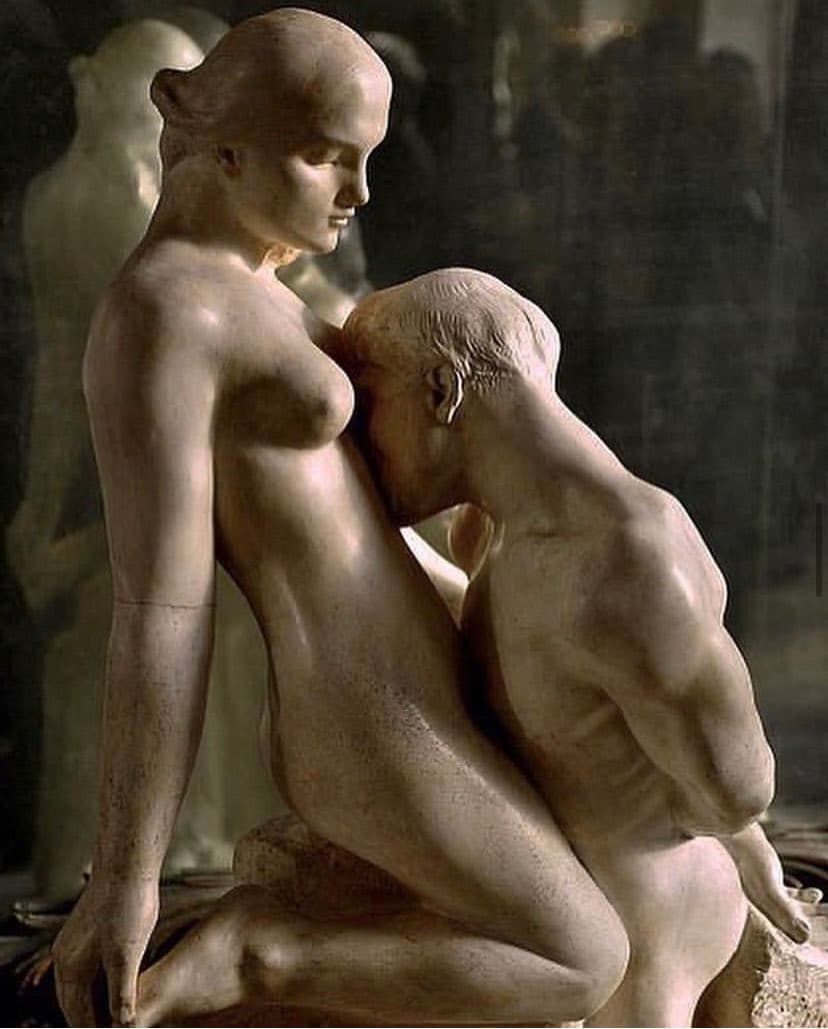
With its heroic nude body and focus on inner life, The Thinker sits at the hinge between classical sculpture, like the Laocoön, and modern art. It is among the most recognized works in our famous sculptures collection, and a fitting emblem of dark academia and its love of the solitary, brooding scholar. For another side of Rodin, see The Eternal Idol.
In the museum garden, the Thinker is usually the first stop for visitors. It is worth walking on to The Gates of Hell, cast after Rodin's death and also in the garden, where the small original figure sits above the doors, looking down into the crowd of Dante's damned. Seeing the two together shows how far the figure traveled from its first role.
Where is The Thinker today?
The first monumental cast, shown here, sits in the garden of the Musée Rodin in Paris. Smaller and later casts are in many museums worldwide, including the Musée Rodin's own galleries, the Cleveland Museum of Art, the Rodin Museum in Philadelphia, Stanford University and the Ny Carlsberg Glyptotek in Copenhagen. On The Gates of Hell itself, the figure can be seen in its original position above the doors.
Questions & answers
Where is The Thinker statue?
The first monumental bronze of The Thinker sits in the garden of the Musée Rodin in Paris, where it was moved from the Panthéon in 1922. More than twenty other monumental casts stand around the world, including in Philadelphia, Cleveland, Copenhagen and on Rodin's tomb at Meudon.
What does The Thinker represent?
Rodin first designed the figure as Dante contemplating Hell, at the top of his doorway The Gates of Hell. Enlarged and shown on its own, it came to represent human thought in general: an intellectual struggle that engages the whole body, not just the mind.
Who made The Thinker and when?
French sculptor Auguste Rodin modeled the figure in 1880–82 for The Gates of Hell, then had it enlarged to monumental size in 1902–03. The first large bronze was cast in 1904 and placed in front of the Panthéon in Paris in 1906.
How many Thinker statues are there?
Because it is a cast bronze, many authorized versions exist. There are more than twenty full-size monumental casts worldwide, plus many smaller casts in various sizes, some made after Rodin's death under the Musée Rodin's control.
Why is The Thinker's pose unusual?
His right elbow rests on his left thigh, not his right, so the torso twists across itself. The pose is awkward to hold, and Rodin used it to make thinking look like intense physical effort.
More by the artist
Auguste Rodin
Kindred works
You may also study
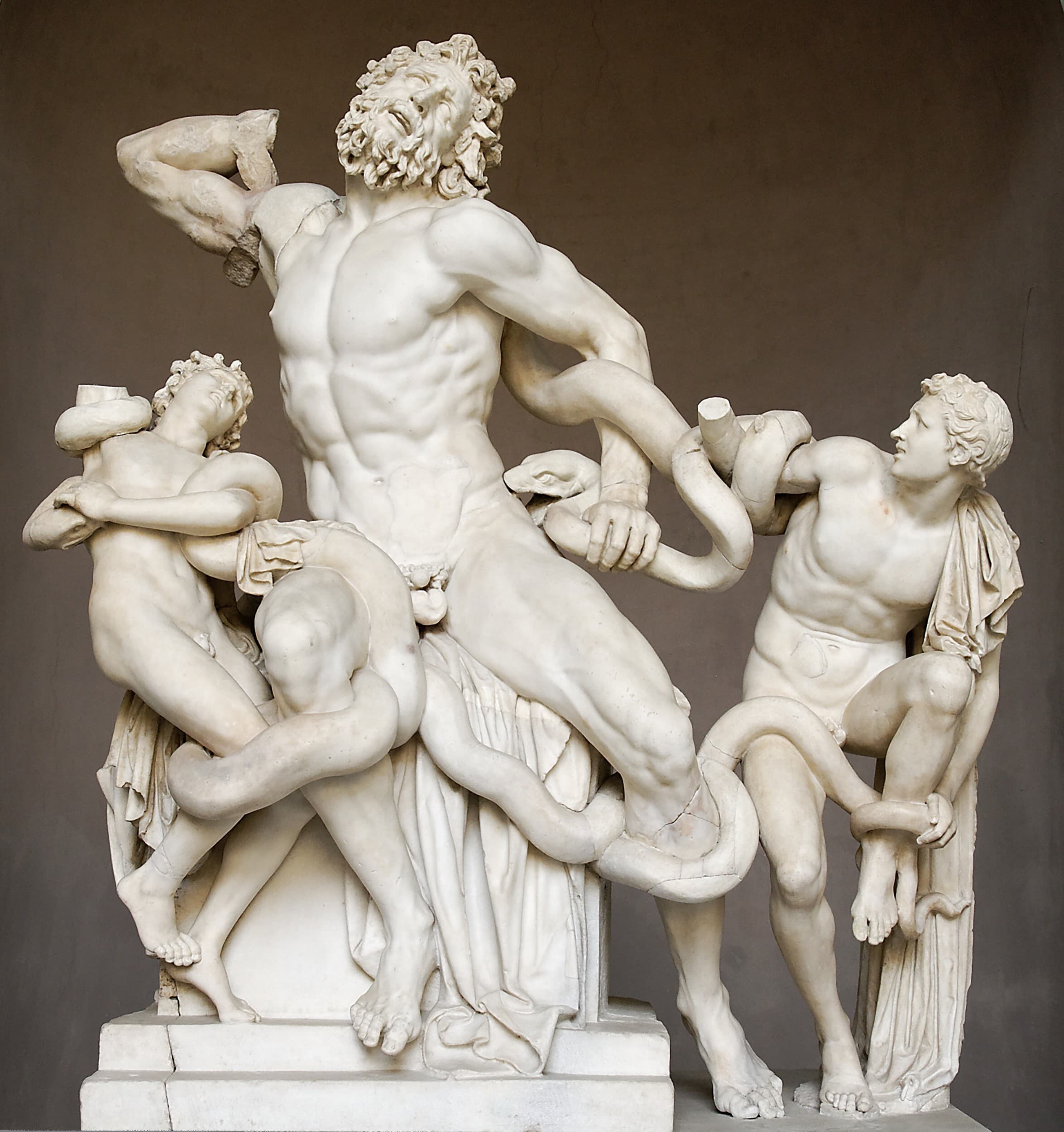
Laocoön and His Sons
Agesander of Rhodes & Athenodoros of Rhodes & Polydorus of Rhodes · c. 200 BC – AD 70 (date debated); excavated 1506

Venus de Milo
Alexandros of Antioch · c. 150–125 BC
Statue of David
Michelangelo · 1501–04
The School of Athens
Raphael · 1509–1511

Bridge over a Pond of Water Lilies
Claude Monet · 1899

Nymphs Dancing to Pan's Flute
Joseph Tomanek

The Scream
Edvard Munch · 1893

Saturn Devouring His Son
Francisco Goya · c. 1819–1823