Contemporary figurative (neo-Baroque)
The Angel, the Death, and the Devil
Roberto Ferri, 2018
The Angel, the Death, and the Devil (L'Angelo, la Morte e il Diavolo) is a 2018 painting by the Italian artist Roberto Ferri. A hooded, black-winged Death presides over a dead angel, a thorn-girdled woman and a brooding man on a bank of cloud.
- Artist
- Roberto Ferri
- Date
- 2018
- Medium
- Oil on canvas
- Movement
- Contemporary figurative (neo-Baroque)
The Angel, the Death, and the Devil (L'Angelo, la Morte e il Diavolo) is a 2018 painting by Roberto Ferri, the Rome-based painter born in Taranto in 1978 whose work revives the dramatic lighting and idealized anatomy of the Baroque. It is catalogued under that Italian title. It is understood to be in a private collection, and its dimensions have not been published.
What you're looking at
The scene takes place on a bank of white cloud under a heavy gray sky, a stage with no earth beneath it. At the top right stands Death, a tall figure entirely wrapped in a black hooded robe, with immense dark wings spread behind. No face is visible inside the hood. One pale, bony hand grips a long staff planted in the cloud, a pole without the familiar scythe blade.
Leaning against Death's shoulder is a nude young woman with auburn curls, turned in close as if whispering into the hood. A strand of thorny briar is bound around her hips, and a thin line of blood runs down her thigh where it cuts. At her feet lies a second winged figure, a woman sprawled on her back across her own pale wings, head thrown back and eyes closed: the angel of the title, apparently dead, with a small pool of red on the cloud beside her.
On the right, slumped on the cloud, sits a muscular, shaven-headed man, gazing down. Look at the crown of his head: a small bleeding wound sits exactly where horns would grow. Whether he is the devil stripped of his horns or a mortal man marked by sin, Ferri leaves open. His heavy, earthbound body is the opposite of the angel's limp grace.
Technique
Ferri works in the tradition he openly cites, that of Caravaggio and the seventeenth-century naturalists, combined with the finish of nineteenth-century academic painting. Flesh is modeled in smooth, carefully blended transitions; the light falls from the upper left, raking across the figures and leaving the black robe of Death almost without detail. The palette is restricted to flesh tones, blacks and cool grays, with red used sparingly, for the blood, so that each drop draws the eye.
Meaning
The title echoes Albrecht Dürer's famous engraving Knight, Death and the Devil (1513), in which a Christian knight rides steadily past both figures. Ferri inverts the idea. Here there is no armored hero; the angel has fallen, Death is in command, and the human figures seem to be negotiating with it rather than resisting.
The painting can be read as an allegory of the soul between salvation and damnation, with the dead angel standing for lost innocence. Ferri has not published an interpretation, and the woman with the thorns in particular resists a single reading: she recalls the crown of thorns and the penitent saints, yet she leans on Death like a lover. That ambiguity, the sacred and the sensual sharing one body, runs through much of his work, including his religious commissions such as the Stations of the Cross for Noto Cathedral.
For related imagery, see Ferri's contemporaries and predecessors in Angels & Demons in Art and Fallen Angels in Art, and compare Alexandre Cabanel's Fallen Angel and Spleen et Idéal.
Questions & answers
Who painted The Angel, the Death, and the Devil?
It is by Roberto Ferri, an Italian painter born in Taranto in 1978 and based in Rome. Ferri trained at the Academy of Fine Arts in Rome and is known for nude, theatrically lit figures inspired by Caravaggio and nineteenth-century academic painting. The work dates from 2018.
Where is The Angel, the Death, and the Devil?
It is understood to be in a private collection; it is not listed by any public museum. Ferri's paintings are mostly sold to private collectors. Its dimensions have not been published, so the image you see online is the main way to know it.
What does The Angel, the Death, and the Devil mean?
Its title echoes Dürer's engraving Knight, Death and the Devil, but here a hooded Death presides over a fallen, apparently dead angel, a woman bound with thorns and a man with a wound where horns would be. It reads as an allegory of innocence lost and the soul caught between sin and salvation; Ferri has not published his own interpretation.
Kindred works
You may also study
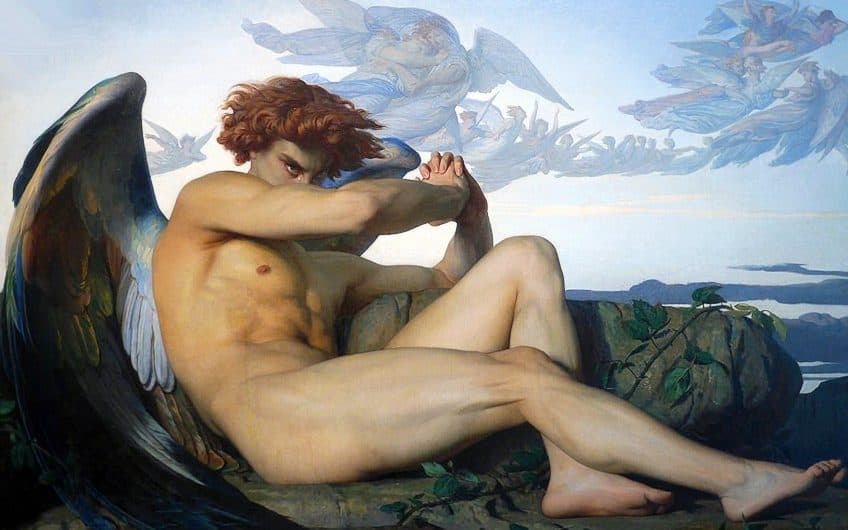
Fallen Angel
Alexandre Cabanel · 1847
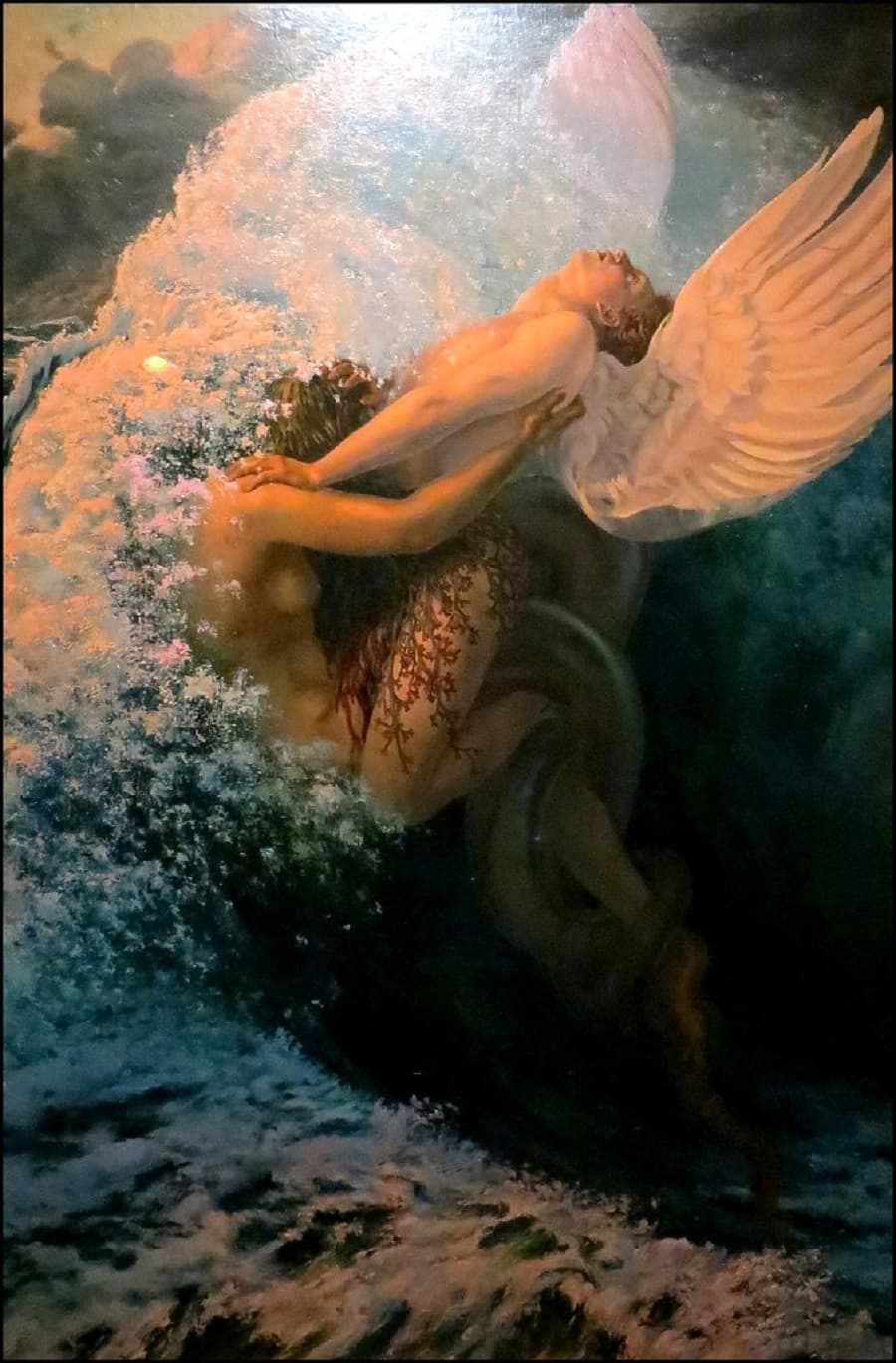
Spleen et Idéal
Carlos Schwabe · 1907
Requiem
Ignacio Trelis
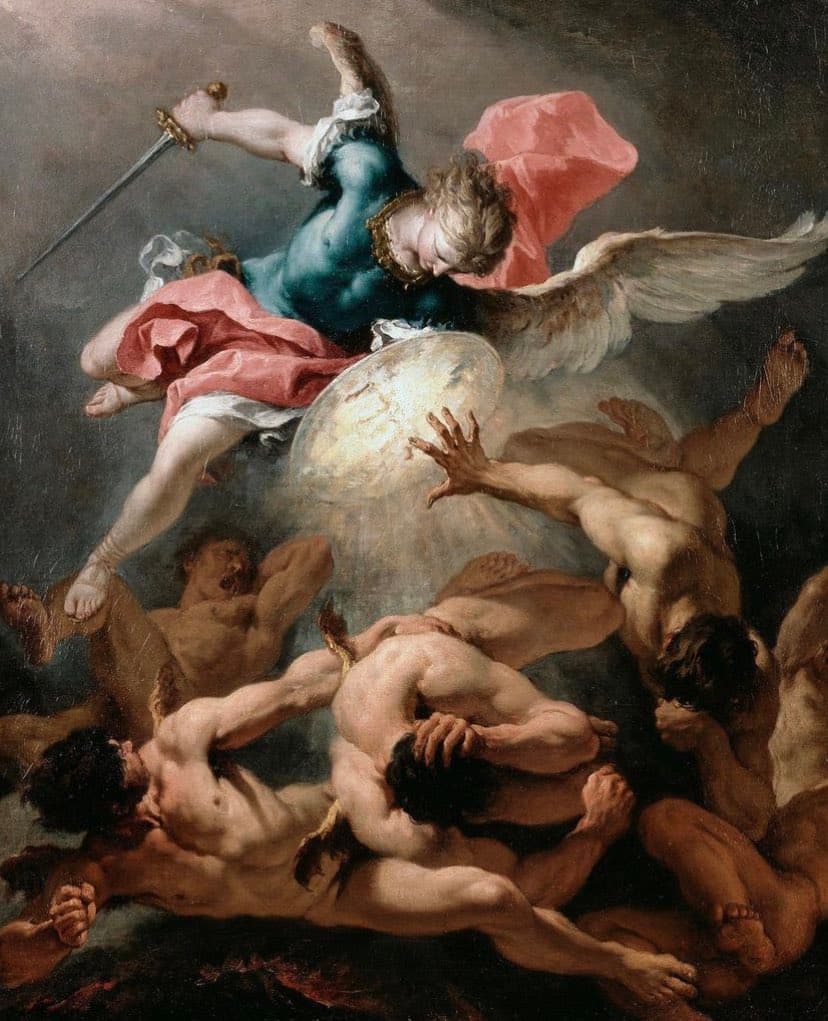
The Fall of the Rebel Angels
Sebastiano Ricci · c. 1720
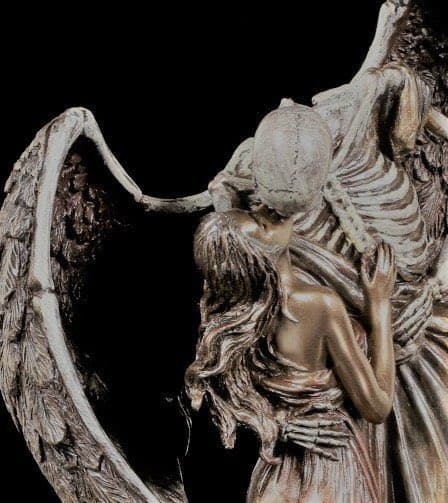
The Kiss of Death
Veronese Design · c. 2020

Venus de Milo
Alexandros of Antioch · c. 150–125 BC

Nymphs Dancing to Pan's Flute
Joseph Tomanek

The Scream
Edvard Munch · 1893