German (Bavarian) · Baroque · Rococo
Adalbart Eder
b. active 18th century, Waldsassen, Bavaria
Adalbart (Adalbert) Eder was an 18th-century Cistercian lay brother at Waldsassen Abbey in Bavaria, credited with dressing the basilica's jeweled catacomb saints, including the skeleton of Saint Gratian.
1 work in the collection
Works by Adalbart Eder
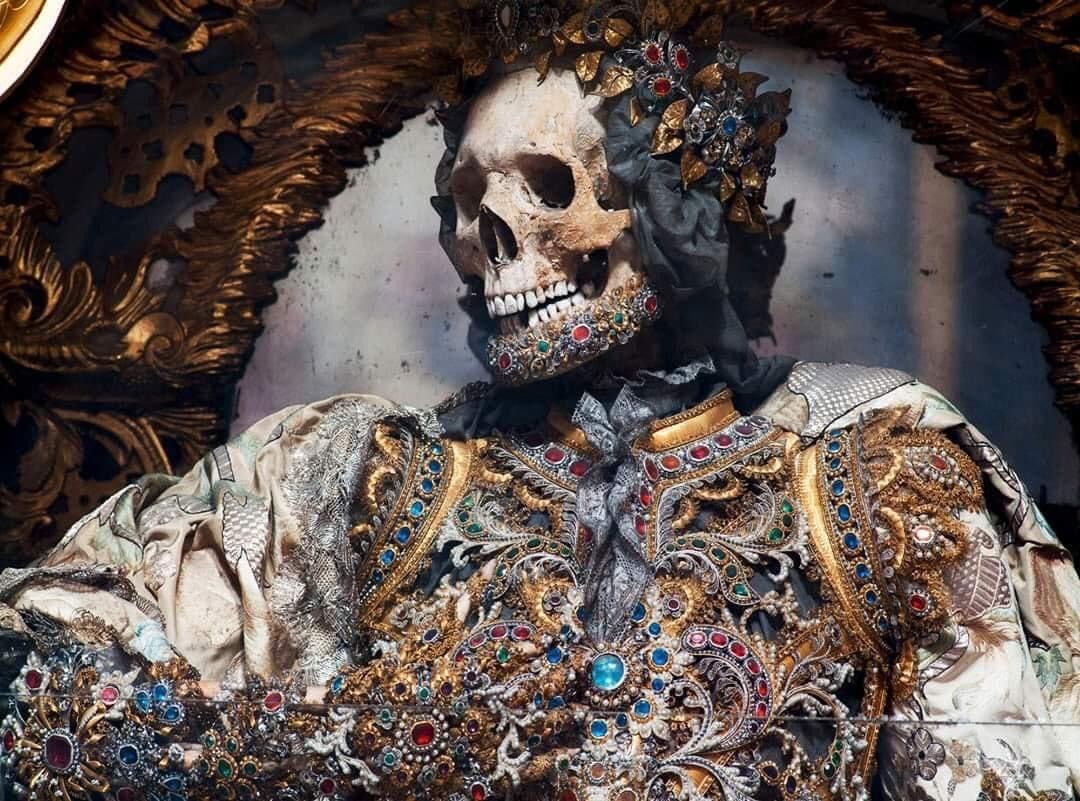
Adalbart Eder, whose name also appears as Adalbert, was a lay brother of the Cistercian abbey of Waldsassen in the Upper Palatinate, Bavaria. He is credited with decorating the abbey's “holy bodies” (Heilige Leiber): skeletons brought from the catacombs of Rome, dressed in jewels, gold thread and finery and displayed in glass shrines along the nave of what is now Waldsassen Basilica. One of them is the Bejeweled Skeleton of Saint Gratian.
What is known
Almost nothing of Eder's life is documented in accessible sources: no birth or death dates, and no portrait. Local accounts describe him as a lay brother trained in goldsmith's work, and the basilica dates the decoration of its relics to between about 1707 and 1765. Waldsassen holds twelve decorated catacomb relics, ten of them full skeletons, often described as the largest such group anywhere. Whether Eder dressed every one himself over that long span, or led the work with helpers, is not clear.
The work
Decorating a holy body was slow, devotional labor. The bones were cleaned and wired into a reclining or seated pose; padding and fabric were fitted; then came layers of ornament: metallic lace, filigree, sequins, colored glass and real or imitation stones. Eder gave each skeleton a costume suited to its supposed rank, from the armor-like breastplate of a soldier-martyr to courtly robes, with crowns, wreaths and jeweled masks around the skull. The effect, a bare skull framed by princely splendor, was meant to show the glory of the saint in heaven, not to frighten.
Rediscovery
These figures reached a worldwide audience through the photographs of Paul Koudounaris, published in Heavenly Bodies (2013). The relics are still honored at Waldsassen with an annual feast of the holy bodies on the first Sunday of August.
Where to see his work
Waldsassen Basilica, Bavaria, near the Czech border. See also The Catacomb Saints and Memento Mori and Vanitas.
Questions & answers
Who decorated the Waldsassen catacomb saints?
The jeweled skeletons of Waldsassen Basilica are credited to Adalbart (Adalbert) Eder, an 18th-century lay brother of the Cistercian abbey. The basilica dates the decoration to between about 1707 and 1765, which suggests he may have worked with helpers.
How many jeweled skeletons are in Waldsassen Basilica?
Waldsassen Basilica holds twelve richly decorated catacomb relics, ten of them whole skeletons displayed in glass shrines in the nave. It is often described as the largest collection of its kind. They came from the catacombs of Rome.
Are the catacomb saints real saints?
Their identities are uncertain. The skeletons came from Roman catacombs rediscovered in 1578 and were assumed to be early Christian martyrs. Names such as Gratian were usually assigned by church officials, so there is no proof that any body is the historical saint whose name it bears.