Symbolism
Vampire (Love and Pain)
Edvard Munch, 1895
Vampire, originally titled Love and Pain, is a painting by Edvard Munch of a red-haired woman bending over a man and pressing her mouth to his neck. This 1895 version, one of six painted in 1893–95, is in the Munch Museum, Oslo.
- Artist
- Edvard Munch
- Date
- 1895
- Medium
- Oil on canvas
- Dimensions
- 91 × 109 cm
- Collection
- Munch Museum, Oslo, Norway
- Movement
- Symbolism
What you are looking at
A man kneels with his head buried in a woman's lap and chest. We cannot see his face, only the dark crown of his head and his arm wrapped around her. She bends over him, her pale arms around his shoulders, her face pressed into the back of his neck. Her long red hair pours over both of them like a net, in streams that run down his back and arm.
The setting is a nearly abstract field of deep blue and violet. Behind the couple, a dark curved shape, perhaps their joined shadow, rises like a hood. Only the woman's skin and the red of her hair stand out against the gloom.
Love and Pain, or Vampire?
Munch first exhibited the composition in Berlin in 1893 under the title Love and Pain (Kjærlighet og smerte), as part of the cycle of paintings on love and death that he later called the Frieze of Life. The name Vampire came from his friend, the Polish writer Stanisław Przybyszewski, who described a man who has become submissive, with a biting vampire's face at his neck. The title stuck. Munch himself said the picture showed nothing more than a woman kissing a man on the neck.
Both readings are present in the image. The embrace is tender: she holds him, and he rests in her arms. But the red hair falling over him looks like blood, and his slumped posture and hidden face suggest a man drained rather than comforted. The ambiguity, love that wounds, fits the rest of the Frieze of Life, where desire is bound up with jealousy, anxiety and death.
Versions
Munch painted the subject six times between 1893 and 1895 and returned to it in woodcuts and lithographs (Vampire II, 1895) and in later paintings of 1916–18. Three of the 1890s canvases are in the Munch Museum, one is in the Gothenburg Museum of Art, and an 1894 version sold at Sotheby's in 2008 for a record price for the artist. This 1895 canvas in the Munch Museum (MM.M.00679) is the one most often reproduced.
Close looking
The paint is thin and scrubbed in many places, so the canvas texture shows through the blue. Look at the hair: it is laid in with long, flowing strokes of orange-red and vermilion, which continue down his arm and over the dark of his jacket, so it seems to bind him. Her arms are painted in warm, chalky flesh tones; his hand, by contrast, is greenish and gray. That difference in color is what led some viewers to see him as drained of life.
Where to see it
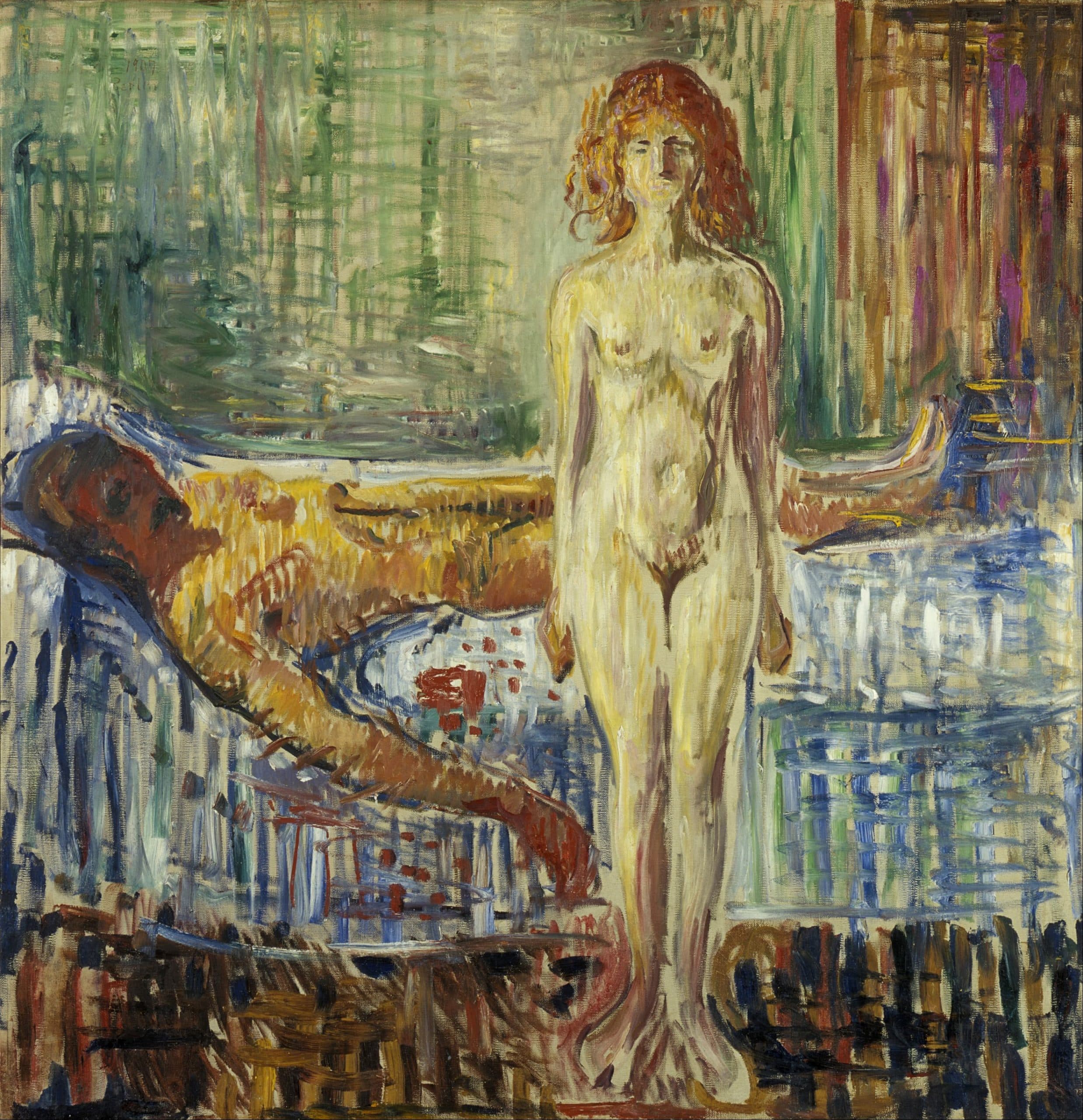
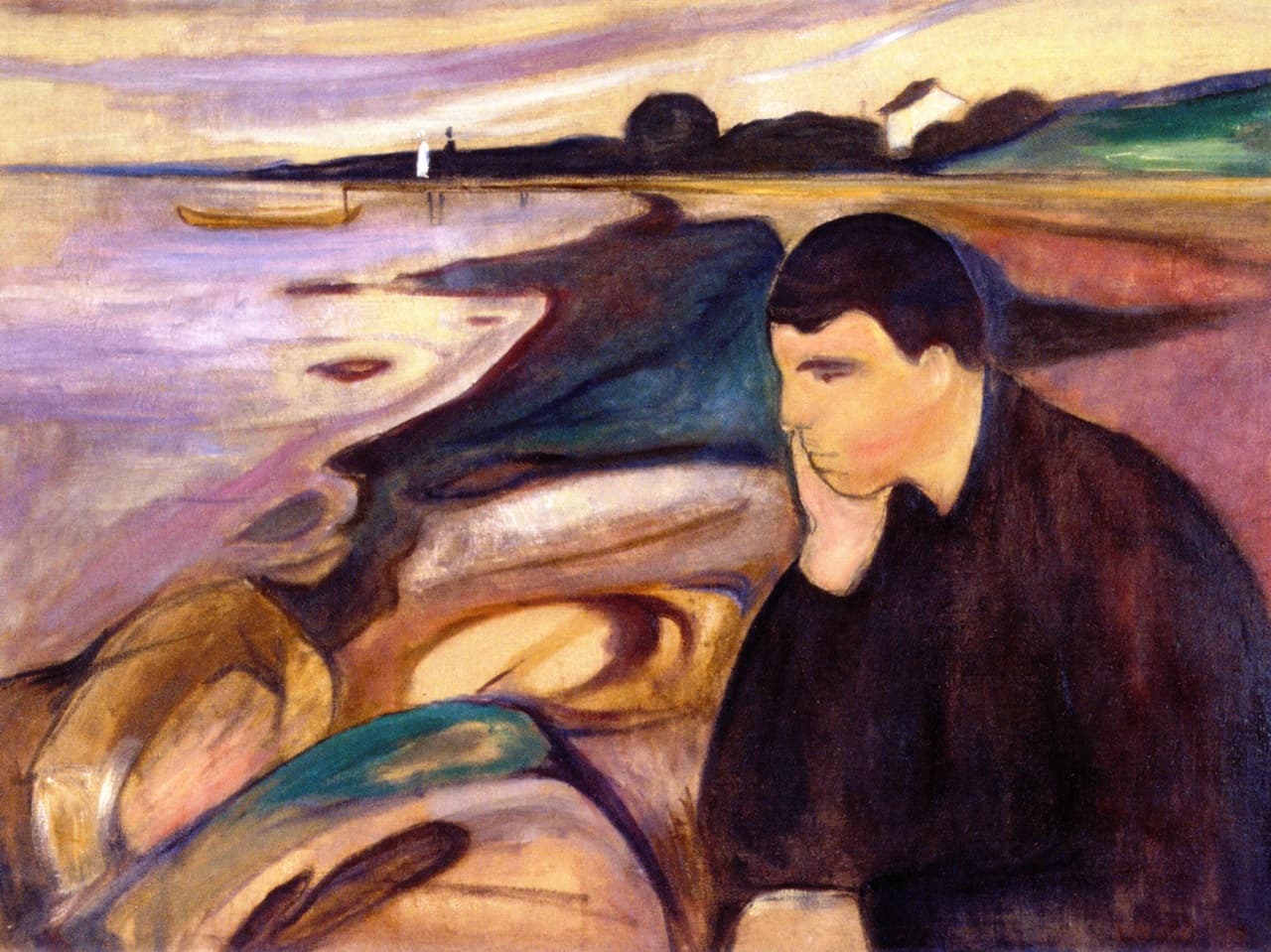
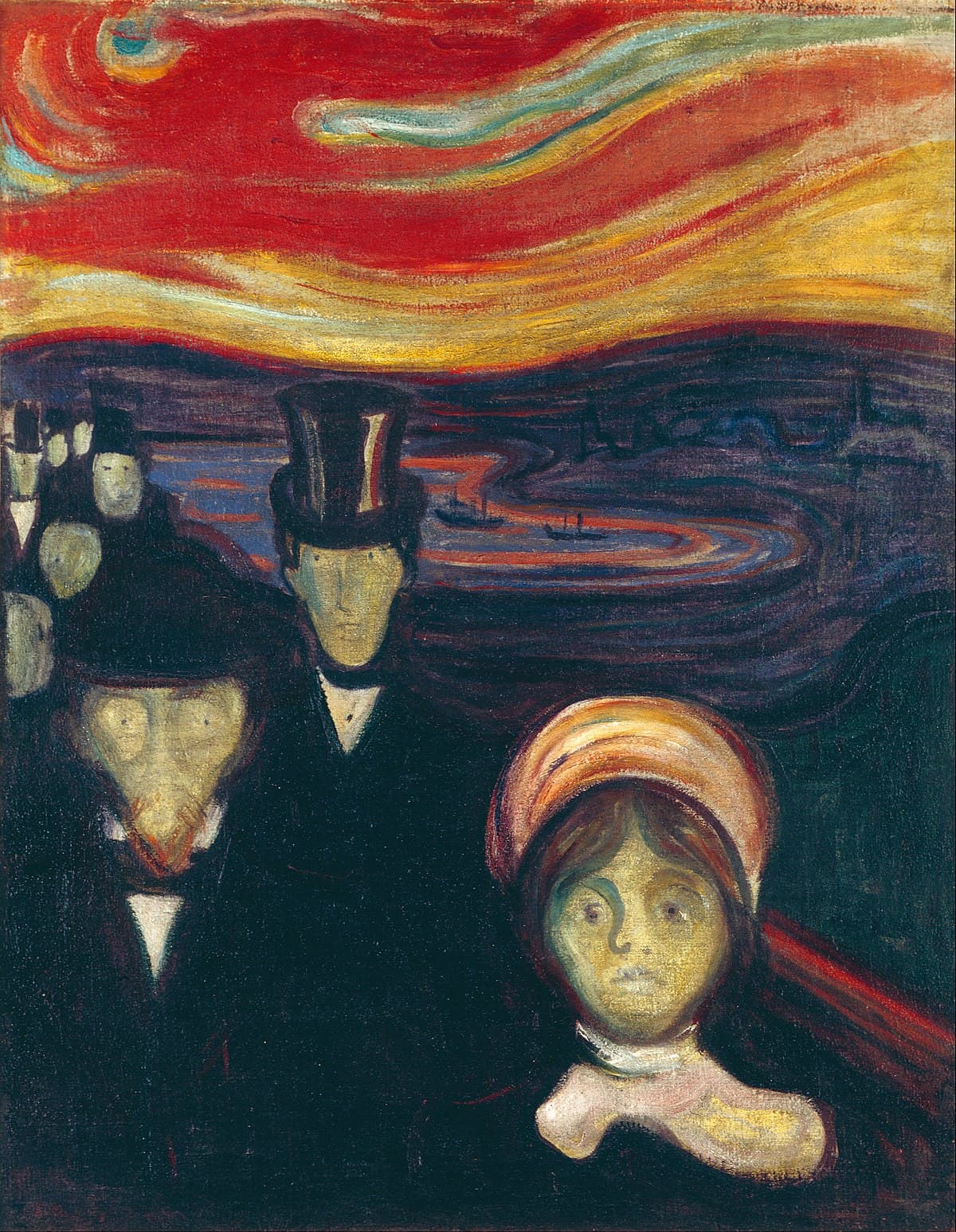
The Munch Museum in Oslo shows its versions in rotation. Compare Munch's other images of desire and despair, Melancholy, Anxiety and The Death of Marat, and see Symbolism and Dark Academia.
Questions & answers
Where is Munch's Vampire?
Munch painted six versions between 1893 and 1895. This 1895 canvas, about 91 by 109 centimeters, is in the Munch Museum in Oslo, which owns three of them. Another is in the Gothenburg Museum of Art in Sweden, and an 1894 version is privately owned.
What is the meaning of Munch's Vampire?
Munch called it Love and Pain and said it showed a woman kissing a man's neck. The writer Stanisław Przybyszewski renamed it Vampire, reading the woman as draining the man. The picture holds both meanings: comfort and danger in the same embrace.
Why is the painting called Vampire?
The title came from Munch's friend, the Polish writer Stanisław Przybyszewski, who described the figure as a vampire biting a submissive man's neck. Munch's own title was Love and Pain, but the more dramatic name became the one used by most viewers.
More by the artist
Edvard Munch

Kindred works
You may also study

Venus de Milo
Alexandros of Antioch · c. 150–125 BC

Nymphs Dancing to Pan's Flute
Joseph Tomanek

Saturn Devouring His Son
Francisco Goya · c. 1819–1823
Lucifer
Franz von Stuck · 1890
The Birth of Venus
Sandro Botticelli · c. 1484–1486
Head of a Skeleton with a Burning Cigarette
Vincent van Gogh · 1886
The Garden of Earthly Delights
Hieronymus Bosch · c. 1490–1510
Spleen et Idéal
Carlos Schwabe · 1907