Norwegian · Symbolism · Expressionism
Edvard Munch
b. 12 December 1863, Ådalsbruk, Løten, Norway — d. 23 January 1944, Ekely, Oslo
Edvard Munch (1863–1944) was the Norwegian painter of The Scream, whose images of love, anxiety and death, including The Death of Marat (1907), laid the foundations of Expressionism.
7 works in the collection
Works by Edvard Munch

Edvard Munch (1863–1944) was a Norwegian painter and printmaker, best known for The Scream (1893), whose raw images of illness, desire, jealousy and death made him a founder of Expressionism. Many people find him in our catalogue through The Death of Marat (1907), his reworking of a famous murder into a picture of his own wrecked love affair.
Life in brief
Munch grew up in Kristiania (now Oslo). His mother died of tuberculosis when he was five, and his favorite sister, Sophie, died of the same disease when he was thirteen; his father was a devout, anxious army doctor. "Illness, insanity and death were the black angels that kept watch over my cradle," he later wrote. He trained at the Royal School of Art and Design in Kristiania and fell in with the city's bohemians around the anarchist writer Hans Jæger, who urged artists to write and paint their own lives.
Trips to Paris introduced him to Gauguin, Van Gogh and Toulouse-Lautrec. In 1892 an exhibition of his work in Berlin caused such outrage that it was closed after a week, which made him famous in Germany. Through the 1890s, living mainly in Berlin, he developed The Frieze of Life, a cycle of paintings about love, anxiety and death, and became a master printmaker in woodcut and lithography.
His relationship with Tulla Larsen, a wealthy Kristiania woman who wanted marriage, ended in 1902 in a quarrel during which a revolver went off and shot away part of a finger on his left hand. Drinking and exhaustion led to a breakdown in 1908 and eight months in a Copenhagen clinic. Afterward he returned to Norway, painted the murals for the University of Oslo's assembly hall (1909–16) and lived from 1916 on his estate at Ekely, outside Oslo. In 1937 the Nazis removed 82 of his works from German museums as "degenerate." He died at Ekely in 1944 and left his remaining work to the city of Oslo.
Style and technique
Munch simplified forms into flowing outlines and flat, symbolic color, and he was ruthless with his surfaces: he left canvases outdoors in rain and snow, scraped paint away and worked thinly so the weave showed through. He painted the same motif many times, in oils and prints, and many famous titles exist in several versions.
The Death of Marat
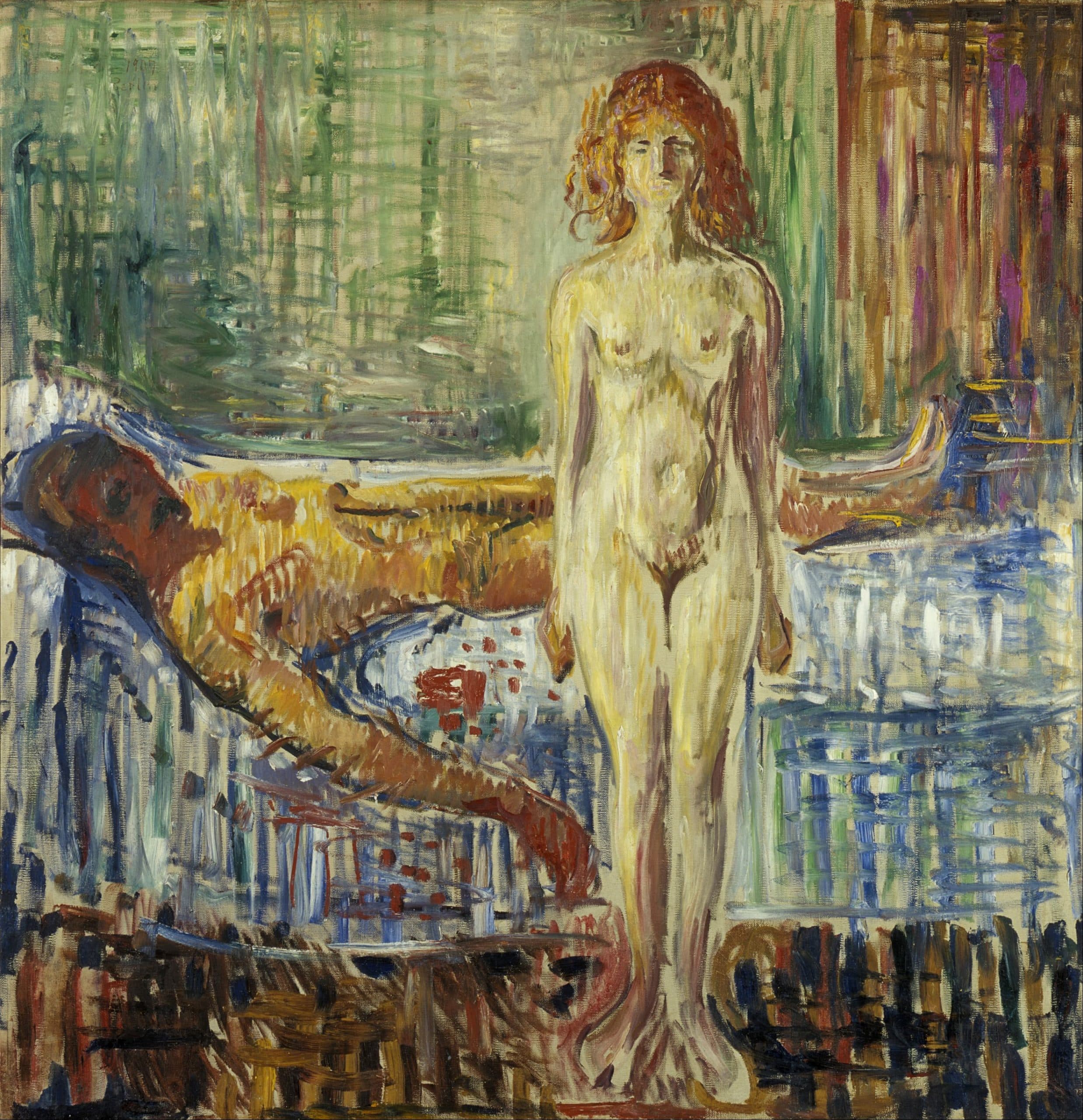
In 1793 Jean-Paul Marat, a radical journalist of the French Revolution, was stabbed in his bath by Charlotte Corday, a scene immortalized by Jacques-Louis David's The Death of Marat. In 1907, five years after the shooting, Munch borrowed the story to stage his break with Tulla Larsen. A naked woman stands rigid and expressionless facing us; behind her a bloodied man lies across a bed. There is no bath. The woman is Corday and Tulla at once, and the man is Marat and Munch.
The painting is as radical in technique as in subject. In the version known as The Death of Marat II, in the MUNCH museum in Oslo, the paint is laid in long, separate streaks, vertical and horizontal, that cross the whole canvas like rain. Munch was experimenting that year with this rough, striped handling, and it makes the room seem to vibrate around two motionless figures.
Other works in the catalogue
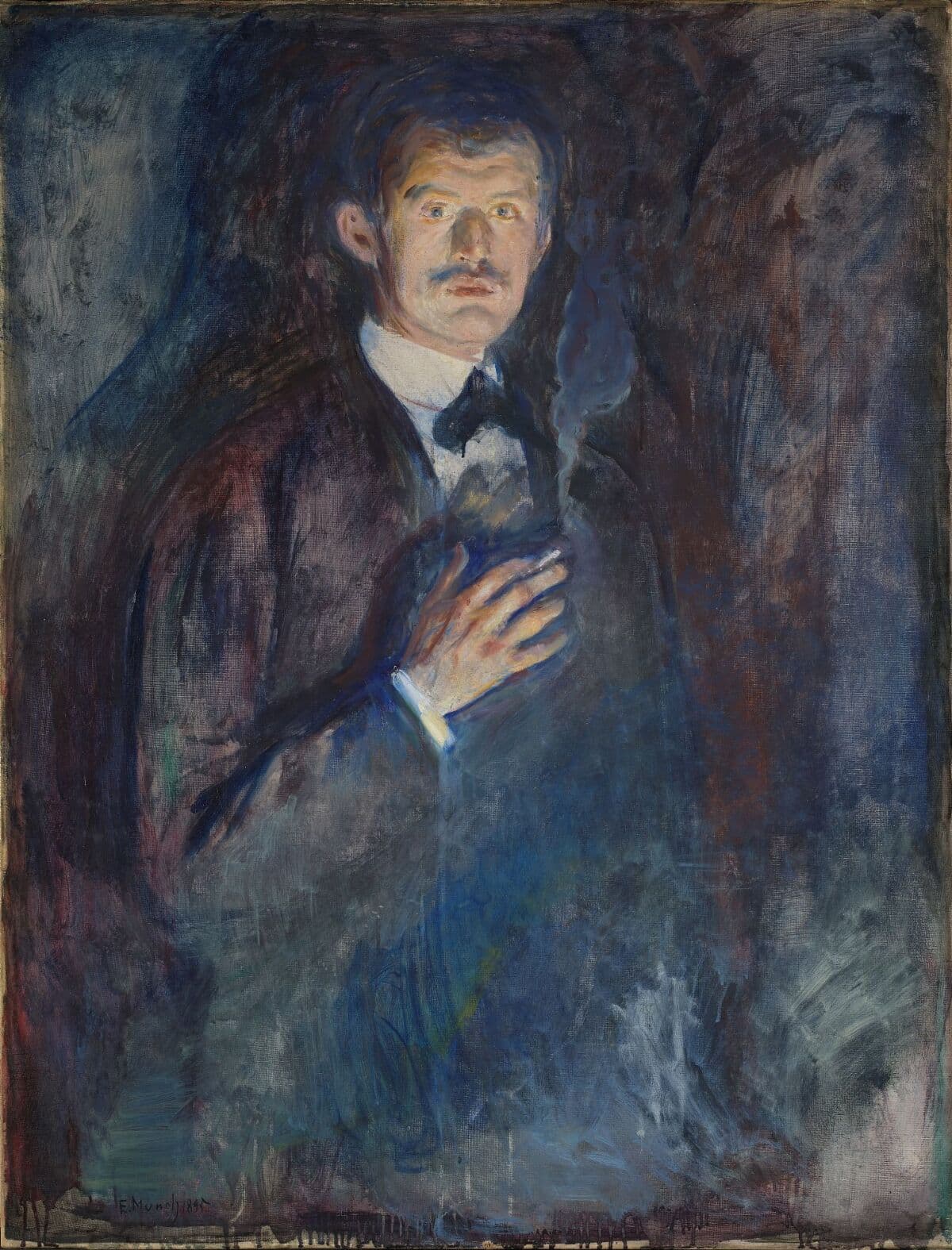
- Self-Portrait with Cigarette (1895, Nasjonalmuseet, Oslo) shows the artist emerging from a haze of blue smoke, lit from below, a cigarette held to his chest.
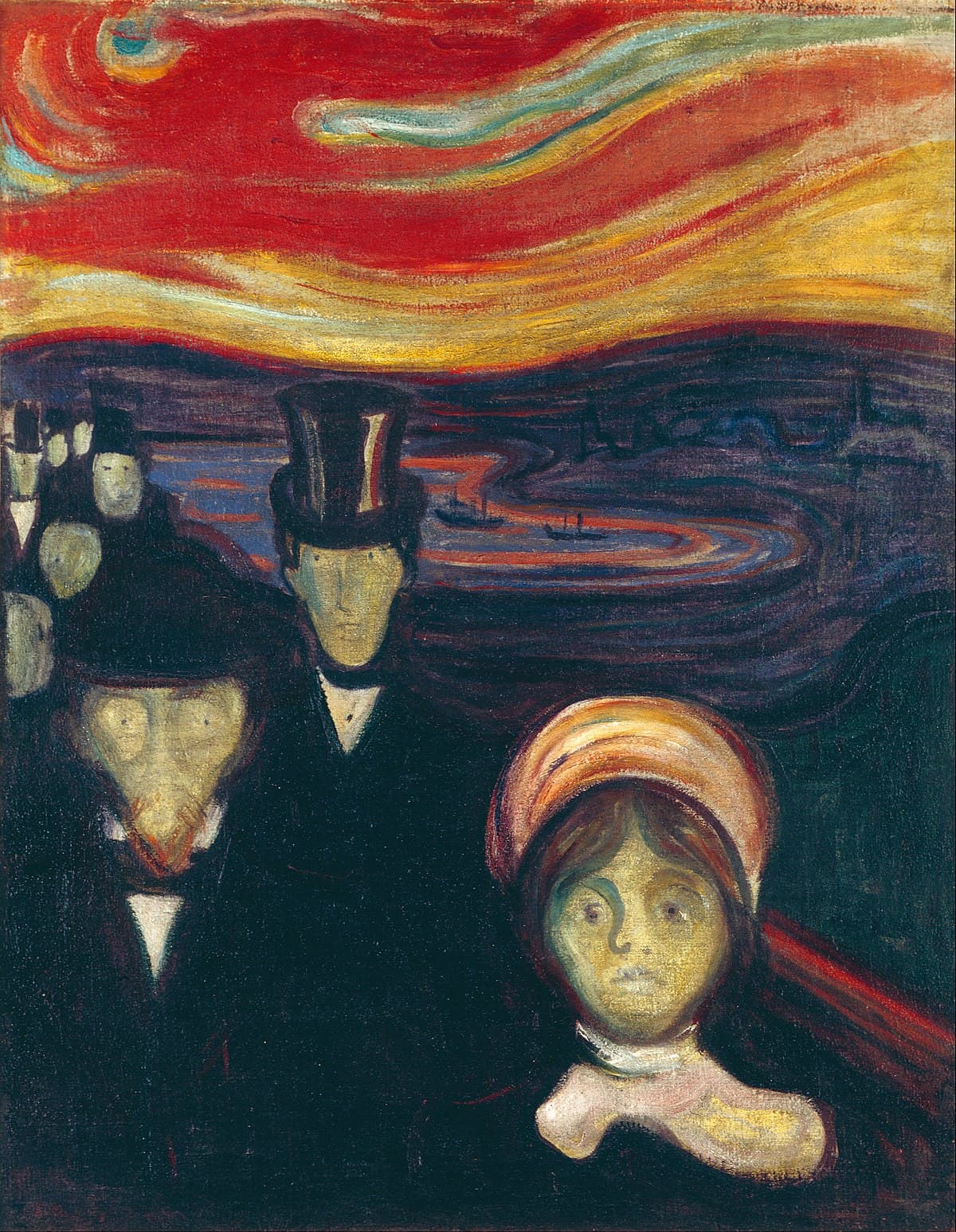
- Anxiety (1894) moves the blood-red sky and swirling fjord of The Scream behind a crowd of ashen-faced figures walking toward us.
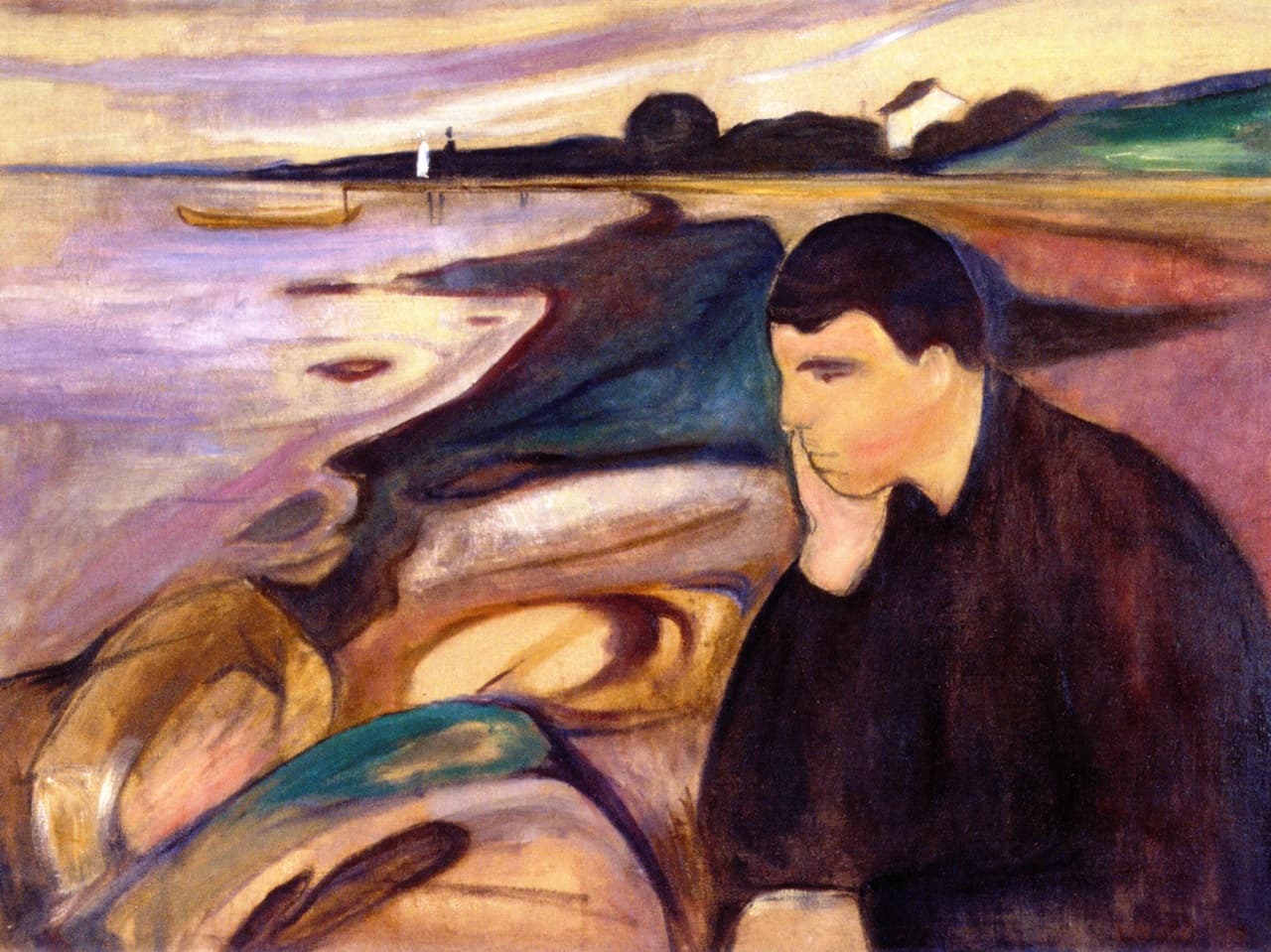
- Melancholy shows a man brooding on the shore at Åsgårdstrand, the curving coastline echoing his mood, one of the first pictures of his Symbolist style.
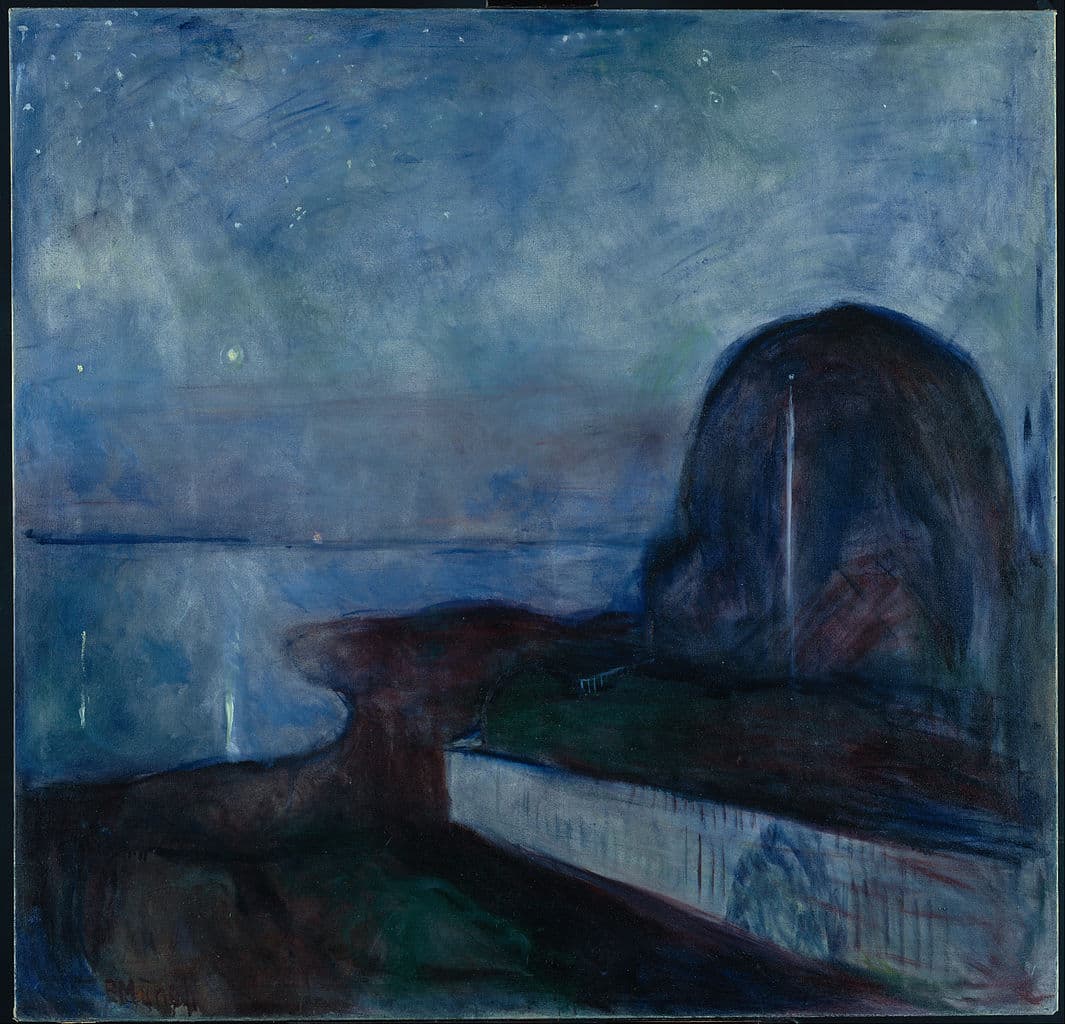
- Starry Night (1893) is a blue nocturne of the shore at Åsgårdstrand, painted without any of Van Gogh's swirling energy; it is now at the Getty Museum.
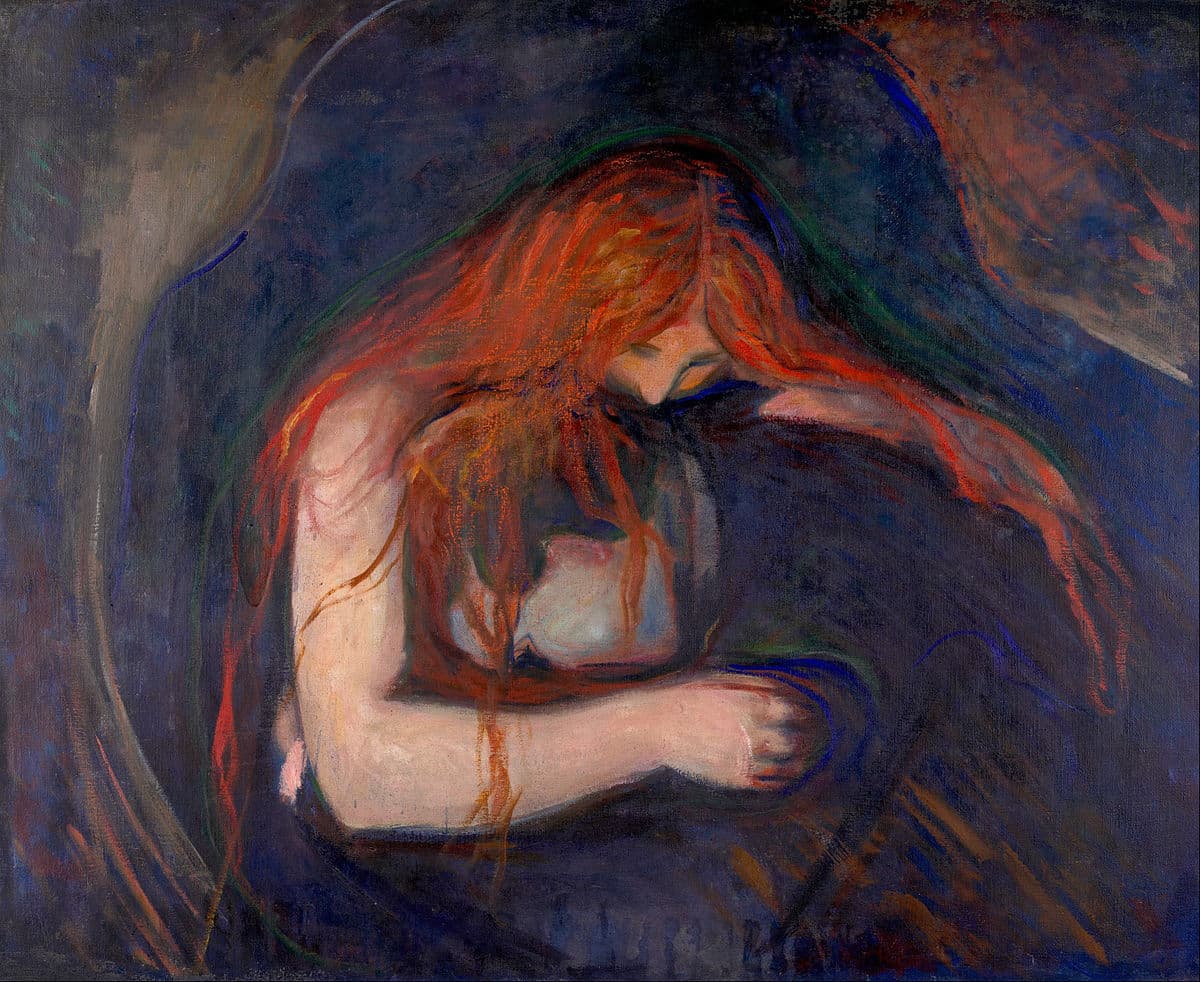
- Vampire (Love and Pain) shows a red-haired woman bent over a man's neck. Munch first titled it Love and Pain; a critic named it Vampire, and the name stuck.
Influence
Munch's mix of personal confession and simplified, expressive form fed directly into German Expressionism, especially the painters of Die Brücke in Dresden. The Scream has become one of the most reproduced images in the world. Explore related themes in Symbolism and Death in Art.
Where to see his work
The MUNCH museum in Oslo, which opened its waterfront building in 2021, holds most of his bequest. The National Museum (Nasjonalmuseet) in Oslo owns the 1893 painted Scream and other key works. Outside Norway, the Getty, the Museum of Modern Art and museums in Germany and Sweden hold important paintings and prints.
Questions & answers
What does Munch's The Death of Marat mean?
Munch used the 1793 murder of Marat by Charlotte Corday as a disguise for his own life. Painted in 1907, it restages his violent 1902 break-up with Tulla Larsen, when a revolver shot injured his hand: the woman is Corday and Tulla, the dying man is Marat and Munch.
Where is The Death of Marat by Munch?
Munch's The Death of Marat paintings of 1907 are in the MUNCH museum in Oslo, Norway, which holds the bulk of the artist's bequest to the city. The version with long striped brushstrokes is known as The Death of Marat II.
Why did Munch paint The Death of Marat in 1907?
In 1907 Munch was still brooding on the 1902 shooting that ended his relationship with Tulla Larsen. He painted several works on the theme of a man destroyed by a woman, and the famous murder of Marat gave him a historical frame for it.
How is Munch's Death of Marat different from David's?
David's 1793 painting shows Marat as a calm martyr in his bath, the murderer absent. Munch shows a naked woman standing upright in front of a bloodied man on a bed, with no bath at all, and turns political martyrdom into a private drama of love and violence.
What is Edvard Munch most famous for?
Munch is most famous for The Scream (1893), which exists in several painted, drawn and printed versions. He is also known for The Frieze of Life cycle, including Vampire, Madonna and Anxiety, and for his woodcuts and lithographs.