Symbolism
Melancholy
Edvard Munch, 1894–96
Melancholy is Edvard Munch's painting of a brooding man on the shore at Åsgårdstrand, painted in several versions in the 1890s. The version shown appears to be the 1894–96 canvas in the Rasmus Meyer Collection, KODE, Bergen.
- Artist
- Edvard Munch
- Date
- 1894–96
- Medium
- Oil on canvas
- Dimensions
- 80 × 100.5 cm
- Collection
- KODE Art Museums (Rasmus Meyer Collection), Bergen, Norway
- Movement
- Symbolism
Melancholy is one of the key images of Edvard Munch's Frieze of Life, his cycle of paintings about love, anxiety and death. Munch painted the motif several times between 1891 and the mid-1890s, and made woodcut versions later. The canvas shown here appears to be the version painted in 1894–96, about 80 by 100.5 centimeters, in the Rasmus Meyer Collection of KODE Art Museums in Bergen, which the collector bought directly from Munch in 1909. An earlier version of 1892 is in the National Museum in Oslo.
What you are looking at
A man sits in the lower right corner, cut off by the frame at the chest. He leans his cheek on his hand, his eyes lowered, his black clothes merging into the dark mass of his body. His face is painted in warm pinks and ochre, the only modeled form in the picture.
Behind him, the shoreline sweeps away in a long, flowing curve to the left. The beach is a band of yellow, ochre and red; the rocks in the foreground are rounded, swelling shapes outlined in dark color, painted almost like cushions. The water is lilac and violet, with streaks of white and yellow. Far off, at the end of a thin jetty, stand two small pale figures, and a yellow boat lies on the water. On the far shore, low dark trees and a white house sit under a sky streaked with cream and pale violet.
The curve of the shore leads the eye from the man's head to the distant figures, linking his thoughts to them.
The story
The man is usually identified as Munch's friend, the writer and critic Jappe Nilssen, who in 1891 was suffering from an unhappy love affair with Oda Krohg, the wife of the painter Christian Krohg. The couple on the jetty, walking toward the boat, has been read as Oda and her husband, leaving for the island. The setting is the shore at Åsgårdstrand, the small resort on the Oslo Fjord where Munch spent his summers.
How it was made
Munch drew on the French Synthetist and Symbolist painting he had seen in Paris: flat areas of color, strong outlines and a rhythmic, decorative line. The curving shore is the most important element, carrying the emotion of the picture rather than describing a place. The color is not naturalistic; it is chosen for mood, the warm, sickly yellows against cool violet.
Where to see it
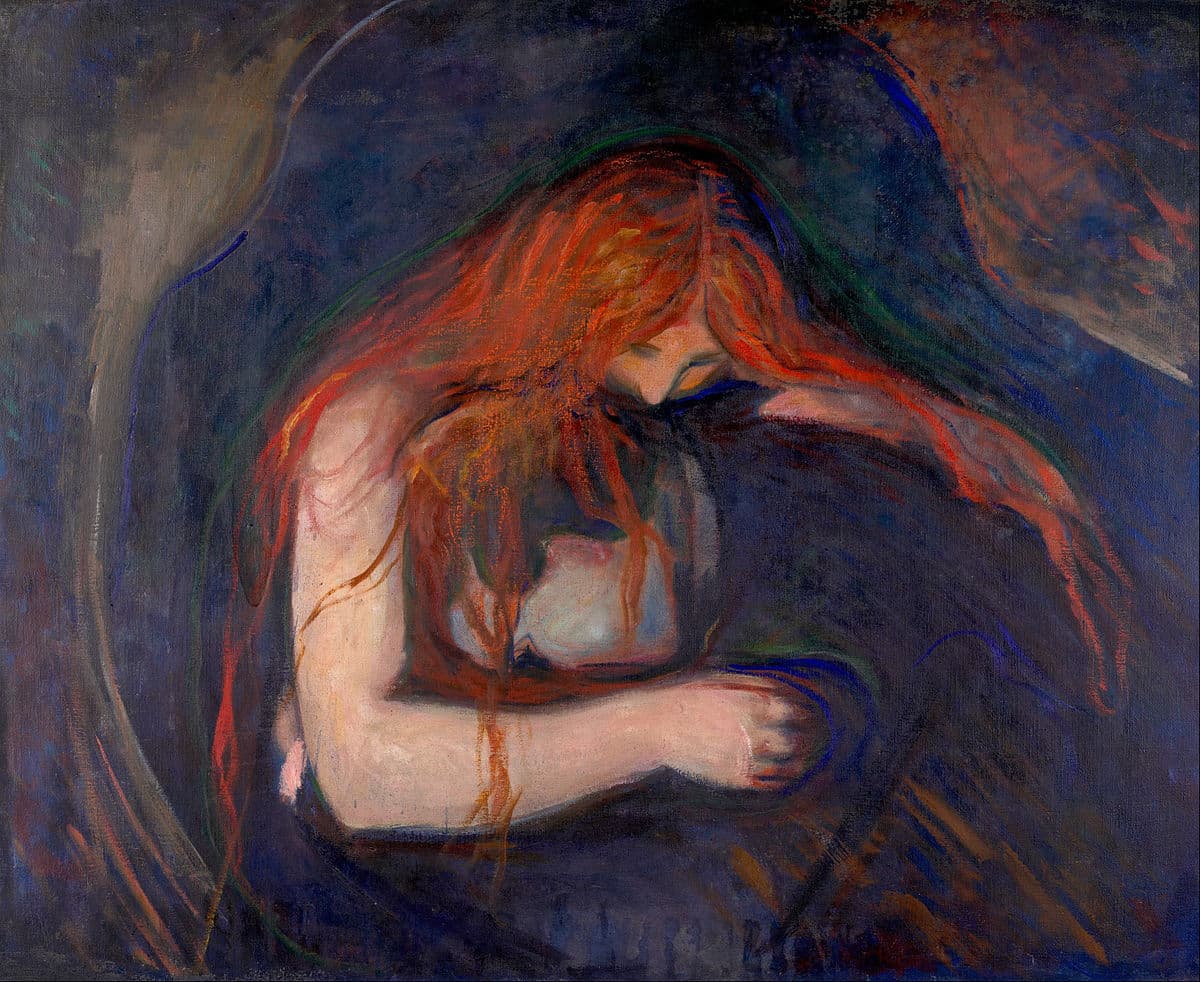
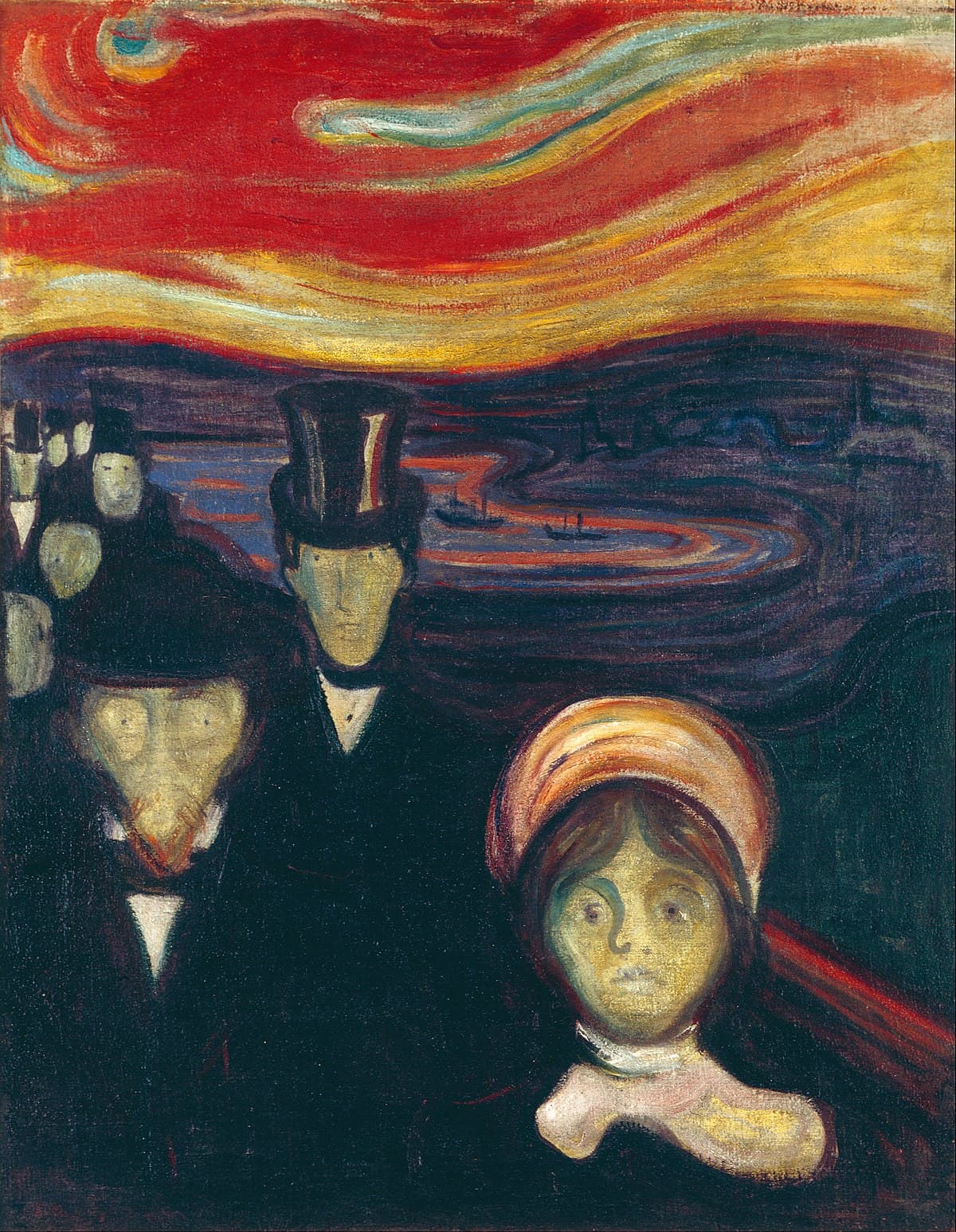
The Bergen version is in KODE Art Museums, whose Rasmus Meyer Collection is one of the great holdings of Munch. See also Munch's Anxiety, Starry Night and Vampire (Love and Pain), and our Symbolism collection.
Questions & answers
Where is Munch's Melancholy?
Munch painted several versions. The 1894–96 canvas, which appears to be the one shown here, is in the Rasmus Meyer Collection of KODE Art Museums in Bergen, Norway. An earlier version of 1892 is in the National Museum in Oslo, and other versions and prints exist.
Who is the man in Munch's Melancholy?
He is usually identified as Jappe Nilssen, a writer and friend of Munch, who in 1891 was unhappily in love with Oda Krohg, wife of the painter Christian Krohg. The small couple on the distant jetty is often read as Oda and her husband.
What does Munch's Melancholy mean?
It belongs to Munch's Frieze of Life, a cycle about love, jealousy, anxiety and death. The brooding figure, the curving shore and the distant couple express the isolation of unhappy love. The color and line convey mood rather than describing the beach realistically.
More by the artist
Edvard Munch

Kindred works
You may also study

Bridge over a Pond of Water Lilies
Claude Monet · 1899

Venus de Milo
Alexandros of Antioch · c. 150–125 BC

Nymphs Dancing to Pan's Flute
Joseph Tomanek

Ophelia
John Everett Millais · 1851–52

The Great Wave off Kanagawa
Katsushika Hokusai · c. 1830–32
Lucifer
Franz von Stuck · 1890
The Birth of Venus
Sandro Botticelli · c. 1484–1486
The Garden of Earthly Delights
Hieronymus Bosch · c. 1490–1510