Catalan funerary sculpture
The Kiss of Death (El Petó de la Mort)
Jaume Barba & Joan Fontbernat, 1930
El Petó de la Mort (The Kiss of Death) is a 1930 marble funerary sculpture in Barcelona's Poblenou Cemetery, usually attributed to Jaume Barba. A winged skeleton kisses the forehead of a dying young man above the grave of the Llaudet family.
- Artist
- Jaume Barba & Joan Fontbernat
- Date
- 1930
- Medium
- Marble
- Collection
- Poblenou Cemetery (Cementiri de Poblenou), Barcelona, Spain
- Movement
- Catalan funerary sculpture
El Petó de la Mort, Catalan for "The Kiss of Death," is a marble sculpture of 1930 on a family tomb in the Cementiri de Poblenou, one of Barcelona's historic cemeteries. It shows Death as a winged skeleton bending over a young man and pressing a kiss to his forehead as he sinks backward. The name Jaume Barba is carved on the monument, but some accounts credit the design to Barba's son-in-law, Joan Fontbernat. It marks the grave of Josep Llaudet Soler, a member of a Barcelona textile-manufacturing family.
What you're looking at
The young man is nude and idealized, his body slack, his head tipped back against Death's shoulder and his eyes closed. Death stands behind and slightly above him, a full skeleton with great feathered wings that rise and fold around the pair like a cloak. One bony hand supports the youth; the skull leans down so that its teeth touch his brow.
The photograph shown here comes in very close, so that the skull fills the frame. From this angle you can see how carefully the sculptor modeled it: the smooth, egg-like dome of the cranium, the deep eye sockets with a faint suggestion of eyes still in them, the nasal cavity and the long row of upper teeth resting on the young man's head. The wing rises behind at left, and in the background stands a large Celtic cross from a neighboring tomb, a reminder that this monument sits among hundreds of others in a crowded nineteenth-century necropolis.
The detail visitors debate is the young man's expression. His face can be read as ecstatic surrender or as the first moment of horror, and the sculptor seems to have left it deliberately balanced between the two. Death is not a grim reaper with a scythe here; it is close, tender, almost a lover.
The inscription
The base carries lines by Jacint Verdaguer (1845–1902), the great poet of the Catalan Renaissance. In paraphrase, they say that the young heart can no longer keep beating, the blood slows and cools in his veins, his strength is gone, and, falling, he feels the kiss of death. The verses make explicit what the sculpture shows: death arriving not as violence but as an embrace.
Who made it?
The attribution is not fully settled. Jaume Barba was a Barcelona sculptor who worked extensively on funerary monuments in the early twentieth century, and his name is carved on the work. Some writers argue that the design was by Joan Fontbernat, who was related to Barba by marriage, with Barba's workshop carrying it out. Both names are therefore usually given.
Meaning and influence
The monument is a modern memento mori: a reminder of death placed where the living come to mourn. Its pairing of beauty and decay, youth and skeleton, belongs to the long tradition of the danse macabre and the "Death and the Maiden" theme, here turned toward a young man. It also reflects the taste of Barcelona's early twentieth-century families for sensual, emotionally charged funerary art, visible throughout the Poblenou and Montjuïc cemeteries.
It is frequently claimed that the sculpture inspired Ingmar Bergman's film The Seventh Seal (1957), with its personified Death. There is no firm evidence for this, and the story should be treated as legend.
Why it became famous
For most of the twentieth century the monument was known mainly to locals and cemetery historians. Its fame grew with photography and the internet: close-ups like the one shown here, which crop the scene down to the skull and the young man's head, turned it into one of the most widely shared funerary sculptures in Europe. It is now often described as the best-known monument in Poblenou. The cropping changes the experience, though. Seen whole, in place, the group is gentler and more balanced; the wings and the youth's long, relaxed body dominate, and the skull is only one part of a quiet, almost classical composition.
Visiting Poblenou Cemetery
Poblenou Cemetery, also called the Cementiri de l'Est, was first opened in 1775 outside the old city walls, destroyed by Napoleon's troops in 1813 and rebuilt to a design by the Italian architect Antonio Ginesi, reopening in 1819. The front sections hold uniform walls of burial niches; the rear contains the individual monuments and mausoleums of Barcelona's wealthy bourgeoisie, where El Petó de la Mort stands. The cemetery is free to enter, and the city's cemetery service runs guided routes that include it.
Related works
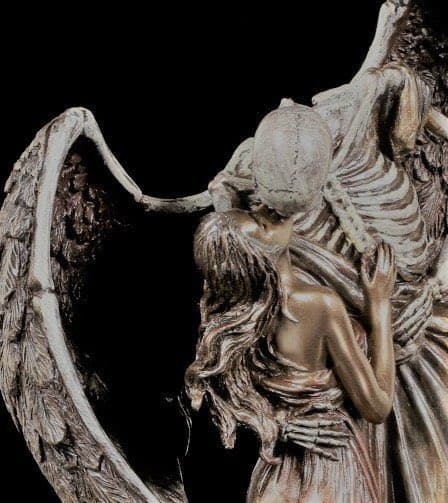
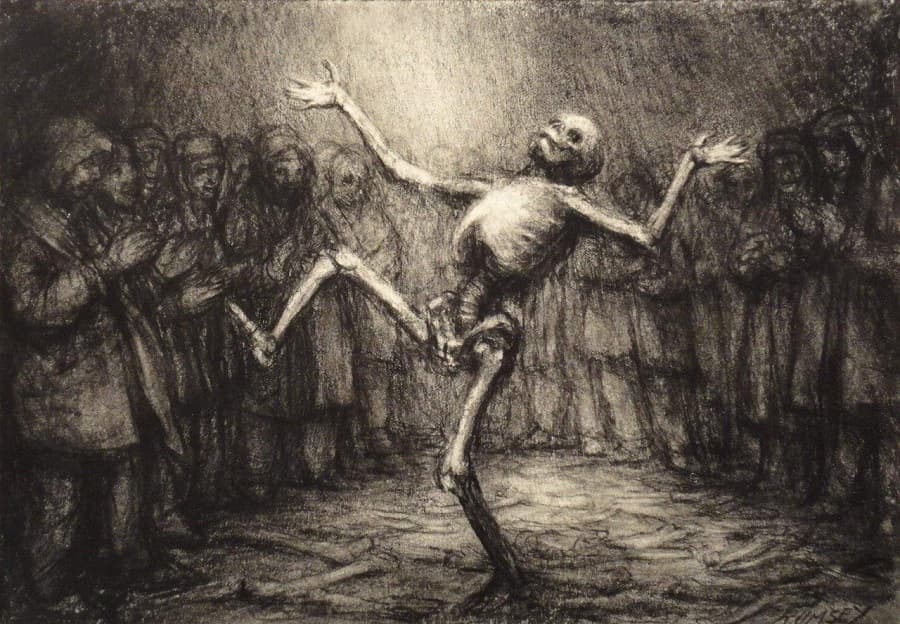
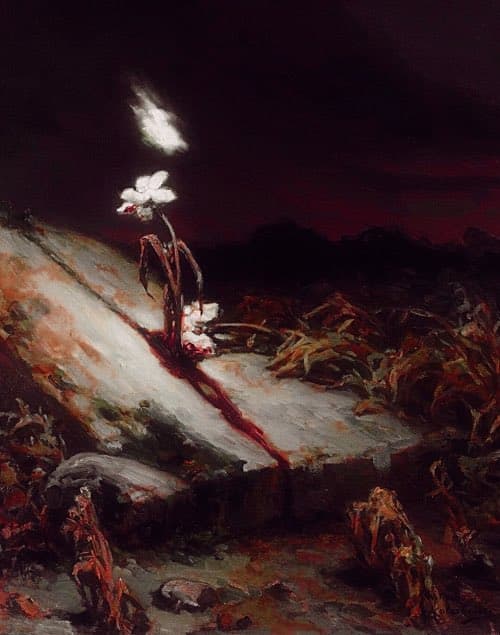
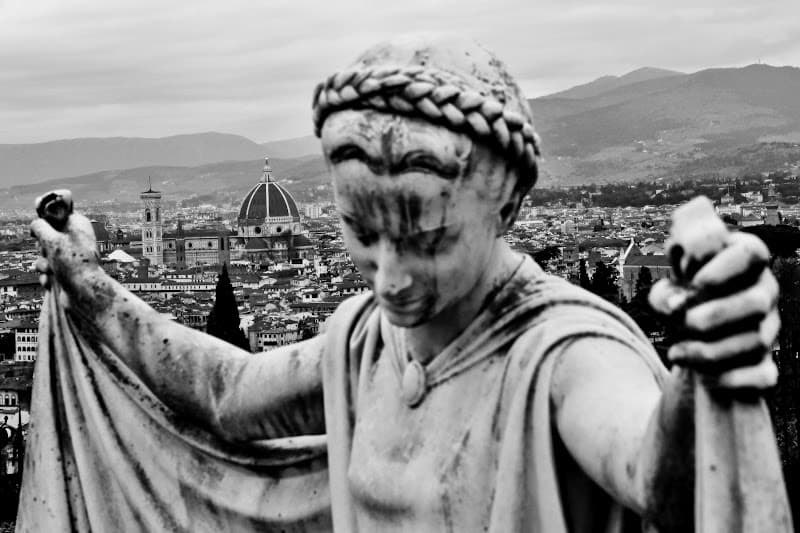
For other images of death as a companion, see The Kiss of Death by Veronese Designs, Paul Rumsey's Danse Macabre, Grave of a Suicide Victim and Tombstone of Silvia Marini. The broader theme is explored in Death in Art and Memento Mori & Vanitas.
Questions & answers
Where is El Petó de la Mort?
The sculpture is in the Cementiri de Poblenou (Poblenou Cemetery), also called the East Cemetery, in Barcelona's Poblenou neighborhood. It stands among the private monuments in the rear section, over the grave of Josep Llaudet Soler. Entry to the cemetery is free, and municipal guided routes include it.
Who made The Kiss of Death sculpture in Barcelona?
It is usually attributed to the Barcelona sculptor Jaume Barba, whose name is carved on the monument, and is dated 1930. Some sources argue that the design was by Joan Fontbernat, Barba's son-in-law, so both names are often given. We know of no published document that settles the question.
What does El Petó de la Mort mean?
It means 'The Kiss of Death' in Catalan. The sculpture shows Death as a winged skeleton kissing the forehead of a dying young man, an image of death as an intimate embrace rather than a violent end. Verses by the poet Jacint Verdaguer on the base describe his heart failing as he falls into death's kiss.
Did El Petó de la Mort inspire The Seventh Seal?
It is often said that Ingmar Bergman's 1957 film The Seventh Seal was inspired by the sculpture, but there is no reliable evidence for the connection. It is best treated as a popular legend that has grown up around the monument.
Kindred works
You may also study
The Kiss of Death
Veronese Design · c. 2020
The Danse Macabre Series
Paul Rumsey
Grave of a Suicide Victim
Wilhelm Kotarbiński · c. 1900
Tombstone of Silvia Marini nei De Rogati
Artist Unknown · After 1947
Requiem
Ignacio Trelis

Venus de Milo
Alexandros of Antioch · c. 150–125 BC

The Scream
Edvard Munch · 1893

Saturn Devouring His Son
Francisco Goya · c. 1819–1823