Contemporary
Vanitas Sculpture (Hooded Bust with Skull)
Various Artists or Collaborations
This vanitas sculpture is a contemporary bust of a hooded young woman whose face is half flesh and half skull, a modern take on the old reminder that beauty and life are brief. The artist is not recorded here.
- Movement
- Contemporary
What you are looking at
A bust of a young woman, made in a matte gray material, is shown against a black background. She wears a hood or shawl over her head, tied at the throat in a loose knot, and a buttoned coat. Her eyes are closed and her face is calm. But only the left side of her face is flesh. On the right, the skin has fallen away to reveal the skull beneath: the empty eye socket, the cheekbone, the nasal cavity and a full row of teeth that meet her living lips at the center. The line between flesh and bone is jagged, as if the face were cracking open.
The modeling is very fine: the folds of the shawl, the strands of hair at her temple, the button on the coat. It looks like a digital sculpture or a cast made from one, and the lighting is studio-smooth.
The vanitas tradition
Vanitas, Latin for "emptiness" or "vanity," comes from the opening of Ecclesiastes: "vanity of vanities, all is vanity." In seventeenth-century Dutch and Flemish painting, vanitas still lifes set skulls, guttering candles, hourglasses and wilting flowers among books and luxuries to remind the viewer that death makes worldly goods meaningless. Sculptors made the same point with tomb effigies and transi figures, which show the dead body decaying.
The split face belongs to an even older image, the motif of a figure that is half alive and half dead. It appears in medieval and Renaissance prints and wax anatomical models, and was used to show that beauty and death are always present together. It is a favorite of contemporary 3D artists, tattoo designers and sculptors because it delivers the memento mori message in a single glance.
Close looking
Notice how the hood frames the face like a nun's veil or a mourner's shawl, which gives the bust a religious, devotional air. The closed eyes make the living half look asleep or at prayer; the skull side has no eyelid, so it stares. The teeth are the most unsettling detail: they continue the line of her lips exactly, so the smile and the grin of the skull are the same.
Attribution
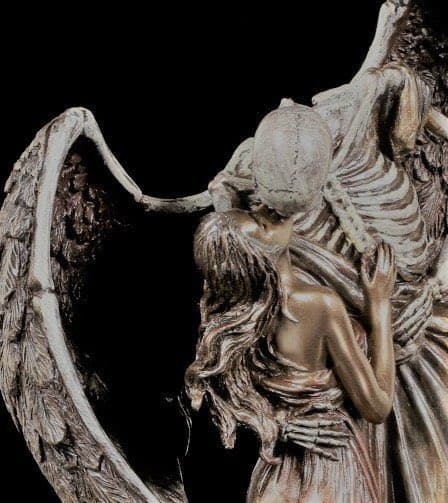
We have not been able to identify the maker or date of this particular piece; it appears to be a contemporary digital sculpture or a cast reproduced from one. For more images in this tradition, see Memento Mori & Vanitas and Death in Art, and compare Head of a Skeleton with a Burning Cigarette and The Kiss of Death.
Questions & answers
What is a vanitas sculpture?
A vanitas sculpture uses symbols of death, most often a skull, to remind the viewer that life, beauty and possessions are temporary. The idea comes from Ecclesiastes and from seventeenth-century Dutch vanitas still lifes, and is related to memento mori, Latin for remember you must die.
What does a half skull, half face sculpture mean?
It shows life and death in the same body: youth and beauty on one side, the skull that waits beneath on the other. The motif goes back to medieval and Renaissance images of figures half alive and half dead, made as reminders of mortality.
Who made this vanitas bust?
We could not identify the artist or date of this piece. It appears to be a contemporary digital sculpture, or a cast made from one. If you know the maker, the attribution can be corrected; until then it is listed under various artists.
More by the artist
Various Artists or Collaborations
Kindred works
You may also study
Head of a Skeleton with a Burning Cigarette
Vincent van Gogh · 1886
The Kiss of Death
Veronese Design · c. 2020
The Danse Macabre Series
Paul Rumsey
Lacrimosa
Nicola Samorì

Venus de Milo
Alexandros of Antioch · c. 150–125 BC

The Scream
Edvard Munch · 1893

Saturn Devouring His Son
Francisco Goya · c. 1819–1823

Ophelia
John Everett Millais · 1851–52