Image: Musée du Louvre, Paris (image via WikiArt) · Public domain · via Wikimedia Commons
Early Impressionism
Glaçons à Bougival
Claude Monet, c. 1867–68
Glaçons à Bougival (Ice Floes on the Seine at Bougival) is a winter view of the frozen Seine painted by Claude Monet around 1867–68, his first picture of river ice. It belongs to the Louvre's Department of Paintings in Paris.
- Artist
- Claude Monet
- Date
- c. 1867–68
- Medium
- Oil on canvas
- Dimensions
- 65 × 81.2 cm
- Collection
- Musée du Louvre, Paris, France
- Movement
- Early Impressionism
- Catalogue
- Wildenstein 105
What you are looking at
The Seine fills the left half of the picture, flat and grey, carrying slabs of ice downstream toward us. Beyond it a line of tall, bare poplars marches along the far bank into the mist. On the right the near bank is deep in snow. A few small dark figures stand at the water's edge beside two beached rowing boats, another walks up the snowy slope, and a row of houses half hidden in trees closes the view at the top right.
Almost everything is grey, white or brown. The sky is a single sheet of overcast, and it is barely distinguishable from the reflections in the water. The only real accents are the black figures and the dark posts sticking out of the snow, which Monet uses like punctuation to measure the distance along the bank.
Look at the ice floes in the foreground. They are a few flat, decisive strokes of white, laid on the water with almost no modeling, and they are what tells you the river is moving. Compare them with the busy, smaller touches on the right bank, where the snow, figures and boats are described much more closely. The contrast between still, broad water and a fussier shoreline is the picture's real structure.
Where and when it was painted
Bougival is a village on the Seine west of Paris, between Saint-Germain-en-Laye and the city. Monet looked upstream, with the Île de Croissy on the left. The winter of 1867–68 was very hard, and the Seine froze in several places.
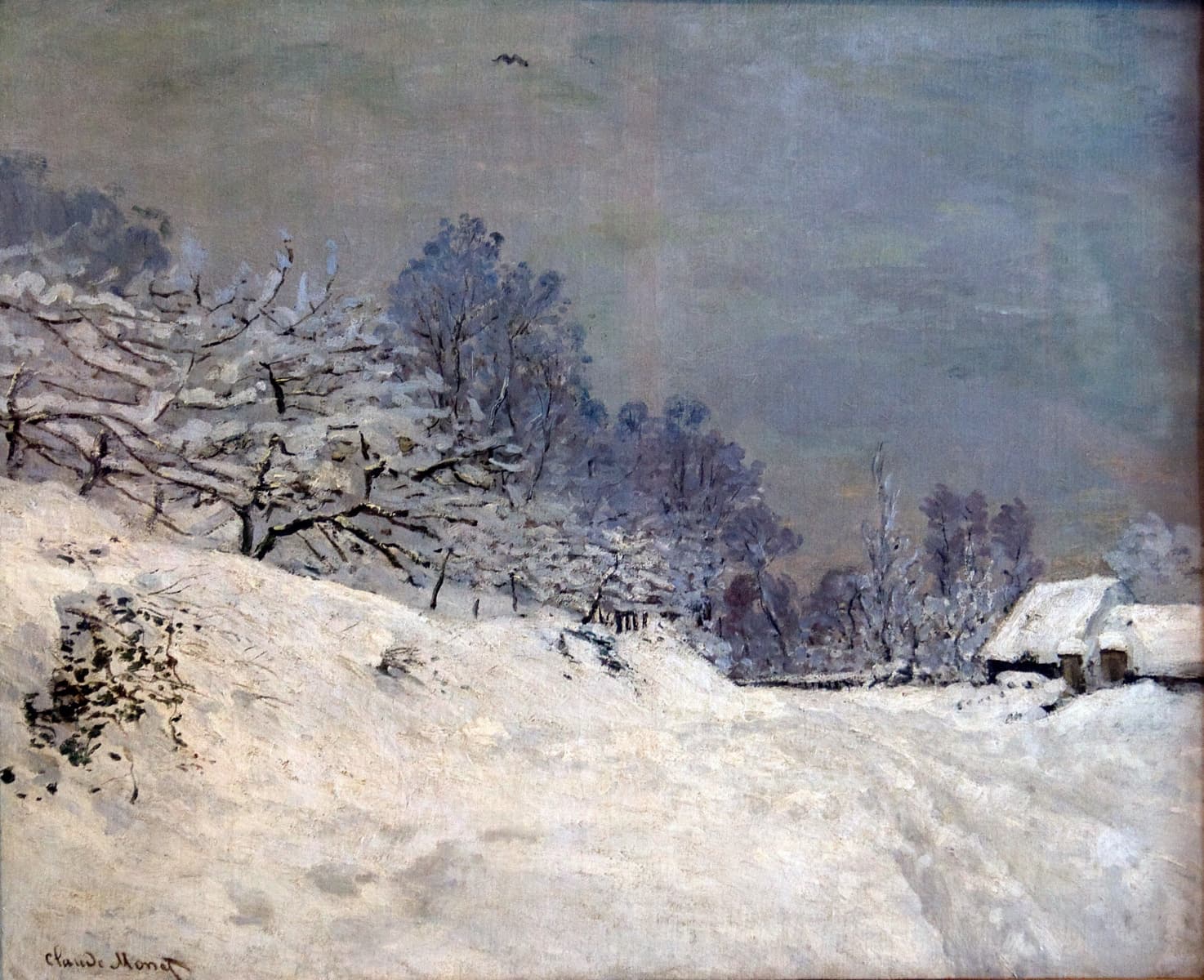
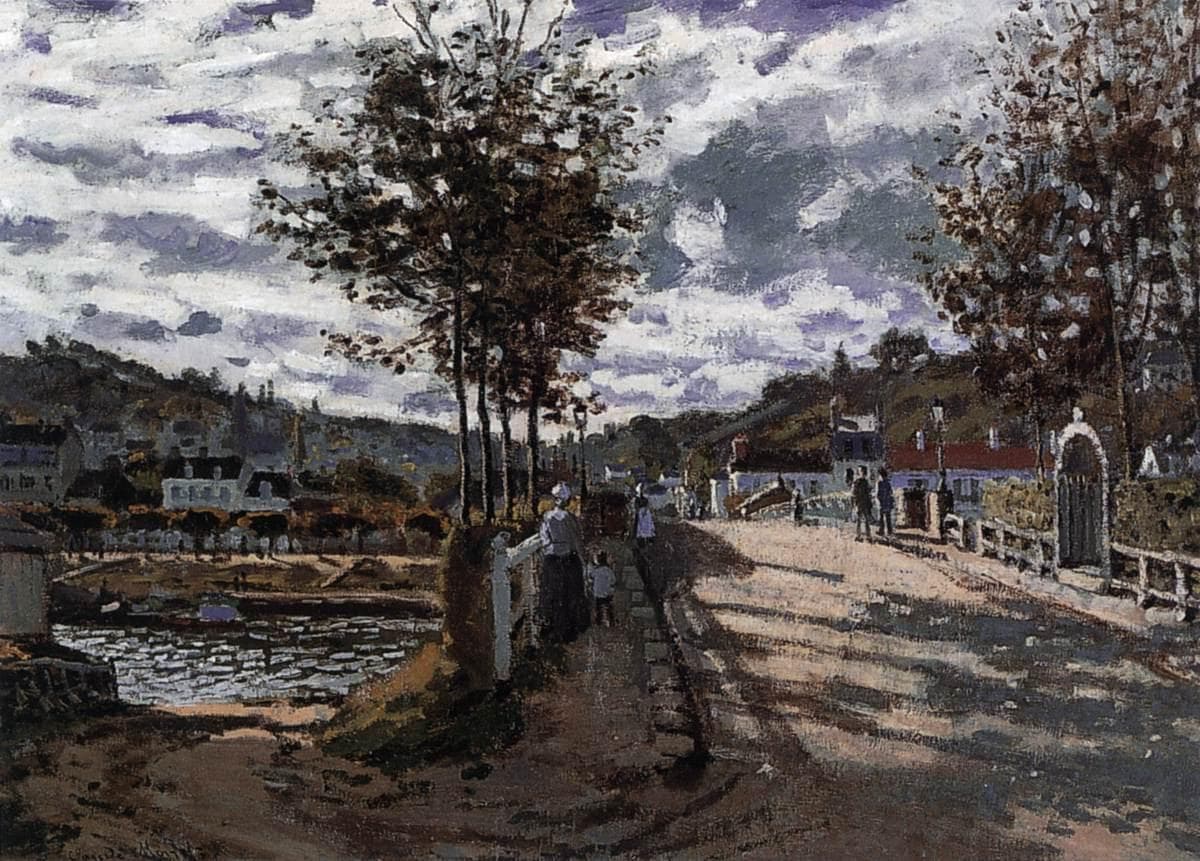
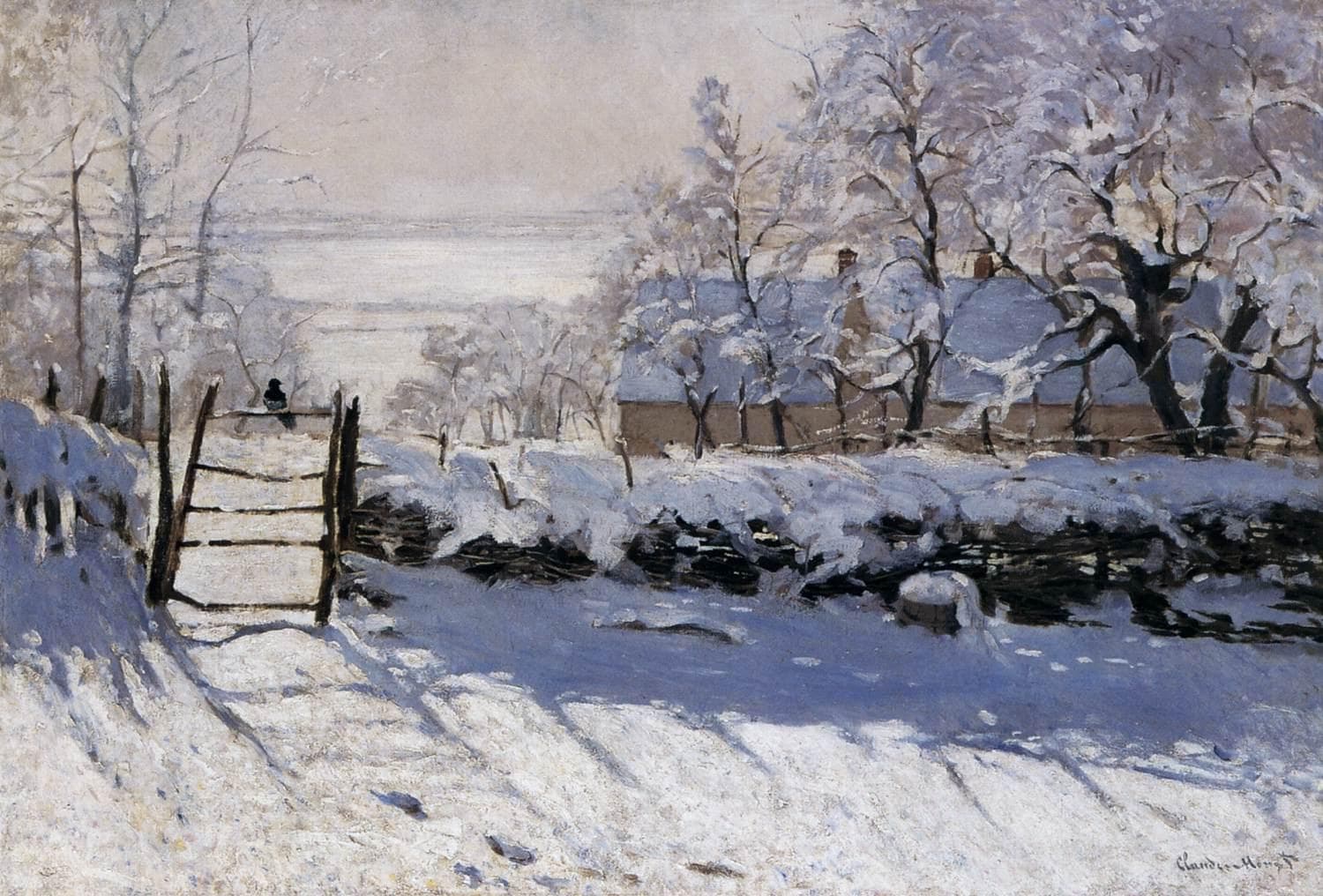
It was a bad winter for Monet too. His large Women in the Garden had been refused by the Salon of 1867, his son Jean was born that August, and he was so short of money that he leaned heavily on Frédéric Bazille, who had agreed to buy Women in the Garden in monthly installments. That season he also painted the snow of Honfleur, as in The Road in Front of Saint-Siméon Farm in Winter, and soon afterward The Magpie. A year later he would be back at Bougival in summer for The Bridge at Bougival.
How it was painted
This was the first time Monet painted the Seine in ice, and he used almost no color to do it. The near-monochrome scheme has often been compared with the river views of James McNeill Whistler, whose work was on view in Paris during the Exposition Universelle of 1867, while Monet was living in the city. Whether Monet looked at Whistler or simply at the weather, the result is one of the quietest pictures of his early career.
The paint is handled in two registers: wide, flat passages for river and sky, and quick, precise touches for the bank. The canvas, about 65 by 81 centimeters, is a standard size Monet used constantly, large enough to be a finished picture but small enough to be worked outdoors.
The ice pictures
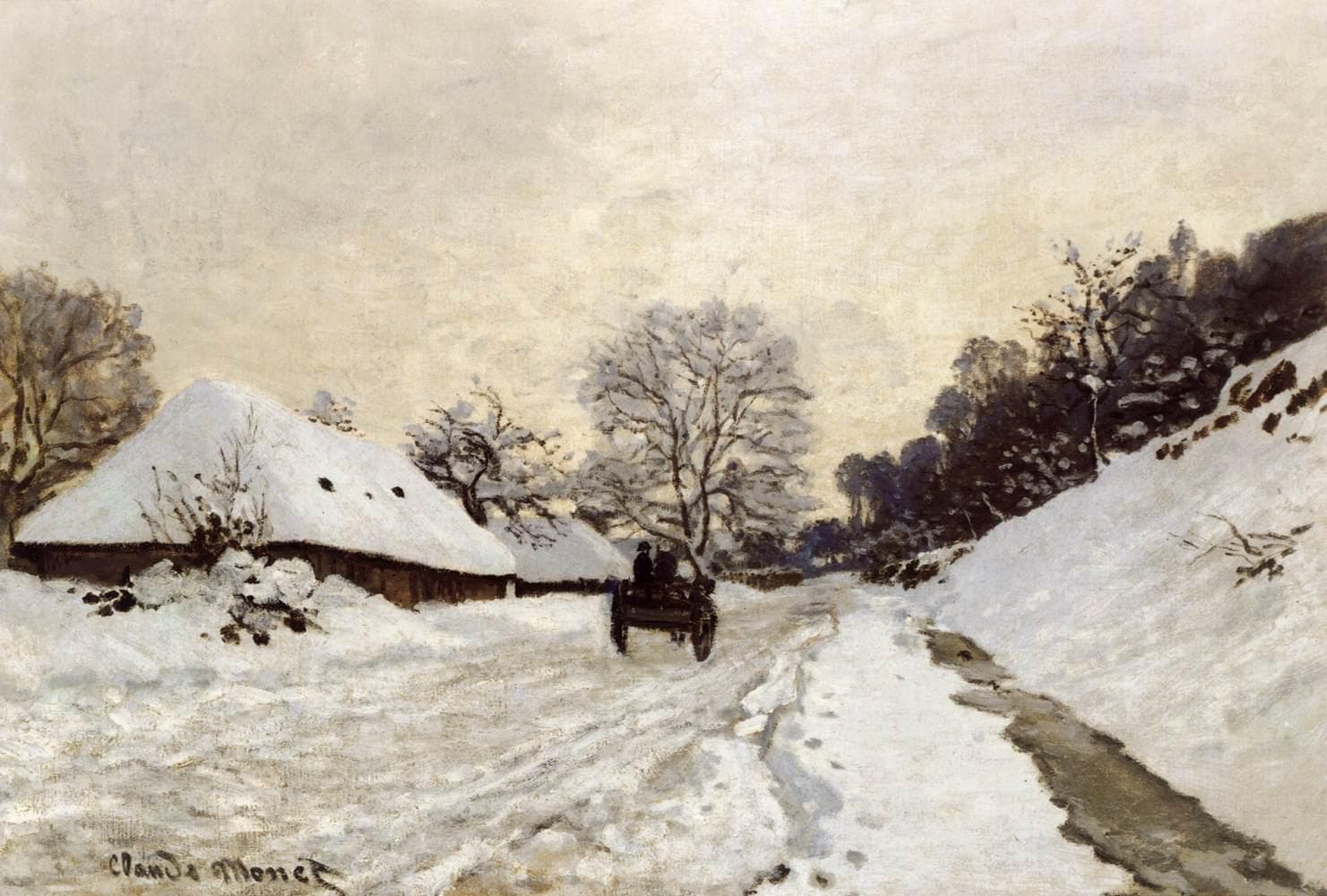
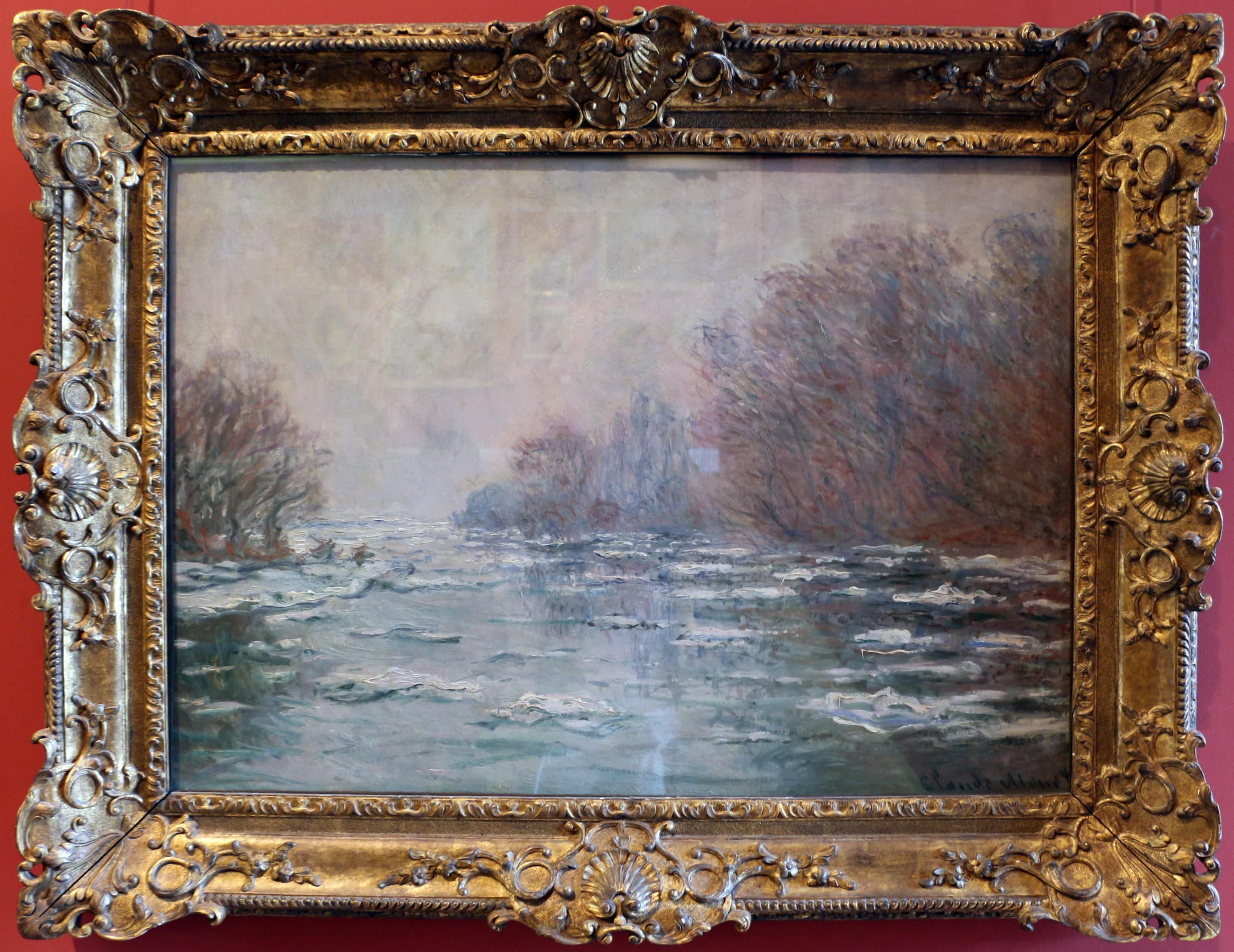
Monet returned to the frozen Seine more than a decade later, at Vétheuil, after the great freeze of 1879–80. Pictures such as The Breaking Up of the Ice near Vétheuil, which also belongs to the Louvre and came to it from the same collector, show what had changed: the brushwork is broken and restless, the color full of rose and blue. Set beside them, this early canvas looks restrained and almost classical. For the snow scenes of his early years, see also A Cart on the Snowy Road at Honfleur.
Where to see it
The painting is one of the few Monets that belong to the Louvre rather than the Musée d'Orsay. It came from the collection of Victor Lyon, who owned it from 1935, as part of a gift to the French state in 1961 (inventory RF 1961 62), and it is shown in the Louvre with the other nineteenth-century pictures from that gift. It has traveled to exhibitions in France and Japan, including Turner, Whistler, Monet in Paris in 2004–05. See where to see Monet's paintings and the Claude Monet page.
Questions & answers
Where is Monet's Glaçons à Bougival?
It belongs to the Department of Paintings of the Musée du Louvre in Paris (inventory RF 1961 62), not the Musée d'Orsay. It came from the collection of Victor Lyon as part of a gift to the French state in 1961 and is shown with the other works from that gift.
When did Monet paint Ice Floes at Bougival?
It is dated around 1867–68. The winter of 1867–68 was severe and the Seine froze in places; Monet painted the river at Bougival, west of Paris, looking upstream with the Île de Croissy on the left. It is his first known picture of river ice.
What does Glaçons à Bougival show?
Slabs of ice drift down a grey Seine under an overcast sky. Bare poplars line the far bank, while on the snowy near bank small figures stand beside beached boats. The palette is almost entirely grey, white and brown.
Did Monet paint other pictures of ice on the Seine?
Yes. His best-known ice pictures date from January 1880 at Vétheuil, when the frozen river broke up after the great freeze; he made about a dozen of them. He returned to the subject again at Bennecourt in 1893.
More by the artist
Claude Monet

Bridge over a Pond of Water Lilies
Claude Monet · 1899

Woman with a Parasol – Madame Monet and Her Son
Claude Monet · 1875

Sunset in Venice
Claude Monet · 1908–12

La Grenouillère
Claude Monet · 1869

Beach in Pourville
Claude Monet · 1882

Springtime
Claude Monet · 1872

Boating on the River Epte
Claude Monet · 1890

The Seine at Asnières (Hermitage)
Claude Monet · 1873
Also painted in 1867
The same year
The Road in Front of Saint-Siméon Farm in Winter
Claude Monet · 1867
The Cradle – Camille with the Artist's Son Jean
Claude Monet · 1867
Regatta at Sainte-Adresse
Claude Monet · 1867
A Cart on the Snowy Road at Honfleur
Claude Monet · c. 1867
Quai du Louvre, Paris
Claude Monet · 1867
Woman in the Garden
Claude Monet · 1867
Garden at Sainte-Adresse
Claude Monet · 1867
The Beach at Sainte-Adresse
Claude Monet · 1867
Kindred works
You may also study
The Breaking Up of the Ice near Vétheuil
Claude Monet · c. 1880
The Road in Front of Saint-Siméon Farm in Winter
Claude Monet · 1867
The Bridge at Bougival
Claude Monet · 1869
A Cart on the Snowy Road at Honfleur
Claude Monet · c. 1867
The Magpie
Claude Monet · 1868–69

The Scream
Edvard Munch · 1893

Ophelia
John Everett Millais · 1851–52

The Great Wave off Kanagawa
Katsushika Hokusai · c. 1830–32