Cubism / Surrealism
The Weeping Woman
Pablo Picasso, 1937
The Weeping Woman is a 1937 painting by Pablo Picasso of a woman in a red hat crying into a handkerchief, modeled on the photographer Dora Maar and made in the aftermath of Guernica. It is in the Tate, London.
- Artist
- Pablo Picasso
- Date
- 1937
- Medium
- Oil on canvas
- Dimensions
- 60.8 × 50 cm
- Collection
- Tate Modern, London, United Kingdom
- Movement
- Cubism / Surrealism
What you are looking at
A woman's head and shoulders fill the canvas. She wears a red hat with a blue flower, her dark hair falls to her shoulder in long blue-black strands, and she holds a white handkerchief to her face with a green hand. The face is broken into hard-edged planes of yellow, green, white and purple. Her eyes, outlined in black, stare out like dishes, and tears are drawn as black teardrops falling from them. At the center, where the mouth should be, the handkerchief and teeth merge into a jagged white shape of shards and lines, as if she were biting the cloth, or as if her face had shattered.
Behind her is a yellow and orange wall and a strip of blue. The colors are bright and almost cheerful, which makes the grief more shocking.
After Guernica
On 26 April 1937, during the Spanish Civil War, German and Italian aircraft bombed the Basque town of Guernica. Picasso, living in Paris, responded with Guernica, the huge black-and-white mural shown at the Spanish Pavilion of the Paris World's Fair that summer. Among its figures are several women screaming and weeping. After finishing it he kept returning to the theme, making a series of drawings, prints and paintings of weeping women. This canvas, dated 26 October 1937, is the most fully worked and colorful of them.
The model was Dora Maar, the photographer and painter who was Picasso's companion at the time, and who documented the making of Guernica in photographs. Picasso later said that for him she was the weeping woman. Maar herself said that his portraits of her were his inventions, not her.
Close looking
Picasso combines profile and front view in one face, a device from his Cubist years. Look at the eyes: one seen from the front, one from the side. The handkerchief area is the most complex passage: thin black lines cross the white like cracks in glass, and the teeth seem to grind at the cloth. Notice the hand, its fingers drawn as green curves with pale nails, pressed to the face.
The red hat and the blue flower are fashionable, even playful. The contrast between Parisian elegance and unbearable grief is at the center of the picture.
Provenance and where to see it
The English Surrealist Roland Penrose, Picasso's friend and later biographer, acquired the painting soon after it was made. The Tate bought it in 1987 (T05010), and it is usually shown at Tate Modern. Another Weeping Woman of 1937, in the National Gallery of Victoria, Melbourne, was famously stolen in 1986 and recovered.
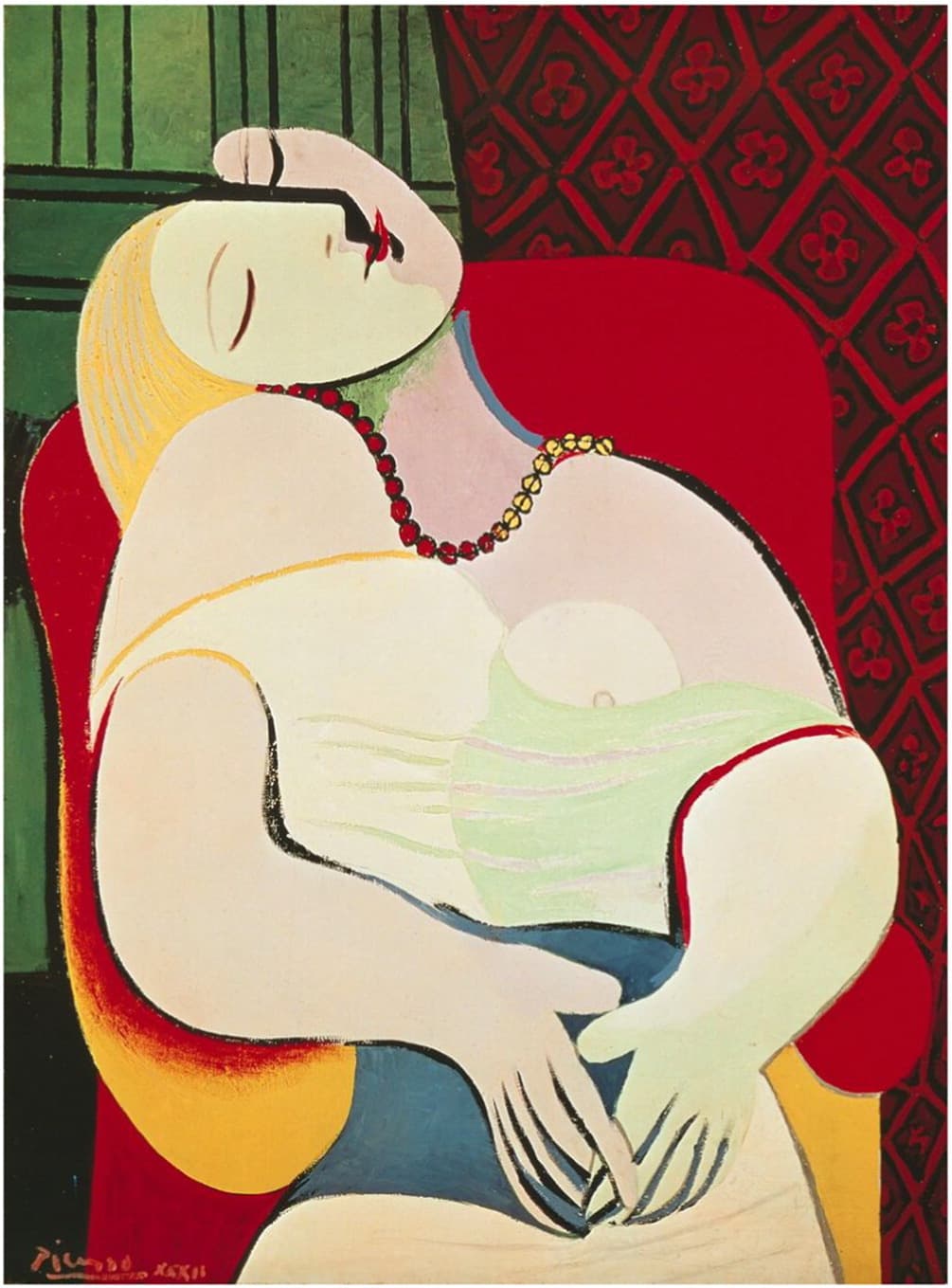
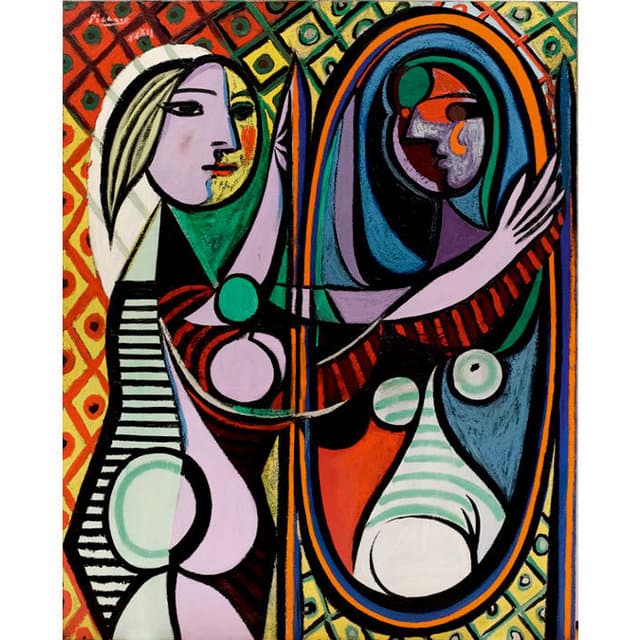
Compare Picasso's Girl Before a Mirror and Le Rêve, also modeled on women in his life, and see Pablo Picasso and Famous Paintings of Women.
Questions & answers
Where is Picasso's The Weeping Woman?
The best-known version, painted on 26 October 1937, is owned by the Tate in London (T05010) and is usually displayed at Tate Modern. The Tate bought it in 1987. Picasso made several other weeping women in 1937, including one in the National Gallery of Victoria, Melbourne.
Who is The Weeping Woman?
The model was Dora Maar, the French photographer and painter who was Picasso's partner from 1936 and who photographed the making of Guernica. Picasso said she was for him the weeping woman, though she insisted his portraits of her were his own inventions.
What is the meaning of The Weeping Woman?
It continues the grief of Guernica, Picasso's response to the bombing of the Basque town in April 1937. The shattered face, hard tears and handkerchief clenched in the teeth turn one woman's crying into an image of the suffering of the Spanish Civil War.
More by the artist
Pablo Picasso
Kindred works
You may also study

Venus de Milo
Alexandros of Antioch · c. 150–125 BC

Saturn Devouring His Son
Francisco Goya · c. 1819–1823

Ophelia
John Everett Millais · 1851–52

Woman with a Parasol – Madame Monet and Her Son
Claude Monet · 1875
Las Meninas
Diego Velázquez · 1656
The Birth of Venus
Sandro Botticelli · c. 1484–1486
The School of Athens
Raphael · 1509–1511
Liberty Leading the People
Eugène Delacroix · 1830