Blue Period
The Old Guitarist
Pablo Picasso, 1903–04
The Old Guitarist is Pablo Picasso's Blue Period painting of a blind, emaciated street musician hunched over his guitar, made in Barcelona in late 1903 to early 1904. It is in the Art Institute of Chicago.
- Artist
- Pablo Picasso
- Date
- 1903–04
- Medium
- Oil on panel
- Dimensions
- 122.9 × 82.6 cm
- Collection
- Art Institute of Chicago, Chicago, United States
- Movement
- Blue Period
The Old Guitarist is one of the defining works of Pablo Picasso's Blue Period, the years from about 1901 to 1904 when he painted the poor, the blind and the outcast in shades of blue. He made it in Barcelona in late 1903 or early 1904, when he was 22. Painted in oil on a panel about 122.9 by 82.6 centimeters, it has been in the Art Institute of Chicago since 1926, part of the Helen Birch Bartlett Memorial Collection.
What you are looking at
An old man sits cross-legged on the ground, hunched so far forward that his head hangs almost at the level of his shoulders. His eyes are closed or sightless, his mouth slack. He is skeletally thin: his collarbone and the tendons of his neck stand out, his arms are long and bony, and one bare foot protrudes at the bottom of the picture.
He holds a large guitar close against his body, his left hand stretched along the neck and his right hand curled over the strings. The guitar is the only warm color in the painting, a soft brown that glows against the blues. Everything else, his ragged clothes, the wall behind him and the ground beneath, is painted in tones of blue and blue-green, with gray-white for his skin and hair.
The figure is distorted. His upper body seems to lean back while his legs are folded beneath him, and his limbs are elongated, a deliberate echo of the sixteenth-century Spanish painter El Greco.
Look closely at the area around the man's neck. Faint shapes show through the blue: the head of a woman and other forms from an earlier composition Picasso painted over. Technical examination has revealed them clearly.
Meaning
Picasso's Blue Period followed the suicide in 1901 of his close friend Carles Casagemas, and coincided with his own poverty in Paris and Barcelona. His blind beggars and musicians are often read as images of suffering, isolation and endurance, but also of art itself. Blindness had a long association with inner vision, from the poet Homer to the blind seers of Symbolist literature, and the guitarist plays though he cannot see.
The monochrome blue, the color of night and melancholy, strips the scene of time and place, so that the man becomes a universal figure rather than a portrait.
Where to see it
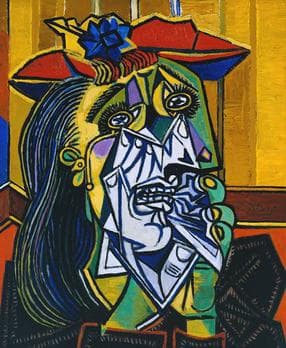
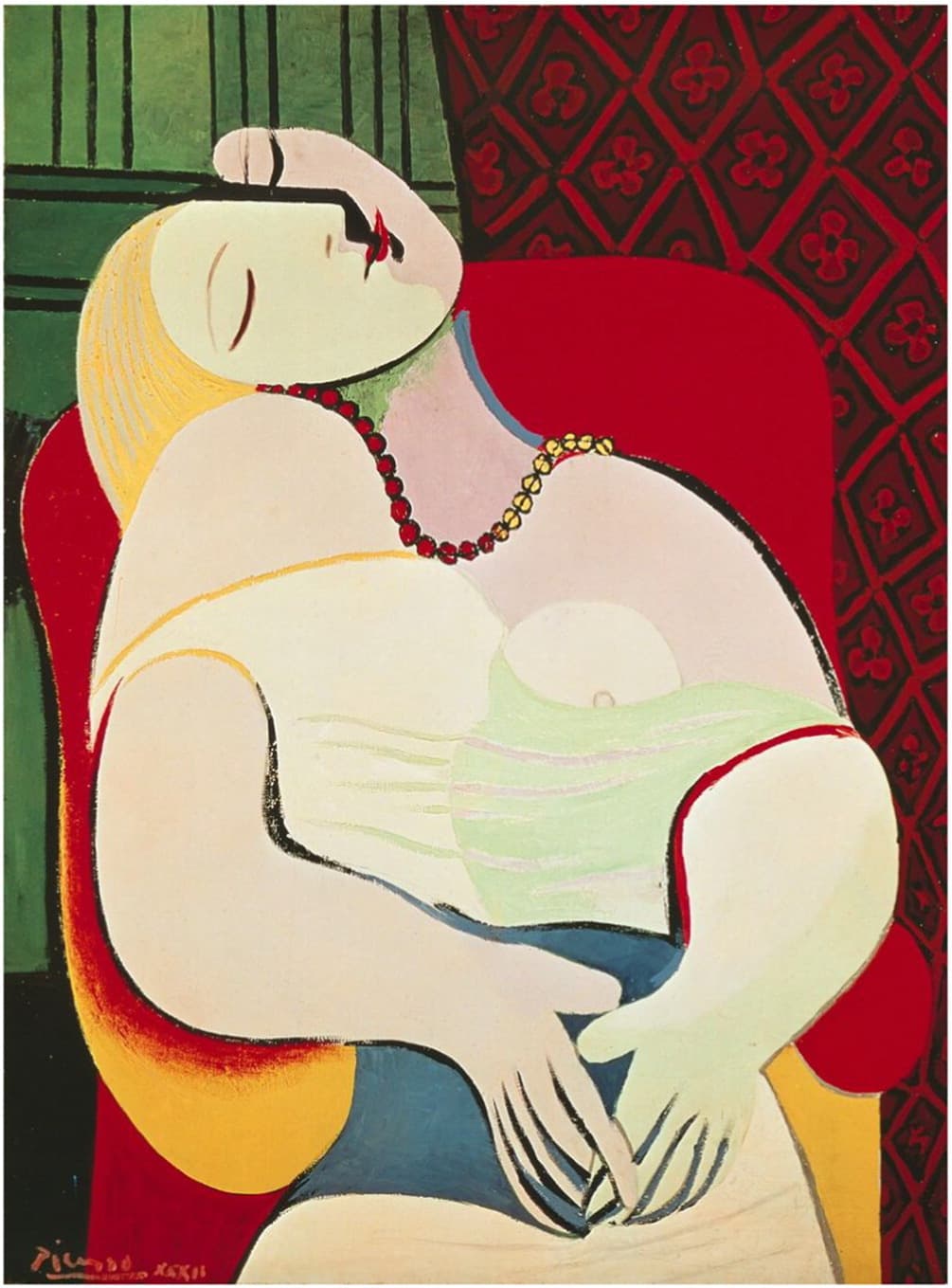
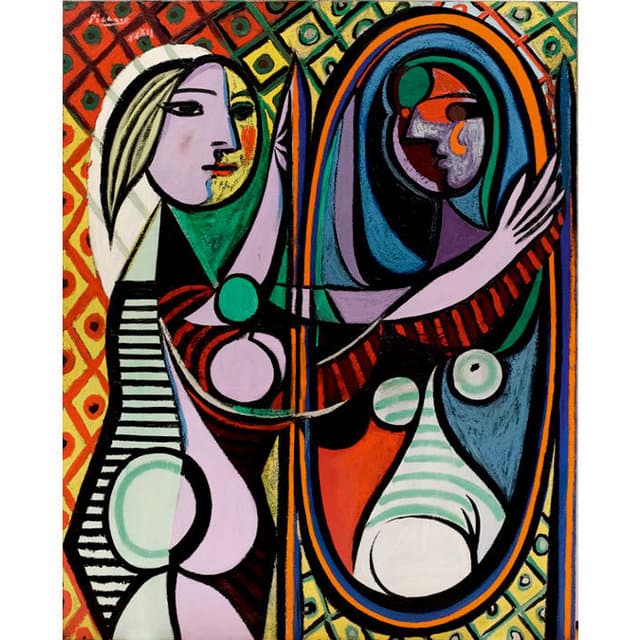
The painting hangs in the Art Institute of Chicago, among its galleries of modern European art. It inspired the poet Wallace Stevens's "The Man with the Blue Guitar" (1937). See also Picasso's Girl before a Mirror, Weeping Woman and Le Rêve, and the Pablo Picasso page.
Questions & answers
Where is The Old Guitarist by Picasso?
It is in the Art Institute of Chicago, which received it in 1926 as part of the Helen Birch Bartlett Memorial Collection. Picasso painted it in Barcelona in late 1903 or early 1904, during his Blue Period, and it is one of the museum's best-known works.
What does The Old Guitarist mean?
It shows a blind, starving street musician, an image of poverty and suffering typical of Picasso's Blue Period, which followed the suicide of his friend Carles Casagemas. Blindness was linked to inner vision, so the guitarist can also be read as a figure of the artist.
Is there a hidden image in The Old Guitarist?
Yes. Picasso painted it over an earlier composition, and faint shapes, including the head of a woman, can be seen through the paint near the guitarist's neck. Infrared and X-ray examination by conservators have revealed more of the underlying figures in detail.
More by the artist
Pablo Picasso
Kindred works
You may also study

Nymphs Dancing to Pan's Flute
Joseph Tomanek

The Scream
Edvard Munch · 1893

Saturn Devouring His Son
Francisco Goya · c. 1819–1823

Ophelia
John Everett Millais · 1851–52

Woman with a Parasol – Madame Monet and Her Son
Claude Monet · 1875
Las Meninas
Diego Velázquez · 1656
Head of a Skeleton with a Burning Cigarette
Vincent van Gogh · 1886
The School of Athens
Raphael · 1509–1511