Spanish · Blue Period · Rose Period · Cubism · Surrealism
Pablo Picasso
b. 25 October 1881, Málaga, Spain — d. 8 April 1973, Mougins, France
Pablo Picasso (1881–1973) was a Spanish painter, sculptor and printmaker who spent most of his life in France. Co-inventor of Cubism and creator of Guernica, he is the most influential artist of the twentieth century.
6 works in the collection
Works by Pablo Picasso
Pablo Picasso was a Spanish artist, born in Málaga in 1881, who worked in France for most of his long life and changed the course of modern art more than any other single figure. With Georges Braque he invented Cubism; he took part in Surrealism, made sculpture from found objects, and produced some 20,000 paintings, drawings, prints, ceramics and sculptures over almost eight decades. His paintings are in nearly every major museum of modern art.
Life in brief
Picasso's father, José Ruiz Blasco, was a painter and drawing teacher, and the boy trained under him in A Coruña and then in Barcelona, where he was precociously skilled. He settled in Paris in 1904, in the ramshackle studio building known as the Bateau-Lavoir in Montmartre. Les Demoiselles d'Avignon (1907, Museum of Modern Art, New York) broke with centuries of pictorial convention, and between 1908 and 1914 he and Braque developed Cubism. During the 1920s and 1930s he moved between a monumental Neoclassical style and a free, Surrealist-influenced distortion. The bombing of Guernica in 1937 prompted his most famous painting, Guernica, now in the Museo Reina Sofía in Madrid. He lived through the German occupation in Paris, joined the French Communist Party in 1944, and spent his last decades in the south of France, where he died at Mougins in 1973.
His private life was closely tied to his work. His partners and wives, among them Fernande Olivier, Olga Khokhlova, Marie-Thérèse Walter, Dora Maar, Françoise Gilot and Jacqueline Roque, appear again and again in his paintings, and the change from one to another often marks a change of style.
Style and periods
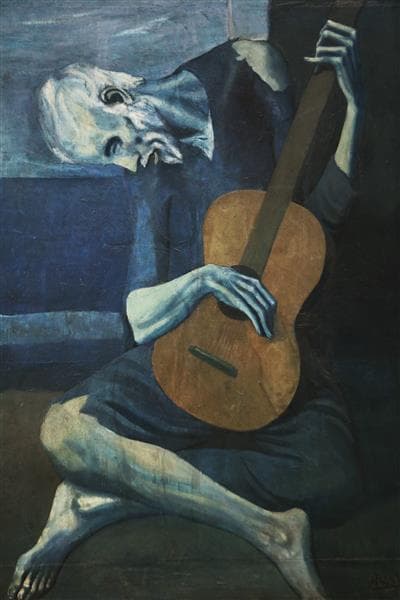
Picasso's career is usually told in periods. The Blue Period (1901–04), begun after the suicide of his friend Carles Casagemas, uses a nearly monochrome blue for beggars, the blind and the poor. The Rose Period (1904–06) turns to warmer pinks and to circus performers. Cubism (from 1907) breaks objects into planes seen from several viewpoints at once, first in muted browns and grays, later with collage and bright color. From the late 1920s his figures are freely reshaped for emotional effect: faces seen in profile and frontally at once, bodies swollen or sharpened.
The works in the catalogue
The Old Guitarist (1903–04, Art Institute of Chicago) is the key image of the Blue Period: a blind, emaciated street musician folded over his brown guitar, the only warm color in a world of blue. X-rays and infrared imaging have revealed other figures painted underneath, as Picasso reused his canvases when he could not afford new ones.
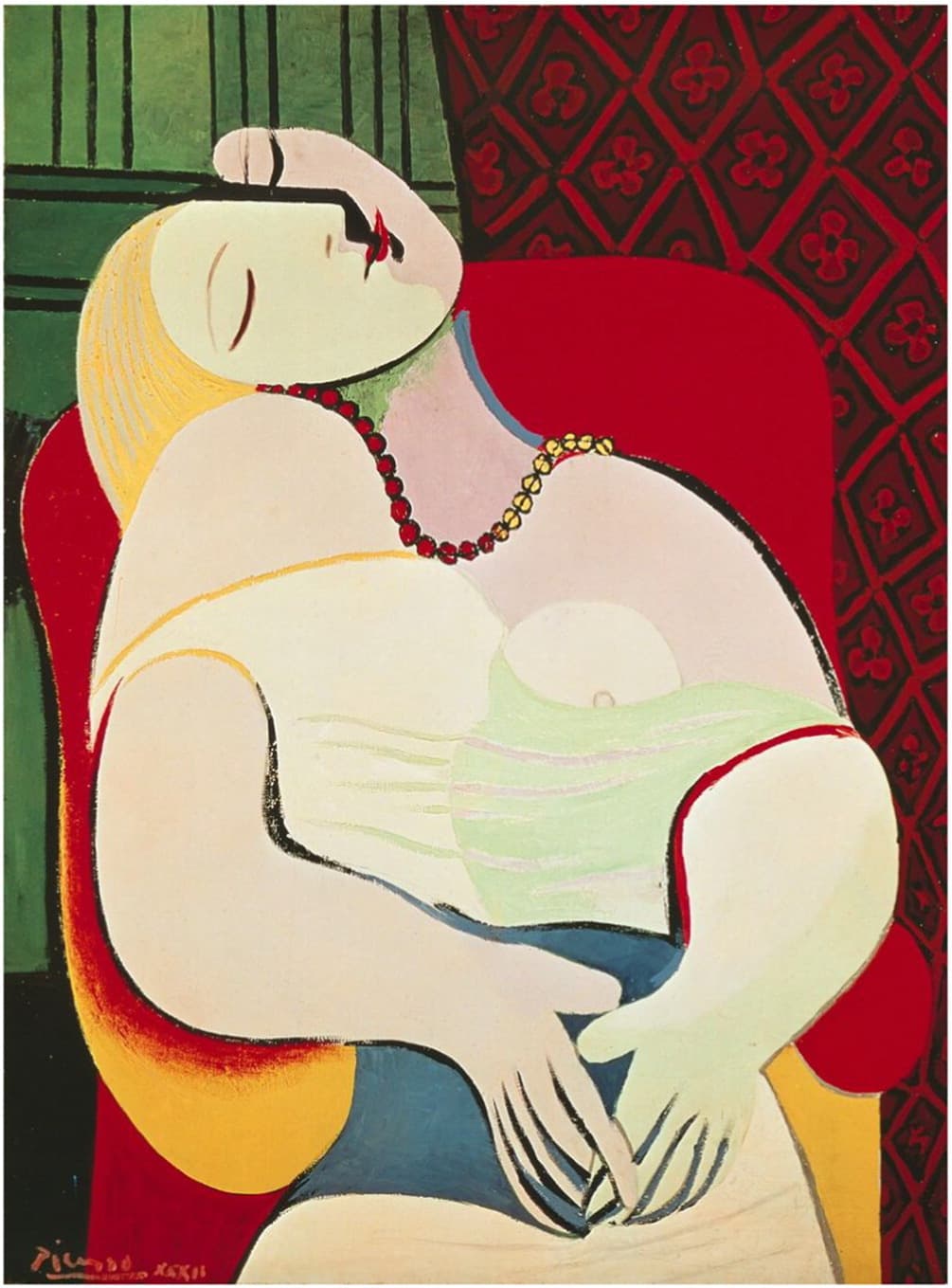
Le Rêve (The Dream), painted in January 1932, shows Marie-Thérèse Walter asleep in an armchair, her face divided into two soft curves in pink and lilac. One of the most famous of his paintings in private hands, it has been sold several times for record prices.
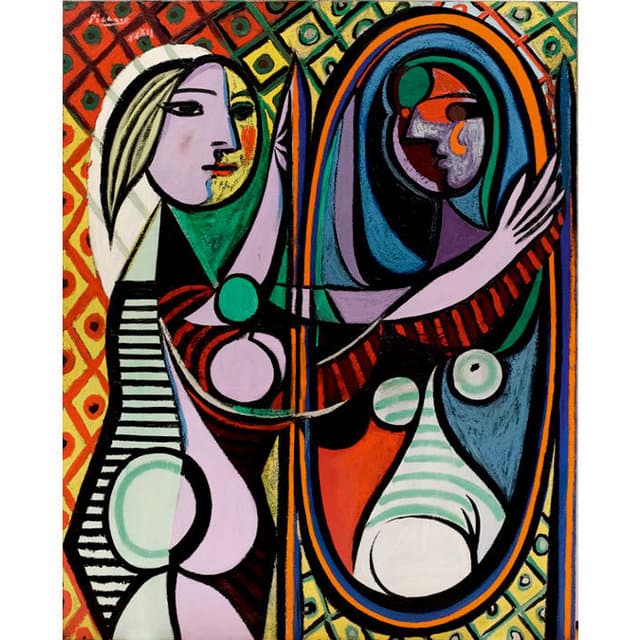
Girl before a Mirror (March 1932, Museum of Modern Art, New York) shows the same young woman reaching toward her reflection in a tall mirror. The figure is bright and patterned like stained glass, and the reflection is darker and more troubled, as if the mirror showed her inner life or her future.
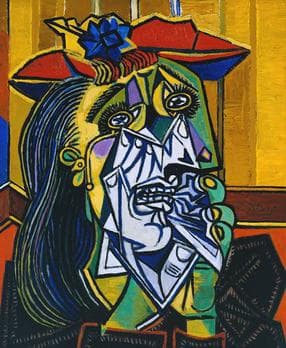
The Weeping Woman (1937, Tate Modern, London) grew out of Guernica. Its model was Dora Maar, the photographer who documented the making of Guernica. Her face, in harsh greens, yellows and reds, crumples around a handkerchief, and grief becomes a breaking of the face itself.
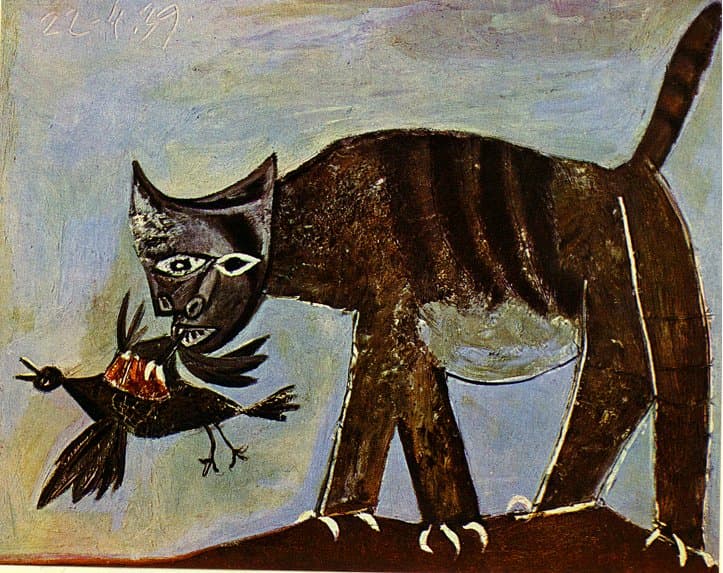
Cat Catching a Bird (1939, Musée Picasso, Paris) was painted in the spring of 1939, as the Spanish Republic fell to Franco and a wider war approached. A wild-eyed cat tears at a bird with bared claws; Picasso, who said he did not paint war the way a photographer looks for subjects, made the war visible through a scene of animal cruelty.
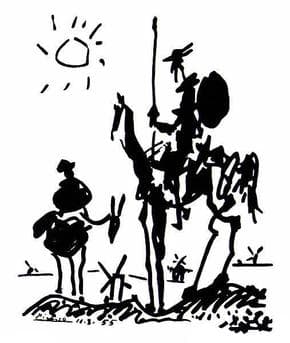
Don Quixote (1955) is a quick ink drawing made for the French weekly Les Lettres françaises to mark the 350th anniversary of the first part of Cervantes's novel. A few bold lines show the lanky knight on Rocinante, the round figure of Sancho Panza on his donkey, a blazing sun and windmills on the horizon. It is among his most reproduced images.
Did Picasso paint a smoking skeleton?
No. The painting of a skull smoking a cigarette that people often search for under Picasso's name is by Vincent van Gogh: Head of a Skeleton with a Burning Cigarette, made in Antwerp in early 1886 and now in the Van Gogh Museum in Amsterdam. Picasso did make many still lifes with skulls, especially during and after the Second World War, such as Still Life with Skull, Leeks and Pitcher (1945), but none with a cigarette that compares to Van Gogh's joke.
Influence
Cubism opened the way to abstraction, collage and assemblage, and Picasso's restless reinvention of his own style set the pattern for the modern artist as a figure of perpetual change. Almost every movement of the twentieth century, from Futurism to Pop art, reacted to him in some way.
Where to see his work
The largest collections are at the Musée Picasso in Paris, the Museu Picasso in Barcelona, the Museo Picasso Málaga and the Museum of Modern Art in New York. Guernica is in the Museo Reina Sofía in Madrid. See also Famous Paintings and Famous Paintings of Women.
Questions & answers
What is Pablo Picasso most famous for?
Picasso is most famous for co-founding Cubism with Georges Braque, for Les Demoiselles d'Avignon (1907) and for Guernica (1937), his response to the bombing of the Basque town. He is widely regarded as the most influential artist of the twentieth century.
Did Picasso paint a skeleton smoking a cigarette?
No. The famous painting of a skull smoking a cigarette is Vincent van Gogh's Head of a Skeleton with a Burning Cigarette, painted in Antwerp in 1886 and now in the Van Gogh Museum, Amsterdam. Picasso painted skulls in still lifes, but not this subject.
Where is The Old Guitarist?
The Old Guitarist, painted in 1903–04 during Picasso's Blue Period, is in the Art Institute of Chicago. Imaging has revealed earlier figures painted beneath the surface.
Who is the woman in Picasso's Weeping Woman?
The model for The Weeping Woman (1937) was Dora Maar, the photographer and painter who was Picasso's partner at the time. The painting, linked to Guernica, is in Tate Modern, London.
What are Picasso's main periods?
His career is usually divided into the Blue Period (1901–04), Rose Period (1904–06), African-influenced period (1907–09), Analytic and Synthetic Cubism (about 1909–19), a Neoclassical phase in the early 1920s, and a Surrealist-influenced period from the later 1920s.