Symbolism
La Mort de la pourpre
Georges Rochegrosse, 1914
La Mort de la pourpre (The Death of the Purple) is a 1914 Symbolist painting by Georges Rochegrosse in the Musée d'arts de Nantes: a man in black mourns a dead, haloed figure of Art lying on a crimson cloth above a smoking industrial harbor.
- Artist
- Georges Rochegrosse
- Date
- 1914
- Medium
- Oil on canvas
- Dimensions
- 219 × 298 cm
- Collection
- Musée d'arts de Nantes, Nantes, France
- Movement
- Symbolism
What you are looking at
The canvas is wide and dark, almost three meters across, and it is built on a hard diagonal. In the lower left, a woman lies dead on her back across a spread of crimson cloth. Her skin has gone a cold green-gray, her chin is tipped up, and a wreath of dark leaves sits in her hair. Around her head the paint flares into a burst of yellow light, a halo so thick with impasto that it seems to sit on top of the picture rather than inside it.
Laid across her body is a large painter's palette, its thumb hole clearly visible, still dabbed with color. One hand rests on it as if she had been holding it when she fell. The cloth beneath her is not a neat shroud but a crumpled, glittering field of red and purple, flecked with gold, which spills across the hillside and heaps up into a mound on the right.
Standing over her, a little to the right of center, is the only living figure: a gray-haired man in a long black frock coat, bent forward with one hand pressed over his face. He is a modern man in modern clothes. He does not kneel or touch her. He simply stands at the edge of the red cloth and grieves.
Behind them the hill drops away to a city. Factory chimneys and steaming stacks rise on the left, a harbor with moored ships and quays opens out under a yellow sunset, and at the upper right a steel gantry or derrick climbs the slope. The buildings are packed in tiers and wrapped in smoke. Rochegrosse paints them in blue and violet haze, so that the whole modern city reads as a kind of fog, while the dead woman and her cloth are the only places of hot, saturated color. The signature, G. Rochegrosse, sits in the lower right corner.
What does the title mean?
La pourpre in French is both a color and a thing. It is the purple-crimson dye of antiquity, and by extension the cloth itself: the purple robe of emperors and the scarlet of cardinals, a word that has long stood for rank, dignity and splendor. La mort de la pourpre (The Death of the Purple) therefore names a death of something precious and ceremonial, not of a particular person.
The painting makes the reading fairly direct. The dead figure carries the attributes of an allegory rather than a portrait: the leafy crown that classical tradition gave to poets and artists, the radiance around her head, and above all the palette. She reads most naturally as a personification of Painting, or of Art and Beauty more broadly, lying dead on her own royal mantle. The mourner in his black coat looks like an artist or a man of culture standing in for the viewer. And the backdrop sets the cause: an industrial city of chimneys, cranes and steam.
That interpretation, a lament for beauty and the old ideal of art in an age of factories, is the reading the imagery invites, and it fits Rochegrosse's own career. The museum's published catalogue notice (by Laurent Houssais, in the Nantes exhibition catalogue Inquiétantes étrangetés, 2011) is the place to check for the artist's documented intentions; the reading offered here comes from the imagery itself.
Who painted it, and when
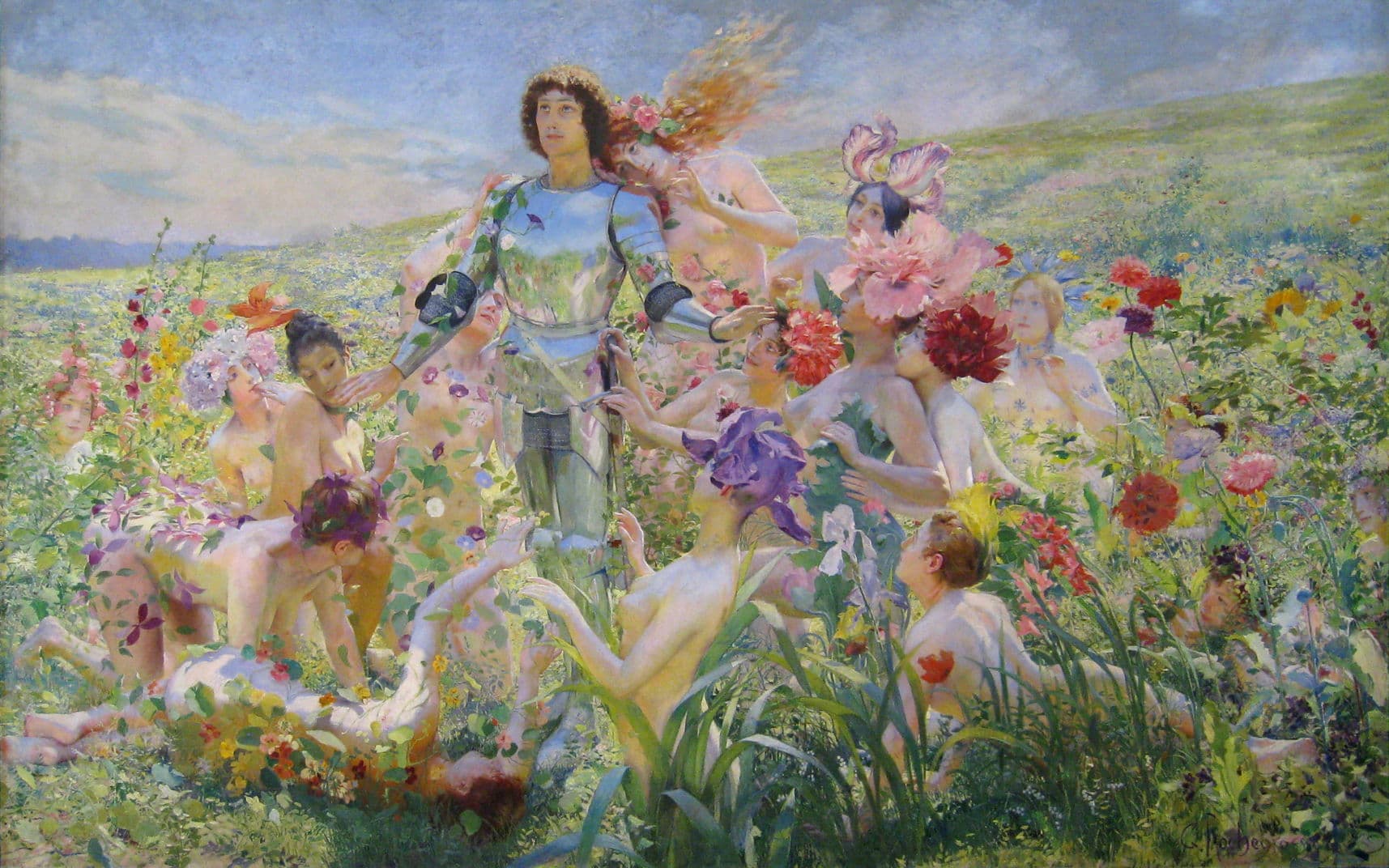
Georges-Antoine Rochegrosse (1859–1938) was a French painter, illustrator and decorator, raised in the literary circle of his stepfather, the poet Théodore de Banville. He made his name at the Paris Salon in the 1880s with violent, crowded history paintings such as Vitellius and Andromache, then moved toward Symbolist subjects and decorative fantasy. His The Knight with the Flower Nymphs (1894), inspired by Wagner's Parsifal, is the best-known example of that turn. From 1900 he spent much of each year in Algeria, at El Biar near Algiers, where he died.
La Mort de la pourpre is dated 1914. It belongs to the late phase in which Rochegrosse used allegory to comment on the modern world, and it carries a mood shared by many artists of his generation who felt that the industrial century had pushed the grand tradition aside. Read against the year it was painted, its smoke-filled horizon can also feel like an omen, although nothing in the record ties the work directly to the outbreak of war.
How it is painted
The surface is worth looking at closely. The city is laid in with thin, misty scumbles of blue and lilac. The hillside is rough and earthy. But the halo and the crimson cloth are built up in heavy, broken strokes with points of gold and white that catch the light, so that the dead figure literally glitters against a muffled world. Rochegrosse also keeps the mourner almost flat and black, a dark vertical cut through the warm red. A detail easily missed: the palette is not blank but carries little pools of blue and yellow, the colors that have drained out of everything else in the picture except the sky.
Where is La Mort de la pourpre today?
The painting belongs to the Musée d'arts de Nantes (formerly the Musée des Beaux-Arts), in Nantes, western France, where it is recorded under inventory number 2033. It is oil on canvas and measures about 219 × 298 cm. As with any large nineteenth- and early twentieth-century canvas, it is not always on display, so check the museum's collection pages before visiting.
Not to be confused with El Petó de la Mort
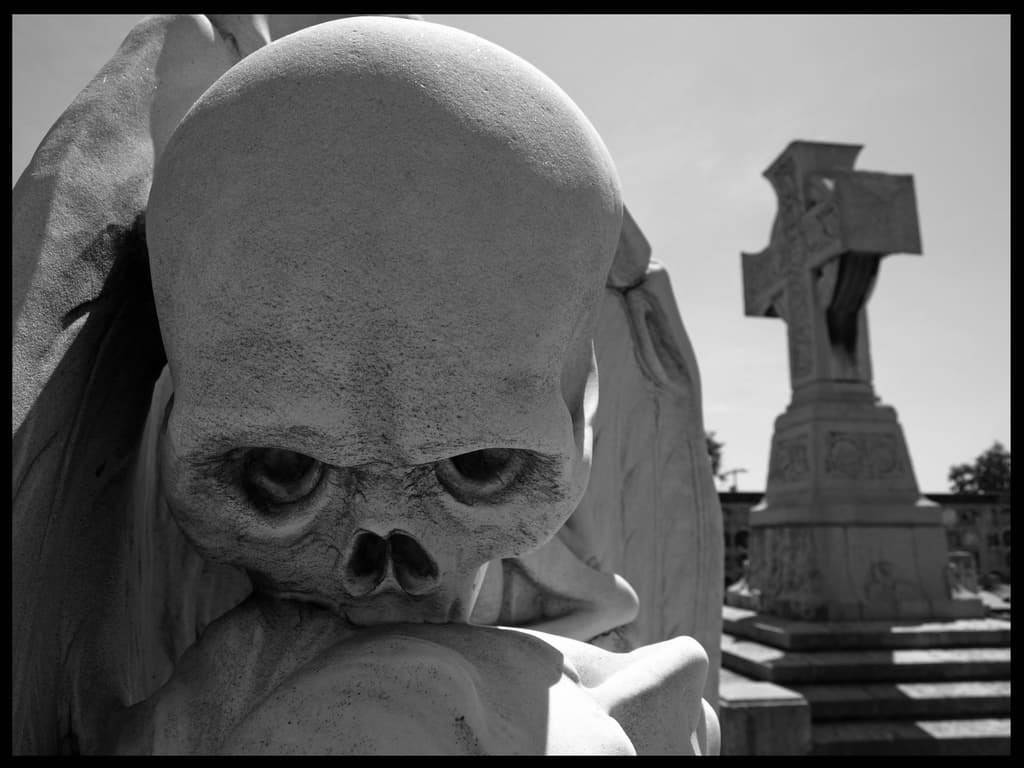
Many people arrive at this page looking for El Petó de la Mort (The Kiss of Death), the marble sculpture of a winged skeleton kissing a young man in Barcelona's Poblenou Cemetery. That is a different work entirely, a funerary monument of 1930 attributed to Jaume Barba, and it has its own page: El Petó de la Mort. The two share a theme, the meeting of beauty and death, but nothing else.
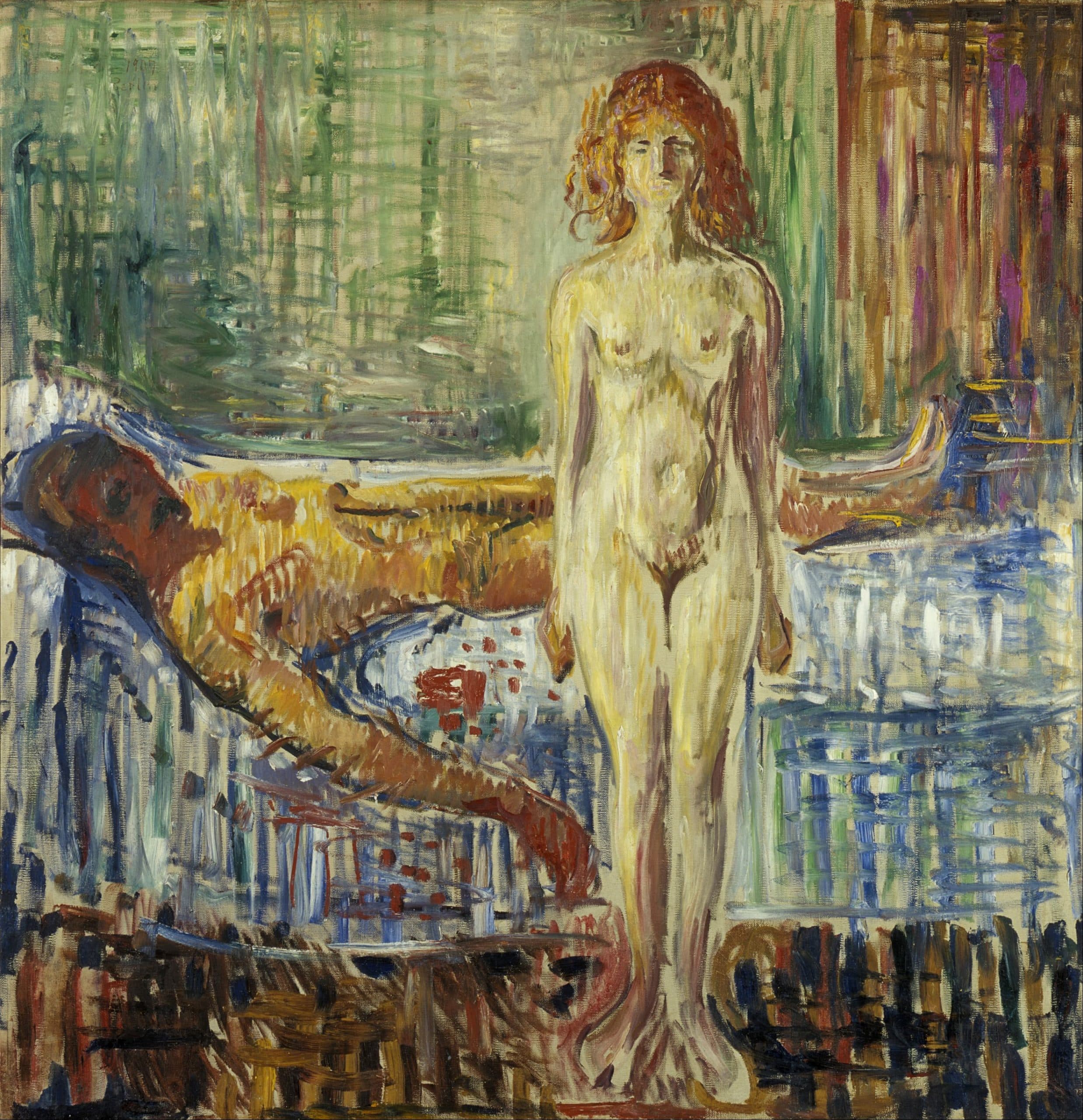
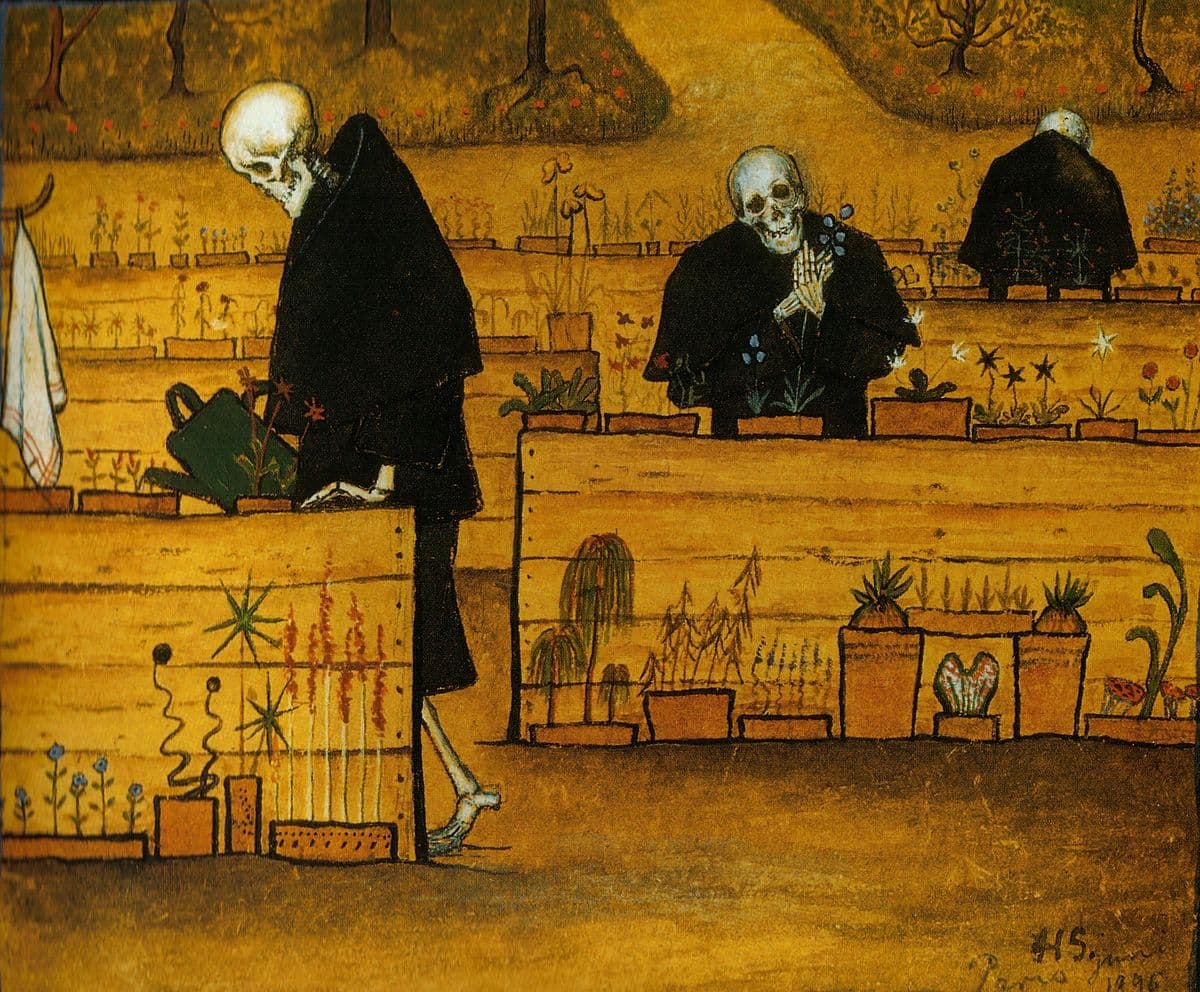
Searchers sometimes also mix this painting up with Edvard Munch's The Death of Marat. For more paintings in which death is personified or mourned, see Death in Art and the wider story of Symbolism.
Questions & answers
Where is La Mort de la pourpre by Rochegrosse?
The painting is in the collection of the Musée d'arts de Nantes in Nantes, France (inventory 2033). It is a large oil on canvas, about 219 × 298 cm, dated 1914. Large canvases rotate on and off display, so it is worth checking the museum's online collection before a visit.
What does La Mort de la pourpre mean?
The title means The Death of the Purple. In French, la pourpre is the royal purple-crimson cloth and, by extension, dignity and splendor. The dead woman carries a laurel-like wreath, a halo and a painter's palette, so she reads as a personification of Art lying on her mantle, mourned by a modern man above an industrial city.
Is La Mort de la pourpre the same as El Petó de la Mort?
No. El Petó de la Mort (The Kiss of Death) is a 1930 marble funerary sculpture in Barcelona's Poblenou Cemetery, showing a winged skeleton kissing a young man, attributed to Jaume Barba. La Mort de la pourpre is a 1914 painting by Georges Rochegrosse in Nantes. The similar titles cause frequent confusion.
Who was Georges Rochegrosse?
Georges-Antoine Rochegrosse (1859–1938) was a French painter and illustrator, stepson of the poet Théodore de Banville. He won fame at the Paris Salon with violent history paintings, turned to Symbolist and decorative subjects in the 1890s, and later lived largely in Algeria, where he died at El Biar.
More by the artist
Georges Rochegrosse
Kindred works
You may also study
The Kiss of Death (El Petó de la Mort)
Jaume Barba & Joan Fontbernat · 1930
The Death of Marat
Edvard Munch · 1907
The Garden of Death
Hugo Simberg · 1896
Finis (The End of All Things)
Maximilian Pirner · 1887

Venus de Milo
Alexandros of Antioch · c. 150–125 BC

The Scream
Edvard Munch · 1893

Saturn Devouring His Son
Francisco Goya · c. 1819–1823

Ophelia
John Everett Millais · 1851–52